Why the TechCrunch Disrupt 2026 Exhibit Deadline Matters
Startup events can create plenty of attention, but attention alone does not necessarily create customers, investors or partnerships.
The value of an exhibition opportunity is the ability to put the product directly in front of people who are already interested in technology, startups and emerging businesses. That face-to-face interaction can make it easier to explain a product, demonstrate its value and discover what potential users actually want.
For companies considering the TechCrunch Disrupt 2026 exhibit, the timing is particularly important because the application deadline is approaching quickly.
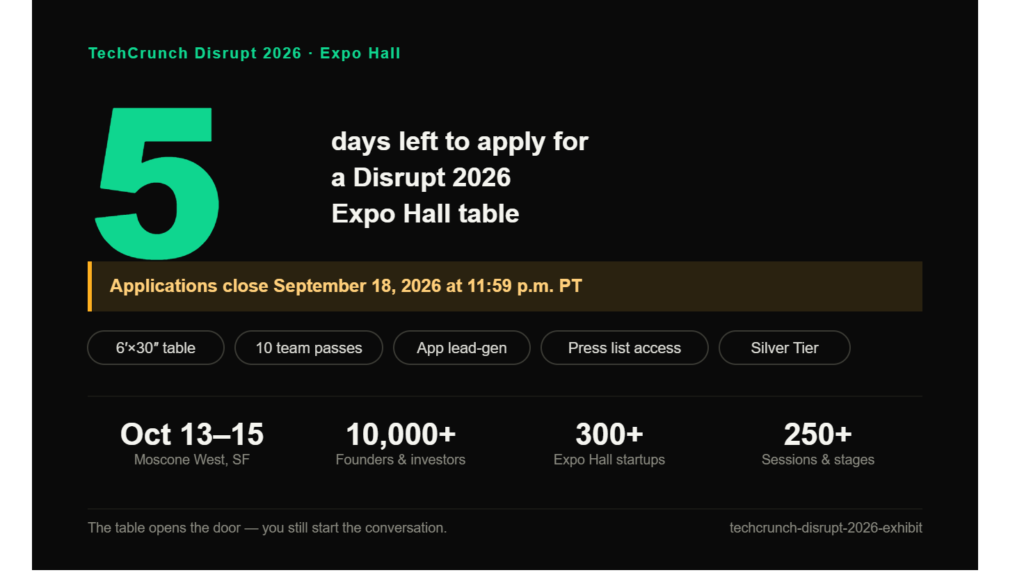
According to TechCrunch Events, startups must book their exhibit table by Friday, September 18 at 11:59 p.m. PT.
Question → Direct Answer: What is the key deadline for TechCrunch Disrupt 2026 exhibit tables?
The final day to apply for an exhibit table is September 18, 2026, at 11:59 p.m. PT. Startups that want a table on the Expo Hall floor need to secure their opportunity before that deadline.
The event itself is scheduled for October, giving exhibitors a short window between the application deadline and the conference to prepare their products, demonstrations and teams.
That makes preparation just as important as registration.
What Is a TechCrunch Disrupt 2026 Exhibit Table?
Definition – Exhibit table: An exhibit table is a branded physical space where a company can showcase its product, demonstrate its technology and interact directly with event attendees.
At TechCrunch Disrupt 2026, exhibitors receive a 6-foot × 30-inch branded exhibit table on the Expo Hall floor.
The setup is designed for interaction rather than simply displaying a logo.
A startup can use the space to demonstrate software, explain a new technology, introduce a product or start conversations with potential customers and partners. For companies whose products are easier to understand through a live demonstration, that physical presence can be particularly useful.
The TechCrunch Disrupt 2026 exhibit package also includes several features intended to help companies continue those conversations after the event.
What Comes With the Exhibit Package?
According to the source material, the package includes:
- Lead generation through the Disrupt app for capturing contacts and following up after the event
- 10 team passes, allowing team members to staff the table while others attend meetings and explore the event
- Branding across the website, event app and signage
- Access to the TechCrunch Disrupt press list
- A company profile on the event website and mobile app
- Silver Tier sponsor designation and additional event recognition
These benefits mean the exhibit opportunity extends beyond the physical table.
The combination of an in-person demonstration, digital visibility and lead-generation tools gives startups several ways to interact with the Disrupt audience.
Question → Direct Answer: Is the exhibit table only useful during the event?
No. The package includes digital branding, company-profile visibility and lead-generation capabilities that can support conversations before, during and after the event. The physical table is the centerpiece, but the broader package is designed to extend the value of the exhibition.
Why Should Startups Exhibit at TechCrunch Disrupt 2026?
A startup exhibit has one major advantage: it puts the product in the room where conversations are already happening.
Instead of relying entirely on cold outreach, online advertising or scheduled meetings, an exhibitor can create opportunities for people to discover the product naturally while walking through the Expo Hall.
That matters because startup products are often difficult to explain in a single sentence.
A live demonstration can show what the product does, how it works and why someone should care.
Meet Investors, Customers and Partners
TechCrunch Disrupt 2026 is expected to bring together more than 10,000 founders, investors, operators and technology leaders.
For an exhibiting startup, that creates a large potential audience.
Not every visitor will be a customer or investor, of course. The value lies in identifying the people who are relevant and having enough time to start meaningful conversations.
Question → Direct Answer: What can startups gain from exhibiting?
Startups can use the Expo Hall presence to demonstrate products, generate leads, meet potential customers, connect with investors and explore partnerships. The strongest value comes from turning those initial interactions into follow-up conversations after the event.
This is why preparation matters.
A team should know exactly which audience it wants to attract and what action it wants visitors to take after seeing the product.
Turn Product Demos Into Conversations
A demo should not simply prove that the product works.
It should answer a visitor’s most important question: “Why does this matter to me?”
For example, a startup could structure its demonstration around a real customer problem, show the workflow, explain the outcome and then invite the visitor to discuss whether the same problem exists in their organization.
That creates a conversation rather than a presentation.
For a TechCrunch Disrupt 2026 exhibit, this distinction can make the difference between someone walking past the table and someone stopping to learn more.
What Do Exhibitors Get With a Table?
The exhibit package combines physical visibility with several digital and networking benefits.
Here is a simplified view:
| Feature | What It Provides | Why It Matters |
| Branded exhibit table | 6-foot × 30-inch physical space | Creates a visible product showcase |
| 10 team passes | Team access throughout the event | Makes staffing and networking easier |
| Disrupt app lead generation | Contact capture | Supports post-event follow-up |
| Website and app branding | Digital company visibility | Extends brand exposure |
| Company profile | Dedicated event presence | Gives attendees more information |
| Press list access | Media-related opportunity | Can support outreach |
| Silver Tier designation | Sponsor recognition | Adds event-level visibility |
The important point is that these features work together.
A physical table creates the initial interaction. Digital tools help capture information. Team passes allow the company to maintain the booth while other team members attend meetings or sessions.
That creates a broader startup-event strategy rather than a simple exhibition stand.
Question → Direct Answer: What is the biggest benefit of the package?
The biggest benefit is the combination of in-person product discovery and structured follow-up opportunities. Startups can demonstrate their product face-to-face while using event tools and company visibility to continue relationships beyond the initial conversation.
TechCrunch Disrupt 2026 Exhibit vs Simply Attending
Not every startup needs an exhibit table.
Attending and exhibiting serve different purposes.
Someone attending TechCrunch Disrupt can spend time networking, attending sessions, exploring startups and meeting people. An exhibitor gets an additional opportunity: people can come directly to the company’s product.
| Option | Best For | Main Advantage | Main Limitation |
| Attend | Networking and learning | Flexibility to explore the event | No dedicated product space |
| Exhibit | Product-focused startups | Direct product demonstrations | Requires staffing and preparation |
| Exhibit + networking | Growth-focused teams | Combines visibility and meetings | Requires stronger coordination |
Question → Direct Answer: Should every startup exhibit?
No. Exhibiting makes the most sense for companies that have a product or technology they can demonstrate and a clear reason for wanting direct conversations with attendees. Startups primarily seeking education or broad networking may find attending without a table more appropriate.
The decision should therefore start with the company’s objective.
If the goal is “We need more people to see and understand our product,” an exhibit can make sense.
If the goal is “We want to learn, network and explore the ecosystem,” attending may be enough.
Who Should Consider Exhibiting?
The opportunity is particularly relevant to startups that can communicate their value through a live interaction.
Early-Stage Startups
Early-stage companies often need validation.
A startup may have a promising product but still be refining its positioning, target audience or go-to-market strategy. Meeting potential users face-to-face can provide useful feedback.
An exhibit can turn the Expo Hall into a real-world testing environment.
Instead of asking whether people understand the product in theory, founders can watch how visitors respond to the actual demonstration.
Growing Technology Companies
Companies beyond the earliest stage may have a different objective.
They may be looking for customers, distribution partners, investors or media attention. A physical presence gives the company a place where these conversations can begin.
For a growing startup, the value can therefore come from relationship density: multiple relevant conversations happening in a concentrated period.
Teams Looking for Partnerships
Not every valuable conversation ends in a sale.
A startup might discover a technology partner, integration opportunity, distribution relationship or investor connection through an Expo Hall interaction.
This is particularly relevant for companies whose products depend on ecosystems.
Question → Direct Answer: Which startups are best suited to an exhibit?
Startups with a demonstrable product, a clear target audience and specific goals around customer acquisition, fundraising, partnerships or visibility are the strongest candidates. The table is most valuable when the company knows what kind of conversations it wants to create.
How to Prepare for a TechCrunch Disrupt Exhibit
Booking a table is only the beginning.
The strongest exhibition strategy starts before the event.
With the September 18 deadline approaching and the October 13–15 event dates already scheduled, startups have a defined preparation window.
Here are some practical steps:
1. Define One Core Message
Visitors should understand what the startup does quickly.
Avoid trying to explain every feature.
Instead, build one simple message around the problem the product solves and the audience it serves.
2. Build a Short Demo
A complicated demonstration can lose attention.
Create a version that communicates the product’s core value quickly. If someone has only a few minutes at the table, they should still leave knowing what makes the product different.
3. Decide Who You Want to Meet
A startup should identify its priority audiences before arriving.
These might include:
- Potential customers
- Investors
- Technology partners
- Enterprise buyers
- Media contacts
- Future hires
Different visitors require different conversations.
4. Prepare a Follow-Up Process
Lead generation only matters if the leads are followed up.
Decide who will contact visitors after the event, how quickly they will receive a message and what the next step should be.
5. Divide Team Responsibilities
With 10 team passes included in the package, exhibitors have room to organize staffing and networking responsibilities.
Some team members can remain at the table while others attend sessions, meet investors or explore the event.
This avoids the common problem of having everyone focused on the booth while missing valuable opportunities elsewhere.
Question → Direct Answer: How can a startup get more value from its exhibit?
Prepare a focused product demonstration, define the people you want to meet, assign team responsibilities and create a follow-up process before the event. The objective should be to convert brief Expo Hall interactions into longer-term relationships.
Why the Expo Hall Matters for Startup Visibility
An event with thousands of technology professionals creates an unusual environment.
People are actively looking for new ideas.
They may be searching for tools, investment opportunities, partnerships, technologies or companies to follow. The Expo Hall gives startups a chance to become part of that discovery process.
The source article says 300+ startups across industries will be showcasing in the Expo Hall.
That makes the environment competitive.
A startup therefore needs more than a table.
It needs a reason for people to stop.
What Makes an Exhibit Stand Out?
The answer does not necessarily require an expensive or complicated setup.
Clarity can be more valuable than complexity.
A strong exhibit should quickly communicate:
What is the product?
Who is it for?
What problem does it solve?
Why is it different?
What should I do next?
If visitors can answer those questions quickly, the company has a better chance of turning curiosity into conversation.
What If You Are Not Ready to Exhibit?
The deadline for an exhibit table should not create unnecessary pressure for startups that are not ready.
TechCrunch Disrupt 2026 offers other ways to participate.
The event will include 300+ startups in the Expo Hall, six industry stages, AI-powered networking and matchmaking, and Startup Battlefield 200, according to the supplied TechCrunch Events material.
That means founders can still attend to learn, network, discover products and connect with the wider technology ecosystem.
Question → Direct Answer: Can startups attend Disrupt without exhibiting?
Yes. Startups and technology professionals can still participate in TechCrunch Disrupt 2026 without booking an exhibit table. The event includes stages, networking opportunities, startup showcases and Startup Battlefield 200, providing multiple ways to engage with the ecosystem.
For some companies, attending first may even be useful.
It allows founders to understand the event environment, identify relevant audiences and decide whether exhibiting at a future event would be worthwhile.
Key TechCrunch Disrupt 2026 Exhibit Details
For startups considering the opportunity, the essential information is straightforward.
| Detail | Information |
| Event | TechCrunch Disrupt 2026 |
| Event dates | October 13–15, 2026 |
| Venue | Moscone West, San Francisco |
| Exhibit application deadline | September 18, 2026 |
| Deadline time | 11:59 p.m. PT |
| Exhibit space | 6′ × 30″ branded table |
| Expected event audience | 10,000+ founders, investors, operators and tech leaders |
| Expo Hall startups | 300+ |
| Team passes | 10 |
| Sponsor designation | Silver Tier |
The deadline is the most urgent detail.
The event is still weeks away, but the exhibition application window closes much sooner.
For a startup that already knows it wants direct product exposure, waiting until the final hours could mean missing the opportunity.
Is a TechCrunch Disrupt Exhibit Worth It?
There is no universal answer.
The value depends on the startup’s objectives, product maturity, audience and ability to follow up.
For a company that needs customers and can demonstrate its product clearly, the exhibit may provide a useful environment for generating conversations.
For a startup that is still developing its product or has no clear audience, the same opportunity may deliver less value.
The best way to think about the TechCrunch Disrupt 2026 exhibit is therefore not as a guaranteed marketing result, but as an opportunity to create concentrated interactions.
The company still has to make those interactions count.
Question → Direct Answer: Is exhibiting at TechCrunch Disrupt 2026 guaranteed to generate customers or investors?
No. An exhibit provides access and visibility, but it does not guarantee customers, investment or partnerships. Results depend on the product, messaging, audience, quality of conversations and follow-up strategy.
That is true of almost every startup event.
The table opens the door.
The startup has to start the conversation.
What the 5-Day Countdown Means for Startups
The phrase “5 days left” sounds like a marketing message, but it reflects a concrete deadline in the supplied source.
The exhibit application deadline is September 18 at 11:59 p.m. PT.
That leaves startups a short period to decide whether a physical presence at Disrupt fits their strategy.
For founders, three questions can make the decision easier:
- Do we have a product worth demonstrating?
- Do we know who we want to meet?
- Do we have a follow-up process ready?
If the answer to all three is yes, exhibiting may be worth considering.
If not, attending without a table could still provide valuable networking and learning opportunities.
The important thing is to make the decision based on the company’s actual goals rather than the event’s size alone.
Why Startup Events Still Matter in an AI-First World
It might seem strange that physical exhibition tables remain important when so much startup discovery happens online.
But technology has not eliminated the value of human interaction.
In fact, as AI makes it easier to create software, content and prototypes, trust and differentiation can become even more important.
A founder demonstrating a product in person can answer questions immediately. A potential customer can explain a problem that was not obvious from the website. An investor can understand the team behind the technology.
Those interactions are difficult to reproduce entirely through digital channels.
That is why events such as Disrupt continue to combine technology with physical networking.
The TechCrunch Disrupt 2026 exhibit is ultimately not just about displaying a product.
It is about putting founders and products into conversations.
And for an early-stage company, one useful conversation can sometimes be more valuable than hundreds of passive impressions.
FAQ
What is the TechCrunch Disrupt 2026 exhibit deadline?
The deadline to apply for an exhibit table at TechCrunch Disrupt 2026 is September 18, 2026, at 11:59 p.m. PT.
When is TechCrunch Disrupt 2026?
TechCrunch Disrupt 2026 will take place October 13–15, 2026, at Moscone West in San Francisco.
How big is a TechCrunch Disrupt exhibit table?
The exhibit package includes a 6-foot × 30-inch branded exhibit table on the Expo Hall floor.
What does the TechCrunch Disrupt 2026 exhibit package include?
The package includes a branded exhibit table, 10 team passes, lead generation through the Disrupt app, branding across the event website and app, access to the TechCrunch Disrupt press list, a company profile and Silver Tier sponsor recognition.
How many people attend TechCrunch Disrupt 2026?
According to the supplied TechCrunch Events article, 10,000+ founders, investors, operators and tech leaders are expected at TechCrunch Disrupt 2026.
Can startups attend TechCrunch Disrupt without exhibiting?
Yes. Startups can participate without an exhibit table and explore networking, industry stages, the Expo Hall, AI-powered matchmaking and Startup Battlefield 200.
Final Takeaway
The TechCrunch Disrupt 2026 exhibit opportunity is designed for startups that want to move beyond online visibility and put their products directly in front of potential customers, investors and partners. With the application deadline set for September 18 at 11:59 p.m. PT, interested companies have only a short time to decide whether an Expo Hall presence fits their growth strategy.
For more startup, AI and technology event insights, keep following Kalinga.ai for practical explainers on the opportunities shaping the next generation of tech businesses.