Why Is Valor Giving SpaceX Stock to Investors?
Question: Why did Valor distribute SpaceX shares instead of selling them?
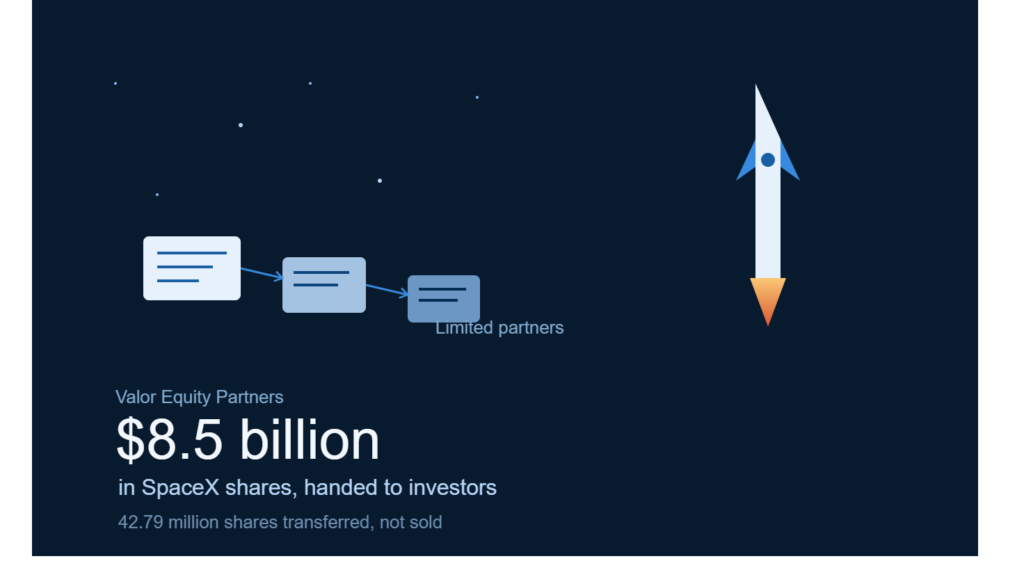
Direct Answer: Valor transferred SpaceX shares directly to its limited partners rather than selling the shares and distributing cash. The structure allows investors to receive an interest in SpaceX directly while avoiding a large sale of shares into the public market.
The transaction involved 42,790,223 SpaceX shares, according to the Form 4 filing associated with Antonio Gracias. After the transaction, the filing showed 460,624,307 shares beneficially owned through the Valor entities.
That makes the transaction unusual enough to attract attention.
When a venture capital or private investment firm has a valuable public-company holding, one conventional way to return money to investors is to sell shares and distribute the proceeds. But a large sale can increase the supply of shares available for trading.
Valor instead chose an in-kind distribution: investors receive the asset itself.
In this case, that asset is SpaceX stock.
What is an in-kind distribution?
Definition + Expansion
An in-kind distribution is when an investment fund gives investors an asset directly instead of selling the asset first and distributing cash.
For Valor, that means its limited partners receive SpaceX shares rather than simply receiving cash generated by a SpaceX stock sale. Bloomberg reported that the distributed shares were worth approximately $8.5 billion. (Bloomberg Law)
The distinction is important because ownership changes hands without requiring those shares to be sold on the open market.
That can have different implications for taxes, liquidity and market supply depending on the investors and applicable rules.
Who Is Antonio Gracias and Why Does He Matter to SpaceX?
Antonio Gracias is the founder of Valor Equity Partners and has been a longtime backer of Elon Musk’s companies.
He is also a SpaceX board member. An SEC Form 3 filed in June identified Gracias as a SpaceX director and reported beneficial ownership of 503,414,530 Class A shares through the Valor entities at that time. (SEC)
A subsequent SEC Schedule 13G covering June 30 showed Gracias with 503,414,530 shares, representing 6.5% of SpaceX’s Class A common stock based on the share count cited in that filing.
These figures help explain why Valor’s transaction is significant.
This is not a small investor trimming a position.
Valor accumulated a substantial SpaceX position over many years, and the company’s public listing transformed that private investment into publicly traded equity.
Question: How long has Valor been invested in SpaceX?
Bloomberg reported that Valor had backed SpaceX for almost two decades before the company went public. (Bloomberg Law)
That long holding period is central to understanding the transaction.
Valor had an opportunity to monetize a highly valuable investment after SpaceX’s IPO. Instead of immediately converting all or part of the position into cash, it transferred a portion directly to its investors.
How Much SpaceX Stock Did Valor Transfer?
The SEC filing provides a more precise picture than the headline estimate.
On September 11, 2026, the filing reported a disposition of 42,790,223 Class A SpaceX shares. After the transaction, the reported beneficial ownership through Valor entities was 460,624,307 shares.
The transaction represented an 8.5% reduction in Valor’s SpaceX holdings, according to reporting based on the filing.
Bloomberg estimated the shares distributed to investors were worth approximately $8.5 billion. (Bloomberg Law)
| Detail | Reported figure |
| SpaceX shares transferred | 42,790,223 |
| Percentage of Valor’s holdings transferred | 8.5% |
| Approximate value | $8.5 billion |
| Shares remaining after transaction | 460,624,307 |
| Transaction date | September 11, 2026 |
The difference between the exact share count and the estimated dollar value is worth remembering. The number of shares is disclosed in the SEC filing, while the $8.5 billion figure is Bloomberg’s estimate based on the relevant valuation.
Why Give SpaceX Shares Instead of Selling Them?
A major reason is market impact.
If Valor had sold tens of millions of SpaceX shares on the public market, those shares would have added significant supply to the available float.
Question: Why does a large stock sale matter?
A large sale can increase the supply of shares available to buyers. If demand does not absorb that supply, the additional selling pressure can affect the market price.
This is especially relevant for SpaceX because only a relatively small portion of the company’s overall shares are publicly trading.
TechCrunch reported in July that roughly 4% of SpaceX’s total shares were trading on Nasdaq at the time. The publication noted that the small public float contributed to substantial price swings after the IPO.
That creates an unusual situation.
SpaceX is a company with an enormous total share count, but the amount of stock actually available for public trading is comparatively limited.
A large institutional sale can therefore become much more noticeable than it might be for a company with a larger public float.
Valor’s decision removes that immediate selling pressure from the equation.
The shares still belong to investors, and those investors can ultimately decide what to do with their holdings subject to applicable restrictions. But the initial transfer itself does not require a large block to be sold.
Could the Transfer Have Tax Advantages?
There is another potential consideration: taxation.
TechCrunch reported that transferring ownership of the shares could provide a tax advantage for Valor’s limited partners.
The exact tax consequences depend on the structure of each investor’s position and applicable tax rules, so the transaction should not be interpreted as providing the same tax outcome to every investor.
Still, the basic concept is straightforward.
If an investment fund sells an appreciated asset and distributes cash, the sale can create taxable consequences. An in-kind transfer instead moves the underlying asset to the investors.
That does not automatically mean taxes disappear.
Rather, the timing and nature of taxable events can differ depending on the fund structure and investor circumstances.
Question: Does giving investors SpaceX stock eliminate taxes?
No. The available reporting only indicates that the structure could provide tax advantages to Valor’s limited partners; it does not establish that every investor avoids tax or receives an identical benefit.
That distinction is important when discussing large private-market transactions.
What Happens to Valor’s Remaining SpaceX Stake?
Valor is not exiting SpaceX.
After transferring the shares, the SEC filing showed 460,624,307 shares still beneficially owned through Valor-related entities.
That means the September transaction was a partial distribution rather than a complete liquidation of Valor’s SpaceX position.
The remaining holding is still substantial.
This also helps put the transaction into context. Valor appears to be returning part of its investment to limited partners while maintaining significant exposure to SpaceX.
Question: How much SpaceX stock does Valor still own?
The September 11 filing reported 460.6 million shares of beneficial ownership after the distribution.
The ownership is held through multiple Valor-related entities, rather than simply being a personal stock position held directly by Gracias.
The SEC documents make this distinction clear. Gracias is considered to have beneficial ownership through his relationship with the Valor entities, while the filing states that he disclaims beneficial ownership of those shares except to the extent of his pecuniary interest. (SEC)
What Happened to SpaceX Stock After the IPO?
Valor’s transaction comes against the backdrop of a volatile first period for SpaceX as a public company.
SpaceX went public in June 2026, and TechCrunch reported that the IPO raised nearly $86 billion. The stock initially climbed above $200 in the days following the IPO before declining.
By July 15, SpaceX shares had fallen to around the $135 IPO price, with the stock briefly trading below $133 before closing at $135.27, according to TechCrunch.
More recent market data shows that the stock has continued to move significantly.
Barron’s reported on September 16 that SpaceX shares rose after the company announced the next Starship orbital test date, with the stock reaching about $151.67.
That illustrates the relationship between SpaceX’s public valuation and developments surrounding the company.
Starship launches, Starlink expansion and the company’s broader technology ambitions can all affect investor sentiment.
Why does SpaceX’s public float matter?
A company’s public float refers to shares available for public trading rather than shares held by insiders or other restricted or closely held owners.
A smaller float can amplify price movements because a relatively small amount of buying or selling can have a larger impact on the shares that are actually changing hands.
That does not mean every price movement is caused by the float.
It does mean investors need to consider market structure when interpreting large changes in a newly public company’s stock.
Valor SpaceX Stock Transfer vs. Traditional Fund Exit
The transaction becomes easier to understand when compared with a conventional investment-fund exit.
| Approach | What happens | Potential market effect |
| Sell shares and distribute cash | Fund sells SpaceX shares and gives investors proceeds | Adds shares to market supply |
| Hold shares | Fund keeps the SpaceX position | No immediate distribution |
| In-kind distribution | Fund transfers SpaceX shares directly to investors | Avoids an immediate large open-market sale |
| Partial sale | Fund sells only part of its position | Creates some selling pressure |
| Partial in-kind transfer | Fund transfers part of its position while retaining the rest | Returns assets while maintaining exposure |
Valor chose the partial in-kind distribution approach.
That does not prevent recipients from eventually selling their shares. It simply means the initial distribution itself does not require Valor to sell the block into the market.
This distinction is particularly relevant for a company such as SpaceX, where the public float is relatively small compared with the total number of outstanding shares.
What Does This Mean for SpaceX Investors?
For investors watching SpaceX, the Valor transaction provides several pieces of information,but it should not be treated as a straightforward bullish or bearish signal.
First, the transaction demonstrates that a major early investor is distributing part of its position after the IPO.
Second, Valor is retaining a large remaining stake, meaning the transaction does not represent a complete departure from SpaceX.
Third, the structure avoids an immediate large sale into the market.
Question: Does Valor’s distribution mean it is losing confidence in SpaceX?
The filing itself does not establish that conclusion.
A distribution to limited partners can be part of normal fund-management and investor-return activity. The transaction also leaves Valor with hundreds of millions of SpaceX shares.
Therefore, the documented facts support describing the transaction as a partial distribution, rather than assigning a particular motivation to Valor beyond what the firm or filing explicitly states.
That distinction is especially important with high-profile companies.
A large ownership transfer can generate speculation, but the underlying filing provides a more limited set of facts: how many shares moved, when they moved and how many shares remained.
Why This Matters Beyond Valor and SpaceX
The transaction illustrates a broader issue in venture capital and private-equity investing.
Investors often hold private-company shares for years before those companies become publicly traded. When an IPO finally creates liquidity, funds have several choices about how to return value to their investors.
They can sell shares.
They can continue holding them.
Or, in some circumstances, they can distribute the shares directly.
Question: Why is this important for the wider venture-capital market?
Because large private-company IPOs can create enormous paper gains for early investors, but converting those gains into cash can affect the newly public company’s stock market.
A fund holding billions of dollars of shares cannot necessarily sell everything immediately without considering liquidity, market conditions and its own investors.
In-kind distributions provide another mechanism for returning an investment.
Valor’s SpaceX transaction is therefore an example of how private-market investors can manage concentrated holdings after a major technology company enters the public market.
What Students and Young Professionals Can Learn From This Deal
At first glance, a multibillion-dollar SpaceX stock transfer might seem relevant only to investors.
But it demonstrates several important financial concepts that are useful for anyone learning about startups, venture capital and public markets.
1. IPOs create liquidity,but not necessarily simple exits
When a private company goes public, early investors can gain access to a public market. That does not mean they automatically sell everything.
2. Ownership and cash are different
Valor’s investors received shares rather than cash. They therefore received ownership of an asset whose market value can change.
3. Public float matters
The number of shares available for public trading can influence how sensitive a stock is to buying and selling activity.
4. Fund structures matter
Limited partners, general partners and investment entities can have different rights, obligations and tax considerations.
5. A transaction’s structure can matter as much as its size
The headline number,$8.5 billion,is striking. But understanding how that value was transferred is what explains its potential market implications.
For students interested in finance or technology, this is a useful reminder that startup stories do not end when a company reaches an IPO.
The financial structure behind the company can remain just as important.
What Happens Next for Valor and SpaceX?
Valor still has a substantial SpaceX position following the distribution.
For SpaceX itself, attention remains focused on the company’s business performance, public-market trading and major projects such as Starship.
The next Starship orbital test was announced for September 22, 2026, according to reporting on September 16. Barron’s reported that the planned mission is intended to be the first in which the Starship upper stage enters a stable Earth orbit and completes six orbits.
That kind of event can become significant for investors because SpaceX’s public valuation is closely watched alongside its technological milestones.
But the market response to individual events can change quickly.
For Valor, meanwhile, the September distribution shows one way an early investor can begin returning value to limited partners without immediately placing a massive block of shares onto the public market.
The remaining 460.6 million shares mean the firm continues to have meaningful exposure to SpaceX.
The Bigger Picture: Why Valor’s SpaceX Move Matters
The most interesting part of this story is not simply that $8.5 billion changed hands.
It is how the value changed hands.
Valor had built a major SpaceX position over many years. After SpaceX became publicly traded, the firm could have sold a large block of shares and returned cash to its investors.
Instead, it transferred 42.79 million shares directly to its limited partners, while retaining more than 460 million shares.
That approach can potentially provide investors with tax advantages and, importantly, avoids an immediate large sale that could add significant supply to SpaceX’s relatively limited public float.
For SpaceX shareholders, the episode is another reminder that the company’s stock is influenced not only by its rockets, Starlink and business performance, but also by the behavior of large shareholders.
For the venture-capital industry, it demonstrates how valuable private-company stakes can be distributed after an IPO without necessarily being converted into cash first.
And for anyone learning how markets work, it offers a useful lesson:
When a huge investment changes hands, always look beyond the headline value and ask what actually happened to the shares.
FAQ: Valor SpaceX Stock Transfer
Why did Valor Equity Partners give SpaceX stock to investors?
Valor distributed SpaceX shares directly to its limited partners rather than selling the shares and distributing cash. Bloomberg reported that the transaction involved about $8.5 billion worth of SpaceX stock. (Bloomberg Law)
How many SpaceX shares did Valor transfer?
An SEC filing reported that 42,790,223 Class A SpaceX shares were transferred on September 11, 2026. Valor’s reported beneficial ownership afterward was 460,624,307 shares.
Who is Antonio Gracias?
Antonio Gracias is the founder of Valor Equity Partners and a SpaceX board member. SEC filings identify him as having beneficial ownership of SpaceX shares through the Valor entities. (SEC)
Why didn’t Valor simply sell the SpaceX shares?
An in-kind distribution allowed Valor to transfer shares to its investors without immediately selling a large block on the public market. This can reduce immediate selling pressure and may offer tax advantages in certain circumstances.
How much SpaceX stock does Valor still own?
After the September 11 transaction, the SEC filing reported 460,624,307 SpaceX shares under the beneficial ownership associated with the Valor entities.
Does the transaction mean Valor is exiting SpaceX?
No. The reported remaining holding of more than 460 million shares shows that Valor retained a substantial SpaceX position after the distribution. The filing itself does not establish that the distribution represents a loss of confidence in SpaceX.
The Bottom Line
Valor’s SpaceX stock transfer shows how a major early investor can return billions of dollars in value without immediately selling a massive block of shares. The firm distributed 42.79 million shares, estimated by Bloomberg at roughly $8.5 billion, while retaining more than 460 million shares.
For investors and startup professionals, the key lesson is that how shares are distributed can matter almost as much as how much they are worth. Explore more explainers on SpaceX, venture capital and technology markets on Kalinga.ai.