Why Is Snap Trying to Make Specs More Useful?
Question: Why is Snap expanding Specs beyond augmented reality?
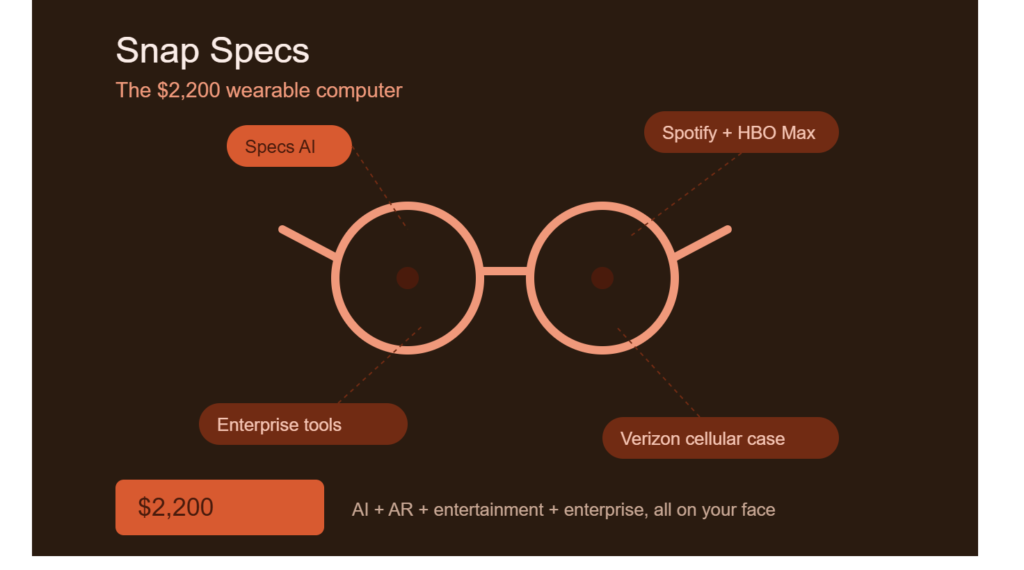
Direct Answer: Snap appears to be trying to make Specs useful across AI, entertainment, workplace applications and mobile connectivity rather than positioning them solely as AR glasses.
When Snap first introduced Specs earlier in 2026, the product attracted significant attention because of its unusual design and $2,200 price tag. TechCrunch reported that the launch generated criticism online and that Snap’s stock subsequently declined.
That created a difficult problem for Snap. Expensive hardware needs a clear reason to exist, particularly when consumers already have smartphones, laptops, earbuds and other connected devices.
The company’s latest strategy is therefore broader. Rather than asking consumers to buy Specs simply for augmented reality, Snap is presenting the glasses as part of a larger computing ecosystem.
That ecosystem now includes:
- Specs Intelligence, Snap’s new anticipatory AI system
- HBO Max and Spotify integrations
- Specs for Enterprise
- Partnerships involving Amazon, Salesforce and Nvidia
- A new cellular connectivity package through Verizon
- AR experiences including an NBA and WNBA basketball application
The underlying idea is simple: if Specs can become useful in enough situations, consumers may begin viewing the device as a computer rather than an expensive pair of glasses.
That distinction matters.
A pair of smart glasses competing primarily with other smart glasses faces one kind of market challenge. A wearable computer competing for a share of the user’s attention, productivity and digital life faces another.
What Are Snap Specs Smart Glasses?
Definition + Expansion
Snap Specs smart glasses are Snap’s wearable computing glasses designed to combine augmented reality, digital experiences and AI-powered functionality in a device worn on the user’s face.
Unlike conventional glasses, Specs are designed to place digital information and interactive experiences into the user’s environment. Snap is now expanding that concept by connecting the glasses with other devices and services.
The company’s latest announcements suggest that Specs are not intended to operate as an isolated gadget.
Instead, Snap wants them to work alongside smartphones, Macs, connected applications and enterprise systems. The company is effectively testing whether glasses can become another interface for interacting with computing.
Question: Are Specs simply AR glasses?
Not according to the direction Snap is taking with the product.
Augmented reality remains an important part of the experience, but Snap is adding AI, entertainment, enterprise applications and connectivity. The broader ambition is to make Specs a wearable computing platform rather than an AR novelty.
This is why the company’s messaging around Specs has shifted toward the idea of a computer you wear.
CEO Evan Spiegel described Specs as an “AI native operating system with intelligence designed around your projects.” He also framed the product as a more human-centric way to engage with computing.
That positioning is important because it explains why Snap is willing to defend the device’s unusually high price.
The company isn’t asking consumers to think of Specs as ordinary eyewear.
It wants them to think of Specs as a computer.
Why Does Snap Specs Cost $2,200?
The biggest barrier is impossible to ignore: $2,200 is a substantial amount for a consumer wearable.
For many buyers, that price immediately raises a basic question: what can Specs do that a smartphone, laptop or cheaper wearable cannot?
Snap’s answer is that the value comes from combining several capabilities into a hands-free interface.
Instead of taking out a phone, a user could potentially interact with digital information while continuing to focus on their physical surroundings.
That concept has obvious appeal in some situations. But the value depends heavily on how frequently those situations occur and whether the glasses make the task easier.
Question: What is Snap trying to justify with the $2,200 price?
Snap is effectively trying to justify Specs as a new category of computer rather than simply as premium eyewear.
The company’s latest features are part of that argument. AI makes the glasses more intelligent, entertainment gives them more everyday functionality, enterprise applications create professional use cases, and cellular connectivity makes them less dependent on Wi-Fi.
The strategy is therefore less about one killer feature and more about creating an ecosystem around the glasses.
That could be important for expensive hardware.
If a user only wears Specs occasionally for an AR game, the price may be difficult to justify. If the same device becomes useful for communication, productivity, navigation, entertainment, AI assistance and professional work, the calculation changes.
Snap’s challenge is proving that those use cases are valuable enough in real life.
What Is Specs Intelligence?
One of the most important announcements from Snap’s event was Specs Intelligence, which Snap describes as an “anticipatory AI” system.
Definition + Expansion
Specs Intelligence is Snap’s AI system designed to understand a user’s goals, priorities, relationships and routines through the applications and tools they choose to connect.
The important part is that Specs Intelligence is not limited to the glasses themselves.
Snap says the system can work across user devices, including iPhones and Macs, meaning the AI functionality can exist as part of a broader digital environment.
Spiegel described it as an AI-native operating system designed around users’ projects.
In practical terms, however, the system appears to have similarities with an AI productivity application that can also be used through Specs.
Question: Does Specs Intelligence require the glasses?
Based on Snap’s description in the source, the AI system does not necessarily require Specs to function.
That creates an interesting tension in Snap’s product strategy.
If Specs Intelligence is useful on an iPhone or Mac, consumers could potentially benefit from the software without buying the $2,200 hardware. At the same time, the glasses provide a hands-free interface that could make AI interactions more contextual and immediate.
That could make Specs less about owning a particular AI model and more about having a new way to access AI.
The larger trend is worth watching.
AI assistants have traditionally lived inside phones, browsers and computers. Wearable AI attempts to move that intelligence closer to the user’s physical environment.
How Could AI Change the Purpose of Specs?
AI may be the most important part of Snap’s attempt to give Specs a long-term purpose.
Traditional smart glasses often depend heavily on individual applications or AR effects. An AI system can potentially become a more flexible interface because users can interact with it across many different tasks.
For Snap, that means AI could connect the different parts of the Specs experience.
Imagine the difference between opening a dedicated AR application and having an AI system understand what you are trying to accomplish.
The first approach is application-centric.
The second is task-centric.
Question: Why does anticipatory AI matter for smart glasses?
An anticipatory AI system could potentially make wearable computing more useful by helping users act on goals rather than requiring them to manually open individual applications.
Snap says Specs Intelligence is designed to understand goals, priorities, relationships and routines from connected apps and tools.
That suggests a more personalized approach to computing.
However, there is an important limitation: the source describes Snap’s claims and demonstrations, not evidence that the system will consistently deliver this experience at scale.
That distinction matters when evaluating emerging AI products.
A feature can sound impressive during a product demonstration while still needing to prove its usefulness through everyday use.
What Can Specs Do for Entertainment?
Snap is also trying to solve another problem: Why would someone actually wear Specs when they are not working?
The company announced that Specs can now connect with HBO Max and Spotify, giving users access to entertainment through the glasses.
These integrations could provide a more familiar reason to use the device.
Music is particularly relevant because people already listen to Spotify while walking, commuting, exercising or working. Bringing that experience into smart glasses could make wearable computing feel less experimental.
Video entertainment is more complicated.
Watching content through glasses can create a different experience from watching it on a smartphone or television, but the practical value depends on the context.
Snap is also introducing an NBA and WNBA application that uses augmented reality to help users practice basketball and improve their shots.
Question: Will AR sports applications become a major reason to buy Specs?
That remains uncertain.
The source itself raises a practical question about whether people will realistically want to play basketball while wearing relatively heavy glasses.
This highlights an important challenge for AR hardware: technical possibility does not automatically equal everyday usefulness.
Developers can create impressive AR experiences, but successful consumer products need experiences that people genuinely want to repeat.
How Could Specs for Enterprise Be Used?
Snap is not limiting Specs to consumers.
The company has introduced Specs for Enterprise, a program designed to integrate the glasses into corporate workflows.
Snap announced partnerships with companies including Amazon, Salesforce and Nvidia, among others, as it works to make Specs more useful for employees.
One of the clearest demonstrations involved an IT technician repairing hardware with assistance from the glasses.
This is a more practical enterprise scenario than some consumer AR experiences.
A technician working on equipment may benefit from having instructions, information or remote assistance available without constantly looking down at a separate device.
Question: Who could benefit from Specs for Enterprise?
Snap’s event presentation particularly highlighted IT technicians, although the broader enterprise possibilities could extend to other workflows if companies develop suitable applications.
The company says it is working on mobile device management, security controls and ways to deploy and manage stacks across teams with established technology providers.
That introduces another possible business model for Specs.
Instead of convincing millions of consumers to spend $2,200, Snap could potentially target organizations where specialized wearable computing provides enough productivity value to justify the cost.
Enterprise hardware often has different economics from consumer hardware.
A company may pay more for a device if it can support a specific workflow, reduce friction or help employees perform specialized tasks.
Whether Specs can demonstrate that value will depend on the actual enterprise applications and measurable outcomes.
Why Is Cellular Connectivity Important?
Another announcement addresses one of the practical limitations of wearable devices: connectivity.
Snap introduced a separate connectivity package for users who want to use Specs away from Wi-Fi.
The package includes a charging case with built-in cellular connectivity through a partnership with Verizon.
The pricing announced by Snap is:
- $10 per month for Verizon customers
- $20 per month for non-Verizon customers
That means Specs users who want mobile connectivity have another recurring cost beyond the initial hardware purchase.
Question: Why add cellular connectivity to smart glasses?
The main benefit is mobility.
A wearable device becomes less useful if its functionality disappears whenever the user leaves a Wi-Fi connection. Cellular connectivity allows connected features to remain available outside the home or office.
For Snap, this is particularly relevant because the company is positioning Specs as a computer rather than a stationary accessory.
A computer designed to be worn while moving around needs connectivity that travels with the user.
The charging case also reflects another challenge of wearable computing: battery management.
Instead of simply making the glasses themselves responsible for every connectivity requirement, Snap is incorporating additional functionality into the case.
Snap Specs vs Traditional Computing Devices
The real competition for Specs may not be another pair of smart glasses.
The device could instead compete with the smartphone, laptop, earbuds and other interfaces people already use.
| Device | Main Strength | Specs’ Potential Difference |
| Smartphone | Broad apps and communication | Hands-free, wearable interaction |
| Laptop | Productivity and complex work | More mobile and contextual computing |
| Smartwatch | Quick notifications and health features | Larger visual AR experience |
| Traditional smart glasses | Wearable convenience | AI, AR, entertainment and enterprise integration |
| Snap Specs | AI + AR + connected computing | Attempts to combine several interfaces |
This comparison also reveals why Snap’s strategy is difficult.
A smartphone is already extremely versatile. A laptop is powerful. Smartwatches are small and convenient. Specs therefore need to offer something those devices cannot easily replicate.
The strongest potential advantage is hands-free and context-aware computing.
If AI can understand what a user is doing and provide useful information without requiring them to pull out a phone, glasses could create a genuinely different computing experience.
But that advantage has to be strong enough to overcome the cost, design and social considerations of wearing the device.
What Are the Biggest Challenges for Snap Specs?
The latest announcements give Specs more capabilities, but they do not automatically solve every problem.
Price
At $2,200, Specs occupy a premium position. The price alone limits the potential audience compared with more affordable consumer electronics.
Hardware comfort
The source describes Specs as heavy and visually reminiscent of scuba gear. For a device intended to be worn for extended periods, physical comfort can be as important as technical capability.
Everyday usefulness
More features do not necessarily mean more value. Consumers need reasons to use the glasses repeatedly rather than occasionally.
AI expectations
Specs Intelligence creates significant expectations around personalization and anticipatory assistance. Users may judge the system by how reliably it understands their goals and context.
Privacy and trust
A wearable computer with cameras, AI and access to connected applications naturally raises questions about data, permissions and social acceptance. Snap’s enterprise push also makes security and device management important considerations.
Subscription costs
The cellular package adds recurring costs of $10 or $20 per month, depending on Verizon customer status.
These challenges do not mean Specs cannot succeed. They show why Snap is trying to build a broader ecosystem around the hardware.
What Does Specs Tell Us About the Future of Wearable AI?
Snap’s strategy reflects a larger shift in technology.
For years, the smartphone has been the central interface for digital life. Users look down at a screen, open an application and interact with information.
Wearable AI proposes a different model.
The computer becomes something that accompanies the user rather than something the user constantly looks at.
Question: Could AI make smart glasses more useful than earlier wearable devices?
Potentially, because AI can provide a flexible interface across different tasks rather than requiring users to interact with a separate application for every function.
Snap’s approach combines this idea with AR.
The glasses can potentially provide information, visual effects and digital experiences while AI handles more conversational or contextual interactions.
That combination could become important if the technology becomes comfortable, affordable and reliable enough for everyday use.
But the technology still has to pass the most important test: will people actually want to wear it?
That is different from asking whether the technology works.
Is Snap Building a New Computer Category?
Snap’s strongest argument is that Specs should not be evaluated like ordinary glasses.
Spiegel explicitly described the product as a computer, and his comments at the event emphasized the idea that computers should make people more important rather than less relevant.
That philosophy connects directly to Snap’s AI strategy.
The company is not presenting Specs solely as a device for consuming information. It is positioning the glasses as a way to interact with computing while remaining engaged with the physical world.
That could be a meaningful distinction.
The smartphone requires visual attention to a screen. A wearable computer potentially allows digital information to coexist more directly with the user’s surroundings.
Question: Has Snap proven that Specs are the future of computing?
No. The latest announcements demonstrate Snap’s strategy, but whether consumers adopt the device at scale remains to be seen.
Snap has announced a Specs pop-up in Los Angeles in October, with the devices expected to ship later in the fall.
Those real-world launches will provide a better test of whether the company’s expanded software and service ecosystem can turn an expensive AR product into a practical computing platform.
What Should Students and Young Professionals Learn From Specs?
For students and young professionals, the most interesting lesson may not be whether they should buy Specs.
It is what the product reveals about where technology careers are heading.
Wearable AI combines several fields:
- Artificial intelligence
- Augmented reality
- Human-computer interaction
- Hardware engineering
- Software development
- Cloud connectivity
- Enterprise technology
- Product design
- Privacy and security
That means future technology products may increasingly require professionals who understand multiple layers of computing rather than only one technology.
For example, an AI engineer working on wearable systems needs to think about how models interact with sensors and users. A product designer needs to understand how people behave when information is displayed in their physical environment. A security professional needs to consider connected devices, enterprise controls and user data.
The broader takeaway is simple: AI is increasingly becoming an interface, not just a backend technology.
Specs is one example of that shift.
The Bigger Question: Is a $2,200 Computer Worth Wearing?
Snap’s latest event is ultimately an attempt to answer one question: why should a person want a computer on their face?
The company has added more pieces to its answer.
Specs now has access to entertainment through Spotify and HBO Max. Specs Intelligence introduces an AI layer that Snap says can understand users’ goals and routines. Specs for Enterprise creates professional use cases, while cellular connectivity extends the device beyond Wi-Fi.
Together, these features create a much broader proposition than the original AR glasses pitch.
But the central challenge remains unchanged.
A successful wearable computer needs to be useful enough to wear, comfortable enough to keep wearing and valuable enough to justify its price.
For Snap, the next phase will be about proving those points outside a product presentation.
If developers build compelling applications, enterprises find genuine use cases and users discover that AI-powered glasses make everyday tasks easier, Specs could begin to look less like an expensive experiment.
If those use cases remain occasional or inconvenient, the $2,200 price will remain a major barrier.
That makes the upcoming launch an important test not only for Snap, but for the broader idea of AI-powered wearable computing.
FAQ: Snap Specs Smart Glasses
What are Snap Specs smart glasses?
Snap Specs smart glasses are wearable computing glasses from Snap that combine augmented reality, AI-powered features and connected digital experiences. Snap is positioning Specs as a computer that users wear rather than simply as conventional smart glasses.
How much do Snap Specs cost?
Snap Specs are priced at $2,200, making them a premium wearable computing product. Snap is attempting to justify the price by positioning Specs as a computer with AI, AR, entertainment and enterprise capabilities.
What is Specs Intelligence?
Specs Intelligence is Snap’s new “anticipatory AI” system. Snap says it can build an understanding of a user’s goals, priorities, relationships and routines through connected apps and tools, and it can work across devices including iPhones and Macs.
Can Snap Specs connect to the internet without Wi-Fi?
Yes. Snap announced a separate cellular connectivity package using a charging case with built-in cellular connectivity through Verizon. The announced price is $10 per month for Verizon customers and $20 per month for non-Verizon customers.
What can Snap Specs be used for?
Snap is positioning Specs for several uses, including augmented reality experiences, entertainment through Spotify and HBO Max, AI-powered assistance and enterprise workflows. Snap demonstrated an enterprise scenario involving an IT technician repairing hardware.
What is Specs for Enterprise?
Specs for Enterprise is Snap’s program for integrating Specs into corporate workflows. Snap announced partnerships involving companies including Amazon, Salesforce and Nvidia while highlighting applications such as IT support, device management and enterprise deployment.
When will Snap Specs launch?
Snap has announced a Los Angeles Specs pop-up in October 2026, with the devices expected to ship later in the fall. The company is using the period leading up to launch to demonstrate additional features and use cases.
Are Snap Specs worth $2,200?
Whether Specs provide enough value to justify $2,200 depends on how useful the buyer finds their AR, AI, entertainment, connectivity and enterprise capabilities. Snap’s latest announcements expand the product’s functionality, but widespread consumer adoption has yet to be established.
The Bottom Line
Snap is no longer asking consumers to see Specs simply as augmented-reality glasses. With Specs Intelligence, entertainment integrations, enterprise applications and cellular connectivity, the company is making a broader case for a wearable computer , while still facing the major challenge of convincing people that a $2,200 device on their face is worth owning.
For more explainers on AI, smart devices and the future of computing, explore the latest technology stories on Kalinga.ai.