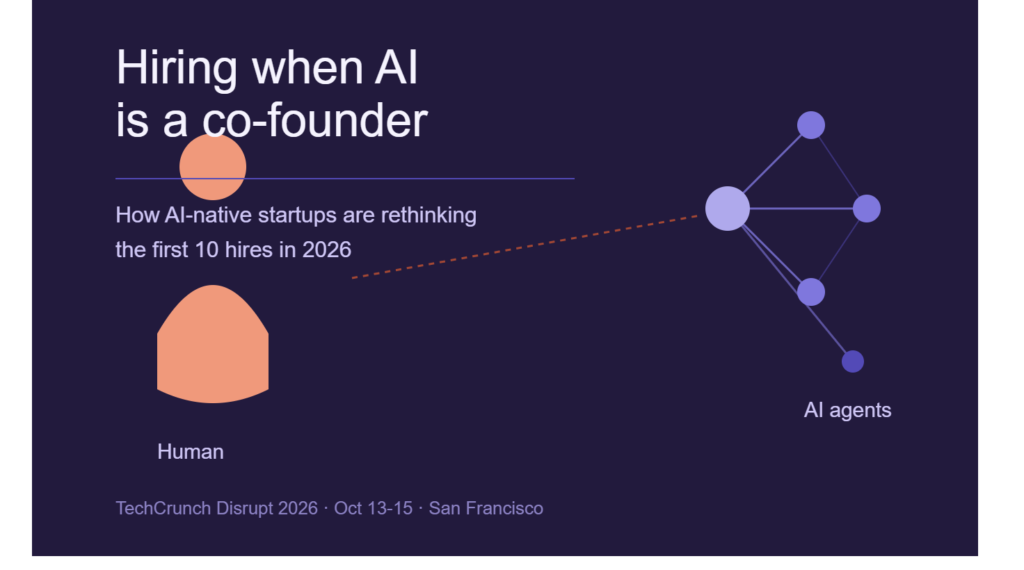
Why AI Agents Are Changing Startup Hiring
What if the next person you add to your startup’s team isn’t a person at all?
That question is becoming increasingly relevant as AI agents begin taking on engineering, customer support, research and operational tasks that previously required employees. At TechCrunch Disrupt 2026, leaders from Gusto, Insight Partners and Leland will explore what happens when founders build teams where humans and AI agents work alongside each other.
The shift is not simply about replacing a job with software. It changes the question founders ask when they are preparing to hire.
Instead of automatically asking, “Who should we hire next?”, a startup can begin with a different question: What work needs to be done, and is a person the best way to do it?
That distinction could influence how early-stage companies think about hiring, team structure, accountability and even company culture.
The topic will be discussed by Josh Reeves, CEO and co-founder of Gusto; Michelle Johnson, senior vice president at Insight Partners; and John Koelliker, CEO and co-founder of Leland. Their session, titled “Hiring When AI Is a Co-Founder,” is scheduled for the Builders Stage at TechCrunch Disrupt 2026.
What Are AI Agents Startup Teams?
Definition + Expansion
AI agents startup teams are startup teams in which AI agents work alongside human employees by carrying out defined, multistep tasks that might previously have been assigned to team members.
An AI agent differs from a simple AI assistant in the sense that it can be given a task and potentially carry out multiple steps toward completing it. The source describes agents taking on work across engineering, customer support, research and operations.
This creates a new layer in startup organization design.
A founder no longer has only two choices , hire a person or leave the work undone. AI agents introduce another option, although using that option also creates questions about supervision, ownership and accountability.
What makes an AI-native startup different?
An AI-native startup is not necessarily a company that merely uses AI software.
The bigger change is organizational. AI can become part of how work is assigned, completed and reviewed from the earliest stages of the company.
That means founders may need to think about people and AI systems together when designing workflows.
For example, if an AI agent can handle a defined research task, the human role might shift toward determining what research matters, reviewing the output and using the findings to make a business decision.
The employee is not necessarily disappearing from the workflow.
Instead, the employee’s responsibilities can change.
Why the First 10 Startup Hires May Look Different
Early employees have traditionally played an outsized role in shaping a startup.
The source notes that the first few hires can help define the company because every early hiring decision involves trade-offs involving capability, cost and speed. AI agents add another option to that calculation.
Why are the first 10 hires important?
Early-stage companies have limited resources, so every role can have a significant effect on what the business can accomplish.
An early engineer might build core technology. An early salesperson might establish the company’s first customer relationships. An operations employee might create processes that later become the foundation for a larger organization.
AI agents potentially change this equation by allowing some work to be delegated without immediately adding another employee.
That does not mean the first 10 people become unimportant.
It means the definition of an “early team” could become broader.
A startup could have a small human workforce supported by a collection of specialized AI systems handling different categories of work.
The new hiring question
The source offers a particularly useful way to frame the shift: instead of asking “Who do we hire next?”, founders can ask “What work needs to be done , and is a person the best way to do it?”
This question separates the task from the job title.
That can matter because traditional hiring often begins with a role. A company identifies a need, creates a position and searches for a person who can fill it.
An AI-native approach can begin with the work itself.
Once the work is identified, the company can consider whether it should be completed by:
- A human employee
- An AI agent
- A combination of both
- An existing employee using AI tools
The source does not claim that AI agents should handle every task. Instead, it highlights the need to determine where people create the greatest value and where an agent might do the job instead.
What Work Can AI Agents Take On?
AI agents are already being discussed as systems capable of handling multistep work rather than simply helping an employee complete an individual task.
According to the source, areas under consideration include engineering, customer support, research and operational work.
What does “delegating work to an AI agent” actually mean?
It means assigning a defined workflow to an AI system that can perform multiple steps toward an outcome, rather than using AI only as a tool for a single isolated action.
That distinction is important for startup founders.
A conventional software tool might help an employee write a message or summarize a document. An agent-oriented workflow can potentially take on a larger sequence of tasks.
The source specifically describes examples involving:
- Engineering tasks
- Customer support
- Research
- Operations
- Prospect research
- Outreach preparation
- Customer-data analysis
- Parts of the sales process
The latter examples come from the discussion of potential revenue-team applications.
The practical implication is that startups may increasingly divide workflows into components that require human judgment and components that can be delegated.
A simple example
Imagine a startup preparing to contact potential customers.
An AI agent might research prospects, organize customer information and prepare outreach material. A human could then review the material, decide which prospects matter and determine how the company should approach the relationship.
The source uses similar examples when discussing what AI agents could do for revenue teams.
The key idea is not “AI does sales.”
It is AI handles selected parts of the sales workflow while humans retain responsibility for higher-level decisions and relationships.
What Should Humans Still Own?
If AI agents can perform more tasks, one of the most important questions becomes: What should remain distinctly human?
The source identifies several areas that are difficult to reduce to a simple workflow.
These include understanding customers, challenging poor strategies, taking responsibility when something fails, building relationships, motivating teams and deciding when data points in the wrong direction.
Why does human ownership still matter?
An AI system can produce an output, but a company still needs people who decide what the company should do with that output.
That distinction becomes especially important when an AI agent makes a mistake.
The source raises several direct accountability questions: Who checks the work? Who makes the final decision? What happens when an agent gets something wrong? And which responsibilities are too important to delegate?
These are organizational questions, not simply technical questions.
A startup could have highly capable AI systems and still struggle if nobody knows who owns the result.
Human skills may become more valuable in different ways
The source suggests that early employees could increasingly be defined by judgment, ownership and the ability to direct both people and machines, rather than simply completing a larger volume of tasks.
That is a meaningful shift.
In a traditional organization, productivity can sometimes be associated with how much work an employee personally completes.
In an AI-native organization, an employee may create value by deciding which work should happen, how AI should be used, what needs review and when a human should intervene.
Three Perspectives on AI-Native Teams at Disrupt 2026
The upcoming TechCrunch Disrupt session brings together three people with different perspectives on startups, scaling and talent.
Josh Reeves: The small-business perspective
Josh Reeves is CEO and co-founder of Gusto, which the source says supports more than 500,000 companies across payroll, benefits, compliance, onboarding, HR and retirement. Gusto combines AI with more than a decade of experience serving small businesses.
That position gives Reeves exposure to companies making decisions about when and how to expand their teams.
The relevant question is therefore not only what AI can do technically, but how businesses can incorporate it into everyday work.
For founders, this perspective connects AI adoption with practical questions about hiring and workforce management.
Michelle Johnson: The scaling and revenue perspective
Michelle Johnson, senior vice president at Insight Partners, works with CEOs and chief revenue officers across North America and Europe on go-to-market strategy, revenue organizations and AI implementation, according to the source.
Her previous experience includes helping scale Flock Safety from less than $1 million to $90 million in ARR as an early sales and revenue operations leader.
Her perspective raises a practical question for revenue organizations: if AI can research prospects, prepare outreach, analyze customer data or manage parts of sales processes, what should human revenue professionals focus on?
That question could influence the skills startups prioritize when making new hires.
John Koelliker: The talent perspective
John Koelliker is CEO and co-founder of Leland, a career and talent platform for the AI era. Before Leland, he held product and growth roles at LinkedIn, Curated and Uber, according to the source.
His position sits directly at the intersection of talent and AI.
That makes the conversation particularly relevant to people thinking about how careers and skills may change as AI becomes part of everyday work.
Why bring these three perspectives together?
The three speakers approach the same challenge from different directions: How do you design a startup team when some of the work can be done by AI agents from day one?
That is broader than a question about automation.
It is a question about how companies organize themselves.
AI Agents vs Traditional Startup Hiring
The difference becomes clearer when the two approaches are placed side by side.
| Traditional startup approach | AI-native approach |
| Start with a job opening | Start with the work that needs to be done |
| Assign most responsibilities to a person | Divide work between people and AI agents |
| Add employees as workload increases | Consider whether some workflows can be delegated to AI |
| Employee completes assigned tasks | Employees may direct, review and coordinate AI-assisted workflows |
| Hiring focuses heavily on task execution | Hiring can place greater emphasis on judgment and ownership |
| Accountability is usually attached to employees and managers | Companies must explicitly define who reviews and owns agent output |
| Team structure grows around human roles | Team structure may include human roles plus AI systems |
This does not mean that one model automatically replaces the other.
The source presents AI agents as another option in the trade-off between capability, cost and speed.
For a startup, the appropriate structure will depend on the work involved and the level of responsibility that can reasonably be delegated.
What Founders Need to Consider Before Delegating Work
Using AI agents can help a small team move faster, but the source emphasizes that it also introduces questions around ownership and accountability.
A founder considering an AI agent should therefore think beyond whether the system can complete a task.
What should founders ask before delegating a workflow?
At minimum, the questions raised by the source include:
- Who owns the work?
Someone should be responsible for the outcome rather than treating the AI agent as the accountable party. - Who checks the result?
Agent-generated work may require human review, particularly where errors could affect customers or strategy. - Who makes the final decision?
The ability to produce information or recommendations does not automatically transfer decision-making authority to an AI system. - What happens when the agent gets something wrong?
Startups need a way to identify, correct and learn from errors. - Which responsibilities are too important to delegate?
Some activities involve relationships, judgment, strategy or accountability that founders may want people to retain.
These questions are directly aligned with the concerns highlighted in the TechCrunch source.
The result is a more deliberate approach to AI adoption.
Instead of saying, “Let’s automate this,” the company can ask, “Which parts of this workflow should AI handle, which parts should humans handle and how will responsibility be divided?”
How AI Agents Could Change Startup Roles
The source suggests that the impact of AI agents may extend beyond reducing the amount of manual work employees perform.
It could change what an early employee is expected to be good at.
Will employees still need to execute tasks?
Yes, but execution may become only one part of the role.
If AI systems can handle some repetitive or multistep activities, employees may spend more time defining objectives, checking outputs, making decisions and coordinating workflows.
For example, a revenue employee might spend less time gathering basic prospect information and more time deciding which prospects deserve attention.
An operations employee might spend less time manually moving information between processes and more time designing how those processes should work.
An engineer might use AI systems for parts of implementation while concentrating more heavily on architecture, review and product decisions.
The source does not prescribe these specific career outcomes. It does, however, point toward a broader shift in which early employees are valued for judgment, ownership and directing people and machines.
What Does This Mean for Students and Young Professionals?
For students and freshers, the AI-native startup discussion is relevant because it changes how technical and professional skills can be viewed.
Learning how to perform a task remains useful.
But understanding how to define the task, evaluate the result and decide when AI should or should not be used can become equally important in AI-enabled workplaces.
The source’s discussion of talent suggests that companies may increasingly need people capable of directing both humans and AI systems.
That creates several areas worth developing:
- Problem-solving and decision-making
- Communication
- Customer understanding
- AI literacy
- Workflow design
- Output evaluation
- Domain expertise
- Collaboration
- Accountability
- The ability to work with AI systems
For someone beginning a career, this does not mean trying to compete with AI at every task.
Instead, it can mean learning how to work effectively with AI while developing capabilities that remain dependent on context, judgment and responsibility.
That is particularly relevant as startups experiment with smaller human teams supported by increasingly capable AI systems.
Why TechCrunch Disrupt 2026 Is Focusing on the AI-Native Team
The discussion comes at a time when AI agents are becoming part of the conversation around how companies are built, not just how software is developed.
At Disrupt 2026, the session “Hiring When AI Is a Co-Founder” will take place on the Builders Stage and focus on how early-stage companies can build teams where humans and AI agents work alongside one another without sacrificing speed, accountability or culture.
The event is scheduled for October 13–15 at Moscone West in San Francisco.
The source says the event will bring together 10,000+ startups, investors and tech decision-makers, with the program covering areas including the Expo Hall, Startup Battlefield 200 and networking opportunities.
For founders, the appeal of the discussion is straightforward.
The technology question , “What can AI agents do?” , is only half the story.
The organizational question , “How should a company change because AI agents can do those things?” , could be just as important.
The Startup Org Chart May Be Changing
The rise of AI agents does not automatically mean startups will need fewer humans.
It means the boundary between a company’s human workforce and its software infrastructure may become less rigid.
A startup might have people responsible for product, strategy, customer relationships and decisions while AI agents handle selected engineering, research, support, sales or operational workflows.
That arrangement creates a different kind of organization.
The source describes the challenge as deciding where people create the greatest value and where an agent might do the job instead.
That is perhaps the most useful way to understand the AI-native startup.
It is not simply a company with lots of AI tools.
It is a company deliberately deciding which work belongs to humans, which work can be delegated to AI and how the two should work together.
What happens next?
The answers will likely emerge through experimentation.
Startups will test different combinations of employees and AI agents. Some workflows will work well with automation, while others will continue to require substantial human involvement.
The important organizational challenge will be creating clear boundaries around responsibility.
An AI agent can become part of a team, but the company still needs people who understand the mission, make decisions and take responsibility for what the business does.
That is precisely the conversation Josh Reeves, Michelle Johnson and John Koelliker are set to explore at TechCrunch Disrupt 2026.
FAQ: AI Agents and Startup Teams
What are AI agents in startup teams?
AI agents are AI systems that can perform defined, multistep tasks on behalf of a team. The TechCrunch source identifies engineering, customer support, research and operational work as areas where AI agents can increasingly be delegated tasks.
How are AI agents changing startup hiring?
AI agents add another option to the traditional decision of whether to hire an employee for a particular capability. Founders can increasingly begin by identifying the work that needs to be done and then consider whether a person, an AI agent or a combination of both should handle it.
What should humans still own in an AI-native startup?
Humans may retain responsibility for areas involving customer understanding, strategy, final decisions, relationships, team motivation and accountability. The source specifically highlights judgment, ownership and directing people and machines as important aspects of early employee roles.
What questions should founders ask before delegating work to AI agents?
Founders should consider who checks the agent’s work, who makes the final decision, what happens when an agent makes a mistake and which responsibilities are too important to delegate. These questions are central to the accountability challenge described in the source.
Who will discuss AI-native startup teams at TechCrunch Disrupt 2026?
Josh Reeves of Gusto, Michelle Johnson of Insight Partners and John Koelliker of Leland will discuss the subject during a Builders Stage session titled “Hiring When AI Is a Co-Founder.”
When is TechCrunch Disrupt 2026?
TechCrunch Disrupt 2026 is scheduled for October 13–15, 2026, at Moscone West in San Francisco. The source says the event will bring together 10,000+ startups, investors and technology decision-makers.
The Bottom Line
AI agents are introducing a new question for startup founders: not simply who to hire, but what work should be done by people, what can be delegated to AI, and where human ownership remains essential. As companies experiment with AI-native teams, judgment, accountability and the ability to direct both people and AI systems may become increasingly important.
For more practical explainers on AI, startups and the future of work, keep exploring Kalinga.ai.