AM Radio for Every Vehicle Act: What Could It Mean for New Cars?
Imagine buying a new car in the next year and discovering that an old-school AM receiver is back on the dashboard,not because automakers chose it, but because federal legislation may require it.
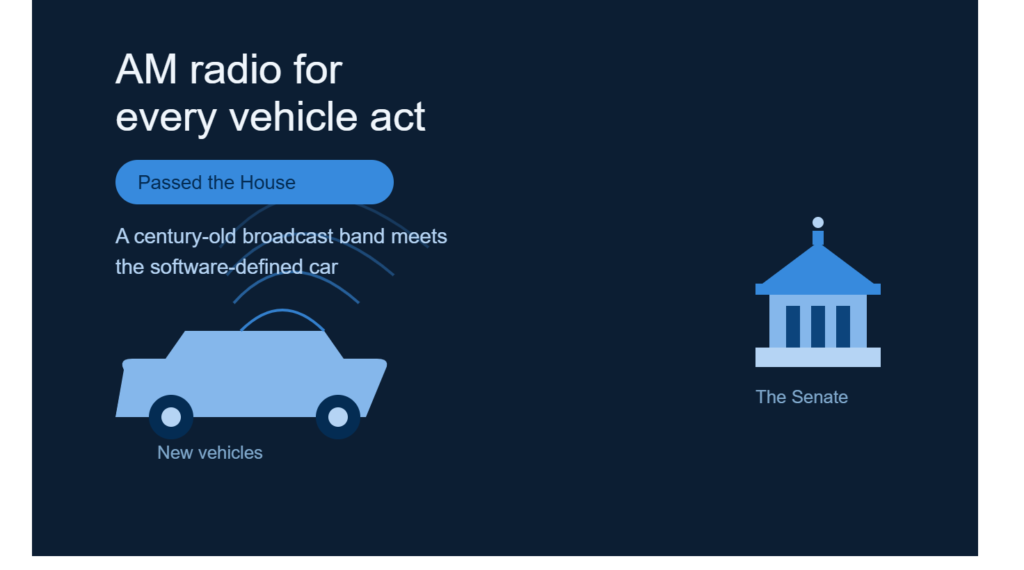
The AM Radio for Every Vehicle Act has cleared the U.S. House of Representatives and is now headed to the Senate. The bill would direct the National Highway Traffic Safety Administration (NHTSA) to require new passenger vehicles to include AM radio as standard equipment at no additional charge to consumers.
That puts a century-old broadcast technology at the center of a modern debate involving electric vehicles, software-defined cars, emergency communications, cellular connectivity, and federal regulation.
The House action does not mean the requirement is already law. The Senate would still need to act, and the legislation would need to complete the remaining steps of the federal legislative process before any mandate could take effect.
So why is AM radio suddenly back in the spotlight?
What Is the AM Radio for Every Vehicle Act?
Definition , AM Radio for Every Vehicle Act: The legislation would require the federal government to establish a rule requiring new motor vehicles to provide access to AM broadcast radio as standard equipment.
The current legislation is identified as H.R. 979 in the House and S. 315 in the Senate. A Congressional Research Service analysis says both bills would direct the U.S. Department of Transportation to require original equipment manufacturers to include broadcast AM radio receivers in future motor vehicles made and sold in the United States.
The House passed its version in September 2026, sending it to the Senate for consideration. Reporting on the House action describes the vote as bipartisan and says the measure would require AM radio in new cars, trucks, and SUVs without an additional charge to consumers.
Question → Does the House vote mean every new car must have AM radio now?
No. The House vote advances the legislation, but it does not by itself create an immediate nationwide requirement.
The Senate still has to consider the measure. If legislation ultimately becomes law, federal agencies would then have to implement the statutory requirements through the process established by Congress.
That distinction matters because headlines about a coming “AM radio mandate” can make the technology sound closer to being compulsory than it actually is at this stage.
Why Is Congress Pushing AM Radio Back Into Cars?
The central argument is not simply nostalgia.
Supporters of the legislation say AM broadcasting remains useful because its signals can cover long distances and can provide information when other communication systems are disrupted. Emergency-response organizations have also backed legislation requiring AM receivers in vehicles. A congressional document signed by emergency-services organizations argued that AM can remain available when cellular or internet connectivity is limited or disrupted.
The Congressional Research Service has similarly described AM broadcast radio as part of the communications infrastructure that can support emergency information and backup communications.
That creates an interesting technology paradox.
Modern vehicles have increasingly sophisticated connectivity, including cellular data, Bluetooth, satellite services, navigation systems, apps, and streaming platforms. Yet the legislation’s supporters are arguing that a comparatively simple broadcast receiver can provide a form of redundancy that internet-dependent systems do not always offer.
AM radio as a communications backup
AM broadcasting has one major characteristic that distinguishes it from many digital services: the receiver does not need a cellular data connection to receive an over-the-air broadcast.
That does not mean AM works everywhere or that it is immune to disruption. But the underlying infrastructure is different from services that depend on an active internet connection.
During severe weather, infrastructure failures, disasters, or other emergencies, that difference can become relevant.
The congressional debate therefore involves two separate questions:
- How important is AM radio as an emergency information channel?
- Should the federal government require automakers to provide access to it?
Those questions are related, but they are not identical.
Question → Why do supporters call AM radio an emergency tool?
Supporters point to AM radio’s long-distance broadcasting capability and its independence from a vehicle’s cellular data connection.
Emergency-response organizations supporting the legislation have argued that AM can help disseminate information when other communication systems are unavailable or disrupted.
Why Have Automakers Been Removing AM Radio?
The automotive industry has been moving toward increasingly software-driven entertainment systems.
Instead of relying entirely on traditional radio hardware, newer vehicles can deliver audio through applications and internet-connected services. That approach can simplify the dashboard experience and give automakers more flexibility over software and digital features.
Several manufacturers have reduced or eliminated traditional AM radio from some vehicles.
The TechCrunch report that prompted this discussion identified BMW, Rivian, Tesla, and Volvo among automakers that have moved away from the century-old broadcast band. Ford previously removed AM radio from some vehicles but later reversed course.
This shift is especially noticeable among electric-vehicle manufacturers.
The EV engineering problem
One reason is technical rather than political.
Electric motors and related vehicle electronics can generate electromagnetic interference. AM radio operates in frequencies that can be affected by this interference, potentially reducing audio quality.
Automakers have therefore faced a choice: engineer around the interference, use alternative radio technologies, or remove the traditional AM receiver and provide audio through digital services instead.
That is one reason the debate over the AM Radio for Every Vehicle Act is also a debate about how modern vehicles are engineered.
Question → Why are electric vehicles especially relevant to AM radio?
Electric vehicles can generate electromagnetic interference that may affect AM radio reception.
Automakers have argued that this interference can degrade AM signal quality, making traditional AM receivers more difficult to integrate into some EV architectures. The result has been greater interest in digital alternatives.
Which Automakers Have Moved Away From AM Radio?
The shift has not been identical across the industry.
Some automakers have retained AM reception in certain models, while others have moved toward streaming, digital radio, or software-based alternatives. Ford, for example, removed AM from some vehicles before reversing that decision.
Tesla and Rivian illustrate how far the transition can go.
According to the TechCrunch report, Tesla’s base versions of the Model 3 and Model Y do not include AM receivers. Rivian’s R2 SUV does not have a traditional AM or FM receiver, although the vehicle provides AM/FM radio through the iHeartRadio digital platform.
That distinction is important because “radio” can now mean two very different things.
A traditional AM receiver captures a broadcast signal directly through the vehicle’s antenna and tuner. A digital radio application can reproduce radio programming through an internet connection.
The listening experience may appear similar to a driver, but the underlying technology is very different.
Traditional AM vs digital radio
| Feature | Traditional AM Radio | Digital Radio/Streaming |
| Signal source | Over-the-air broadcast | Internet/data connection |
| Cellular connection required | No | Usually yes |
| Vehicle hardware | AM tuner and antenna system | Software/app and connectivity |
| Emergency redundancy | Can operate independently of cellular data | Can be affected by connectivity outages |
| Content delivery | Broadcast stations | Apps and digital platforms |
| Vehicle integration | Dedicated radio hardware | Software-defined system |
| Main industry trend | Declining in some newer vehicles | Increasing |
The comparison also explains why the legislation matters beyond the radio itself.
It is effectively asking whether access to a particular legacy communication technology should remain a required feature in an increasingly software-defined vehicle.
How Would the AM Radio Mandate Work?
The AM Radio for Every Vehicle Act does not simply instruct automakers to start installing receivers immediately.
Instead, the legislation would direct the transportation department to establish a requirement for AM broadcast reception in new motor vehicles.
The Congressional Research Service says the bills would direct the Department of Transportation to require original equipment manufacturers to include broadcast AM receivers in future motor vehicles made and sold in the United States. Its analysis also notes that the legislation includes a 10-year limit on the relevant DOT implementation and enforcement authority after enactment.
That means implementation would involve more than a congressional vote.
A simplified path
If the legislation ultimately becomes law, the process would broadly involve:
- Congressional approval of the legislation.
- Presidential action as required for the bill to become law.
- Federal implementation, including the relevant regulatory process.
- Automaker compliance with the resulting vehicle requirements.
- Integration into affected new vehicles according to the applicable rules.
The precise timing would depend on the final legislation and subsequent federal implementation.
Question → Would the requirement apply to existing cars?
The legislation is aimed at new motor vehicles, rather than requiring owners to retrofit vehicles already on the road.
That is significant because installing AM hardware in millions of existing vehicles would be a substantially different policy and engineering challenge.
The proposal instead focuses on what manufacturers provide in future vehicles sold in the United States.
Why EVs Have Become Central to the AM Radio Debate
The AM debate might sound unusual in an era of 5G-connected cars and advanced driver-assistance systems.
But the controversy illustrates a broader problem in vehicle technology: adding digital capabilities does not automatically eliminate the need for older communication systems.
EVs are at the center because electromagnetic compatibility can be more complicated when vehicles rely on electric motors and increasingly powerful electronic systems.
The Congressional Research Service has examined the issue from technological, public-safety, economic, and jurisdictional perspectives.
For automakers, the question is therefore not merely whether a tuner can be physically placed inside a vehicle.
The engineering challenge can involve antennas, electromagnetic interference, vehicle electronics, software, packaging, testing, and audio quality.
Software-defined vehicles change the equation
A software-defined vehicle is one in which software plays a major role in features that historically depended on dedicated hardware.
That architecture can make it easier to update features after a vehicle is sold. It can also encourage manufacturers to replace traditional hardware with software services.
For drivers, that can mean more connected features.
For regulators, however, it raises a question: Which capabilities should remain available even when an internet connection is unavailable?
AM radio has become one test case for that broader question.
What Happens After the House Vote?
The next major stage is the Senate.
The House passage reported in September 2026 sent the measure to the Senate. The Senate version has bipartisan support, and the TechCrunch report notes that Senators Ed Markey and Ted Cruz are co-sponsors. The report also states that the senators had secured 60 Senate co-sponsors earlier in 2026, a threshold relevant to overcoming a filibuster.
That does not guarantee passage.
Legislation can still encounter procedural, scheduling, amendment, or other obstacles before becoming law.
The important point for consumers is that AM radio is not yet a federally mandated feature in every new U.S. vehicle simply because the House passed the bill.
Question → What should car buyers know right now?
Buyers should check the specific vehicle’s equipment list rather than assume that every new car currently includes AM radio.
Until legislation becomes law and any resulting requirements take effect, AM availability remains dependent on the vehicle, manufacturer, model, trim, and technology package.
AM Radio vs Streaming: Which Technology Is More Resilient?
The debate becomes clearer when viewed as a comparison between two communications models.
Traditional AM broadcasting is fundamentally a one-to-many broadcast system. A station transmits a signal, and compatible receivers within range can listen without establishing individual internet connections.
Streaming is a network-based system. The vehicle connects to a digital service, which delivers the audio over a communications network.
Neither system is universally reliable under every circumstance.
Streaming can provide a much broader selection of content, personalized experiences, podcasts, on-demand programming, and integration with connected-car software. Traditional AM, meanwhile, can operate without a cellular data subscription.
| Factor | AM Broadcast | Internet Streaming |
| On-demand content | Limited | Extensive |
| Requires internet | No | Yes |
| Personalized content | Limited | Strong |
| Emergency redundancy | Potential advantage | Dependent on network availability |
| Local broadcast access | Strong where stations exist | Depends on digital availability |
| Hardware dependence | AM receiver required | Connectivity and software required |
| Content flexibility | Broadcast schedule | On-demand and live |
This is why the debate is not necessarily about whether one technology can completely replace the other.
A vehicle could potentially provide both.
What Could the Legislation Mean for Automakers?
If enacted and implemented, the legislation could create a common baseline for new vehicles sold in the United States.
Automakers would need to account for the requirement in vehicle design and equipment planning.
For companies already including AM receivers, the impact could be smaller than for manufacturers that have removed traditional AM hardware entirely.
For EV manufacturers that rely heavily on software-based audio systems, integration could require additional hardware or engineering work.
However, the precise technical and financial effects would depend on the final law and implementing requirements.
Potential considerations for manufacturers
Automakers could need to evaluate:
- AM receiver hardware
- Antenna configuration
- Electromagnetic interference
- Audio-system integration
- Vehicle software
- Testing and compliance
- Packaging and component costs
- Differences between vehicle platforms
The proposal therefore intersects with a much bigger transformation in the auto industry.
Cars are increasingly becoming connected computing platforms, but they still operate in a physical world where radio frequencies, antennas, batteries, motors, and electrical systems matter.
What Could the Legislation Mean for Drivers?
For consumers, the most direct change would be simple: if the measure becomes law and its requirements take effect, eligible new vehicles would be required to provide AM radio access as standard equipment rather than treating it as an optional or omitted feature.
The legislation could also preserve a communication channel that some drivers use for news, sports, talk programming, and emergency information.
But the practical value will vary by driver.
Someone who exclusively uses podcasts and streaming services may rarely use AM. Another driver may value local broadcast stations or the ability to receive information without relying on mobile data.
The key consumer issue is therefore access, rather than whether every driver will actually use the feature.
Question → Is AM radio being brought back because people stopped using streaming services?
No.
The legislation is primarily concerned with maintaining access to AM broadcasting in vehicles, particularly because supporters argue that it provides public-safety and emergency-communication value.
Streaming remains a major part of modern vehicle audio systems. The proposal does not mean digital audio services are disappearing.
Why This Is a Bigger Technology Story Than AM Radio
At first glance, a federal proposal concerning an old broadcast format might look like a niche automotive story.
It is actually a useful example of how technology transitions work.
New technologies do not always eliminate old technologies immediately. Instead, societies often retain older systems when they provide a particular function that newer systems do not perfectly replicate.
AM radio’s proposed role is redundancy.
A connected car may have satellite navigation, cellular connectivity, Wi-Fi, Bluetooth, streaming services, digital assistants, and sophisticated software. Yet many of those features depend on networks, data services, or functioning digital infrastructure.
A basic broadcast receiver represents a different communications pathway.
That is why the AM Radio for Every Vehicle Act has attracted support from groups beyond traditional broadcasters. Emergency-response organizations and other supporters have framed the issue around communication resilience rather than simply preserving an older form of entertainment.
What the AM Radio Debate Says About Future Cars
The modern car is becoming a fascinating combination of old and new technologies.
Inside one vehicle, you can have an electric motor controlled by sophisticated power electronics, an AI-powered driver-assistance system, a high-resolution touchscreen, cloud-connected software, satellite navigation, Bluetooth audio, and potentially a decades-old AM receiver.
That combination is not necessarily contradictory.
Technology systems are often designed around redundancy, compatibility, regulation, cost, and real-world constraints,not just technological novelty.
The AM debate also shows why connectivity should not automatically be treated as synonymous with resilience.
A vehicle that can stream almost anything from the internet is powerful. But a vehicle that can also receive information independently of the cellular network has a different capability.
The AM Radio for Every Vehicle Act is therefore part of a broader conversation about what connectivity should mean in the next generation of automobiles.
Frequently Asked Questions
What is the AM Radio for Every Vehicle Act?
The AM Radio for Every Vehicle Act is U.S. legislation that would direct federal transportation authorities to require new motor vehicles to provide AM broadcast radio as standard equipment. The House passed its version in September 2026, and the measure is now before the Senate.
Has the AM radio mandate become law?
No. The House has passed the legislation, but that does not by itself make it law. The Senate still needs to consider the measure, followed by the remaining steps required for legislation to take effect.
Why does Congress want AM radio in new vehicles?
Supporters argue that AM broadcasting can provide emergency information without depending on cellular or internet connectivity. Emergency-response organizations have also supported the proposal, citing AM radio’s potential usefulness when other communications systems are disrupted.
Why are some electric vehicles removing AM radio?
Electric vehicles and their electronic systems can generate electromagnetic interference that affects AM reception. Automakers have also increasingly adopted software-based audio systems and streaming services, reducing their reliance on traditional radio hardware.
Does digital AM radio work the same way as a traditional AM receiver?
Not exactly. A traditional AM receiver picks up an over-the-air broadcast directly, while a digital radio application generally delivers programming through an internet or cellular connection. The content can be similar, but the underlying communication technology is different.
Will existing cars have to add AM radio?
The proposed legislation is focused on new motor vehicles, not retrofitting vehicles already on the road. Existing vehicles would not generally need to be modified simply because the legislation advances.
The Bottom Line
The return of AM radio to the center of the automotive debate is less about nostalgia than it first appears. The AM Radio for Every Vehicle Act raises practical questions about emergency communication, vehicle engineering, EV electromagnetic interference, software-defined cars, and the role of federal standards in connected transportation.
For now, the legislation has cleared the House and moved to the Senate. Whether it ultimately becomes law,and exactly how any resulting requirements would be implemented,remains to be determined.
For more explainers on how technology, regulation, and the automotive industry are changing together, explore the latest technology coverage on Kalinga.ai.