Solar Desalination Could Turn Seawater Into Fresh Water Without Brine
What if the salt left behind after turning seawater into fresh water could be collected instead of dumped back into the ocean?
Researchers at the University of Rochester have developed a solar desalination system that uses sunlight to evaporate seawater, collect the resulting salts as solids, and produce fresh water without discharging liquid brine. The researchers also demonstrated a related version of the technology for extracting lithium from salt-rich water, pointing toward a future where desalination could produce both water and valuable minerals.
The research, led by optics and physics professor Chunlei Guo and colleagues at the University of Rochester’s Institute of Optics, was published in Light: Science & Applications in May 2026. The main system was tested with real seawater from the Pacific, Atlantic, and Indian oceans, rather than only laboratory-made saltwater.
That distinction matters because real seawater contains a complicated mixture of salts and minerals that can quickly clog conventional solar evaporation surfaces.
The Rochester approach is designed to prevent that buildup while continuously moving crystallized salts away from the area where water is evaporated.
Why Desalination Needs a Different Approach
Fresh water may cover only a small fraction of Earth’s total water resources, while oceans provide an enormous supply of saltwater. Turning that seawater into usable fresh water is therefore an important strategy for regions facing water shortages.
But conventional desalination creates a problem of its own: what happens to all the concentrated salt left behind?
Reverse osmosis, one of the most widely used desalination methods, pushes seawater through membranes that allow water to pass while retaining much of the salt. Thermal desalination instead uses heat to separate water from dissolved substances.
Both approaches can provide fresh water, but desalination systems can also generate highly concentrated liquid waste called brine.
When concentrated brine is discharged into coastal waters, it can affect local salinity and marine conditions. The Rochester research describes brine discharge as one of the environmental concerns limiting conventional ocean-water desalination.
Definition + Expansion: What is solar desalination?
Solar desalination is the process of using sunlight, usually converted into heat, to separate fresh water from saltwater.
Instead of relying entirely on grid electricity or externally supplied heat, solar-thermal systems use sunlight to heat a thin layer of water until it evaporates. The water vapor can then be condensed into fresh water while dissolved salts remain behind. The Rochester system takes this concept further by actively moving those salts away from the evaporation surface so they can be collected rather than forming a blocking crust.
Why is this important?
Because producing fresh water is only half of the desalination challenge. A practical system also needs to manage everything that remains after the water has been removed.
How the New Solar Desalination System Works
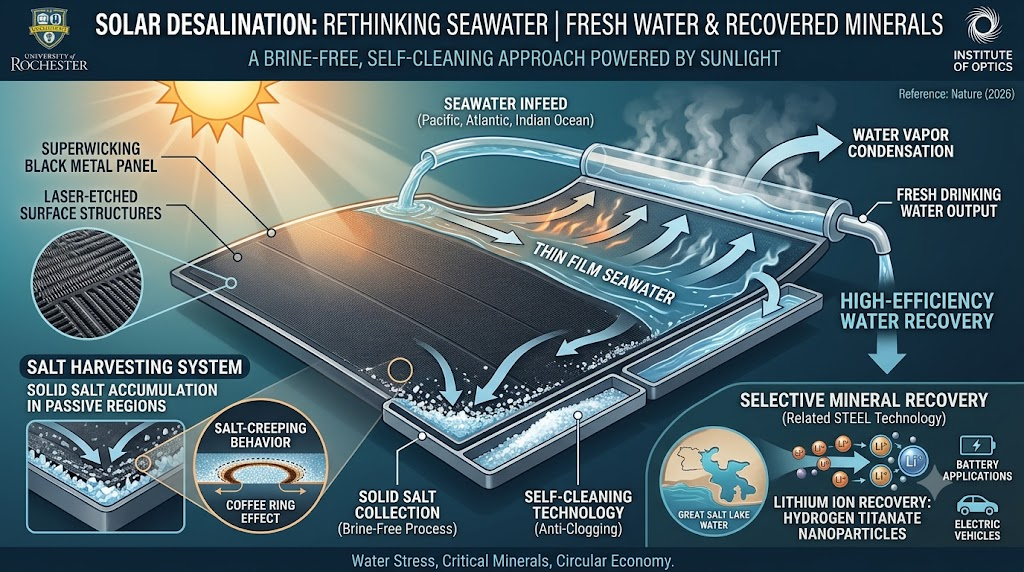
At the center of the Rochester design is a specially engineered material called superwicking black metal.
Researchers use femtosecond lasers to create microscopic structures on the surface of metal. A femtosecond is one quadrillionth of a second, so these laser pulses are extraordinarily short.
The treatment changes how the metal interacts with both sunlight and water.
The resulting surface is extremely effective at absorbing solar radiation while also attracting and spreading water across itself. In other words, the metal acts both as a highly efficient solar absorber and as a surface that can move a thin film of water.
What is superwicking black metal?
Superwicking black metal is laser-structured metal designed to strongly absorb sunlight while rapidly spreading water across its surface.
The Rochester researchers created an active region where a thin film of seawater moves across the laser-treated metal. Sunlight heats this water, causing evaporation. Instead of leaving all the salt directly on the active region, the system guides crystallized material toward untreated areas called passive regions.
This separation between evaporation and salt collection is one of the key ideas behind the technology.
Question → Direct Answer: How does the panel produce fresh water?
The panel draws a thin layer of seawater across its light-absorbing surface. Sunlight heats that water, causing the water to evaporate while dissolved salts and minerals remain behind; the water can then be recovered as fresh water.
The researchers reported an average evaporation rate of 1.76 ± 0.04 kilograms per square metre per hour under one-sun illumination, with a salt harvesting rate of 61.74 ± 2.46 grams per square metre per hour. They calculated roughly 74% solar-to-vapor conversion efficiency and nearly 100% salt extraction in their experiments.
Those figures come from controlled experimental testing, so they should not be interpreted as proof that the technology is already ready to replace large commercial desalination plants.
The Clever Part: Making Salt Move Away From the Surface
Salt buildup is a major headache for solar evaporation technologies.
Imagine leaving a salty drop of seawater under the sun. As the water disappears, the concentration of dissolved minerals increases. Eventually, crystals begin forming.
If those crystals form directly over the area responsible for evaporation, they can block water movement and reduce the system’s performance.
The Rochester researchers designed microscopic grooves into the metal to encourage salt movement away from the active region.
They also exploited a phenomenon many people have accidentally observed while drinking coffee.
The coffee ring effect
When a drop of coffee dries, particles suspended in the liquid often migrate toward the edge. Once the water evaporates, a visible ring of concentrated particles remains.
This is known as the coffee ring effect.
The Rochester team uses a related physical process to encourage salts to move outward toward the panel’s passive regions. According to the researchers, the surface structures and salt-creeping behavior work together to keep the active evaporation region from becoming covered by a persistent salt crust.
Question → Direct Answer: Why doesn’t the salt simply clog the solar panel?
The panel is engineered to move crystallized salts from the active evaporation region toward passive collection regions. This allows salt to accumulate away from the area where water is being evaporated, helping the surface continue operating.
This self-cleaning feature is particularly important because the researchers did not limit their experiments to artificial seawater.
Why Real Seawater Is Much Harder Than Laboratory Saltwater
A glass of laboratory-made saltwater can be surprisingly simple compared with the ocean.
Researchers can prepare artificial seawater using water and a controlled quantity of sodium chloride. Real seawater contains sodium chloride along with magnesium, calcium and numerous other dissolved materials.
Those additional substances matter because different minerals crystallize in different ways.
The Rochester paper notes that minerals such as magnesium sulfate and calcium carbonate can create hard, relatively non-porous deposits between sodium chloride crystals. These deposits can obstruct capillary water flow and eventually cause clogging.
That means a solar evaporation surface that works well with simple sodium-chloride water may struggle when exposed to actual ocean water.
The researchers tested water from three oceans
The team tested its system using real seawater collected from the:
- Pacific Ocean
- Atlantic Ocean
- Indian Ocean
The system was able to produce fresh water while directing the remaining salts into passive regions for collection. The researchers also reported that salt accumulation did not significantly reduce the desalination efficiency during their tests.
The device was designed to track the sun and operated continuously for a week during the reported experiments. The paper also describes continuous operation over extended periods without maintenance in its experimental demonstrations.
Question → Direct Answer: Why is testing real seawater significant?
Real seawater contains many minerals that can form difficult, hard deposits. Demonstrating self-cleaning operation with actual ocean water therefore addresses a major practical problem that can be hidden when desalination devices are tested only with simplified laboratory solutions.
How Brine-Free Desalination Changes the Waste Problem
Traditional desalination often leaves behind concentrated liquid brine.
The Rochester approach changes the physical form of that leftover material. Instead of keeping the salts dissolved in a concentrated liquid stream, the system extracts them as solid minerals.
The research describes the process as brine-discharge-free and reports nearly complete salt extraction from the ocean-water feed.
From liquid waste to solid resource
This creates an important difference:
| Approach | Main energy/input mechanism | Salt outcome | Main challenge |
| Reverse osmosis | Pressure and electricity | Concentrated brine | Brine management and membrane operation |
| Thermal desalination | Heat | Concentrated saltwater stream | High energy and heat requirements |
| Conventional solar evaporation | Sunlight | Salt can accumulate on evaporator | Surface clogging |
| Rochester solar-thermal system | Sunlight + engineered surface | Solid salt collection | Scaling from laboratory proof of concept |
The goal is not simply to eliminate a waste stream.
The bigger idea is to change desalination from a water-only process into a water-and-resource recovery process.
Question → Direct Answer: Does the system produce zero waste?
The researchers describe the technology as brine-discharge-free because it avoids producing a liquid brine discharge and instead harvests nearly all dissolved salts in solid form. That does not mean the entire technology has zero environmental footprint under every future deployment scenario; large-scale manufacturing, maintenance, land use and downstream mineral processing would still need evaluation.
That distinction is important when discussing emerging technologies. A laboratory demonstration can show that a particular technical problem is solvable without proving that every commercial or environmental question has already been answered.
Could Solar Desalination Also Produce Lithium?
Here is where the research becomes especially interesting for the clean-energy economy.
Lithium is widely used in rechargeable batteries, including those used in electric vehicles, smartphones and laptops. Demand for lithium has encouraged researchers to investigate alternatives to conventional extraction from mineral ores and other resources.
The Rochester group developed a related system called STEEL, or solar-thermal interfacial evaporator with simultaneous extraction of lithium.
In that system, researchers incorporated hydrogen titanate nanoparticles into the microscopic structures of the superwicking black metal. These nanoparticles act as lithium-ion-selective materials, helping separate lithium from competing ions.
The researchers tested the approach using Great Salt Lake water.
The published study reported 50% lithium extraction efficiency, while nearly 100% of the total minerals were recovered. The resulting eluate increased lithium’s cation mass composition from 0.09% in the original salt-lake water to 70.12% after the extraction process, creating a more concentrated feedstock for later refining.
Question → Direct Answer: Can this desalination technology recover lithium?
A related version of the Rochester technology has demonstrated lithium extraction from salt-rich water. It is not yet evidence that commercial ocean-water desalination plants can economically produce large quantities of battery-grade lithium, but it demonstrates the possibility of integrating water purification and mineral recovery into one solar-driven platform.
That last point is crucial.
The main seawater study demonstrates nearly complete salt extraction, while the separate lithium study demonstrates selective lithium recovery from salt-rich water. They are related technologies, but their experimental results should not be treated as though the seawater system has already demonstrated commercial-scale lithium production.
Why Combining Water and Mineral Recovery Matters
Desalination has traditionally been viewed as a way to obtain one product: fresh water.
The Rochester research suggests a different model.
Instead of asking only, How much fresh water can we produce?, future systems could ask:
How much fresh water and how many useful materials can we recover from the same input?
This concept is particularly interesting because seawater contains numerous dissolved minerals. The main challenge is not simply finding those materials; it is separating them economically and selectively from a huge mixture.
A system that already concentrates and collects salts during water production could potentially provide a starting point for additional mineral recovery.
The research paper notes that the superwicking panel could also be functionalized to selectively collect desirable salts or other solutes.
That opens a broader research direction beyond desalination.
A possible circular model
A future resource-recovery facility could theoretically follow this sequence:
- Seawater enters the system.
- Solar energy heats a thin surface water film.
- Water evaporates and is recovered as fresh water.
- Dissolved salts move away from the active evaporation region.
- Solid salts are collected rather than discharged as liquid brine.
- Selected minerals could undergo additional separation.
- Recovered materials could potentially enter industrial supply chains.
The important word here is potentially.
The current research demonstrates the underlying processes, not a finished commercial facility capable of performing all these steps at industrial scale.
Solar Desalination vs Conventional Desalination
The new system does not make existing desalination technologies obsolete overnight.
Reverse osmosis is already a mature technology used commercially around the world. Solar-thermal approaches face their own engineering questions, including how to maintain performance under changing weather, how to manufacture large areas of engineered surfaces and how to manage downstream salt processing.
Still, the approaches solve somewhat different problems.
| Feature | Reverse Osmosis | Thermal Desalination | Rochester Solar-Thermal Approach |
| Primary mechanism | Membrane separation | Evaporation and condensation | Solar-driven interfacial evaporation |
| Main energy source | Usually electricity | Heat | Sunlight |
| Fresh water production | Yes | Yes | Yes, demonstrated experimentally |
| Liquid brine generation | Yes | Yes | Designed to avoid brine discharge |
| Salt collection | Requires additional processing | Requires additional processing | Direct solid salt harvesting |
| Salt buildup challenge | Membrane fouling | Scaling | Active salt movement/self-cleaning |
| Lithium recovery | Separate process required | Separate process required | Related version demonstrated lithium extraction |
| Development stage | Commercially mature | Commercially mature | Proof-of-concept research |
The comparison shows why the Rochester work is interesting without suggesting that the technology is already a commercial replacement.
Its distinctive feature is the attempt to integrate freshwater production, salt harvesting and self-cleaning into a solar-driven process.
What the Numbers Actually Tell Us
The headline figures are impressive, but context matters.
For the main ocean-water system, researchers reported an evaporation rate of 1.76 ± 0.04 kg/m²/h, a salt harvesting rate of 61.74 ± 2.46 g/m²/h, approximately 74% evaporation efficiency, and nearly 100% salt extraction under one-sun illumination.
These are laboratory research measurements, not a guarantee of commercial output.
For the related lithium-recovery technology, the reported lithium mining rate was around 0.21 ± 0.02 g/m²/day, with 50% lithium extraction efficiency in the reported experiments.
That difference illustrates why mineral recovery is a separate engineering challenge.
Recovering nearly all salts from seawater is not the same thing as selectively recovering a small quantity of one valuable element.
For students and young engineers, this is an important lesson in technology development: high laboratory efficiency does not automatically translate into low-cost industrial production.
The next questions involve scale, durability, economics, manufacturing and environmental impact.
What Could This Mean for Water-Scarce Regions?
The potential application is easy to understand.
Coastal regions have access to enormous quantities of seawater but may lack reliable freshwater supplies. Solar energy is also widely available in many water-stressed regions.
A desalination system that can operate using sunlight while avoiding liquid brine discharge could therefore be attractive for certain applications.
The University of Rochester notes that approximately 2.2 billion people lack safely managed drinking water, highlighting the scale of the global water challenge.
However, geography matters.
A solar-powered desalination system would need enough sunlight, suitable seawater access and infrastructure for collecting and handling the recovered salts. Fresh water would also need to meet appropriate treatment and drinking-water standards before being supplied to people.
Could this matter for India?
India has a long coastline and several regions where water availability is a major infrastructure concern. Solar energy is also an important part of India’s broader renewable-energy strategy.
That does not mean the Rochester system can immediately be deployed across Indian coastal communities.
Instead, the research provides a technological direction worth watching: using renewable energy to combine water purification with resource recovery.
For India and other countries investing in water security, technologies that reduce waste while producing useful materials could eventually become part of a broader portfolio of desalination solutions.
What Are the Biggest Challenges Ahead?
The researchers describe the basic design as scalable, but the technology remains at the proof-of-concept stage.
Moving from a small experimental panel to an industrial desalination facility is a major engineering step.
Several questions will need answers.
1. Can the panels be manufactured cheaply?
Femtosecond laser processing creates the specialized surface structures that give the metal its unusual properties. Industrial deployment would require large areas of material to be fabricated consistently and economically.
2. How long will the surface remain effective?
A desalination facility may need to operate for years, not days or weeks. Long-term exposure to seawater, sunlight, temperature changes and mechanical wear could affect performance.
3. What happens to the harvested salts?
Turning brine into solid salt solves one problem but creates a material stream that must still be stored, processed or sold.
Not every mineral mixture recovered from seawater will have immediate commercial value.
4. Can valuable minerals be separated economically?
The lithium work demonstrates selective extraction, but commercial mineral production involves more than extraction efficiency. Refining, purification, transportation and market prices all matter.
5. How does the system perform outside the laboratory?
Sunlight changes throughout the day and across seasons. Cloud cover, humidity, wind and seawater temperature could all influence real-world output.
These are not failures of the concept. They are the normal questions that determine whether a promising laboratory technology can become useful infrastructure.
Why This Research Is Bigger Than Desalination
The most interesting part of this research may not be the solar panel itself.
It is the underlying design philosophy.
For decades, many industrial systems have been built around a linear model:
input → useful product → waste
The Rochester work points toward a different model:
seawater → fresh water + recovered minerals
That shift is important because waste streams can sometimes contain materials that have economic value.
The researchers’ main study describes the possibility of using the platform for other inorganic and organic solutions, including solvent recovery and selective solute collection.
A related 2026 study also shows that solar-powered systems are being explored for simultaneous recovery of multiple resources from seawater and other saline sources, suggesting that the broader research field is moving toward integrated water-and-resource technologies.
The long-term opportunity, therefore, may be less about building one perfect desalination machine and more about developing resource-recovery platforms powered by renewable energy.
The Bottom Line on Solar Desalination Without Brine
The University of Rochester’s new system offers a clever answer to one of desalination’s biggest problems: don’t allow the salt to become waste in the first place.
Its laser-etched superwicking black metal uses sunlight to evaporate a thin film of seawater while directing crystallized salts away from the active region. Experiments with Pacific, Atlantic and Indian Ocean water demonstrated fresh-water production, self-cleaning behavior and nearly complete salt extraction.
A related Rochester technology has also demonstrated 50% lithium extraction efficiency from Great Salt Lake water, showing how solar-driven evaporation could potentially be combined with critical-mineral recovery.
The technology is still early-stage, so commercial scalability, economics, durability and real-world deployment remain open questions.
But the core idea is compelling: use sunlight to produce fresh water, prevent salt buildup, and turn part of the desalination waste stream into a potentially useful resource.
For a world dealing with both water stress and growing demand for critical minerals, that combination could make the next generation of desalination technologies look very different from today’s systems.
FAQ: Solar Desalination and Brine-Free Water
What is solar desalination?
Solar desalination uses sunlight, usually as a source of heat, to separate fresh water from saltwater. The University of Rochester system uses laser-engineered black metal to absorb sunlight and heat a thin film of seawater for evaporation.
How does the Rochester system avoid harmful brine?
The system moves crystallized salts away from the active evaporation region and collects them as solids. Because the dissolved salts are extracted rather than remaining in a concentrated liquid waste stream, the researchers describe the technology as brine-discharge-free.
What makes the Rochester solar desalination system self-cleaning?
Microscopic grooves and surface structures encourage salt crystals to move toward passive regions instead of accumulating on the active evaporation area. The researchers link this behavior to the coffee ring effect and salt creeping.
Can the system recover lithium?
A related Rochester system uses hydrogen titanate nanoparticles to selectively extract lithium ions from salt-rich water. In experiments using Great Salt Lake water, the researchers reported 50% lithium extraction efficiency and nearly 100% total mineral recovery.
Has the technology been tested with real seawater?
Yes. The main study tested the system using actual seawater collected from the Pacific, Atlantic and Indian oceans. The researchers reported stable desalination and salt collection without the salt buildup that would normally obstruct the active evaporation surface.
Is this technology ready to replace commercial desalination plants?
Not yet. The Rochester research is a proof-of-concept demonstration, and large-scale deployment would still require further work on manufacturing, durability, economics, environmental performance and long-term operation.
Final Takeaway
The future of desalination may not be simply about getting salt out of water. It could be about producing fresh water while recovering the materials that were once treated as waste.
The University of Rochester research shows one promising route: combine sunlight, advanced laser-engineered surfaces and selective mineral recovery to rethink how seawater becomes a resource rather than just a difficult waste-management problem. keep exploring kalinga.ai for more.