Why This 240-Million-Year-Old Fossil Matters
Imagine discovering that a timestamp you have trusted for decades is wrong by millions of years.
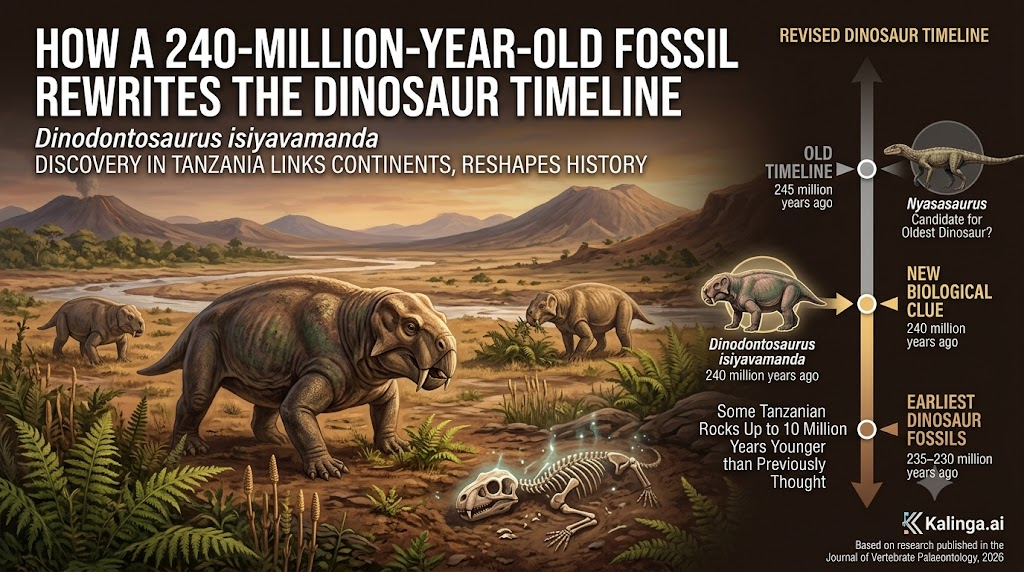
That is roughly what is happening with a key set of Triassic rocks in Tanzania. The newly identified Dinodontosaurus isiyavamanda gives researchers a new way to compare those rocks with fossil-bearing deposits in South America, potentially changing how scientists interpret fossils previously proposed as among the earliest dinosaurs.
The fossil itself is not a dinosaur. It belonged to a group of plant-eating synapsids called dicynodonts, which were part of the mammal lineage rather than the dinosaur lineage. But its importance comes from where it was found and what its presence tells researchers about the age of the rocks surrounding it.
Definition + Expansion: What is the dinosaur timeline?
The dinosaur timeline is the sequence scientists use to reconstruct when dinosaurs originated, diversified and became dominant in Earth’s ecosystems.
Scientists build that timeline using fossils, rock layers, radiometric dating and comparisons between organisms found in different geological deposits. Because the fossil record is incomplete, discovering a species in a new location can sometimes change how individual rock formations are correlated and dated.
In this case, Dinodontosaurus provides an important biological connection between Tanzania and South America.
Question → Direct Answer: Did scientists discover a new dinosaur?
No. Dinodontosaurus isiyavamanda was a dicynodont, an extinct plant-eating synapsid and distant relative of mammals. Its importance to the dinosaur timeline comes from its ability to help researchers correlate fossil-bearing rocks and reassess the age of deposits containing potential early dinosaur fossils.
That distinction is crucial.
The discovery changes the context surrounding some of the oldest possible dinosaur evidence rather than adding another dinosaur to the earliest dinosaur record.
What Is Dinodontosaurus isiyavamanda?
Dinodontosaurus isiyavamanda was a previously unknown species that lived in what is now Tanzania approximately 240 million years ago, during the Triassic Period.
Researchers identified the animal from Tanzanian fossil material that included an associated skeleton and a more recently discovered fragmentary skull. Anatomical analysis showed that the specimens belonged to the genus Dinodontosaurus, which had previously been confirmed only in South America.
That geographical discovery is what makes the species particularly useful to paleontologists.
The researchers named the species Dinodontosaurus isiyavamanda. The species name refers to the land of the Wamanda people, who inhabit the area of Tanzania where the fossils were discovered.
A plant-eating animal from the Triassic
The animal belonged to the dicynodonts, a group of herbivorous synapsids that existed long before modern mammals appeared.
Dicynodonts were not dinosaurs. They were part of a separate branch of the vertebrate evolutionary tree, but their fossils are extremely useful for reconstructing ancient ecosystems and correlating geological formations.
The newly described species therefore gives scientists two pieces of information at once:
- Biological information: a previously unknown dicynodont species lived in Tanzania.
- Geological information: the presence of its genus provides a way to compare Tanzanian rocks with deposits elsewhere.
That second point is what connects this fossil to the broader dinosaur timeline.
Question → Direct Answer: Why does a non-dinosaur fossil affect dinosaur research?
Because fossils can help scientists determine whether rock formations in different regions are approximately the same age. Dinodontosaurus is now known from Tanzania and South America, giving researchers a new biological marker for comparing those fossil-bearing sequences.
The 1963 Fossil Discovery That Started the Story
The story of this fossil is almost as remarkable as its age.
In 1963, a British expedition collected a large collection of synapsid fossils from what is now Tanzania. The material was eventually housed at the Natural History Museum in London. While some specimens were studied, others remained only partially investigated for decades.
One of those specimens was the dicynodont skeleton that eventually became part of the new study.
This means the discovery was not simply a matter of scientists walking into the field and uncovering an entirely new fossil yesterday. Instead, researchers returned to material that had already been collected and preserved.
That is an important lesson about how paleontology works.
A discovery decades in the making
Nigel Larkin, a co-author of the study and Visiting Research Fellow at the University of Reading, had examined the skeleton during his 1994 MSc thesis at University College London.
According to the University of Bristol, Larkin had already concluded that the specimen appeared to represent a species new to science. But the formal research and publication process took almost three decades.
Modern technology eventually helped researchers investigate the fossil in much greater detail.
The team could use techniques such as micro-CT scanning to examine fossil anatomy in ways that were not available to researchers working on the specimen in the 1990s. International collaboration also made it easier to combine expertise from multiple institutions.
Question → Direct Answer: How long was the Tanzanian fossil in museum collections?
The Natural History Museum in London had the specimen for more than 60 years before its identity was formally brought to light through the new research.
That makes the fossil a striking example of why museum collections are scientific resources, not simply historical archives.
How One Fossil Links Tanzania and South America
This is the central scientific development behind the revised dinosaur timeline.
Before this discovery, Dinodontosaurus was known from South America. Finding the same genus in Tanzania gives scientists a new connection between fossil-bearing geological sequences on two continents.
Why does that matter?
Scientists often use fossils to correlate rocks. If the same species or genus appears in two geographically separated locations, researchers can investigate whether the deposits formed during similar periods.
The new Tanzanian fossil therefore acts as a biological clue.
From fossil identification to geological correlation
The Tanzanian rocks containing Dinodontosaurus isiyavamanda are also the rocks that have produced fossils proposed to represent some of the oldest potential dinosaurs.
Those deposits had previously been compared with South African rocks partly because some fossil genera appeared to overlap.
But the new Dinodontosaurus evidence provides a different connection.
The University of Bristol reports that the genus’s presence in Tanzania and South America indicates that the corresponding fossil-bearing sequences are equivalent in age. New radiometric dates from South America suggest those early dinosaur-bearing sequences may be up to 10 million years younger than comparable South African rocks.
This is why the fossil can influence the broader dinosaur timeline without being a dinosaur itself.
Question → Direct Answer: How can one animal change the age assigned to rocks?
A fossil can act as a correlation tool. If the same genus occurs in geographically separated deposits whose ages can be independently constrained, its presence can help scientists determine which rock sequences are likely equivalent in age.
Why the Dinosaur Timeline Is Being Revised
The new study does not simply say, “Dinosaurs appeared later.”
The more precise conclusion is that some Tanzanian fossils previously considered candidates for the earliest dinosaurs may no longer represent rocks as old as previously assumed.
The University of Bristol says the new evidence supports a younger age for the alleged oldest dinosaurs in Tanzania and prompts a reassessment of when and where dinosaurs first evolved.
The distinction matters because determining the age of a fossil depends partly on determining the age of the geological layer in which it occurs.
If the rock layer turns out to be younger, then the fossil cannot automatically be used as evidence for an earlier point in evolutionary history.
The dating problem in simple terms
Think of a fossil as a photograph with an uncertain date.
Scientists can study the animal itself, but they also need to establish when the surrounding geological layer formed. If new evidence changes the estimated age of that layer, the historical position of the fossil can shift too.
For early dinosaurs, even a difference of several million years can significantly affect interpretations of their origin and diversification.
| Evidence | What it tells scientists | Why it matters |
| Dinodontosaurus isiyavamanda | A new dicynodont species lived in Tanzania | Adds a new fossil marker |
| Dinodontosaurus in South America | The genus existed on both continents | Links fossil-bearing sequences |
| Radiometric dating | Provides numerical age constraints | Helps test geological correlations |
| Tanzanian dinosaur candidates | Fossils previously associated with very early dinosaurs | Their geological age may need reassessment |
| Museum specimens | Previously collected fossils can contain new information | Old collections can refine modern research |
Question → Direct Answer: Does the discovery give an exact new date for the origin of dinosaurs?
No. It provides evidence that some Tanzanian rocks associated with the oldest potential dinosaur fossils may be younger than previously thought. The study therefore helps refine the timeline rather than supplying a single definitive new date for dinosaur origins.
That is a much more accurate interpretation of the research.
What Are Dicynodonts and Synapsids?
To understand why this fossil matters, it helps to know what kind of animal Dinodontosaurus actually was.
Synapsids are a major group of vertebrates that includes the evolutionary lineage leading toward mammals.
They were already diverse during the Triassic and earlier periods. Dinosaurs belonged to a different major branch of the vertebrate family tree.
Dicynodonts were a group within the synapsids. Many were herbivorous, and their fossil remains are particularly useful for understanding terrestrial ecosystems during the Triassic.
The newly described Dinodontosaurus isiyavamanda therefore gives researchers a window into an ecosystem that existed around 240 million years ago, at a time when dinosaurs were still in the early stages of their evolutionary history.
Why the animal’s identity matters
If researchers had simply found an unidentified fragment of bone, its usefulness for geological correlation might have been limited.
But identifying the material as Dinodontosaurus connects it to specimens from another continent.
That makes taxonomy , the scientific classification of organisms , an important part of geological dating and reconstruction.
Question → Direct Answer: Was Dinodontosaurus a dinosaur?
No. It was a plant-eating dicynodont synapsid, meaning it belonged to the mammal-lineage side of vertebrate evolution rather than the dinosaur lineage.
That is precisely why the discovery is such an interesting indirect clue about dinosaurs.
Why Museum Fossils Can Transform Science
One of the clearest lessons from this research is that a scientific discovery does not always begin with a brand-new excavation.
Sometimes, the answer is already sitting inside a collection.
The Tanzanian Dinodontosaurus material had been preserved at the Natural History Museum in London for over six decades. Researchers revisited it using modern anatomical methods and combined it with a more recently discovered fragmentary skull.
This kind of work can be especially valuable because museum collections preserve specimens from locations that may be difficult to revisit.
What modern technology adds
Earlier researchers often had to rely heavily on external anatomy and physical preparation.
Modern imaging can reveal internal structures without requiring researchers to destroy or extensively alter a specimen. In this project, advances including micro-CT scanning helped researchers examine fossil anatomy more thoroughly than would have been possible decades ago.
Museum collections can therefore become more scientifically valuable over time as analytical technology improves.
The specimen itself does not change.
Our ability to study it does.
Question → Direct Answer: Why are old museum fossils still important?
Because improved imaging, classification methods and geological dating can reveal information that earlier researchers could not access. A fossil collected decades ago can therefore contribute to new scientific conclusions many years later.
For students interested in science careers, that is an important reminder: discovery can involve excavation, laboratory analysis, computation, imaging, curation and reanalysis of existing evidence.
What Researchers Will Study Next
The new species is only the beginning.
The research team says a substantial amount of the Tanzanian Dinodontosaurus material remains to be fully studied, particularly the postcranial skeleton , the bones of the body other than the skull.
Researchers plan to compare these remains with Dinodontosaurus specimens from South America.
That could reveal more about how the species varied across regions and how these animals lived during the Triassic.
Future research questions
The researchers also plan to investigate the biomechanics of Dinodontosaurus and related dicynodonts.
That could help answer questions such as:
- How did these large herbivores move?
- How did their bodies function mechanically?
- How did several large herbivorous species coexist?
- What did Triassic ecosystems look like before dinosaurs became dominant?
- How closely can fossil-bearing rock sequences from different continents be correlated?
These questions extend beyond simply naming a new species.
They could help reconstruct an entire ecosystem.
Question → Direct Answer: What happens next with the fossil?
Researchers will continue studying the remaining anatomy, compare the Tanzanian material with South American specimens and investigate the biomechanics and ecology of Dinodontosaurus and related dicynodonts.
What This Discovery Does , and Does Not , Prove
Science becomes clearer when exciting findings are separated from what the evidence actually establishes.
The study, published in the Journal of Vertebrate Palaeontology on September 15, 2026, describes the new species and presents evidence supporting a younger age for the rocks associated with the alleged oldest dinosaurs in Tanzania.
What the research supports
The evidence indicates that:
- Dinodontosaurus isiyavamanda is a new species from Tanzania.
- The animal lived approximately 240 million years ago during the Triassic.
- Dinodontosaurus was previously known from South America.
- The Tanzanian discovery creates a new correlation between African and South American fossil deposits.
- New South American radiometric dates suggest relevant dinosaur-bearing sequences may be up to 10 million years younger than comparable South African rocks.
- Some Tanzanian fossils previously regarded as potential evidence of the oldest dinosaurs may therefore need to be reassessed.
What remains uncertain
The research does not establish:
- A single definitive location where the first dinosaurs evolved.
- An exact date for the origin of dinosaurs.
- That the newly discovered species was itself a dinosaur.
- That every existing interpretation of early dinosaur fossils is incorrect.
- That the entire early dinosaur record must be discarded.
Instead, the study provides new evidence for refining geological correlations and the chronology of early dinosaur evolution.
That distinction is especially important when headlines use phrases such as “rewrites history.”
In scientific research, rewriting a timeline usually means updating a model as new evidence changes the available constraints, not replacing everything scientists previously knew.
Why the Discovery Is Bigger Than One Fossil
At first glance, Dinodontosaurus isiyavamanda might seem like another entry in an enormous list of extinct species.
It is much more interesting than that.
The fossil demonstrates how taxonomy, geology, radiometric dating, museum collections and modern imaging can work together to change our understanding of evolutionary history.
It also highlights how interconnected Earth’s ancient ecosystems were.
The fact that a member of the Dinodontosaurus genus is now confirmed in both South America and eastern Africa provides evidence of biological connections across regions that were part of a very different global landscape during the Triassic.
At the same time, the finding reminds us that the early history of dinosaurs remains an active scientific question.
The oldest potential dinosaur fossils mentioned by the University of Bristol include Nyasasaurus and the silesaur Asilisaurus. Their interpretation depends partly on the geological context in which they are found, which is why accurately establishing the age of the rocks is so important.
Question → Direct Answer: Why does the age of the rocks matter so much?
Because a fossil’s significance depends not only on what organism it represents but also on when that organism lived. If the surrounding rocks are younger than previously believed, the fossil’s position in evolutionary history can change accordingly.
FAQ: 240-Million-Year-Old Fossil and the Dinosaur Timeline
What is Dinodontosaurus isiyavamanda?
Dinodontosaurus isiyavamanda is a newly described plant-eating dicynodont species from Tanzania that lived approximately 240 million years ago during the Triassic Period. It is a synapsid rather than a dinosaur.
Did scientists discover the world’s oldest dinosaur?
No. The discovery is not itself a dinosaur fossil. Instead, Dinodontosaurus isiyavamanda helps researchers correlate Tanzanian and South American geological deposits, providing evidence that some Tanzanian rocks associated with potential early dinosaur fossils may be younger than previously believed.
Why does the fossil affect the dinosaur timeline?
The genus Dinodontosaurus was previously known from South America. Finding it in Tanzania provides a new connection between fossil-bearing sequences on the two continents and supports reassessing the age of Tanzanian rocks containing some of the oldest potential dinosaur fossils.
How old is the new fossil?
The animal lived approximately 240 million years ago, during the Triassic Period. The study was published online ahead of print on September 15, 2026, in the Journal of Vertebrate Palaeontology.
Was Dinodontosaurus related to mammals?
Yes. Dicynodonts were synapsids, meaning they belonged to the broad evolutionary lineage that ultimately includes mammals. They were not dinosaurs, although they lived alongside early dinosaur relatives and other Triassic animals.
Why are museum fossils important to paleontology?
Museum collections preserve specimens that can be reexamined when new technologies and scientific methods become available. In this case, a Tanzanian fossil collected more than 60 years ago became central to a new study that is helping researchers reassess the age of important Triassic deposits.
Conclusion: A Fossil Can Change More Than a Species List
The discovery of Dinodontosaurus isiyavamanda is a reminder that Earth’s evolutionary history is continually refined as scientists connect new evidence with old collections.
A 240-million-year-old fossil from Tanzania has provided a new link to South American fossils and strengthened the case that some rocks associated with the oldest potential dinosaurs are younger than previously thought.
The result is not a final answer to when dinosaurs first appeared. Instead, it is a more precise scientific story , one in which a fossil collected in 1963, examined with modern tools decades later, can help reshape our understanding of the Triassic world.
For more science and technology stories explained in a clear, accessible way, explore Kalinga.ai’s latest research coverage and keep following how new evidence changes what we know.