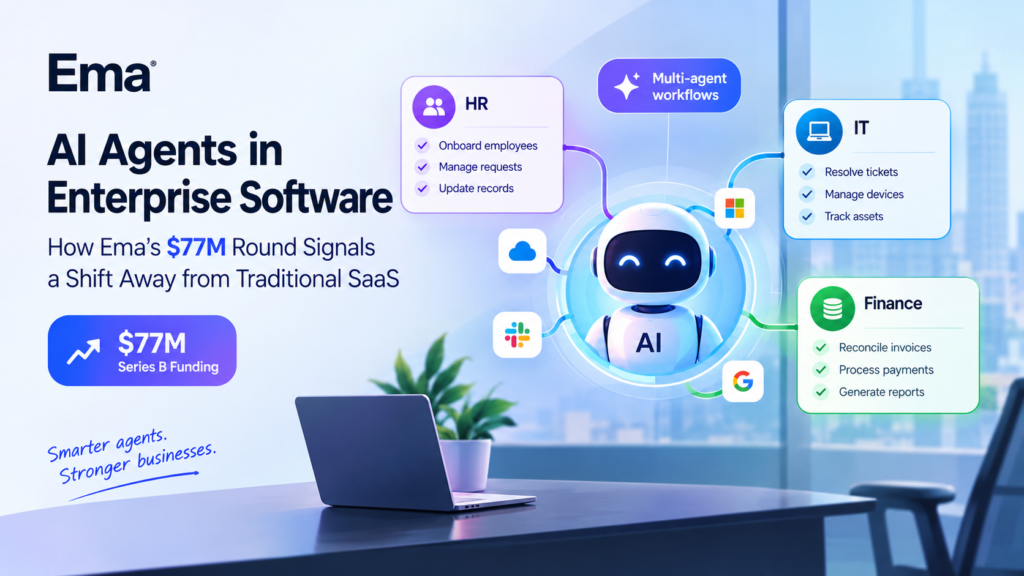
AI agents in enterprise software are no longer a side experiment, they’re starting to replace the tools businesses have relied on for decades. That shift just got a major real-world validation: Ema, a startup that runs teams of AI agents across HR, IT, and finance, has raised $77 million in a Series B round, taking its total funding to $140 million and more than quadrupling its valuation since 2024.
This isn’t just another funding headline. It’s a signal of where enterprise technology spending is heading, and it has implications for every business, from Silicon Valley giants to growing companies in India, that budgets for software, IT services, and digital transformation.
What Are AI Agents in Enterprise Software?
AI agents in enterprise software are autonomous or semi-autonomous systems that plan, execute, and complete multi-step business tasks across a company’s existing applications, without a human manually operating each step.
Unlike a traditional chatbot or a single-purpose automation script, an AI agent can:
- Understand a business goal (“onboard this new employee” or “reconcile this month’s invoices”)
- Break that goal into a sequence of actions
- Interact with multiple software systems to carry out those actions
- Adjust its approach if something doesn’t go as expected
Ema calls its version of this concept “AI employees”, a term meant to convey that these systems don’t just automate a single click-and-response task, they coordinate several specialized AI agents to handle an entire workflow, the way a human employee would move across systems to get a job done. This is the essence of what the industry now calls agentic AI: software that acts with a degree of independence, rather than waiting for a human to trigger every step.
The distinction matters because it changes what companies are willing to pay for. A tool that automates one task is a feature. A system that can replace an entire workflow, and the software licenses tied to it, is a budget line item.
Why Ema’s $77 Million Raise Matters
The Funding Details
Ema’s Series B was led by Bengaluru-based venture firm Creaegis, with existing backers Accel, Section 32, and Prosus all increasing their stakes. The round was composed entirely of primary equity, no debt, no secondary share sales, which typically signals strong investor confidence in future growth rather than a rescue or a partial cash-out for early stakeholders.
The company was founded in 2023 by Surojit Chatterjee, a former Google and Coinbase executive, and Souvik Sen, a former Okta executive. In under three years, it has grown to nearly 200 employees with offices in Mountain View, Bengaluru, London, and Vancouver.
Who’s Backing Ema, and Why It Matters
The customer list is arguably more telling than the funding number. Ema counts NTT DATA, Hitachi, ADP, PwC, Google, KPMG, Wipro, and Microsoft among its enterprise clients, a roster that spans consulting giants, cloud hyperscalers, and traditional IT services firms. That last category is notable: some of the very companies whose service revenue is theoretically threatened by AI agents in enterprise software are also becoming Ema’s customers, using the technology to restructure their own delivery models rather than compete against it.
Ema reports more than 50 active enterprise deals, over 1 million active users, and more than 5 million completed actions and queries. Revenue has reportedly grown 50-fold over two years, with bookings surpassing $150 million (a figure that reflects multi-year contract value rather than annual recurring revenue).
How AI Agents in Enterprise Software Are Disrupting Traditional SaaS
From Software Seats to Task-Based Outcomes
Traditional enterprise software is priced by seats or by usage tiers, you pay for a certain number of users, regardless of how much value each one extracts from the tool. Ema’s pricing model breaks from that entirely: it charges based on completed tasks and measurable business outcomes, not on the number of employees logged in or the volume of AI tokens consumed.
This outcome-based model is a preview of where AI agents in enterprise software could push the broader software industry. If a vendor can prove its agents completed X invoices, resolved Y support tickets, or onboarded Z employees, it can charge for that result directly, bypassing the seat-based model that has defined SaaS pricing for twenty years.
AI Employees vs. Point Automation Tools
Older-generation automation tools (think robotic process automation, or RPA) were built to handle narrow, repetitive tasks within a single system. AI agents in enterprise software go further: they operate across multiple applications, adapt when a process doesn’t follow the expected script, and, critically, reduce a company’s day-to-day dependence on the underlying SaaS product itself.
Chatterjee has described this as Ema first “wrapping” around a company’s existing software stack, and over time, some customers reducing or eliminating their dependence on the underlying applications, which start to function more like a database than an active tool employees log into. That’s a direct threat to the SaaS business model, which depends on ongoing, active user engagement to justify renewal pricing.
AI Agents vs. Traditional Enterprise Software: A Side-by-Side Comparison
| Factor | Traditional Enterprise Software | AI Agents in Enterprise Software |
| Pricing model | Per-seat or per-user license | Task- or outcome-based pricing |
| Scope of work | Single application, single function | Cross-application, multi-step workflows |
| Human involvement | Manual data entry and navigation | Agents execute; humans supervise exceptions |
| Adaptability | Fixed workflows, rule-based | Learns from deployments, adjusts dynamically |
| Vendor dependency | High, active daily engagement required | Existing apps can become passive data stores |
| Implementation | Often requires IT services/consulting partners | AI can absorb parts of implementation and integration work |
| Margin structure (vendor) | Varies by product | Ema reports gross margins near 80% |
The Bigger Trend: Frontier AI Labs Are Moving Into Enterprise Work Too
Ema’s raise doesn’t exist in isolation. It’s happening as the largest AI labs push further into the same enterprise territory.
Anthropic’s Enterprise Push
Anthropic has been expanding Claude’s presence inside companies’ core operations, including dedicated efforts in financial and legal workflows, domains that were previously the exclusive territory of specialized enterprise software vendors.
OpenAI’s Forward-Deployed Engineers
OpenAI has taken a services-oriented approach, building teams of forward-deployed engineers who embed directly with customers to get AI systems into production. This mirrors the traditional systems-integrator model, except the “integrator” is now the AI lab itself.
Notably, Ema’s founder doesn’t view these labs as direct competitors. Since Ema’s platform can draw on more than 150 underlying models, frontier and open-source alike, improvements from any single AI lab actually strengthen Ema’s own product rather than threatening it. Ema positions itself as the orchestration and domain-knowledge layer sitting on top of whichever models perform best, rather than trying to out-build the model providers themselves.
Benefits of AI Agents in Enterprise Software
For businesses evaluating whether to adopt this category of tools, the practical advantages tend to cluster around a few consistent themes:
- Lower total cost of ownership, outcome-based pricing can align spend with actual value delivered, rather than paying for unused software seats
- Cross-system workflow automation, a single agent-driven process can span HR, finance, and IT tools instead of requiring separate point solutions
- Reduced reliance on IT services firms, some implementation, integration, and consulting work can be absorbed by the AI system itself
- Faster expansion within existing accounts, Ema reports that more than 90% of its customers expand beyond their initial use case, with a net dollar retention rate around 180%
- Continuous improvement, agents that learn from live deployments require less ongoing human support over time, which also improves vendor margins
Challenges and Open Questions
Adoption of AI agents in enterprise software isn’t without friction. Companies still need to think through:
- Governance and oversight, who is accountable when an autonomous agent makes an incorrect decision across a multi-step process?
- Data security and access control, agents that touch multiple systems need carefully scoped permissions
- Vendor lock-in in a new form, outcome-based pricing sounds flexible, but switching agent providers after deep workflow integration may not be simple
- Workforce transition, both internal teams and external IT services providers are being asked to rethink roles as AI absorbs more execution work
What This Means for Businesses in India
Ema’s expansion plans specifically call out Asia-Pacific as a target region for the next phase of growth, and the company already has an engineering base in Bengaluru. For Indian enterprises, IT services firms, and the broader tech ecosystem, this is a preview of a trend that will likely accelerate locally: companies that once outsourced multi-step business processes to services providers may increasingly evaluate AI agents in enterprise software as a direct alternative, or as a tool their own services partners use to deliver work more efficiently.
Frequently Asked Questions
What are AI agents in enterprise software?
They are autonomous systems that plan and execute multi-step business tasks across a company’s existing applications, rather than handling one isolated action at a time.
How much did Ema raise, and what is it used for?
Ema raised $77 million in a Series B round, bringing total funding to $140 million; the capital will primarily fund expansion of sales and marketing after several years focused on product development.
Do AI agents replace enterprise software entirely?
Not immediately. Most deployments “wrap” around existing applications first; full replacement happens gradually as companies grow comfortable reducing their dependence on the underlying software.
Are frontier AI labs like Anthropic and OpenAI competitors to companies like Ema?
Not necessarily. Ema’s leadership frames model providers as complementary, better underlying models improve Ema’s own orchestration layer rather than displacing it.
Is AI agent pricing cheaper than traditional SaaS?
It depends on usage patterns. Task- or outcome-based pricing can lower costs for companies with variable or high-volume workflows, but it requires careful evaluation against seat-based alternatives.
Conclusion
Ema’s $77 million raise is a concrete data point in a much larger shift: AI agents in enterprise software are beginning to compete directly for budget that has historically gone to SaaS licenses and IT services contracts. With backing from major investors, a fast-growing customer base that includes some of the world’s largest companies, and a pricing model built around outcomes rather than seats, Ema represents an early, well-funded example of where enterprise technology spending is headed. Businesses, particularly in fast-growing markets like India, should start evaluating where agentic AI could realistically absorb existing software and services spend, rather than treating it as a future consideration.