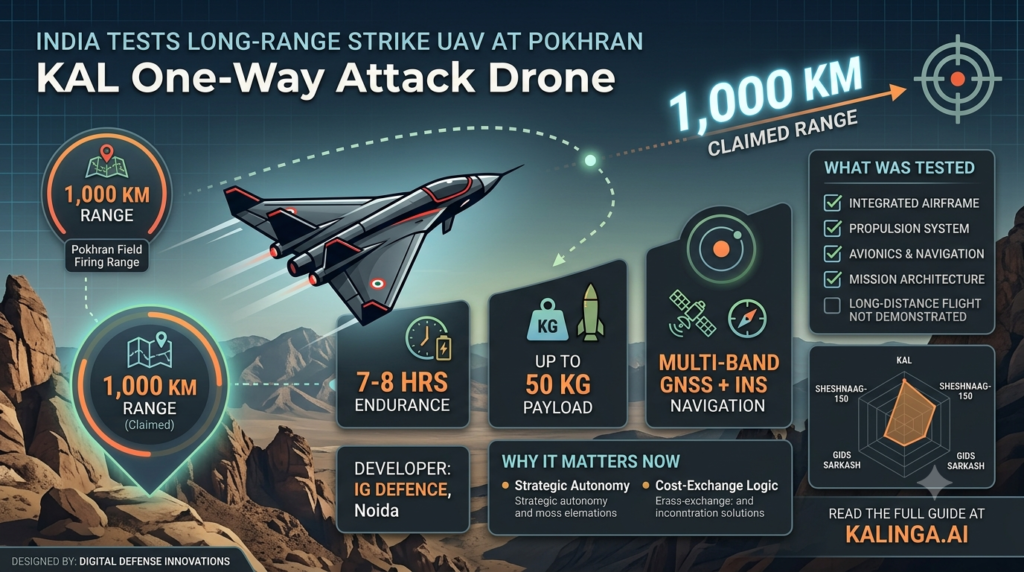
Noida-based IG Defence has completed a trial of its KAL one-way attack drone at the Pokhran Field Firing Range in Rajasthan, and the company says the platform can strike targets up to 1,000 km away. The trial, reported on 21 September 2026, checked how the airframe, propulsion, avionics, navigation and mission systems work together, but the company has not disclosed how far or how long the drone flew.
That gap between a headline range and a demonstrated flight is the most important thing to understand about this story. The KAL one-way attack drone is a notable step for privately built Indian long-range strike hardware, yet it is an early validation milestone, not proof of operational service. This guide explains what was tested, what the published numbers mean, how KAL compares with similar systems, and which questions are still open.
Key Facts at a Glance
- Developer: IG Defence, a private aerospace and defence manufacturer based in Noida.
- Trial site: Pokhran Field Firing Range, Rajasthan.
- Reported date: Coverage appeared on 21 September 2026. The exact trial date was not given in the reports reviewed.
- Launch method in the trial: A vehicle-mounted platform.
- Claimed range: Up to 1,000 km.
- Claimed endurance and payload: Seven to eight hours of flight and up to 50 kg of payload.
- Navigation: Multi-band GNSS combined with an inertial navigation system.
- Not disclosed: The distance and duration actually flown during the trial.
What Is the KAL One-Way Attack Drone?
Definition: One-Way Attack Drone
A one-way attack drone is an unmanned aircraft built to fly to a designated target and strike it without returning to base. It is often called a kamikaze drone or a loitering munition, although “loitering” strictly describes the subset that can circle an area and wait for a target to appear. The aircraft is expendable by design, which is why unit cost, rather than survivability, is the central engineering trade-off in this category.
Expansion: What Makes KAL Different
The KAL one-way attack drone is IG Defence‘s entry at the long-range end of that category. India TV News reports that the company describes it as designed for precision engagement of designated targets, including infrastructure, radar installations and air-defence systems, subject to mission configuration and applicable operational authorisations. The same report says the platform was developed indigenously across its major systems. That claim matters to anyone who cares about supply-chain independence, although the coverage does not break down which individual components are made in India.
Who Is Behind It?
IG Defence is a private company based in Noida. NewsBytes reports that its founder and chief executive, Bodhisattwa Sanghapriya, stressed the value of long-range one-way attack drones for precision strike and air-defence operations, especially in light of recent conflicts. His argument reflects a wider shift in how militaries think about cheap, expendable strike aircraft, a point covered later in this guide.
What Happened at the Pokhran Trial?
Where Was KAL Tested?
KAL was tested at the Pokhran Field Firing Range in Rajasthan. Pokhran is one of India’s best-known military test ranges, and other Indian unmanned systems have been evaluated there. According to Wikipedia’s entry on the Rudrastra hybrid VTOL UAV, for example, the Indian Army ran multiple trials of that system at Pokhran on 11 June 2025.
How Was the Drone Launched?
NewsBytes reports that the test was carried out from a vehicle-mounted platform. Vehicle launch is generally attractive for this class of aircraft because a mobile launcher can move and relocate without fixed infrastructure, though the reports do not describe the launcher itself.
What Did the Trial Validate?
IG Defence describes the Pokhran trial as a validation milestone for the integrated airframe, propulsion, avionics, navigation and mission architecture, according to India TV News. In plain terms, the test was about proving that the major subsystems function together as one aircraft. It was not presented as a full-range mission.
What Was Not Disclosed?
NewsBytes notes that the company did not reveal the distance or duration of the flight in this trial. In the coverage reviewed, there was also no published telemetry, no target-engagement result and no production schedule. Readers should treat the 1,000-km figure as a design specification rather than a demonstrated result.
KAL Specifications: What the Reports Say
The table below collects the figures that appear in press coverage of the IG Defence announcement. Every number originates with the company or with secondary reports citing company specifications, and none has been independently verified.
| Parameter | Reported value | Reporting note |
| Range | Up to 1,000 km | Company claim, reported by India TV News and NewsBytes |
| Endurance | 7 to 8 hours | Reported by NewsBytes |
| Payload | Up to 50 kg | Reported by NewsBytes |
| Operating altitude | Up to 5,000 m above mean sea level | Reported by NewsBytes |
| Maximum take-off weight | About 200 kg | Secondary reports citing company specifications |
| Warhead | 50 kg high-explosive | Secondary reports citing company specifications |
| Cruise speed | 160 to 200 km/h | Secondary reports citing company specifications |
| Navigation | Multi-band GNSS plus inertial navigation | Reported by India TV News |
| Trial launch method | Vehicle-mounted platform | Reported by NewsBytes |
Do the Numbers Add Up?
Broadly, yes. At the reported cruise speeds of 160 to 200 km/h, seven hours in the air equals roughly 1,100 to 1,400 km of distance, so a 1,000-km range is consistent with the reported endurance. This is only a plausibility check based on simple arithmetic. Real-world range depends on wind, payload, altitude and flight profile, and only a documented long-distance flight would confirm it.
How the KAL One-Way Attack Drone Navigates and Strikes
How Does KAL Find Its Way?
Direct answer: KAL combines multi-band Global Navigation Satellite System (GNSS) signals with an inertial navigation system (INS) to fly autonomously through its mission profile, according to India TV News.
Expansion: GNSS gives the aircraft its position from satellites, while an INS estimates position from onboard motion sensors and keeps working when satellite signals are weak or unavailable. Using several GNSS frequency bands gives the receiver more signal options. Secondary reports describe the combination as jam-resistant, but that is a manufacturer-style claim that the coverage does not support with test data.
What Can It Target?
The company lists infrastructure, radar installations, air-defence systems and other strategic targets as intended categories, all subject to mission configuration and operational authorisations. Secondary reports from IndianMasterminds and Defence.in, both citing company specifications, put the warhead at 50 kg of high-explosive. The reports do not explain how targets are assigned or confirmed, which is a meaningful omission for anyone assessing how the system would actually be used.
How Does GRID STRIKE Fit In?
Direct answer: KAL is planned to operate within IG Defence’s GRID STRIKE weapons portfolio and to integrate with the company’s GRID Battle Management System.
Expansion: Defence.in describes GRID as an artificial intelligence-powered network that helps commanders coordinate unmanned weapons. The battle-management layer matters as much as the airframe. A single drone is a munition, while a coordinated group of drones tied to a common picture of the battlefield is a capability. The coverage does not say how many aircraft the system can coordinate at once or how it has been tested.
Why One-Way Attack Drones Matter Now
What Changed in Modern Warfare?
India TV News frames KAL against the operational use of Iranian-origin Shahed-136 and Russian Geran-2 systems in the Russia-Ukraine war. That use showed how relatively low-cost unmanned platforms can deliver long-range strike, keep air-defence networks under sustained pressure and enable high-volume attacks. The lesson many defence planners took from it is that quantity and affordability can matter as much as sophistication.
Why Is India Building Its Own?
Direct answer: The stated motive is strategic autonomy. Defence.in reports that India has accelerated efforts to build scalable, long-range strike capabilities at home rather than depend on foreign suppliers.
Expansion: Timing supports that reading. Wikipedia’s entry on the Sheshnaag-150, a comparable Indian drone from a different company, says its development was fast-tracked after Operation Sindoor, when the startup’s leadership was summoned by the Indian military. Whether KAL followed a similar path is not stated in the coverage reviewed.
What Is the Cost-Exchange Logic?
The basic argument for one-way attack drones is economic. If an inexpensive aircraft forces a defender to spend costly interceptors or divert scarce assets, the attacker gains an advantage even when many drones are shot down. No reports on KAL give a unit cost, so this argument cannot yet be quantified for the platform. Unit cost and production rate are the two figures that will determine whether KAL is a niche demonstrator or a scalable capability.
How the KAL One-Way Attack Drone Compares With Other Long-Range Drones
The table below places KAL beside three other systems mentioned in the reporting. It draws on Wikipedia entries and press coverage that vary in depth and reliability, so treat it as a rough orientation rather than a technical benchmark. Where a source did not state a figure, the cell says so.
| Platform | Developer and country | Class | Reported mass | Reported range | Reported endurance | Warhead or payload |
| KAL | IG Defence, India | One-way attack | About 200 kg (take-off) | Up to 1,000 km | 7 to 8 hours | Up to 50 kg |
| Sheshnaag-150 | NewSpace Research and Technologies, India | One-way attack, swarming design | 150 kg | 1,000 km | 5 hours | 25 to 40 kg |
| GIDS Sarkash | Global Industrial Defence Solutions, Pakistan | One-way attack | 175 kg | 700 to 1,000 km | Not stated in source | Not stated in source |
| Rudrastra | Indian Army trials, India | Recoverable hybrid VTOL strike UAV | Not stated in source | Over 50 km mission radius demonstrated | Not stated in source | Precision strike role |
KAL vs Sheshnaag-150
Both are Indian, both are privately developed and both claim a 1,000-km class range. On the reported numbers, KAL is heavier and claims longer endurance, while Sheshnaag-150 is lighter with a smaller stated warhead range. Wikipedia describes Sheshnaag-150 as a swarming design intended for the Indian Army and Indian Air Force. KAL’s stated differentiator is its link to the GRID battle-management ecosystem. The existence of two private Indian programmes in the same class suggests a competitive domestic field rather than a single national solution.
KAL vs GIDS Sarkash
Wikipedia lists the Pakistani GIDS Sarkash as a long-range one-way attack drone with a mass of 175 kg and an effective firing range of 700 to 1,000 km. The similarity in class and range shows that long-range one-way attack drones are now a regional category rather than a single-country development. It also means that direct comparisons should be careful, because published figures from different countries and companies are rarely produced on the same basis.
KAL vs Rudrastra
Rudrastra is a different kind of aircraft. Wikipedia reports that in June 2025 Pokhran trials it flew a mission radius of more than 50 km with real-time video, then returned to its launch point. That recoverable design suits surveillance-and-strike tasks at shorter range. KAL trades recoverability for reach and warhead capacity, which is the core logic of a one-way system.
Strengths and Open Questions
What Looks Strong
- Range class: A claimed 1,000 km puts KAL in the long-range category alongside other regional programmes.
- Endurance consistent with range: The reported seven to eight hours matches the claimed distance at the reported cruise speed.
- Integrated navigation: Combining multi-band GNSS with inertial navigation is a sensible approach for autonomous flight when signals may be degraded.
- Ecosystem approach: Pairing the aircraft with a battle-management platform points toward coordinated use rather than a standalone munition.
- Indigenous development claim: IG Defence says major systems were developed in India, which, if borne out, supports supply-chain resilience.
What Remains Unanswered
- Demonstrated distance: The company did not disclose how far or how long the drone flew at Pokhran.
- Electronic resilience: Jam resistance is asserted in secondary coverage but not shown with test results.
- Guidance in the terminal phase: The reports describe navigation, not how a target is finally identified or confirmed.
- Cost and production: No unit price, production rate or timeline has been published.
- Customer: None of the coverage reviewed mentions an order, induction or user trial by an armed service.
- Independent verification: All performance figures come from the company or from reports citing company material.
What This Means for India’s Defence Manufacturing
The KAL trial is best read as a data point in a broader trend: private Indian firms are building long-range unmanned strike systems, not just small surveillance drones. With IG Defence and NewSpace Research and Technologies both publicly working in the 1,000-km class, the domestic market is developing multiple suppliers. That competition can speed up iteration, but it also raises questions about standardisation, testing rigour and how the armed forces will evaluate competing claims.
For policymakers and buyers, the practical next steps are unglamorous. Long-distance flight demonstrations, repeatable accuracy testing, electronic-warfare trials and cost-per-unit disclosure are the milestones that convert a trial announcement into a procurement candidate. A Pokhran trial shows a system works as an integrated aircraft. It does not, on its own, show that it is ready to be fielded.
Legal, Ethical and Policy Questions
Long-range autonomous strike systems draw scrutiny beyond engineering. Supporters argue that such systems give states affordable deterrence and reduce reliance on crewed aircraft in high-risk missions. Critics argue that cheap, long-range munitions lower the threshold for using force and can raise the risk of escalation, particularly between neighbouring states with tense histories.
Reports on KAL describe autonomous navigation. They do not describe how much human control exists over target selection or engagement. That distinction is central to international humanitarian law, which requires attackers to distinguish military targets from civilians and to weigh expected harm against military advantage. The company itself says employment is subject to applicable operational authorisations, but the coverage does not explain what those authorisations involve. Anyone following this space should watch for how India’s armed forces and government describe human oversight as these systems mature.
India Angle: Skills and Careers Behind the Headline
For students and early-career professionals in India, stories like this one point to a set of technical skills that sit beneath the defence label. Many of them are useful across aerospace, robotics, logistics and autonomous vehicles as well:
- Embedded systems and avionics: Flight controllers, sensors and real-time software.
- Navigation and sensor fusion: GNSS receivers, inertial sensors and the algorithms that combine them.
- Radio-frequency and communications engineering: Secure links and resilience against interference.
- Computer vision and autonomy: Perception and decision-making on constrained hardware.
- Systems integration and testing: Bringing airframe, propulsion, electronics and software together, which is exactly what the Pokhran trial was designed to check.
- Software for command and control: Platforms that coordinate many unmanned systems at once.
Defence work carries its own regulatory, security and ethical considerations, so anyone exploring it should look closely at the employer, the export and licensing rules involved and their own comfort with the end use. The underlying engineering skills, however, transfer widely.
Frequently Asked Questions
What is the KAL one-way attack drone?
The KAL one-way attack drone is a long-range unmanned strike aircraft developed by Noida-based IG Defence. It is designed to fly to a designated target and strike it without returning, and the company claims a range of up to 1,000 km.
Who developed KAL?
IG Defence, a private aerospace and defence manufacturer based in Noida, developed KAL. India TV News reports that the platform was developed indigenously across its major systems.
What is KAL’s claimed range?
IG Defence claims up to 1,000 km, along with seven to eight hours of endurance and up to 50 kg of payload, according to NewsBytes.
Did KAL fly 1,000 km during the Pokhran trial?
There is no public evidence that it did. NewsBytes reports that the company did not reveal the distance or duration of the trial flight, so the 1,000-km figure should be read as a design claim.
Where was KAL tested?
KAL was tested at the Pokhran Field Firing Range in Rajasthan, using a vehicle-mounted launch platform, according to NewsBytes.
How does KAL differ from the Sheshnaag-150?
Both are Indian one-way attack drones with a claimed 1,000-km range. Based on published figures, KAL is heavier with longer claimed endurance, while Sheshnaag-150 is described on Wikipedia as a 150 kg swarming design with a 25 to 40 kg warhead and about five hours of endurance.
Is KAL in service with the armed forces?
None of the reports reviewed mention an order, induction or user trial by the armed forces. The Pokhran trial is described as a validation milestone for the integrated design.
Conclusion
The KAL one-way attack drone trial at Pokhran is a real milestone for IG Defence and for India’s private defence sector, because it shows an integrated airframe, propulsion, avionics, navigation and mission system working together. It also shows how the category is spreading, with comparable programmes in India and in the wider region. But the most important facts are still missing. The company has not said how far the drone flew, how it performs against electronic interference, what it costs or who will buy it.
Until those details emerge, the sensible reading is measured: a credible design-validation step, backed by specifications that are plausible but unverified. Watch for long-range flight demonstrations, independent evaluations, production announcements and any statement on human oversight. Those will tell you far more than a headline range figure.
Want more clear, sourced explainers on technology, AI and innovation with an India lens? Explore the latest resources and coverage at Kalinga.ai.