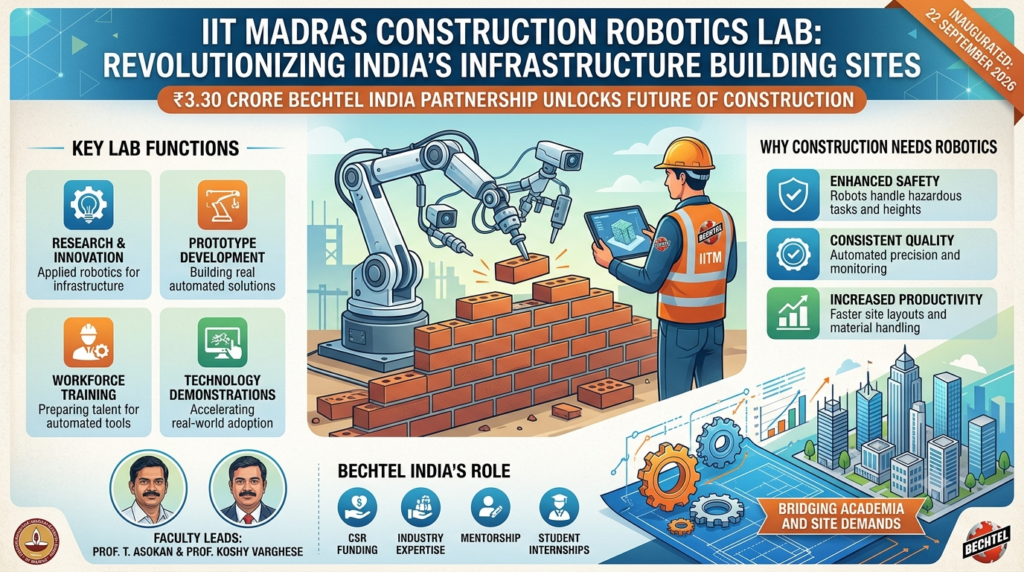
India’s building sites are getting a robotics upgrade, and it starts on a campus in Chennai. The IIT Madras construction robotics lab is a ₹3.30-crore facility, inaugurated on 22 September 2026 with CSR support from Bechtel India, to accelerate research, innovation and industry applications in robotics and automation for construction and infrastructure. In plain terms, it is a shared workspace where students, faculty and industry engineers turn real construction problems into automated solutions. Skilloutlook
This guide explains what the lab is, who is behind it, what it will work on, and why it matters if you are a student, an engineer, a JEE aspirant, or someone who builds things for a living. Each section is written to stand on its own, so you can jump straight to the part you need.
Quick Facts at a Glance
If you only have thirty seconds, here is the short version:
- What: A construction robotics and automation research laboratory at IIT Madras, Chennai.
- Cost: ₹3.30 crore.
- Funding model: Corporate Social Responsibility (CSR) support from Bechtel India Private Limited.
- Inauguration date: 22 September 2026.
- Focus areas: Research, prototype development, workforce training and technology demonstrations for construction and infrastructure. Sahyadri Startups
- Faculty leads: Prof. T. Asokan and Prof. Koshy Varghese.
- Industry partner: Bechtel India, part of the global Bechtel group, an engineering, construction, procurement and project management company.
- Bigger goal: Narrow the gap between academic research and what construction sites need.
What Is the IIT Madras Construction Robotics Lab?
Definition: The IIT Madras construction robotics lab is a dedicated research and prototyping facility on the IIT Madras campus where robotics and automation technologies are developed, tested and demonstrated for construction and infrastructure work.
Expansion: Unlike a general-purpose robotics lab, this one is built around a single industry. The problems it tackles come from construction: repetitive site tasks, hazardous environments, tight schedules, and worksites that change every day. The lab gives researchers a place to build prototypes, and gives industry partners a place to see whether those prototypes could survive outside a demo.
The IIT Madras construction robotics lab also fits a longer story. IIT Madras has been building its robotics capacity for years, including a robotics research and teaching facility in its Department of Engineering Design, which an alumnus supported with a ₹1 crore donation in 2020. The new lab extends that foundation into a specific, high-impact application area.
Who Leads the Lab?
Short answer: Two IIT Madras professors, T. Asokan and Koshy Varghese, will lead it.
The memorandum of understanding (MoU) behind the partnership was signed by Prof. Ashwin Mahalingam, Dean (Alumni and Corporate Relations) at IIT Madras, along with faculty members Prof. T. Asokan and Prof. Koshy Varghese, and by Raja Yeluri, managing director, and Ravi Tata, robotics manager, from Bechtel India. Pairing faculty from different engineering backgrounds is sensible here, because construction robotics sits between mechanical design, automation and construction management. Skilloutlook
How Is the Lab Funded?
Definition: CSR, or Corporate Social Responsibility, refers to spending that companies direct toward social and developmental causes. Under Indian law, larger companies are required to spend a share of their profits on such activities, and education and research are eligible areas.
Expansion: In this case, Bechtel India is channelling its CSR contribution into a research facility rather than a one-off grant. The initiative sets up a long-term framework for collaboration between IIT Madras and Bechtel India. For readers wondering how the IIT Madras construction robotics lab will keep running after the ribbon-cutting, that framework is the answer: the relationship is designed to continue, not to end with the inauguration. Sahyadri Startups
Why Does Construction Need Robotics?
Question: Why is construction one of the last big industries to embrace automation?
Direct answer: Because construction sites are unpredictable. A factory floor is controlled and repetitive, so robots thrive there. A construction site changes daily, involves many trades working at once, and often differs from the last project. That makes it hard to drop in a robot that was built for a fixed environment.
Yet that same difficulty is why construction automation is attractive. Several long-standing pain points make a strong case for robotics:
Question: What problems can robotics realistically help with on a construction site?
Direct answer: Robots and automated systems are best suited to tasks that are repetitive, physically demanding, dangerous, or dependent on precision. Examples commonly explored across the industry include layout marking, drilling, material handling, inspection and progress monitoring, and repetitive finishing work.
Question: Will construction robotics replace workers?
Direct answer: The stated emphasis of this partnership is on building talent and adoption, not on replacing people. Bechtel India’s managing director described the aim as building the talent the industry will need over the coming decades. In practice, the more likely near-term outcome is a shift in skills: workers and engineers who can operate, supervise and maintain automated equipment become more valuable.
What Will the Lab Work On?
The facility has a broad but clear mandate. According to reports on the announcement, its activities span four areas:
- Research: Fundamental and applied work on robotics and automation for construction and infrastructure.
- Prototype development: Building working systems, not just papers.
- Workforce training: Preparing students, engineers and site professionals to work with automated tools.
- Technology demonstrations: Showing promising technologies to industry so they can move closer to deployment.
That last item matters more than it sounds. Many good research ideas stall in the gap between “it works in the lab” and “a contractor will trust it on a live project.” A dedicated demonstration function is designed to shrink that gap. Prof. Ashwin Mahalingam framed the partnership in exactly those terms, saying it will let IIT Madras tackle industry-relevant problems while creating chances to test, demonstrate and move technologies toward real-world use.
Definition: Construction Robotics vs. Construction Automation
These two terms are often used interchangeably, but they are not identical.
Construction robotics refers to physical machines, such as robotic arms, autonomous vehicles or drones, that perform tasks on a site or in prefabrication.
Construction automation is the broader category. It includes robotics but also covers software-driven processes, sensors, automated scheduling and monitoring, and machine-assisted design-to-build workflows.
The lab’s stated scope covers both robotics and automation, which suggests it will look at the full technology stack rather than just hardware.
What Does Bechtel India Bring to the Partnership?
Short answer: Money, industry problems, mentorship and career pathways.
Bechtel India is part of the global Bechtel group, a major engineering, construction, procurement and project management company. Beyond CSR funding, the reported terms say Bechtel India will contribute industry expertise to curriculum enhancement, mentor researchers and provide internship opportunities to students. Sahyadri Startups
That mix is what makes the arrangement more than a donation. Academic labs are strong at exploring ideas, while construction firms are strong at knowing which problems are costly, risky or slow. Bringing both into the same room is the core logic of any industry-academia partnership, and Bechtel India’s managing director described the lab as a shared space for students, faculty and industry engineers to convert real construction challenges into automated solutions.
Traditional Sites vs. Robotics-Assisted Sites: A Comparison
The table below is a general illustration of how robotics and automation can change day-to-day construction work. It is not a claim about specific results from this lab.
| Aspect | Traditional Construction | Robotics-Assisted Construction |
| Repetitive tasks | Performed manually, prone to fatigue | Handled by machines with consistent output |
| Precision | Depends on individual skill and manual checks | Guided by sensors and digital models |
| Worker safety | Workers exposed to hazardous tasks and heights | Robots can take on some dangerous work |
| Progress monitoring | Periodic manual inspection | Continuous data from drones and sensors |
| Skills required | Mostly manual and trade skills | Trade skills plus operation and supervision of automated systems |
| Adoption barrier | Low technology cost, high labour dependence | Higher upfront investment, needs training and trust |
| Data availability | Limited, often paper-based | Rich digital records for planning and audits |
How the Partnership Is Structured
Here is how responsibilities are divided, based on the reported terms.
| Contributor | Role in the Partnership |
| IIT Madras faculty (Asokan, Varghese) | Lead research, prototype development and lab operations |
| IIT Madras students | Conduct research, build prototypes, access internships |
| Bechtel India | CSR funding, industry expertise, mentoring, curriculum input, internships |
| Industry engineers | Bring real construction challenges and test technologies |
Why the IIT Madras Construction Robotics Lab Matters for India’s Infrastructure Push
Question: Why should anyone outside the campus care about this lab?
Direct answer: Because infrastructure is central to India’s growth, and construction productivity affects how fast and how safely that infrastructure gets built.
The IIT Madras construction robotics lab is small in rupee terms compared with a single large infrastructure project, but its potential leverage is large. If a lab can demonstrate one automation approach that a contractor adopts across many sites, the benefit compounds. The reported goal is exactly that: to contribute to the deployment of advanced construction technologies across India’s infrastructure ecosystem.
There is also a talent angle. The construction sector will need people who understand both engineering fundamentals and automated systems. A lab that trains students on real problems, with a major industry partner offering internships, creates a pipeline. This is why construction robotics in India is increasingly discussed as a workforce question as much as a technology one.
What It Means for Students and JEE Aspirants
Question: Does this lab matter if I am preparing for JEE?
Direct answer: Indirectly, yes. It signals where engineering careers are heading, and it shows the kind of research environment IIT Madras is building.
Admission to IIT undergraduate programmes runs through JEE Main and JEE Advanced, so the lab is not something you apply to directly. But if you are choosing a branch and an institute, the IIT Madras construction robotics lab is a useful data point: it shows that civil, mechanical, electrical, computer science and design students can all find a place in the same field. Construction robotics blends structures, control systems, machine learning and human-centred design.
A few practical points for aspirants and current students:
- Do not assume a specific access route. Reports describe research, training and internships, but the exact participation pathways, such as projects, electives or degree programmes, have not been detailed publicly. Check IIT Madras’s official channels for updates.
- Build fundamentals first. Mathematics, physics, programming and basic mechanics remain the foundation for any robotics work.
- Think interdisciplinary. Construction robotics rewards people who can talk to both software engineers and site engineers.
- Watch for internships. Bechtel India’s reported commitment to internships is the most concrete student-facing benefit announced so far.
What It Means for Construction Companies and Developers
If you work in the industry, the lab is worth watching for three reasons.
First, it is a testing ground. The lab is set up so promising technologies can be demonstrated and moved closer to deployment. Companies with specific site problems may find a research partner who understands both the engineering and the constraints.
Second, it is a talent source. Students trained on construction robotics problems, with internship exposure to a global contractor, are likely to be more prepared for industry than those trained on abstract exercises alone.
Third, it is a signal. When a global engineering and construction group funds robotics research in India, it suggests the sector sees automation as a serious long-term investment rather than a novelty.
Challenges and Realistic Expectations
It is worth being honest about what a single lab can and cannot do. Construction robotics faces real obstacles:
- Site variability: Every project is different, which complicates standardised robotic solutions.
- Cost and adoption: Upfront investment can be a hurdle, especially for smaller contractors.
- Skills gap: Workers and supervisors need training to use new tools effectively.
- Trust and regulation: New methods need to prove safety and reliability before being widely accepted.
None of these are reasons to dismiss the effort. They are the reasons a lab focused on demonstration and training is needed in the first place.
What to Watch Next
For anyone tracking the IIT Madras construction robotics lab, the useful signals over the next year or two will be concrete rather than rhetorical: the first prototypes announced, any pilot deployments on real sites, published research, student internship numbers, and additional industry partners joining. The reported long-term collaboration framework suggests these outputs should emerge over time rather than all at once.
Frequently Asked Questions
What is the IIT Madras construction robotics lab?
It is a ₹3.30-crore research and prototyping facility at IIT Madras focused on robotics and automation for construction and infrastructure, established with CSR support from Bechtel India.
When was the lab inaugurated?
It was inaugurated on 22 September 2026 at the IIT Madras campus in Chennai.
Who funded the lab?
Bechtel India Private Limited funded it through its CSR programme.
Who leads the lab?
IIT Madras professors T. Asokan and Koshy Varghese lead the lab.
What will the lab research?
It will cover robotics and automation for construction and infrastructure, including research, prototype development, workforce training and technology demonstrations.
Is Bechtel India only providing money?
No. Reported contributions also include industry expertise for curriculum enhancement, mentoring for researchers and internship opportunities for students.
Can JEE aspirants apply to work in the lab?
Not directly. Entry to IIT undergraduate programmes is through JEE Main and JEE Advanced, and specific ways for students to participate in the lab have not been detailed publicly.
Why does construction robotics matter for India?
Construction productivity, safety and skilled talent all affect how efficiently the country can build infrastructure, and robotics and automation are among the tools that could improve each of them.
Conclusion: A Small Lab With a Big Job
The bottom line is simple. The IIT Madras construction robotics lab is a purpose-built, industry-backed space designed to move construction robotics from concept to practice. Its strengths are a clear focus, experienced faculty leads, a long-term partnership with a global contractor, and an emphasis on training as well as technology.
Whether it delivers will depend on what comes out of it: working prototypes, field trials, skilled graduates and new collaborations. For now, it is a promising sign that construction robotics in India is being taken seriously by both academia and industry, and it is one worth following closely.