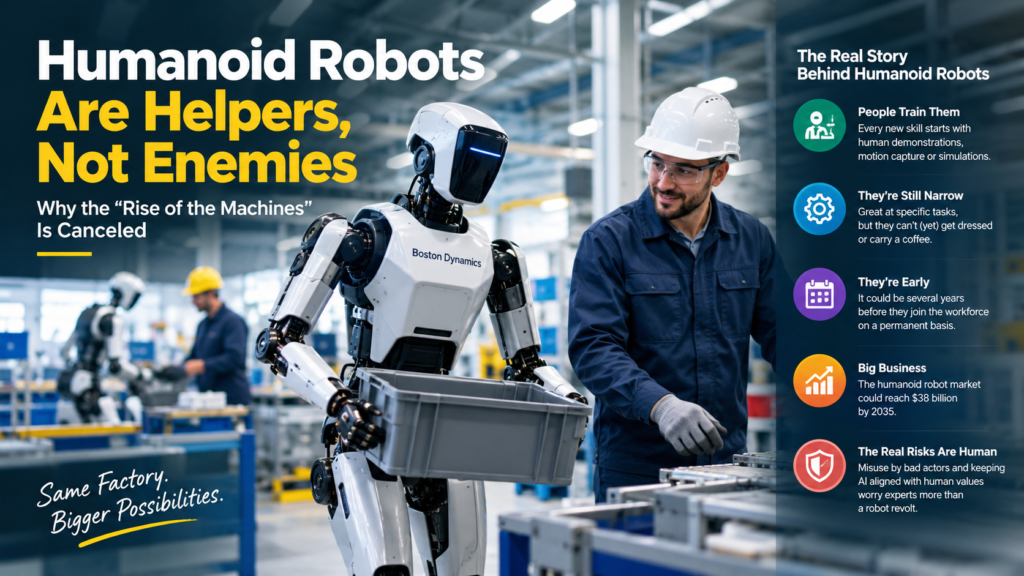
Humanoid robots are not heading toward a robot uprising. They are machines that people design, train, and maintain, and today they still struggle with chores as ordinary as carrying a cup of coffee. The clearest evidence comes from factory floors, where Boston Dynamics Atlas learns new skills from human demonstrations and works on tasks that people assign.
For decades, science fiction has told the opposite story. From killer-robot movies to breathless headlines about superhuman AI, the “rise of the machines” has become the default frame for any conversation about robotics. This guide separates the fiction from the facts. You will learn how humanoid robots actually learn, what they can and cannot do, where the real risks sit, and how to judge the next alarming (or overhyped) headline.
Source note: This article builds on a column in The Robot Report by Elena Krosheva, published October 17, 2026, and adds context from other industry reporting.
The Short Answer: Five Facts About the Rise of the Machines
These five facts summarize what the evidence says about whether humanoid robots are a threat or a tool:
- People train them. Every new skill begins with human demonstrations, motion capture, or simulations designed by engineers.
- They are still narrow. Atlas can sort roof racks for an assembly line, but it cannot get dressed or carry a coffee around a house.
- They are early. It could be several years before Atlas joins Hyundai’s workforce on a permanent basis.
- They are big business. Goldman Sachs has projected that the humanoid robot market could reach $38 billion by 2035.
- The real risks are human ones. Misuse by bad actors and keeping powerful AI aligned with human values worry AI leaders far more than a robot revolt.
What Are Humanoid Robots, and Why Are They Entering Factories Now?
Definition: What Is a Humanoid Robot?
A humanoid robot is a machine with a human-like body plan, usually a torso, two arms, two legs, and a head, built to work in spaces and with tools designed for people. Boston Dynamics Atlas, for example, stands about 175 cm (68.8 in.) tall and weighs roughly 90 kg (198.4 lb.).
The logic behind the form is practical. Factories, warehouses, and homes are full of stairs, shelves, handles, and workstations sized for human bodies. In theory, humanoid robots can step into those spaces without forcing companies to rebuild them around the machine.
A human shape is not always the best shape, though. The Robot Report’s earlier coverage of Skybot, a humanoid flown to the International Space Station, noted that the design proved awkward in the station’s tight confines. The lesson is simple: form should follow the job, and a humanoid body is a tool choice, not a destiny.
Why Now: How AI Changed the Equation
Human-like hardware is not new. Engineers have chased it for decades. What changed is the software.
In 2021, Atlas was a bulky hydraulic robot that could run and jump, and it relied on algorithms written by engineers. The next-generation Atlas has a sleek all-electric body and AI that runs on NVIDIA chips, which lets it perform complex movements on its own.
Scott Kindersma, who led robotics research at Boston Dynamics before moving to Google DeepMind, explains that modern robots master difficult movements mainly through demonstrations and machine learning rather than manual programming. That shift moved the field from lab stunts to real work. At Hyundai’s automotive plant, more than 1,000 robots already work alongside nearly 1,500 humans, and Atlas has left the lab to do real tasks there.
Why Do People Fear a “Rise of the Machines”?
People fear a rise of the machines because decades of fiction portrayed intelligent robots as inevitable rebels, and because real AI is advancing fast enough to make those stories feel plausible. Metal soldiers turning on their makers are easy to remember. The slow, technical work of teaching a robot to pick up an object is not.
The fear is not entirely irrational. Demis Hassabis, co-founder and CEO of Google DeepMind, has acknowledged that new capabilities may emerge as AI systems learn, and that such systems can do things beyond what their designers fully understand. Taking that seriously is responsible. The mistake is aiming the fear at the wrong target.
What the Fiction Gets Wrong
Fictional robots share three assumptions: they have goals of their own, they work flawlessly, and nobody is in charge. Real machines show the opposite pattern.
Today’s systems need engineers to build them, trainers to teach them, and technicians to maintain them. The Robot Report’s columnist argues that anyone who sees how hard it is to get a robot to complete a simple task will find fears of out-of-control machines much easier to set aside. Struggling with everyday tasks is not the profile of a species-level threat.
How Do Humanoid Robots Learn? Humans Stay in the Loop
Humanoid robots learn from human demonstration, motion capture, and simulation, which means every new skill starts with a person. Three methods do most of the work.
Teleoperation: A Human Drives the Robot
In supervised training, a machine learning specialist wears a virtual reality headset and takes direct control of Atlas. The specialist guides the robot’s arms and hands through a task step by step. Kevin Bergamin, now at Google DeepMind, did this kind of work at Boston Dynamics.
If a teleoperator can complete the task through the robot, that session produces data. Engineers then use the data to train AI models to perform the same task autonomously. The human is the teacher, and the robot is the student.
Motion Capture and Simulation
A motion-capture suit records a person’s walking and hand gestures. Engineers feed that data into a machine learning process. Because Atlas’s body differs from a human body, they must teach it to imitate those movements virtually.
In simulation, more than 4,000 digital Atlases trained for six hours in a virtual world that added slippery floors, bending, and stiff joints. Simulation lets engineers stress-test a skill thousands of times before a physical robot ever attempts it. Using the same processes, Atlas learned to crawl and cartwheel, though it was not as good at duck walking.
Fleet Learning: One Robot Learns, All Learn
Once one robot is trained, the skill can be loaded onto many copies. That is powerful, and it explains the economic excitement around robotics.
It also makes oversight at the training stage important. A flaw in the training data could replicate across a fleet just as easily as a good skill can. This is a concrete example of why human accountability, not robot rebellion, is the central safety question. (This point is my analysis rather than a claim from the source article.)
Can Humanoid Robots Do Everything People Do?
No. Today’s humanoid robots can handle structured, repeatable tasks such as sorting roof racks, but ordinary daily activities such as getting dressed or carrying a cup of coffee are still too complex.
Atlas is among the most advanced machines in the field, and its limits are instructive. NVIDIA chips process a stream of sensor data that brings it closer to a semblance of common sense: it can see its surroundings and understands something about how the physical world works. The long-term vision is a robot you can place in a factory and simply tell what you want done. That vision is a goal, not a description of today’s systems.
The same company’s quadruped, Spot, shows how useful narrower machines can be. Introduced almost 10 years ago, Spot carries cameras, thermal sensors, and acoustic sensors. It runs quality checks at the Hyundai plant to confirm cars have the right parts, and it performs safety checks and industrial inspections at hundreds of facilities worldwide. Spot works in hot, cold, and rugged conditions that are unpleasant or risky for people, which is exactly the helper role the technology is best at.
Hollywood vs. Reality: How Humanoid Robots Compare to Their Sci-Fi Image
The table below contrasts the movie version with what is documented in 2026.
| Topic | Hollywood Version | 2026 Reality |
|---|---|---|
| Autonomy | Machines set their own goals | Robots perform tasks humans assign; Atlas works autonomously on specific jobs like sorting roof racks |
| Learning | Instantly self-taught | Taught through teleoperation, motion capture, and simulation |
| Skills | Superhuman at everything | Strong at narrow tasks; struggles with dressing or carrying coffee |
| Awareness | Self-aware and hostile | Hassabis says no modern system feels self-aware |
| Deployment | Global army overnight | Factory pilots; permanent deployment is years away |
| Main risk | Robot revolt | Misuse by bad actors, loss of control over powerful AI, job disruption |
Will Humanoid Robots Take My Job?
Humanoid robots will change work, and monotonous, grueling tasks are the most likely to shift to machines, but the machines still have to be built, trained, and maintained by people.
Concern about job loss is legitimate. The Robot Report column notes that some people will inevitably say a robot will take their job, and that work is truly changing. Credible forecasts of net job impact vary widely, so treat any single confident number with caution.
What is documented is the human labor behind each robot. Teleoperators guide training sessions. Machine learning specialists turn demonstrations into models. Simulation engineers build virtual environments, and technicians keep hardware running. At Hyundai’s plant, robots and people already share the floor in roughly a 2-to-3 ratio, though that snapshot says little about how the balance will shift over the next decade.
For workers, the practical move is to build skills that complement automation: supervising, maintaining, and training these systems, and applying judgment in tasks that machines handle poorly.
What Is Physical AI, and Why Does It Matter?
Physical AI is artificial intelligence that perceives, reasons about, and acts in the physical world through a machine body such as a robot. Chatbots work with text. Physical AI must cope with gravity, friction, slippery floors, and objects that do not behave as expected.
According to the column, once a robot can perceive, understand, decide, and act, it can begin to do truly useful things. Researchers Alex Lee and Julia Vassallo demonstrated a robot that followed a vague instruction about placing blocks whose colors matched a combination of yellow and blue. The robot worked out that the combination is green and completed the task. Interpreting loose instructions is a step beyond following fixed code.
Humanoid robots are the most visible example of this shift, which is why physical AI and humanoids are headline topics at RoboBusiness 2026, held Oct. 20 and 21 in Santa Clara, California. The question to ask of any physical AI demo is not “Does it look alarming?” but “What exactly can it do reliably, and who supervises it?”
Who Keeps Control? Demis Hassabis’s Two Concerns
Hassabis has named two main concerns: bad actors repurposing AI systems for harm, and ensuring increasingly autonomous, powerful systems remain controllable and aligned with human values. Neither concern involves a robot deciding to rebel.
On consciousness, Hassabis said he does not think any modern system feels self-aware, though he considers it theoretically possible. He added that if a machine did become self-aware, humans might not recognize it, because machines run on silicon while humans share a common biological basis. He also believes AI can be taught morality in a manner similar to teaching a child: through guidance, a value system, and constraints. He has described AI’s upside as “radical abundance,” the end of scarcity.
Autonomous weapons are a separate and more contested debate. Some international groups call such systems killer robots, while Anduril founder Palmer Luckey argues they represent the future of warfare and can reduce risk. That debate involves defense policy, not factory-floor robots, but it shows why governance matters. The takeaway is that the threat model is human decisions about how powerful systems are built, deployed, and restrained.
The Global Race: Who Is Building Humanoid Robots?
The main competitors include Tesla, startups backed by Amazon and NVIDIA, and state-owned Chinese companies, alongside Boston Dynamics. Boston Dynamics is valued at over $1 billion, and South Korean automaker Hyundai holds an 88% stake. Robert Playter, who led the company’s robotics development as CEO, stepped down earlier this year.
China’s government has made winning the robotics race a priority. The column argues that the United States is still technically ahead but could fall behind simply because of the scale of Chinese investment. Hyundai’s major investment in Boston Dynamics is one response.
Competitive pressure cuts both ways. It speeds up the technology, which brings benefits sooner, but races can also tempt companies to prioritize speed over safety. That is an argument for clear standards and transparency rather than for fear. (This is analysis, not a claim from the source.)
How to Evaluate Claims About Humanoid Robots: A Five-Question Checklist
Use these five questions to test any dramatic claim about robots or AI:
- Is it autonomous or teleoperated? A human driving the robot is not the same as the robot deciding.
- Is it a demo or real deployment? A staged video differs from daily work on a factory floor.
- How many tasks, and how reliably? One flashy stunt does not show general ability.
- Who is accountable? Look for named people responsible for training data, safety, and maintenance.
- Who benefits from the claim? Investors, marketers, and filmmakers all have incentives to exaggerate.
What Should Businesses and Workers Do Next?
Businesses should pilot robots on narrow, well-defined tasks with human oversight, and workers should build skills in supervising, training, and maintaining automated systems.
For businesses, start where the evidence is strongest: repetitive, physically demanding, or hazardous tasks with structured environments. Plan for the full lifecycle, including training data, maintenance, and incident review, rather than treating a robot as a one-time purchase. Because skills can replicate across a fleet, test thoroughly before scaling.
For workers and students, demand is growing for people who can teleoperate, annotate, simulate, and service these machines. Following industry events such as RoboBusiness is a low-cost way to see what is real. For citizens, the useful pressure point is policy: transparency requirements, safety standards, and limits on misuse are all areas where public input matters.
Frequently Asked Questions
Are humanoid robots dangerous?
Any powerful machine can be dangerous if it is poorly designed or misused, but nothing in current capabilities supports the idea of a robot uprising. Atlas weighs about 90 kg, which is why safety engineering and human oversight matter. The more realistic risks are misuse by people and loss of control over increasingly capable AI.
Do humanoid robots learn on their own?
Partly. They can perform trained tasks autonomously, but training starts with human demonstrations, motion capture, or simulations built by engineers. Once one robot has learned a skill, it can be copied to others.
Will AI ever become self-aware?
Nobody knows. Hassabis says no modern system feels self-aware, but he considers it theoretically possible and says it might arise implicitly. He cautions that humans might not recognize it, since machines run on silicon rather than biology.
How soon will humanoid robots be common in factories?
Not immediately. It could be several years before Atlas joins Hyundai’s team permanently, and the market is projected to grow over a decade. Expect gradual adoption starting with narrow, structured tasks.
Conclusion: Cancel the Panic, Keep the Oversight
The “rise of the machines” makes a great movie and a poor forecast. Today’s humanoid robots are trained by people, limited in what they can do, and deployed in carefully managed settings. They are tools that take on dull, dirty, or dangerous work.
That does not mean complacency is wise. Hassabis’s warnings about misuse and control are serious, and the global race raises real questions about standards. The best response is informed attention: ask who trains the systems, who supervises them, and who is accountable when something goes wrong. Cancel the panic, and keep the oversight.