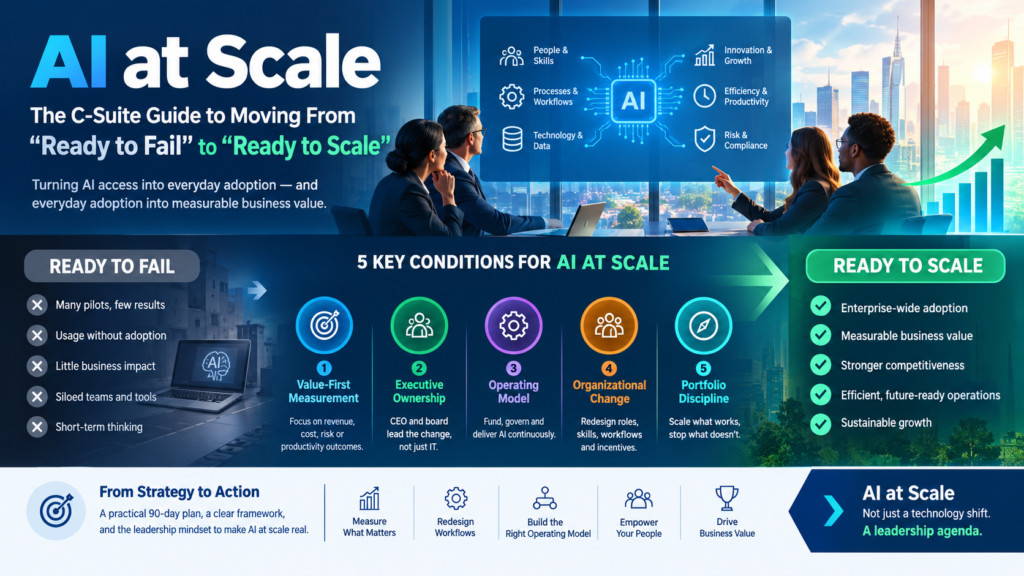
AI at scale means turning AI access into everyday adoption, and everyday adoption into measurable business and financial value. Reaching it depends less on buying better technology and more on how executives lead, how the company operates, and how work gets redesigned.
Organizations have spent heavily on building and buying AI, funding pilots, and pushing deployments into production. Yet access has not translated into adoption, and adoption has not translated into measurable business and financial value. This guide explains why that gap exists, what separates “ready to fail” organizations from “ready to scale” ones, and what boards and CEOs can do about it this quarter. It builds on themes from Gartner’s upcoming C-suite session and adds a practical framework you can apply immediately. gartner
The Short Answer: What Does AI at Scale Require?
Five conditions separate organizations that reach AI at scale from those that stall:
- Value-first measurement: Success is defined by revenue, cost, risk, or productivity outcomes, not by licenses, prompts, or pilots launched.
- Executive ownership: The CEO and board treat AI as a business transformation, not an IT project.
- A production-grade operating model: Funding, governance, and delivery are built to run AI continuously, not to demo it once.
- Organizational change: Roles, skills, workflows, and incentives are redesigned around how AI changes the work.
- Portfolio discipline: Initiatives earn the right to scale, and those that don’t are stopped quickly.
Each condition is unpacked below as a standalone unit, so you can jump to the one that matters most to you.
What Is AI at Scale?
Definition
AI at scale is the condition in which AI is embedded in core business processes, used routinely by the people it was designed for, and linked to outcomes that appear in financial results.
Expansion: The Three Tests of Scale
You can check any AI initiative against three tests:
- Reach: Is the capability available across the processes and teams where it matters, not just in one lab or business unit?
- Routine use: Do people use it as part of their normal work without being nudged, mandated, or trained again each quarter?
- Results: Can finance trace a measurable improvement back to it?
A company that passes only the first test has AI access, not AI at scale. Passing two of three still leaves value on the table. This is the central idea behind the access, adoption, and impact gap discussed later in this article.
How Is AI at Scale Different From an AI Pilot?
A pilot proves a technology can work in a controlled setting; scale proves the business can work differently because of it. Pilots are usually staffed by enthusiasts, shielded from legacy processes, and judged by technical feasibility. Production environments have none of those protections. They have messy data, skeptical teams, compliance reviews, budget cycles, and competing priorities. That is why many pilots that look brilliant in a demo never change a financial statement.
Why Does This Definition Matter to the C-Suite?
Because organizations tend to get what they measure. If the definition of success is “licenses deployed,” the company will deploy licenses. If leaders define AI at scale around business outcomes, funding, staffing, and governance decisions start to change accordingly. Definitions are the cheapest strategic lever an executive team has, and they are almost always overlooked.
Why Do AI Investments Fail to Deliver Business Impact?
Most AI investments underdeliver because each step in the value chain is treated as automatic when it is not. Buying AI does not create adoption, and adoption does not create impact. Gartner has also stated that more than 50% of generative AI projects fail, which underlines how common this breakdown is. govevents
Access Does Not Equal Adoption
Giving people AI tools does not mean they will use them well, or at all. Employees may not trust outputs, may not know which tasks suit AI, or may fear that productivity gains will be used against them. Others may use tools heavily for low-value tasks while high-value workflows stay untouched. Strong AI adoption requires redesigned workflows, clear guidance on where AI belongs, visible leadership use, and incentives that reward the new way of working.
Adoption Does Not Equal Impact
Even widespread use can fail to move financial results. Time saved on one task rarely becomes a measurable benefit unless the process around it changes. If a team drafts reports 30% faster but the approval chain stays the same, the organization has not captured AI business value. Impact requires deciding in advance what happens to the freed capacity: more output, better quality, lower cost, or a new service. Without that decision, the gain disappears into the general noise of the working day.
Why the Fast-Follower Strategy No Longer Works
Waiting for competitors to prove the path used to be a safe default, but traditional fast-follower strategies are becoming obsolete as AI investment accelerates. The reason is structural. Organizations that learn faster build better data, better processes, and better people capabilities, and those advantages compound. A fast follower can copy a tool, but it cannot copy years of operating-model learning. In a market where AI at scale reshapes cost structures and customer expectations, the late mover inherits not just a delay but a capability gap. gartner
Ready to Fail vs. Ready to Scale: A Side-by-Side Comparison
The clearest way to see the difference is to compare the two postures across the decisions executives make every week. The table below is a diagnostic framework synthesized from the access, adoption, and impact logic above, not a Gartner publication.
| Decision Area | Ready to Fail | Ready to Scale |
|---|---|---|
| Success metric | Number of pilots, licenses, and users | Financial and operational outcomes tied to P&L |
| Executive role | Sponsors and approves budgets | Owns outcomes and uses AI visibly |
| Funding model | One-off project funding | Ongoing product-style funding tied to value milestones |
| Operating model | Scattered experiments by individual teams | Shared platform, standards, and accountable owners |
| Workforce approach | Training sessions after rollout | Work redesign, role changes, and incentives before rollout |
| Risk posture | Governance as a late-stage gate | Governance built into delivery from day one |
| Response to failure | Quietly extend or rebrand the pilot | Stop quickly, capture lessons, redeploy resources |
| Competitive stance | Wait and follow | Deliberately choose where to lead and where to follow |
How to use the table: If you recognize more than three rows in the “Ready to Fail” column, your organization is probably not yet prepared for AI at scale. The good news is that every row is a leadership choice, not a technology limitation.
What Are Leading CEOs and Boards Doing Differently?
They treat AI as a leadership and operating-model challenge rather than a technology purchase. Gartner’s session draws on interviews with chairpersons and CEOs from organizations including IBM, Accenture, Tata Group, and PwC, and it promises to cover the leadership, operating model, and organizational shifts required to turn AI investments into sustained business value. gartnergartner
The specific findings are Gartner’s to present, so this article does not attempt to summarize them. What the session description does make clear is the shape of the answer: the differences sit in how top leaders behave, how the enterprise is organized to deliver AI, and how people and structures change around it. The Five Shifts Framework below turns those three themes into concrete moves.
The Five Shifts Framework for AI at Scale
The Five Shifts Framework is a practical model for moving from scattered AI activity to AI at scale. The first three shifts map to the leadership, operating model, and organizational themes Gartner highlights. The last two are extensions I recommend based on common failure patterns.
Shift 1: From Sponsor to Owner (Leadership)
Executives who sponsor AI approve the budget; executives who own it answer for the outcome. Ownership means the CEO or a named senior leader has a target, reviews progress regularly, and uses AI in their own work so they understand the friction employees face. Boards play a role here too. They can ask for value evidence instead of activity updates and make AI progress a standing agenda item rather than an annual presentation.
Shift 2: From Projects to Products (AI Operating Model)
A project ends; a product is maintained, measured, and improved. An effective AI operating model assigns each important AI capability a business owner, a technical owner, a budget line, a roadmap, and a quality standard. It also provides shared components such as data access, evaluation methods, security reviews, and vendor management so each team does not rebuild them. This is where an enterprise AI strategy becomes executable rather than aspirational.
Shift 3: From Tool Rollout to Work Redesign (Organization)
AI changes tasks before it changes jobs, and tasks live inside workflows. Rolling out a tool without redesigning the workflow produces the access-without-impact pattern described earlier. Leaders should map the workflows where AI could matter most, decide what changes in each step, retrain accordingly, and revise roles, targets, and incentives to match. People adopt what the organization visibly rewards.
Shift 4: From Activity Metrics to Value Metrics
What gets reported to the board shapes what the organization optimizes. Replace dashboards of usage counts with a small set of outcome measures agreed with finance. Usage is still useful as a leading indicator, but it should never be the headline.
Shift 5: From Fast Follower to Deliberate Positioning
Not every AI bet deserves to lead. Strong teams decide where AI creates a competitive advantage and invest deeply there, while buying or following in commodity areas. The key is that following becomes a conscious choice with a stated rationale, not a default caused by indecision.
How Do You Measure Whether AI at Scale Is Working?
Measure AI at scale with a layered scorecard that links usage to outcomes to financial results. A single metric will mislead you. A layered view shows where the chain breaks.
The scorecard should include:
- Reach metrics: the share of target processes and teams with a live AI capability.
- Adoption metrics: the share of intended users who use it weekly, and for which tasks.
- Quality metrics: accuracy, error rates, rework, and user trust scores.
- Process metrics: cycle time, throughput, and cost per transaction in redesigned workflows.
- Financial metrics: revenue lift, cost reduction, or risk avoided, agreed in advance with finance.
- Risk metrics: incidents, policy exceptions, and audit findings.
Diagnostic rule: If reach is high but adoption is low, you have an access problem disguised as success. If adoption is high but process and financial metrics are flat, you have an impact problem. Each pattern calls for a different fix, which is why measuring only one layer is risky.
A 90-Day Plan to Get Ready for AI at Scale
You can create real momentum in 90 days by focusing on decisions rather than deployments. The plan below is a starting template to adapt to your context.
Days 1 to 30: Diagnose
- Inventory every AI initiative, its owner, its budget, and its current status.
- Score each one against the three tests of reach, routine use, and results.
- Run the comparison table above with your executive team and agree on where you stand.
- Agree on three to five business outcomes that AI must influence this year.
Days 31 to 60: Decide
- Stop, pause, or merge initiatives that cannot name a value owner and a measurable outcome.
- Select a small number of workflows for redesign, ideally where value is large and data is accessible.
- Name accountable owners and set up a shared operating model, including governance and evaluation standards.
- Align with finance on how benefits will be measured and counted.
Days 61 to 90: Commit
- Launch redesigned workflows with changed roles, targets, and training, not just new tools.
- Start a monthly executive review using the layered scorecard.
- Brief the board on the value evidence, the decisions made, and the initiatives stopped.
- Set the next 12-month portfolio based on what earned the right to scale.
Five Mistakes That Stall AI at Scale
The most common mistakes are predictable and avoidable.
- Funding technology without funding change. Budgets cover licenses and engineers but not training, workflow redesign, or change management.
- Letting every team run its own experiments. Duplication, inconsistent governance, and unclear ownership slow everything down.
- Treating governance as a brake. Late-stage reviews cause delays and resentment. Built-in guardrails speed delivery.
- Declaring victory on usage. High activity feels like progress but may hide flat results.
- Never stopping anything. Zombie pilots consume talent and attention that scalable initiatives need.
Frequently Asked Questions
What Is AI at Scale in Simple Terms?
AI at scale is when AI is used routinely across the business and produces results you can see in the financials. It is not about how many tools you own. It is about whether the way your organization actually works has changed, and whether that change shows up in revenue, cost, risk, or productivity.
Why Do AI Pilots Rarely Become AI at Scale?
Pilots succeed in protected conditions that production does not offer. They benefit from motivated teams, clean data, and light governance. Scaling requires ownership, funding, workflow change, and training across skeptical teams. Without these, the pilot stays a pilot regardless of how impressive the demo was.
Who Should Own AI Strategy: the CIO, the CEO, or a Chief AI Officer?
Accountability for outcomes should sit with the CEO or a senior business leader; technology leaders own enablement. The right structure depends on the company, but the principle is stable. If AI value is treated as purely an IT deliverable, business processes rarely change. A strong enterprise AI strategy assigns business owners to outcomes and technology owners to platforms and standards.
How Long Does It Take to Reach Scale?
There is no universal timeline, because scale depends on workflow complexity, data readiness, and organizational change capacity. Leaders can usually show early value evidence within a few months in well-chosen workflows. Broad, durable change across the enterprise takes longer and should be planned as a multi-year program with annual checkpoints.
Is It Too Late to Start if Competitors Are Ahead?
No, but waiting is increasingly costly. The practical response is to choose a few high-value areas, build the operating model and measurement discipline first, and move deliberately. Catching up is mostly about leadership decisions and organizational learning speed, which any company can improve.
Conclusion: Make AI at Scale a Leadership Agenda
The central lesson is that AI results are decided by leadership, operating model, and organizational choices more than by the technology itself. Access does not guarantee adoption, adoption does not guarantee impact, and following others is no longer a safe plan. Treat AI at scale as a standing executive agenda with clear owners, value-based metrics, redesigned work, and the discipline to stop what is not working.
If you want to hear the research behind these themes directly, Gartner’s session “C-Suite AI Conversations: Ready to Fail vs Ready to Scale” is scheduled as a one-hour live webinar on October 29, 2026 at 10:00 a.m. EDT, hosted by Distinguished VP Analyst Frances Karamouzis. Use it alongside the diagnostic table and 90-day plan above to pressure-test your own organization before your next board meeting.