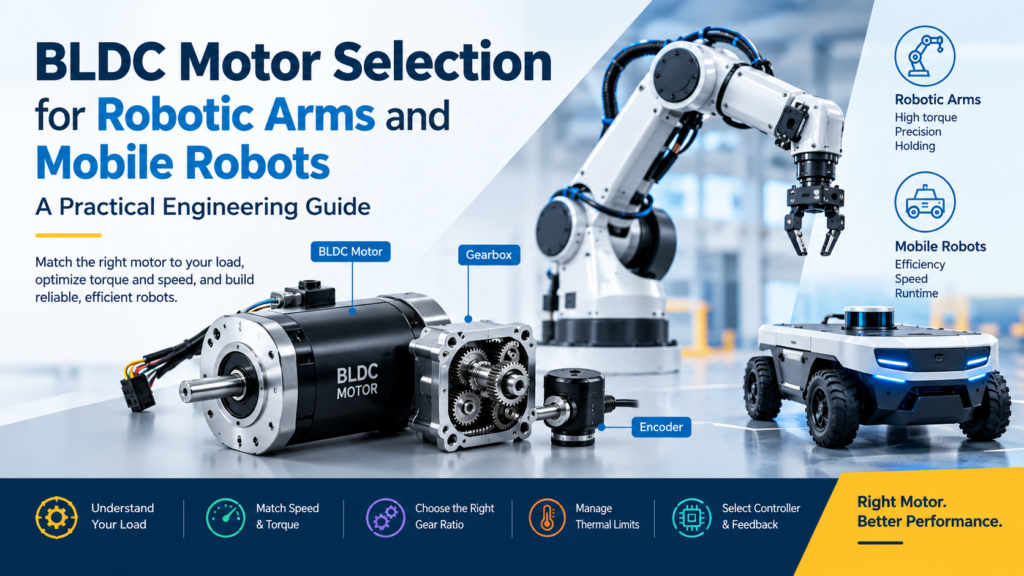
BLDC motor selection works best when you start from the load, not the catalog. Calculate the peak and continuous torque your joint or wheel needs, convert it to motor-side torque and speed through your gear ratio, then choose a motor whose Kv, torque constant, and thermal rating cover that operating point with margin. For robotic arms, that usually means a low-Kv, high-torque motor behind a reduction stage. For mobile robots, it means an efficient motor sized for sustained speed, slopes, and battery life.
Get it wrong and the symptoms are familiar. An arm sags under payload or runs hot after ten minutes, and a mobile robot stalls on a ramp or loses half its expected runtime. This guide gives you a repeatable method, with worked numbers, to avoid both.
What Is a BLDC Motor, and Why Does Robotics Favor It?
A brushless DC (BLDC) motor is a permanent-magnet synchronous motor that is commutated electronically instead of with brushes. Magnets sit on the rotor, copper windings sit on the stator, and a controller energizes the windings in sequence to keep the rotor turning.
That design explains why roboticists prefer it:
- No brush wear. Life is limited mainly by bearings, not by a consumable part.
- High efficiency. Well-designed BLDC motors waste far less energy as heat than brushed motors, which matters on battery power.
- Strong torque density. More torque per kilogram means lighter joints and a lighter robot.
- Good controllability. With a proper controller and feedback, torque and speed can be regulated smoothly.
The trade-off is complexity. A BLDC motor cannot run from a battery alone, because it needs a dedicated controller and position feedback. That requirement shapes the rest of your design.
Why BLDC Motor Selection Differs for Arms and Mobile Robots
The same motor family serves two very different duty cycles, so the selection logic changes. Treating a wheel like a joint, or the reverse, is a common source of oversized, overheated, or underpowered designs. Good BLDC motor selection begins by naming which problem you actually have.
Robotic Arms: Torque Density, Precision, and Holding
A joint in a robotic arm moves a changing load through a limited range, often stopping and holding. The key demands are:
- High torque at low joint speed
- Smooth, low-cogging motion for precise positioning
- Low weight, because every motor’s mass is carried by the joints before it
- Ability to hold a pose without overheating
A BLDC motor for robotic arms is therefore usually a high-pole-count, low-Kv motor, often a frameless or “gimbal-style” design, paired with a reduction gearbox and a precise encoder.
Mobile Robots: Efficiency, Speed, and Duty Cycle
A wheel turns continuously, and the load is dominated by rolling resistance, slopes, and acceleration. The key demands are:
- High efficiency at the typical cruise speed
- Enough peak torque for ramps, curbs, and acceleration
- Robustness against dust, vibration, and shock
- Long runtime from a fixed battery
A BLDC motor for mobile robots may be a geared motor, or a direct-drive hub motor if the speed is moderate and the wheel is large enough.
Side-by-Side Comparison
| Factor | Robotic Arm Joint | Mobile Robot Wheel |
|---|---|---|
| Typical load | Gravity, payload, inertia | Rolling resistance, slope, acceleration |
| Speed profile | Low speed, frequent starts and stops | Moderate, often continuous |
| Priority | Torque density, precision, holding | Efficiency, runtime, robustness |
| Typical Kv | Low (high torque per amp) | Low to medium, depending on gearing |
| Gearing | Almost always (planetary, harmonic, cycloidal) | Optional (direct drive or planetary) |
| Feedback | High-resolution encoder, often absolute | Hall sensors or modest encoder |
| Main failure risk | Overheating at standstill | Undersized for slopes or acceleration |
| Mass sensitivity | Very high | Moderate |
The Five Specs That Drive BLDC Motor Selection
Five parameters decide whether a motor fits: Kv, torque constant, continuous vs. peak torque, winding resistance, and voltage/current limits. Understanding them turns a datasheet from a wall of numbers into a decision tool, and this is the core vocabulary of BLDC motor selection.
Kv Rating: Speed per Volt
Kv is the no-load speed in RPM produced per volt applied. A motor rated at 330 Kv will, ideally, spin at about 330 RPM per volt of supply. Higher Kv means higher speed and lower torque per amp. Lower Kv means the opposite.
Kv is not a quality score. It is a trade-off, and it should match your gearing and bus voltage.
Torque Constant (Kt)
The torque constant tells you how much torque you get per amp of current. In SI units, Kt is approximately the inverse of Kv, so a low-Kv motor has a high Kt. In plain terms, torque equals Kt times current.
This is the number to use when you convert a torque requirement into a current requirement, which in turn sizes your controller and battery.
Continuous Torque vs. Peak Torque
Continuous torque is what the motor can produce indefinitely without overheating; peak torque is what it can produce briefly.
- Size for continuous torque using the RMS (average heating) load over your duty cycle.
- Check peak torque against your worst-case acceleration, collision, or ramp event.
Arms that hold a posture are a classic trap. A motor holding a load at standstill is producing steady current, so heat builds even though nothing is moving.
Winding Resistance and Copper Loss
Heat in the windings equals current squared times resistance. Low resistance helps efficiency, but a motor designed for low resistance usually has a different Kv and Kt trade-off. Use the resistance value to estimate heating at your expected current, because copper loss is what limits continuous torque.
Voltage and Current Limits
Your supply voltage sets the top speed, and your current limit sets the torque. The motor’s back-EMF rises with speed and opposes the supply. At high speed, the voltage headroom disappears and torque falls. Make sure the motor can reach your required speed at your minimum battery voltage, not just a full charge.
How Do You Calculate the Torque a Robotic Arm Joint Needs?
Multiply the weight of everything beyond the joint by its distance from the joint, add the torque to accelerate it, then divide by gear ratio and gearbox efficiency. Torque is the foundation of BLDC motor selection for robotic arms.
Worked example (shoulder joint):
- Mass beyond the joint (link plus payload): 2 kg
- Distance from joint to center of mass: 0.4 m
- Static torque = mass × gravity × distance = 2 × 9.81 × 0.4 = about 7.85 N·m at the joint (arm horizontal, the worst case)
- Add acceleration torque (inertia × angular acceleration) and a safety margin. For this example, allow a 1.5 to 2× margin on the static value.
Convert to the motor side. With a 50:1 gearbox at 85% efficiency:
- Motor torque = 7.85 ÷ (50 × 0.85) = about 0.185 N·m
- With a 2× margin, target roughly 0.37 N·m peak at the motor.
Now check speed. If the joint must swing at 60 RPM, the motor needs 60 × 50 = 3,000 RPM. Confirm that your Kv and supply voltage can reach that speed with headroom.
Key takeaway: Gearing trades speed for torque, so a small, fast, low-torque motor can drive a heavy joint. The price is added weight, backlash, and friction.
How Do You Size a BLDC Motor for a Mobile Robot?
Add up rolling resistance, slope force, and acceleration force, then multiply by wheel radius to get wheel torque, and compute wheel speed from your target velocity. Mobile robots simplify BLDC motor selection in one way: the load is mostly predictable.
Worked example (two-wheel-drive robot):
- Robot mass: 20 kg
- Target speed: 1 m/s, wheel diameter 0.2 m
- Rolling resistance coefficient: about 0.02 on a smooth floor
- Steepest slope: 5 degrees
- Acceleration target: 0.5 m/s²
Forces:
- Rolling resistance = 0.02 × 20 × 9.81 = about 3.9 N
- Slope force = 20 × 9.81 × sin(5°) = about 17.1 N
- Acceleration force = 20 × 0.5 = 10 N
- Total = about 31 N
Wheel torque and speed:
- Total wheel torque = 31 N × 0.1 m radius = about 3.1 N·m, or about 1.55 N·m per wheel
- Wheel speed = 1 ÷ (π × 0.2) = 1.59 rev/s = about 95 RPM
From here, choose between a direct-drive motor able to deliver 1.55 N·m at 95 RPM (often a larger, low-Kv outer-rotor motor) and a smaller, faster motor with a planetary gearbox. Add a margin for payload changes, worn floors, and battery sag.
How Do Gear Ratio and Motor Choice Interact?
Gearing multiplies torque and divides speed, so the ideal motor depends on the reduction you choose. Gear ratio and BLDC motor selection are inseparable, and you should evaluate them together.
- Planetary gearboxes are compact and efficient, and they suit most wheels and many arm joints.
- Harmonic (strain wave) drives offer high ratios with very low backlash, which suits precise arm joints but adds cost and compliance.
- Cycloidal drives are robust and shock-tolerant, a good fit for high-torque or impact-prone joints.
- Quasi-direct-drive (low ratio, such as 6:1 to 10:1) keeps the joint back-drivable and responsive, which is popular in legged and collaborative robots.
A higher ratio lets you use a smaller motor, but it increases reflected inertia, friction, and backlash. A lower ratio gives smoother, more transparent force control but demands a larger, hotter motor.
What Feedback Does a BLDC Motor Need?
At minimum, the controller needs rotor position; precision work needs an encoder. Feedback is part of BLDC motor selection, not an afterthought.
- Hall sensors give coarse position and suit wheels and simple speed control.
- Incremental encoders give fine position and speed, but need a homing routine on startup.
- Absolute encoders report position immediately at power-on, which is valuable for arm joints that must not move unexpectedly.
- Sensorless control removes sensors and works at speed, but is weak at standstill and low speed, which is a poor match for arm holding.
For a robotic arm, choose an encoder resolution that supports your positioning accuracy after gearing. For a wheel, hall sensors are often enough.
How Do You Choose a BLDC Motor Controller?
Match the controller’s voltage and current ratings to the motor, and pick field-oriented control (FOC) if you need smooth torque. Treat the controller as part of BLDC motor selection, since a mismatched pair wastes the motor’s capability.
Check these items:
- Bus voltage: it must cover your maximum battery voltage, including regenerative spikes.
- Continuous and peak current: these should exceed the motor’s needs with margin.
- Control mode: torque, velocity, and position modes for the task.
- Commutation method: FOC gives quieter, smoother torque than trapezoidal control, which matters for arms.
- Communication: CAN, EtherCAT, UART, or similar, matched to your robot’s architecture.
- Protection: over-current, over-temperature, and under-voltage cutoffs.
Choose a driver with a power rating slightly above the motor’s maximum, and consider the environment, since moisture, dust, and vibration all affect controller choice.
Why Do Thermal Limits Matter So Much?
Heat, not torque, is what usually destroys a poorly chosen motor. Thermal limits are where BLDC motor selection most often fails in practice, because datasheet torque figures assume specific cooling conditions.
Follow these practices:
- Compute RMS torque over a realistic duty cycle, not just peak torque.
- Estimate copper loss from current and winding resistance.
- Add a temperature sensor and a software derating strategy.
- Remember that hot magnets lose strength, and hot windings gain resistance, so performance drops as the motor warms.
- Mount the motor on a surface that conducts heat away, because the robot frame can act as a heat sink.
Arms are most at risk because of holding torque. If a joint holds a heavy pose for long periods, consider a higher gear ratio, a brake, or a larger motor.
What Are the Most Common Mistakes?
Most failures trace back to a handful of avoidable errors. The most common BLDC motor selection mistakes are:
- Sizing for peak torque only and ignoring continuous heating
- Forgetting gearbox efficiency and friction in the torque budget
- Ignoring battery sag, so the robot cannot reach speed at low charge
- Choosing a high-Kv motor for a joint and then over-gearing to compensate
- Skipping thermal analysis for joints that hold a pose
- Pairing the motor with an underrated controller or the wrong feedback type
- Leaving no margin for payload growth, future upgrades, or aging
A Step-by-Step BLDC Motor Selection Checklist
Follow this sequence to move from requirements to a short list of motors.
- Define the task. List payload, reach or wheel size, speed, accuracy, and duty cycle.
- Calculate load torque and speed at the joint or wheel, including worst-case conditions.
- Choose a gear strategy (direct drive, planetary, harmonic, or cycloidal).
- Convert to motor-side torque and speed using ratio and efficiency.
- Filter by Kv, Kt, and bus voltage so the motor reaches speed at minimum battery voltage.
- Check continuous torque against RMS load and peak torque against worst-case events.
- Estimate heating from current and winding resistance.
- Select feedback and a controller matched to precision and communication needs.
- Add a margin (commonly 1.5 to 2×) and prototype.
- Test under real loads, measure temperature and current, and iterate.
Frequently Asked Questions
What is the most important factor in BLDC motor selection?
Torque at the operating speed, with thermal capacity to sustain it. A motor that meets the peak number but overheats at the real duty cycle is the wrong motor. In BLDC motor selection, continuous torque and heating usually matter more than the headline peak figure.
Is a high-Kv or low-Kv motor better for a robotic arm?
Low Kv is usually better. It delivers more torque per amp and pairs well with a reduction gearbox. High-Kv motors suit fast, light-load applications such as propellers.
Do mobile robots need a gearbox?
Not always. A large-diameter, low-Kv hub or outer-rotor motor can drive a wheel directly at moderate speeds. Smaller, faster motors need a gearbox to reach the wheel torque required.
Hall sensors or encoders?
Use hall sensors for simple wheel drives and encoders for precise arm joints. An absolute encoder is the safest choice when power-on position matters.
Can I use sensorless control on a robot arm?
Generally no. Sensorless methods struggle at zero and low speed, which is exactly where arms hold position and need smooth starts.
Conclusion
BLDC motor selection is a chain of calculations, not a guess. Start with the load, convert it through the gearing, verify with Kv, Kt, and voltage, then confirm that heat, feedback, and the controller all hold up. Robotic arms reward torque density, precision, and thermal care. Mobile robots reward efficiency, robustness, and enough peak torque for the worst slope. Follow the checklist above and prototype early, and you will land on a motor that performs reliably.
Key Takeaways for Better BLDC Motor Selection
- Arms: Choose a BLDC motor for robotic arms with a low Kv rating, a high torque constant, and enough thermal capacity to hold a pose, since joints spend much of their time at low speed under steady load.
- Mobile robots: Choose a BLDC motor for mobile robots for efficiency at cruise speed, with enough peak torque for slopes and acceleration. Check that the motor still reaches speed as the battery sags.
- Gearing: Match the Kv rating and torque constant to your gear ratio so the motor delivers the required speed and torque together.
- Controller: Pair every motor with a BLDC motor controller whose voltage, current, and control mode (ideally FOC) fit both the motor and your communication bus.
- Validation: Test every prototype under real loads, and measure temperature, current draw, and runtime before you commit to production.
Final Thoughts
Teams that treat BLDC motor selection as a documented process, not a one-time decision, build robots that are lighter, cooler, and cheaper to maintain. Record your load assumptions, safety margins, and test results so the next design starts from evidence. As payloads grow and battery chemistries improve, revisit those assumptions. A disciplined approach to BLDC motor selection lets you upgrade a single joint or drive module without redesigning the whole robot, whether you are building a precise manipulator or a rugged mobile platform.