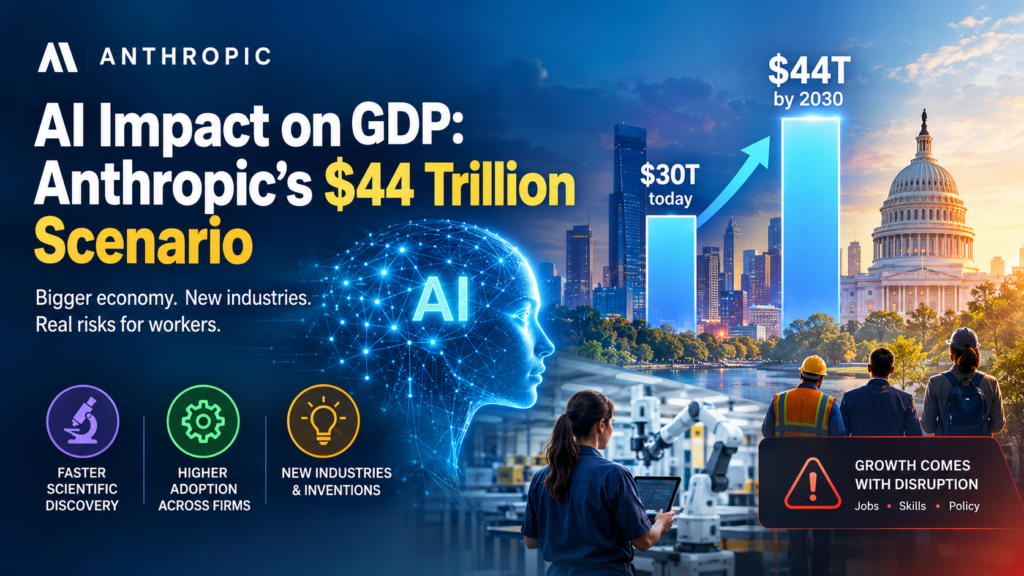
The short answer: Anthropic co-founder Jack Clark said on October 17, 2026, that one of the company’s internal economic models shows AI could push US economic output from just over $30 trillion today to about $44 trillion by 2030, a gain of nearly 50%. That is a conditional scenario that depends on AI continuing to improve, not a verified prediction, and the AI impact on GDP it describes would arrive alongside real disruption for workers.
Picture the world’s largest economy growing by roughly half in four years. Most economists would call that implausible, and Clark himself acknowledged how extreme it sounds. Yet his argument at the IMF and World Bank annual meetings in Bangkok was that the number follows logically if the technology keeps getting better. This guide explains what he said, what sits behind the figure, how to read it critically, and what it means for workers, businesses and policymakers. Each section is written to stand on its own, so you can jump straight to the question you care about.
Last updated: October 19, 2026. This article is analysis, not financial or investment advice.
What did Jack Clark say about the AI impact on GDP?
Direct answer: According to Reuters, Clark told the IMF and World Bank annual meetings in Bangkok on Saturday, October 17, 2026, that rapidly improving AI capabilities will bring far faster change across all fields, and that one of Anthropic’s internal economic models points to US output reaching $44 trillion by 2030 under certain conditions.
The core claim in plain language
Reuters reports that the $44 trillion figure compares with a current US GDP of just over $30 trillion. The gap amounts to an increase of almost 50% in about four years. Clark conceded the number is “very outlandish” at first glance, but he argued it is implied by the technology continuing to improve, particularly because AI is vastly increasing the pace of scientific discovery.
The accounting logic behind the number
Clark also made a point worth pausing on. If GDP really did grow by that much, economic doctrine suggests that new industries and inventions would have to exist to power the expansion. In other words, he framed the headline figure as a consequence of what AI would need to be doing in the real economy, not as a freestanding prophecy. That framing matters because it turns an abstract forecast into a testable claim: you would expect to see new products, new sectors and new scientific results long before you saw the GDP line move.
What the claim does not say
- It is not a guarantee. Reuters describes it as a forecast from an internal model under certain conditions.
- It is not an independent estimate. The figure comes from the company that builds AI systems, which has an obvious interest in the topic.
- It does not promise shared gains. Clark acknowledged that AI is already causing job losses in fields with high AI exposure, such as call centers and customer service.
- It does not specify every assumption. Public coverage of the speech does not publish the full model inputs, so outsiders cannot yet audit them.
What is Anthropic’s Economic Scenario Explorer?
Definition: The Economic Scenario Explorer is a modeling tool Anthropic released in September 2026 that lets people test how different speeds of AI adoption could change US economic growth and employment.
One caveat first: Reuters says the $44 trillion figure came from “one of the company’s internal economic models” and does not name which one. Any direct link between that number and the Explorer is therefore unconfirmed, though the two clearly belong to the same body of work on the AI impact on GDP.
What the scenarios span
NPR’s coverage of the launch described a wide range of outcomes. At one end, AI provides a gentle boost, lifting growth rates with little effect on workers. At the other end, GDP grows at more than seven times its current pace, but nearly 14% of workers lose their jobs to AI and fewer than half of them find new ones. Anthropic’s own authors summarized the spread by saying the economy either stays on a conventional path with changes at the margins, or AI transforms it.
What the public expects
Anthropic also surveyed nearly 11,000 people. On average, respondents expected a significant boost to productivity and economic growth, but also substantial disruption for workers in AI-sensitive fields. That mix of optimism and anxiety is useful context: the public is not simply bullish or bearish on the AI impact on GDP, it expects both a bigger pie and a rougher transition.
Why adoption speed is the key variable
Anton Korinek, Anthropic’s head of transformative AI economic studies, made the central point in NPR’s report: capable AI that nobody uses produces no economic effect. Speed of diffusion through firms and households is therefore the hinge on which the whole range of scenarios turns. Faster adoption raises both the upside in output and the risk of abrupt disruption.
How big is $44 trillion? Putting the AI impact on GDP in context
Direct answer: Moving from just over $30 trillion to $44 trillion by 2030 is an increase of nearly 50%, which implies average growth of roughly 9 to 10% a year over four years, several times what large, mature economies typically manage.
The arithmetic is simple. Divide 44 by 30 and you get about 1.47. Take the fourth root of that to spread the gain over four years and you land near 1.10, or about 10% annual growth. That annual rate is my own back-of-envelope calculation, not a figure from Reuters, and it assumes a four-year runway while ignoring inflation and the exact baseline. Treat it as an order-of-magnitude guide.
Scenario comparison table
The table below lines up the three reference points discussed in public coverage. Only the cells sourced to coverage contain figures; where coverage is silent, the table says so.
| Scenario | Growth outcome | Labor-market outcome | Where it comes from |
|---|---|---|---|
| Gentle boost | Growth rates lifted modestly; economy stays near a conventional path | Little effect on workers | Anthropic scenario work, via NPR |
| Clark’s $44 trillion case | US output of about $44 trillion by 2030, roughly 50% above today’s just-over-$30 trillion | Job losses acknowledged in high-exposure fields such as call centers and customer service; wider effects not specified | Reuters, October 17, 2026 |
| Extreme scenario | GDP grows at more than seven times its current pace | Nearly 14% of workers lose jobs; fewer than half find new ones | Anthropic scenario work, via NPR |
Do not read the middle row as a point on the same curve as the other two. Coverage does not say how the $44 trillion case maps onto the Explorer’s scenarios, so the table presents them side by side rather than as one continuous scale.
Why might AI raise GDP this much? Three channels
Direct answer: The public statements point to three channels: faster scientific discovery, faster adoption across the economy, and the creation of entirely new industries. Each is necessary for a large AI impact on GDP, and each can fail independently.
Channel 1: Faster scientific discovery
Definition: Scientific discovery as a growth channel means AI shortening the time from idea to validated result in fields such as materials, medicine and engineering.
Clark pointed to this directly in Bangkok, saying AI is vastly increasing scientific discovery. The economic logic is that new knowledge is non-rival: once a better battery chemistry or drug target exists, many firms can build on it. If AI compresses research cycles, the benefits compound across sectors. The catch is that discovery is not the same as deployment. A breakthrough still needs testing, manufacturing, regulation and customers before it shows up in output.
Channel 2: Faster adoption across firms
Definition: Adoption is the share of businesses and workers who actually use AI in daily production, as opposed to experimenting with it.
Korinek’s point about unused capability is the heart of this channel. History offers a useful pattern: general-purpose technologies such as electricity took decades to reshape factories because firms had to reorganize around them. AI may diffuse faster because much of it is delivered as software, but organizational change, training and trust still take time. Any forecast of a large AI impact on GDP is implicitly a bet on unusually fast organizational change.
Channel 3: New industries and inventions
Definition: New industries are sectors that did not exist, or were economically marginal, before the technology arrived.
This is the channel Clark emphasized when he said growth of that size would require new industries and inventions. It is also the hardest to forecast, because by definition nobody can list the industries in advance. Earlier technological waves produced whole categories of work, from software development to digital advertising, that earlier forecasters did not anticipate. The same uncertainty cuts both ways: it makes optimistic models hard to dismiss and hard to verify.
What does the AI impact on GDP mean for workers?
Direct answer: Clark said AI is already causing job losses in some fields, and Anthropic’s extreme scenario has nearly 14% of workers losing jobs, with fewer than half finding new ones. Whether the gains in output reach workers depends on how fast people can move into new roles and on the policy response.
Which jobs are most exposed
Reuters reports Clark naming call centers and customer service as fields with high AI exposure where losses are already occurring. These roles share features that make them early targets: high volumes of repetitive, text-based interactions with clear success criteria. Workers in adjacent roles that involve routine communication, scheduling or first-line triage should expect similar pressure.
Why higher output could fund support
The scenario work offers one optimistic mechanism. In the extreme case, GDP growth is so fast that it could generate a large amount of additional tax revenue to support people hurt by AI. Clark was quoted by NPR as saying that at such growth rates, policymakers would have options that are unimaginable today. The key word is “could”: revenue is only a tool, and it matters only if governments choose to direct it toward retraining, income support or transition programs.
The gap between average and individual outcomes
A rising national average can coexist with painful local outcomes. A call center worker in one city does not directly benefit from a new pharmaceutical industry in another. This is why the AI impact on GDP should be read alongside labor-market data, not instead of it. Output can grow while the share going to wages, or the number of available jobs in particular occupations, falls.
Why GDP alone is an incomplete scorecard
Direct answer: GDP measures the total value of goods and services produced, so it can rise sharply while leaving questions about who benefits, what is lost, and how reliable the forecast is unanswered.
Output is not the same as distribution
GDP says nothing about how gains are divided. A fast-growing economy with concentrated gains and widespread displacement would look excellent in headline numbers and feel very different to people living in it. Any serious discussion of the AI impact on GDP should therefore pair the headline figure with measures of employment, wages and household income.
Source and incentive caution
The $44 trillion figure was produced by an AI developer’s internal model and presented by one of its co-founders. That does not make it wrong, but it does mean readers should look for independent replication. Academic economists, central banks and statistical agencies will test these claims against their own models, and their conclusions may differ. Clark himself framed the number as startling rather than certain.
Bottlenecks that models can miss
Models tend to capture what the technology can do more cleanly than what organizations, infrastructure and institutions will allow. Energy supply, chip availability, regulation, data access and workforce skills can each slow the translation from capability to output. This is analysis rather than something Clark said, but it is the standard reason experienced forecasters apply wide uncertainty bands to technology-driven growth projections.
How should you read any AI economic forecast? A five-question checklist
Direct answer: Ask who produced it, what it assumes, over what time frame, how it handles workers, and whether anyone independent has checked it. The five questions below turn that into a repeatable routine you can apply to the Anthropic figure or to any other AI economic growth forecast.
- Who built the model, and what is their interest? Developers, consultancies and academics have different incentives and different data.
- What is the forecast conditional on? Phrases such as “if the technology keeps improving” or “under certain conditions” define the scenario; they are not footnotes.
- What is the baseline and the time frame? A figure like $44 trillion by 2030 only means something against a stated starting point, a stated year and a stated treatment of inflation.
- What does it say about people? Look for assumptions about job losses, retraining and wages, not just totals.
- Has anyone independent tested it? Replication by outside economists is the strongest signal that a number deserves weight.
What policy response did Clark call for?
Direct answer: Clark said international cooperation is needed to put exceptional, serious rules around AI, arguing that a technology capable of this scale of change cannot be left to ad hoc national approaches.
Reuters reports he made the case at a global economic forum, which is notable because the audience was finance and economic policymakers rather than AI researchers. The message to that audience was about speed: AI progress is moving faster than many institutions are structured to respond. Reuters also reported that Clark issued a wake-up call on the pace of development.
The practical implication for governments is to prepare on two tracks at once. One track is economic: retraining, social insurance and tax design that can respond if displacement arrives quickly. The other is governance: coordination on safety and standards across borders, so that competitive pressure does not erode safeguards. Neither track depends on the $44 trillion figure being right; both are sensible if even a fraction of the projected AI impact on GDP materializes.
What should businesses, workers and investors do with this?
Direct answer: Treat the forecast as a stress test, not a plan. Prepare for faster change than your current baseline assumes, without staking decisions on one number.
For businesses
Audit which workflows are text-heavy, repetitive and measurable, because those are the first to change. Run small adoption pilots with clear metrics, and invest in the organizational side (training, process redesign, governance), since Korinek’s point about unused capability applies inside companies too.
For workers
Build skills that complement AI rather than compete with it: judgment, domain expertise, client relationships and the ability to supervise and verify AI output. If your role sits in a high-exposure field, start exploring adjacent roles now rather than waiting for disruption to force the move.
For investors and analysts
Use the figure as one scenario among several. A growth path of roughly 10% a year would reshape corporate earnings, interest rates and tax receipts, but the range of plausible outcomes for the AI impact on GDP remains very wide. Track leading indicators such as adoption rates, productivity statistics and the emergence of new industries rather than waiting for GDP prints. This is general analysis, not personalized financial advice.
Frequently asked questions
Did Anthropic predict US GDP will reach $44 trillion by 2030?
Direct answer: Not as an unconditional prediction. Reuters reports that Clark cited an internal model forecasting $44 trillion by 2030 under certain conditions, chiefly that AI keeps getting better, and he acknowledged the figure sounds extreme.
How much would that raise US GDP?
Direct answer: Nearly 50%. In this scenario, the AI impact on GDP is a gain of roughly $14 trillion on a current level of just over $30 trillion, or about 10% a year on average over four years by simple arithmetic.
Who is Jack Clark?
Direct answer: Jack Clark is a co-founder of Anthropic, the AI company that builds Claude. He made the remarks while speaking at the IMF and World Bank annual meetings in Bangkok in October 2026.
Is the AI impact on GDP already visible in official data?
Direct answer: Coverage of the speech does not present current GDP statistics as proof. The claim concerns future growth that depends on continued AI improvement, so the best evidence will be later productivity and output data from statistical agencies.
Will AI cause mass unemployment?
Direct answer: Not necessarily. Anthropic’s extreme scenario includes nearly 14% of workers losing jobs with fewer than half re-employed, but that is one end of a range, and the gentle scenario shows little effect on workers. Clark did acknowledge current losses in fields like customer service.
How can I track the AI impact on GDP over time?
Direct answer: Follow quarterly GDP releases from national statistical agencies, productivity data, employment statistics for exposed occupations, and adoption surveys. Together they show whether output, jobs and usage are moving in the direction the models imply.
Key takeaways on the AI impact on GDP
- Clark said an Anthropic internal model points to about $44 trillion in US output by 2030, versus just over $30 trillion today.
- The figure is conditional on AI continuing to improve and comes from the developer’s own modeling, so independent verification matters.
- Anthropic’s wider scenario work spans a gentle boost to an extreme case with growth above seven times the current pace.
- Adoption speed, scientific discovery and new industries are the three channels that would have to deliver.
- Job displacement is already visible in high-exposure fields, and the extreme scenario implies nearly 14% of workers losing jobs.
- Policymakers face a two-track task: economic transition support and international coordination on rules.