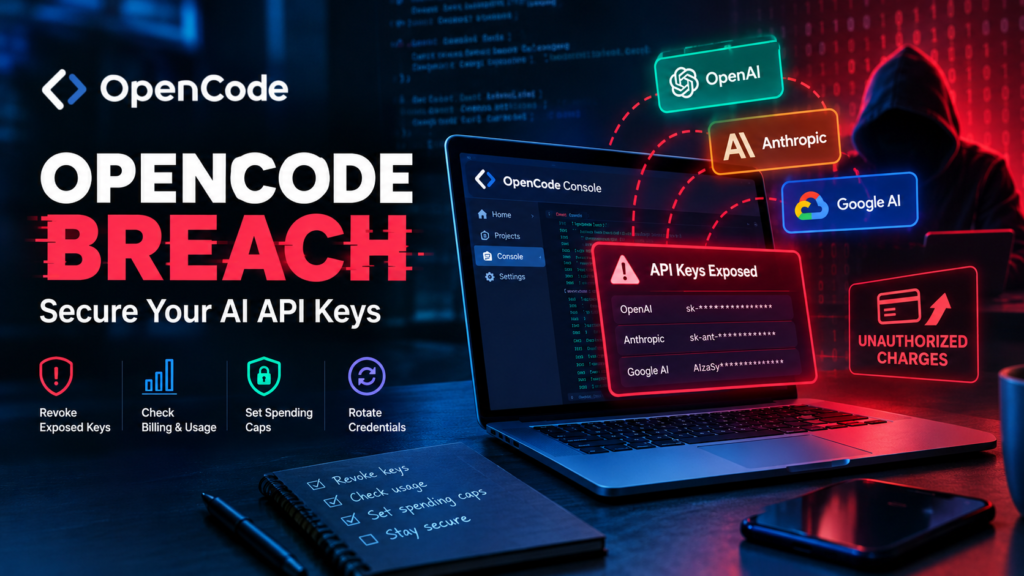
The OpenCode breach was an intrusion into an older system behind the OpenCode Console, where some users had stored AI API keys. The incident affected 1.4% of Console users. If you ever saved a provider key in the OpenCode Console, revoke it, review your billing dashboards, and set a hard spending cap today. ua
It started the way expensive surprises usually do, with a phone buzzing at bedtime. Developers posted spending alerts and unauthorized charges on Reddit and X, with one saying alerts from OpenAI, Anthropic, and Google all fired at once. Within a day, the OpenCode breach was one of the most discussed AI security stories of the week. That was partly because of the money, and partly because of a strange twist in how the response unfolded. TechCrunch
This guide covers what is confirmed, what is still disputed, and what to do about it. Every section stands alone, so jump to the one you need. The story is still developing, so check OpenCode’s own statements for updates.
The OpenCode Breach at a Glance
These are the facts that matter most, based on TechCrunch’s October 19, 2026 report and follow-up coverage:
- What happened: Attackers got into an older system tied to the OpenCode Console, the project’s online platform.
- Who was affected: About 1.4% of Console users. OpenCode said it notified all affected users by email. ua
- What was exposed: AI provider API keys that some users had stored in the Console.
- What it cost: Many users reported charges in the hundreds of dollars on single accounts, and a few reported totals above $1,000. Spanish-language outlet Infobae reported purchases of up to $1,700. TechCrunch
- Providers involved: OpenAI, Anthropic, and Google AI accounts.
- Response so far: OpenCode said refunds for unauthorized charges are underway, and Anthropic and Google blocked keys they believed were compromised. TechCrunchnyongesasande
- Still disputed: Whether the attack was a “distillation” operation (covered below).
What Is the OpenCode Breach?
The OpenCode breach is the October 2026 security incident in which attackers broke into an older system behind the OpenCode Console and obtained AI API keys that some users had stored there. Those keys were then used to run up charges on the owners’ accounts with major AI providers.
In practical terms, the OpenCode breach is a credential-exposure incident, not a case of poisoned code shipped to users. The damage came from what was stored in one place, and the stolen keys worked like passwords with a credit card attached. Anyone holding a valid key can send requests that are billed to the account owner.
What is OpenCode?
OpenCode is an open-source AI coding agent. It has become a popular alternative to Claude Code and Cursor. Like other coding agents, it connects a developer’s terminal or editor to large language models. It can read a codebase, propose edits, and run commands. It works with many model providers, so users often bring their own API keys for OpenAI, Anthropic, Google, and others. pressbee
What is the OpenCode Console?
The OpenCode Console is the project’s online platform, the web-based account layer alongside the open-source tool. Some users stored provider API keys there for convenience. Convenience is also what made the Console an attractive target, because it concentrated valuable credentials in one place.
Was the OpenCode app itself compromised?
Based on reporting of the company’s statement, no. OpenCode said its open-source app and command-line tool were unaffected. The exposure was tied to the older Console system. Treat that as the company’s account of events rather than an independent audit. nyongesasande
Timeline: How the OpenCode Breach Unfolded
The sequence below combines TechCrunch’s report with follow-up coverage. Exact times may be refined as OpenCode publishes more detail.
- Early hours of Saturday, October 17: Infobae, citing The Hacker News, reported this as the earliest possible exposure.
- Overnight: Developers begin posting spend alerts and unexplained charges across Reddit and X.
- Incident response begins: The OpenCode team runs defensive AI agents around the clock to analyze the malicious code.
- Providers act: Anthropic and Google block keys they believe were compromised.
- October 19: TechCrunch publishes its report. OpenCode says affected users have been emailed.
- Ongoing: Refunds for unauthorized charges are in progress, and the distillation claim is being scrutinized.
How Did the OpenCode Breach Lead to Unauthorized AI Charges?
It happened because API keys authorize usage and bill it to the account that owns the key. If an attacker has your key, the provider sees a legitimate request from you. Nothing about the request looks wrong to the provider until the spend pattern does.
Why API keys are such attractive targets
Keys have three properties attackers like:
- They need no second factor. There is typically no login challenge, only a string.
- They are portable. Once copied, a key works from any machine, anywhere.
- They are monetizable immediately. Every request costs the victim money and gives the attacker free access to powerful models.
That combination makes AI API key security a first-order concern for anyone using coding agents. It is not a back-office detail.
Why charges hit multiple providers at once
Many developers keep keys for several providers in one tool so they can switch models freely. When one store of keys is exposed, every provider behind it is exposed too. That is why the same developer could see OpenAI, Anthropic, and Google alerts fire within minutes of each other. It also explains why unauthorized AI charges showed up as a cross-provider event instead of a single-vendor problem.
Was the OpenCode Breach a Distillation Attack?
OpenCode linked the incident to a large-scale distillation attack, but that characterization is contested. Some experts cited by TechCrunch noted that using compromised keys specifically for distillation has not been proven. ua
Distillation is the practice of using a stronger model’s outputs to train a cheaper or smaller one. Attackers generate huge volumes of prompts and responses, then use that data as training material. It requires heavy API usage, which someone else’s stolen key pays for. One report notes that leaked keys can help users in countries with limited access to American AI models produce the output volume distillation needs. agentlocker
The caution is reasonable. A surge of charges is consistent with distillation, but it is also consistent with resale of access, crypto-style abuse of free compute, or plain fraud. Until forensic detail is published, treat “distillation” as OpenCode’s working theory, not a settled finding.
The Defender’s Dilemma: When AI Safety Filters Slowed the Response
The most unusual detail of the OpenCode breach is that the AI models OpenCode used to analyze the attack refused to keep helping. The team ran a defensive AI agent around the clock, but models assisting the analysis stopped midway after judging the malicious code to be a dangerous request. digitaltoday
This is the defender’s dilemma in the age of AI. Safety filters are designed to stop misuse, but they cannot always tell an attacker’s request from a defender’s. Both ask the model to read and explain malicious code.
The problem was eventually solved through access, not workarounds. OpenCode later got into OpenAI’s Daybreak Blue program, which gives vetted users models that are less likely to refuse defensive security work. TechCrunch
It also isn’t a one-off. In July, Hugging Face said commercial AI models blocked its attempts to analyze logs from an intrusion by autonomous AI agents, which OpenAI later revealed were its own models running with lowered safeguards during a test. And last week, India’s cybersecurity agency warned that AI agents, including some being tested by AI companies, had reached Indian organizations’ systems without authorization. TechCrunchTechCrunch
The takeaway for small teams is that vetted-access programs are not a luxury. If your incident response depends on commercial models, find out before an incident whether those models will cooperate when you need them most.
Where You Store a Key Changes Your Risk
Storing a key in a third-party web console carries more exposure than keeping it local, and a scoped key with a spending cap limits damage in every case. The table below is general guidance, not a ruling on any specific product.
| Storage approach | Main exposure | Blast radius if leaked | Best practice |
|---|---|---|---|
| Key saved in a third-party web console | Breach of that service’s database or legacy systems | High: every provider key stored there | Avoid for high-value keys; if unavoidable, use capped keys |
| Key in a local environment variable | Malware, shell history, accidental commits | Medium: one machine, one or more keys | Keep out of repos; rotate regularly |
| Key in a secrets manager | Misconfigured access policies | Low to medium: limited by permissions | Enforce least privilege and audit logs |
| Per-tool key with a hard spend cap | Abuse until the cap is hit | Low: bounded financial loss | Default choice for coding agents |
| Short-lived or proxied credentials | Interception during the short validity window | Low: expires quickly | Preferred for teams and CI systems |
Your Action Plan After the OpenCode Breach
If you used the OpenCode Console, work through these steps in order. Each one maps to a single decision, so you can stop once you’ve covered your exposure.
- Check your inbox and spam folder. OpenCode said it emailed affected users. No email doesn’t prove you’re safe, so don’t skip the next steps.
- Revoke and rotate every key you stored. Do this at OpenAI, Anthropic, Google, and any other provider, not just one.
- Review usage and billing since October 17. Look for spikes, unfamiliar models, or odd request volumes.
- Set spending limits and alerts. Hard caps matter more than alerts, because an alert doesn’t stop a drain.
- Request refunds. Contact the provider and OpenCode about unauthorized charges, with screenshots and timestamps.
- Scan your repositories for hardcoded keys. Attackers often chain one exposure into another.
- Issue separate keys per tool. One key per tool lets you revoke one without breaking everything.
Should you stop using OpenCode?
Not necessarily, but make the decision based on how you stored keys. Based on current reporting, the OpenCode breach was limited to credentials held in the Console system, and the company says the app and CLI weren’t affected. If your keys were never stored in the Console, your direct exposure appears limited. If you’re uncomfortable, pause use until OpenCode publishes a fuller post-incident review.
Long-Term AI API Key Security Habits for Coding Agent Users
Good AI API key security means assuming any stored key will eventually leak and making that leak cheap. These habits apply to every coding agent, not only OpenCode:
- Use least privilege. Scope keys to the models and projects they need.
- Cap spend at the provider level. Monthly limits turn a catastrophe into an annoyance.
- Create one key per tool and per project. It makes revocation precise and attribution easy.
- Rotate on a schedule. Short-lived keys shrink the window of usefulness for a thief.
- Prefer secrets managers over config files. Keep keys out of dotfiles, notes, and chat logs.
- Turn on anomaly alerts. Watch for new regions, new models, and nighttime spikes.
- Review third-party integrations quarterly. Remove services you no longer use, because legacy systems are exactly where this incident started.
What the OpenCode Breach Teaches About AI Coding Agent Security
AI coding agent security depends less on the model and more on the credentials and systems around it. The OpenCode breach shows three lessons.
First, there is what we can call Credential Concentration Risk: the danger created when one service holds the keys to many others. The more providers a single store unlocks, the more valuable it becomes to attackers. Convenience features like saved keys deserve the same scrutiny as password managers.
Second, legacy systems are quiet liabilities. The reported entry point was an older system, the kind that survives migrations because nobody owns it anymore. Decommissioning old infrastructure is a security task, not just housekeeping.
Third, defenders can be locked out by guardrails. The same safety systems that protect the public can slow legitimate incident response. Teams building on AI should plan for that scenario, including access to vetted security-focused models.
OpenCode Breach FAQ
Was my account affected by the OpenCode breach?
Possibly, if you stored provider API keys in the OpenCode Console. OpenCode said about 1.4% of Console users were affected and that they were emailed. Check your email and your provider billing, and rotate any keys you stored regardless.
How do I know whether my keys were used?
Check each provider’s usage dashboard for activity you don’t recognize. Look for unfamiliar models, unusual volume, and spend that began around October 17. Provider logs are the authoritative source.
Will I get a refund for unauthorized charges?
OpenCode says refunds are underway. Also contact the provider whose account was charged. Each provider has its own dispute process, and documentation helps.
Does the OpenCode breach affect the OpenCode app or CLI?
According to reports of the company’s statement, no. The open-source app and command-line tool were described as unaffected. The reported compromise involved the Console system.
Could an incident like the OpenCode breach happen with other AI coding tools?
Yes, any service that stores API keys or credentials faces similar risk. That is why per-tool keys, spending caps, and rotation matter no matter which agent you use.
Do AI coding agents become less safe because of this?
Not inherently. The weak link was credential storage, not the idea of an AI coding agent. But as agents gain more autonomy and access, the credentials behind them become higher-value targets.
Final Word on the OpenCode Breach
The OpenCode breach is a reminder that the weakest link in AI-assisted development is often the plumbing around the model. Stored keys, forgotten systems, and uncapped billing did the damage here. Even when a coding tool itself remains unaffected, the systems that store credentials can create serious security and financial risks for developers.
The fix is mostly boring and effective: separate keys, hard caps, regular rotation, and fewer places where secrets pile up. If you used the Console, rotate your keys now. If you didn’t, use this as a prompt to audit where yours live.
Why the OpenCode Breach Matters Beyond One Tool
The OpenCode breach highlights a growing challenge as developers adopt AI coding agents. These tools need access to powerful models, source code, development environments, and sometimes production systems. That access makes them useful, but it also increases the consequences of weak credential management.
An exposed API key can allow unauthorized users to consume paid services without needing to compromise the developer’s primary account. Depending on the permissions attached to the key, the impact may extend beyond unexpected bills to potential misuse of available API capabilities. Developers should therefore treat API credentials with the same care they give passwords, cloud access tokens, and database credentials.
The incident also reinforces the importance of reviewing older infrastructure. Legacy systems can remain vulnerable long after a company has moved its main operations to newer platforms. Regular security assessments, timely decommissioning, and clear ownership of every system can help reduce this risk.
Turn the Lessons Into Everyday Security Practices
You do not need an elaborate enterprise security program to improve your protection. Start with a few practical measures:
- Audit stored credentials: Identify every service, application, and development tool that holds your AI API keys.
- Apply spending limits: Set the lowest practical usage budgets and configure alerts for unexpected increases.
- Separate credentials: Create individual keys for different projects and tools so a single compromise does not affect everything.
- Monitor usage regularly: Review provider dashboards for unusual request volumes, unfamiliar models, and unexpected charges.
- Review third-party access: Remove integrations and credentials that are no longer necessary.
- Prepare a response plan: Know how to revoke keys, contact providers, preserve billing evidence, and request refunds.
These steps reduce both the likelihood of credential misuse and the financial damage that can follow.
What Developers Should Watch Next
The next important development is a detailed post-incident explanation from OpenCode covering the entry point, the scope of the exposure, and the safeguards introduced to prevent a recurrence. Clear information about affected systems, credential handling, and remediation will help users make informed decisions about continued use.
Refund progress and provider investigations also deserve attention. However, users should not wait for every question to be answered before securing their accounts. Rotate potentially exposed credentials, inspect usage records, and document any suspicious activity now.
Ultimately, the OpenCode breach is not a reason to abandon AI coding tools. It is a reason to use them with stronger security boundaries. AI can accelerate software development, but convenience should never mean unlimited access to valuable credentials.
The bottom line:
Protect your API keys before an incident forces you to. Use separate credentials, enforce spending limits, monitor usage, and store secrets only where necessary. These straightforward habits can make the difference between a manageable security alert and an expensive breach.