When a clot blocks an artery in your brain, the clock starts immediately. Brain tissue begins to die within minutes, and the treatment that can reverse the damage depends on a specialist, a skilled team, and an equipped operating room. If you live in the wrong place, none of those may be within reach.
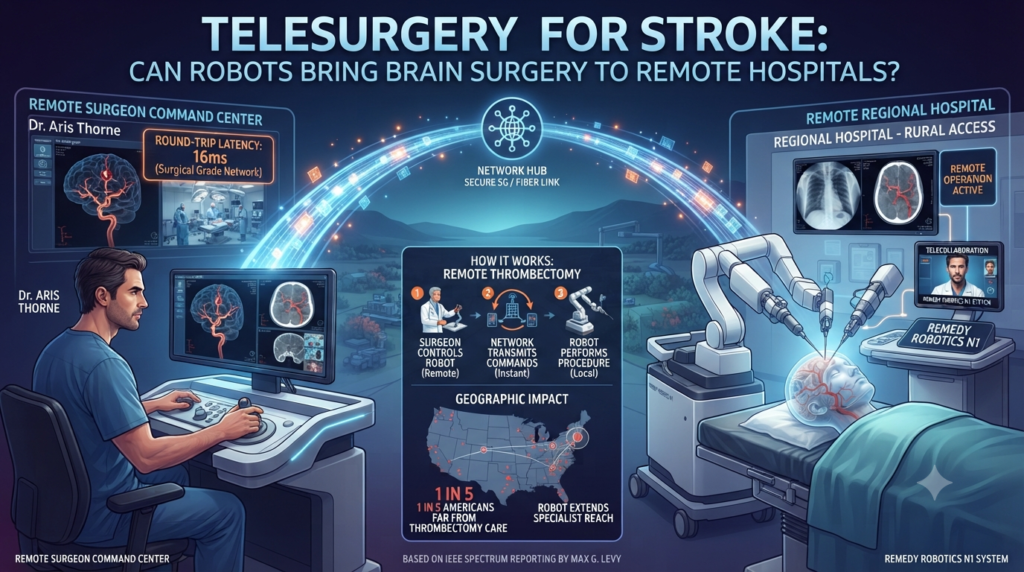
That mismatch is the problem a small San Francisco company is trying to solve. The idea is telesurgery for stroke: a surgeon sits in one location and operates a robot that sits beside the patient in another. It sounds like science fiction, but the first human tests have already happened, and the results raise real questions about how emergency medicine might change.
This guide goes beyond the headlines. It explains why stroke is such a natural target for remote robotics, how the technology works, where it could fail, and what hospital leaders, clinicians, and policymakers should do now. It draws on reporting by Max G. Levy for IEEE Spectrum, published November 16, 2026, with added context and practical takeaways.
Key Takeaways
- Around 5 million people worldwide suffer an ischemic stroke each year, and stroke is the fourth leading cause of death in the United States.
- Only about 1 in 10 patients eligible for a thrombectomy actually receives one, mostly because of geography and staffing.
- Remedy Robotics has run first-in-human tests of a remotely operated catheter robot, completing diagnostic procedures nearly twice as fast as the current standard.
- Network latency, hospital readiness, and regulatory approval are the biggest obstacles.
- Mid-size regional hospitals may be a better first target than the smallest rural clinics.
- No company has yet earned full regulatory approval for telesurgery, and no patient in the United States has been operated on remotely.
Why Stroke Care Has a Geography Problem
Stroke is a race against time, and the race is unfair. A blood clot starves part of the brain of oxygen, and a neurologist quoted in the original reporting estimates that roughly 2 million brain cells are lost every minute treatment is delayed. Faster treatment means better odds of walking out of the hospital without lasting disability.
The treatments themselves have improved enormously. Clot-busting drugs arrived in the mid-1990s, and mechanical thrombectomy, in which a clot is physically pulled out of an artery, followed about a decade later. Before that, many neurologists felt there was little they could do. Today a stroke can be a treatable event rather than a sentence of disability or death.
The catch is access. Consider these numbers:
- 1 in 10: the share of thrombectomy-eligible patients who receive the procedure.
- 1 in 5: the share of Americans who live more than an hour from a hospital offering thrombectomy.
- 2: the number of thrombectomy centers serving all of Alaska, both in Anchorage, which leaves more than half of the state’s residents out of practical range.
Mid-size and small hospitals usually can’t staff a round-the-clock thrombectomy team, so they stabilize the patient and transfer them. Every transfer burns time. The therapy exists, but the system that delivers it is concentrated in cities, and a stroke doesn’t care where you live.
How a Standard Thrombectomy Works (and Why It’s Hard)
To see why robots might help, it helps to know what surgeons do today.
In a standard thrombectomy, the surgeon makes a small opening, usually in the groin, and threads a thin guide wire through the blood vessels. A hollow catheter follows the wire. Once the tip reaches the clot in the brain, instruments pass through the catheter to dislodge or capture it, and everything is withdrawn.
It sounds methodical, but it is closer to navigating with a flashlight that only shows a flat shadow.
- The view is limited. The surgeon relies on live X-ray, which doesn’t show soft tissue like blood vessels. Brief injections of contrast dye light up the path, but only for a moment.
- The geometry is counterintuitive. The guide wire can twist inside the body. Because the surgeon sees a flat silhouette, steering left can rotate the wire to the right.
- The surgeon is physically distant from the action. The operator pushes the equipment by hand from well outside the body, often more than a meter from the catheter tip.
- Mistakes are costly. In more than 1 percent of thrombectomies, a vessel is accidentally cut open, a feared and sometimes fatal complication.
David Bell, a clinician and former cardiac-surgery trainee, experienced this firsthand and concluded that this was not the ideal way to do the job. That frustration became the seed of a company.
How the Remedy N1 Robot Rethinks the Procedure
Bell met bioengineer Jake Sganga at Stanford in 2019. Bell was finishing an MBA and hoping to find an engineer for a medical robot. Sganga had been building pathfinding algorithms for a robotic bronchoscope. They chose stroke because the clinical need was already proven and the cost of delay was obvious.
Their system, the Remedy Robotics N1, combines a robotic arm, snap-on instrument cartridges, a steerable catheter, and software. Three design choices stand out.
A Catheter That Steers Itself
Instead of relying on a guide wire to carve the route, Remedy’s catheter is steerable. A robotic arm outside the body advances it, while tiny wires pull the tip in any direction, a little like a worm feeling its way through narrow passages. Eliminating the guide wire removes one of the trickiest parts of the maneuver.
Computer Vision That Handles the Twist
Small markings on the catheter aren’t for the surgeon. They let a computer-vision algorithm track how the catheter is rotating inside the body. When the operator indicates “go right” on the X-ray image, the software converts that intention into the correct motion. The surgeon no longer has to mentally compensate for every twist in a 2D shadow.
A CT Overlay for Better Wayfinding
The system can overlay a pre-procedure CT scan onto the live X-ray feed. Vessels that were invisible on X-ray alone appear as bright three-dimensional routes. For a procedure often described as blind, that is a meaningful upgrade.
Even the controller is deliberately familiar. The prototype uses a game-style handheld controller, and the team’s goal is for operating it to feel easy and intuitive without trivializing the stakes.
Why Telesurgery for Stroke Is Getting Serious Attention Now
Remote surgery is not new. In 2001, surgeons in New York removed a patient’s gallbladder in Strasbourg, France, more than 6,000 kilometers away, in a milestone known as the Lindbergh Operation. It went off without complications.
Then, mostly, nothing happened. Companies chose to build robots that operate in the same room as the surgeon. That path was a commercial success: robots now assist in roughly 22 percent of surgeries, and more than 2 million operations were performed in 2023 on Intuitive’s da Vinci platform alone.
Remote operation has picked up momentum recently:
- In summer 2025, surgeons near Orlando, Florida, performed a prostate removal on a patient in Luanda, Angola, about 11,000 km away.
- Intuitive demonstrated “telecollaboration,” with surgeons on different continents working together on a tissue model.
- SS Innovations in India has tested cardiac telesurgery, and Texas-based XCath has tested a steerable guide wire for thrombectomies in Panama.
Why is telesurgery for stroke attracting so much interest compared with, say, remote appendix removal? Researchers argue that the best first use cases are emergencies where patients can’t reach specialists in time. Stroke, heart attack, and some fetal operations fit that description.
Vascular procedures also have a built-in safety advantage. As one robotics researcher at ETH Zurich noted, if the connection drops while the catheter is inside a vessel, the worst outcome is that it stops moving. There is no open cavity to manage and no organ-transplant choreography to coordinate. The operation can simply pause.
The Latency Problem: Can the Network Keep Up?
If you ask any engineer what could derail remote surgery, the answer is usually the same word: latency. It is the delay for a data packet to travel to its destination and back, measured in milliseconds.
| Setting | Typical round-trip latency | What it means for surgery |
|---|---|---|
| Major city with strong 5G or fiber | Tens of milliseconds | Comfortable margin for remote control |
| Many rural areas, even in the US | Can exceed 100 ms | Approaches or crosses commonly cited safety thresholds |
| Remedy’s design target | 150 ms or less (round trip) | System pauses all surgical action if exceeded |
| Average human reaction time | About 200 ms | Reference point for what feels responsive |
The reassuring news is that surgeons adapt. A review of five years of simulations and demonstrations in Japan found that operators slowed down and paused as needed to cope with lag. Remedy reports the same pattern in its own tests and says operators have proven resilient. The company also claims it recently ran the system across the Pacific using a mobile hotspot.
The less reassuring news is that many experts treat 100 milliseconds as the safe threshold, and a University of Washington team recently reported that many rural communities, and even most countries, struggle to meet it. Last June, specialists from five major robotics corporations co-authored technical standards for “surgical-grade networks,” a sign that the industry knows connectivity can’t be an afterthought.
Notice the irony. The places that most need remote stroke treatment are often the places with the weakest networks.
Where Telesurgery for Stroke Could Work Best
It is tempting to picture a robot in the smallest, most isolated clinic with a world-class surgeon beaming in from a big city. The reality is more complicated.
The Infrastructure Reality Check
A thrombectomy needs far more than a catheter robot. Hospitals also need neurologists, catheterization teams, CT scanners, and specialized intensive care units. The smallest and most remote facilities often lack several of these. As one researcher put it, this is fundamentally an infrastructure problem.
The Case for Mid-Size Regional Hospitals
A more realistic first target is the mid-size regional hospital in a stable town. These sites often have the volume, the imaging, and the nursing and ICU capacity, but not a full-time thrombectomy team. For them, telesurgery for stroke could supply the missing piece, a specialist’s hands, without a complete rebuild.
Training, Not Just Treating
One physician in Kenya raised an important caution: remote robotics could concentrate expertise in cities and widen the gap between wealthy and poor regions. The upside case is the opposite. A system that both treats patients and mentors local clinicians, a kind of digital operating room with an expert looking over your shoulder, could lift skills where they are needed. Remedy’s cofounders say that vision fits their mission.
Here is a quick framework for matching hospital type to telesurgery readiness:
| Hospital type | Network | Imaging and ICU | Staff | Telesurgery fit |
|---|---|---|---|---|
| Large urban stroke center | Strong | Full | Full | Low need, high capability |
| Mid-size regional hospital | Often adequate | Usually present | Partial | Strongest early candidate |
| Small rural hospital | Often weak | Limited | Minimal | High need, major barriers |
| Remote clinic | Weak or unreliable | Minimal | Minimal | Needs infrastructure first |
Early Evidence: What the Toronto Procedures Showed
The most important question isn’t whether the robot is smooth or precise. As Bell put it, those aren’t clinical outcomes. What matters is whether patients get treated who otherwise wouldn’t be, and whether they do better.
In September 2025, Remedy ran its first tests in human patients in Toronto. Ten patients consented to nonemergency procedures. A neurosurgeon operated six patients from an adjoining room, two elsewhere in the same hospital, and two at a different hospital across town. The procedures captured angiograms from inside patients’ vessels, and they were finished nearly twice as quickly as the current standard.
Earlier tests on lab animals suggested the robot collided with vessel walls less often than a human operator and finished faster. Speed matters because faster procedures let a hospital treat more people.
What comes next:
- Remedy announced $62 million in new funding to support clinical trials.
- The University of California system will host studies within about a year.
- Trials begin with on-site elective procedures, such as treating unruptured aneurysms.
- Remote procedures in Australia or within the University of California system are targeted for near the end of 2027.
Sganga stresses that the on-site trials are not just a stepping stone. If the system doesn’t improve operations when the surgeon is in the room, doctors won’t adopt it, and they won’t build the expertise to use it remotely.
The caveat is that telesurgery for stroke remains unproven at scale. No company has earned full regulatory approval for telesurgery beyond one-time demonstrations, and no patient has been operated on remotely in the United States. Ten procedures is a promising start, not proof.
The Hard Questions Nobody Should Skip
Even the founders acknowledge that remote operation raises uncomfortable questions.
- Skill erosion: If robots do more of the physical work, will surgeons lose hands-on proficiency?
- Platform dependence: Will trainees learn one vendor’s system and struggle elsewhere?
- Allocation: What happens if two stroke patients need the same remote surgeon at the same moment? Is one person’s emergency more important because of where they live? Bell says the answer is no, which makes the triage rule hard to design.
- Cybersecurity: A remotely controlled device in a patient’s blood vessels demands secure communications, which hospitals and vendors are only starting to work through.
- Human connection: Bell has even wondered whether showing the surgeon a photo or video of the patient’s face would preserve the emotional weight of the work.
Standard Thrombectomy vs. Robotic Remote Thrombectomy
| Factor | Standard thrombectomy | Robotic remote approach |
|---|---|---|
| Surgeon location | Beside the patient | Anywhere with a surgical-grade network |
| Navigation | Guide wire, X-ray silhouette, contrast puffs | Steerable catheter, CT overlay, computer-vision rotation tracking |
| Access | Limited to centers with 24-hour teams | Potentially extends specialists to regional hospitals |
| Main risk | Vessel injury in over 1 percent of cases | Latency, network failure, cybersecurity |
| Evidence | Decades of data | Early human feasibility tests |
| Regulatory status | Established standard of care | Not yet fully approved for telesurgery |
Actionable Insights: What to Do With This Information
If You Lead a Hospital or Health System
- Audit your stroke pathway. Measure door-to-transfer times and how many thrombectomy-eligible patients you send elsewhere. That is your baseline.
- Map your infrastructure. Check CT access, ICU capacity, catheterization staffing, and network performance. If you are evaluating telesurgery for stroke, these gaps matter more than the robot.
- Test your network now. Measure round-trip latency and consistency at peak times, not just average speed.
- Start conversations early. Trial sites are being chosen, and regional hospitals with the right foundation are strong candidates.
If You Are a Clinician
- Follow the on-site trials. Evidence that the system improves ordinary thrombectomies is the leading indicator of whether remote use will take off.
- Think about training. The mentorship model, where an expert guides local teams, may be as valuable as the treatment itself.
If You Work in Policy or Telecommunications
- Treat connectivity as clinical infrastructure. A staff editor at IEEE Spectrum pointed out that regulators may need to consider whether such links deserve special status or spectrum allocation.
- Clarify liability and licensing. A surgeon in one jurisdiction operating on a patient in another raises questions that existing rules weren’t written to answer.
If You Are a Patient Advocate or Caregiver
- Know your nearest stroke center. Find out how far away the closest thrombectomy-capable hospital is, and remember that speed to treatment, not the technology, is what counts today.
- Know the symptoms and call emergency services immediately. No future robot replaces fast recognition.
Frequently Asked Questions
What is robotic thrombectomy?
It is a thrombectomy in which a robotic system, rather than a surgeon’s hands, advances the catheter and instruments through the patient’s blood vessels to remove a clot. The surgeon controls the robot from a console, either in the same building or, in the remote case, from another location.
Is telesurgery for stroke approved for patients?
Not yet for routine use. Remedy has completed first-in-human tests, and larger clinical trials are planned, but no company has obtained full regulatory approval for telesurgery, and no patient in the United States has been operated on remotely.
Why not just transfer patients faster?
Transfers are slow and expensive, and in sparsely populated regions the nearest thrombectomy center may be hours away. Moving the expertise by network is potentially faster than moving the patient by ambulance or helicopter.
How much latency is too much?
Many experts consider 100 milliseconds a safe threshold. Remedy’s system targets a round trip of 150 milliseconds or less and pauses surgical action if it is exceeded. Surgeons also adapt to lag by moving more slowly.
Will robots replace neurointerventional surgeons?
Nothing in the current work suggests that. The surgeon remains the decision-maker, and the technology extends their reach. The bigger risk the founders discuss is skill erosion and over-dependence on specific platforms.
Conclusion: A Promising Idea That Still Has to Prove Itself
The logic behind telesurgery for stroke is compelling. Stroke is time-critical, thrombectomy is highly effective, and the shortage of specialists means too many patients never receive it. A robot that can steer a catheter with better visibility, and a network that can carry a surgeon’s hands across distance, could narrow that gap.
But the idea has to clear several hurdles, and none of them is purely technical. Networks must be reliable where they are weakest. Hospitals need the surrounding infrastructure. Regulators need evidence of real patient benefit, and the field must decide who gets the expert’s attention when two emergencies collide.
The most hopeful reading of the early results is not that robots will replace surgeons, but that they may extend what a good surgeon can reach. If the coming trials show that patients benefit, the question changes from whether remote stroke surgery is possible to how fairly and widely we can deploy it. For now, the best move for health systems and policymakers is to prepare the ground: measure the gaps, strengthen the networks, and watch the evidence closely.