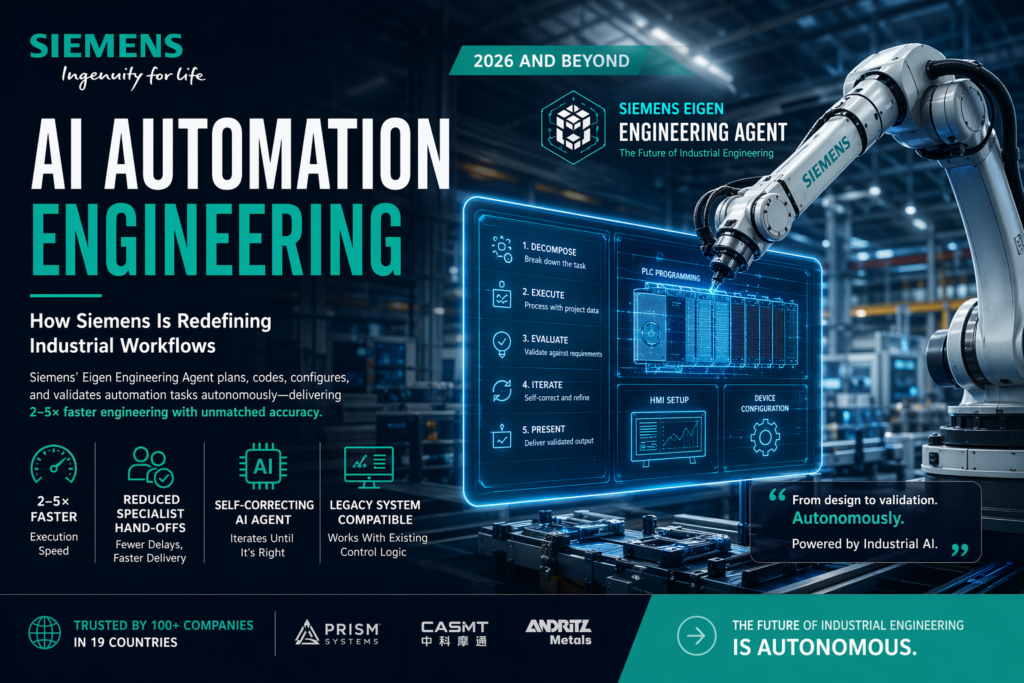
AI automation engineering is no longer a future concept — it is actively replacing manual engineering tasks on production floors today. Siemens’ newly launched Eigen Engineering Agent demonstrates precisely how agentic AI systems can plan, code, configure, and validate industrial automation workflows end-to-end, without human hand-holding at every step.
If you work in manufacturing, industrial operations, or systems engineering, this article breaks down what the technology does, how it performed in real deployments, and why the shift toward autonomous engineering agents is accelerating faster than most industry leaders anticipated.
What Is AI Automation Engineering?
Definition: AI automation engineering refers to the application of artificial intelligence — specifically reasoning-capable, multi-step AI agents — to plan, execute, and validate engineering tasks in industrial and manufacturing environments.
This is distinct from simple rule-based automation or robotic process automation (RPA). Where traditional tools follow rigid scripts, AI automation engineering systems interpret project requirements, generate code, configure devices, and self-correct until outputs meet predefined standards — all within the engineering platforms engineers already use.
Why does it matter now? The convergence of large language models capable of structured reasoning, deep integration with industrial platforms like SCADA and TIA Portal, and a widening skilled workforce gap has made this the right moment for AI to move from the lab into the control room.
Siemens Eigen Engineering Agent Explained
Siemens has introduced the Eigen Engineering Agent, an AI system designed to plan and validate automation engineering tasks in operational environments. artificialintelligence-news
This is not a chatbot layered on top of an engineering tool. It is a full agentic system embedded directly within Siemens’ industrial engineering stack.
The system uses multi-step reasoning and self-correction to carry out tasks autonomously and operates directly inside engineering platforms, letting it complete workflows from initial design through to validation. artificialintelligence-news
In plain terms: an engineer defines the goal, and the agent figures out the path, checks its own work, and hands back a validated result — not a draft.
How the Agent Works Step by Step
The agent is designed to interpret project requirements, generate automation code, configure industrial systems, and refine outputs until predefined performance targets are achieved. artificialintelligence-news This covers tasks including programmable logic controller (PLC) programming, human-machine interface (HMI) setup, and device configuration.
The execution model follows a structured loop:
- Decompose — The agent breaks the engineering problem into discrete, sequential sub-tasks.
- Execute — Each sub-task is processed using project-specific data.
- Evaluate — Outputs are tested against predefined requirements.
- Iterate — The agent self-corrects and refines until results pass validation.
- Present — Completed outputs are surfaced for engineer review and sign-off.
This iterative loop is the core of what makes AI automation engineering fundamentally different from generating code with a standard LLM — the system does not stop at generation; it keeps going until it’s right.
Integration with TIA Portal
One of the most significant technical differentiators of the Eigen Engineering Agent is where it lives. The system connects to Siemens’ Totally Integrated Automation Engineering platform, TIA Portal, letting it access project-specific data like structures and component relationships. artificialintelligence-news
This integration means the agent is not working from generic industrial knowledge. It can reference control logic, system hierarchies, and component dependencies in a project, allowing outputs to match existing engineering standards without requiring manual translation. artificialintelligence-news This is particularly valuable when dealing with legacy systems or complex undocumented environments — situations where junior engineers typically struggle and senior engineers are in short supply.
The Eigen Engineering Agent is integrated into Siemens’ TIA Portal, which has more than 600,000 users, and is available as part of the company’s Xcelerator portfolio. artificialintelligence-news
Real-World Deployments and Results
Theory is one thing. Pilot results are another. In pilot deployments involving more than 100 companies in 19 countries, the Siemens system was applied to standard automation engineering processes. Participating organisations included ANDRITZ Metals, CASMT, and Prism Systems. artificialintelligence-news
Here is what happened in practice:
Prism Systems used the Eigen Engineering Agent to generate and import structured control language (SCL) code. The result was a measurable reduction in execution time for these tasks — work that previously required specialist engineers working through multiple review cycles.
CASMT took the application further. CASMT applied the system to automate device configuration, code generation, and HMI visualisation in production line development, reporting reduced specialist hand-offs in engineering disciplines and shorter delivery timelines. artificialintelligence-news
Reduced specialist hand-offs is a significant operational outcome. In industrial engineering, every hand-off between an automation specialist, an HMI designer, and a systems integrator is a potential delay, version mismatch, or rework event. Eliminating those friction points directly translates to faster project delivery.
According to Siemens, the system executes tasks two to five times faster than manual workflows while maintaining accuracy. artificialintelligence-news
AI vs. Traditional Engineering Workflows: A Comparison
| Dimension | Traditional Engineering Workflow | AI Automation Engineering (Eigen Agent) |
|---|---|---|
| Task initiation | Engineer interprets requirements manually | Agent interprets requirements from project data |
| Code generation | Written by specialist engineers | Auto-generated, iterated until validated |
| Error detection | Manual review cycles | Continuous self-correction during execution |
| Legacy system handling | Requires experienced specialist | Agent reads existing control logic and adapts |
| HMI/Device configuration | Separate specialist disciplines | Handled within a single automated workflow |
| Speed | Baseline | 2–5× faster per Siemens pilot data |
| Specialist hand-offs | High (multiple disciplines) | Significantly reduced |
| Review by engineer | Throughout the process | At output stage only |
The table above highlights why AI automation engineering is attracting industrial investment at scale: it does not just speed up existing workflows, it fundamentally restructures how they are composed. The engineer shifts from executor to reviewer.
Key Benefits of AI Automation Engineering for Industrial Teams
For organizations evaluating whether to adopt agentic AI in their engineering operations, the benefits cluster into four areas:
- Speed without sacrificing accuracy. The self-correcting loop means the agent does not trade quality for pace. Outputs meet predefined validation criteria before an engineer sees them.
- Legacy system compatibility. Because the agent reads existing project structures, it can work within environments that have years of accumulated, often poorly documented, control logic — without requiring a clean-slate redesign.
- Reduced dependency on scarce specialists. By handling PLC programming, HMI setup, and device configuration in an integrated workflow, the agent reduces the number of specialist disciplines needed on any given project.
- Scalability across geographies. With deployments already running across 19 countries and over 100 organizations, the technology has demonstrated it can adapt to different industrial contexts and regulatory environments.
- Faster onboarding of new projects. Teams working on production line development can compress timelines by automating the configuration and visualization stages that typically consume the most calendar time.
The Workforce Gap AI Is Designed to Address
No analysis of AI automation engineering is complete without confronting the workforce reality that is driving its adoption.
Industry estimates point to a global shortfall of up to seven million manufacturing workers by 2030, with some sectors reporting that around one in five engineering roles remain unfilled. artificialintelligence-news
This is not a cyclical hiring dip. It is a structural gap between the complexity of modern industrial systems and the pipeline of engineers trained to operate them. Companies cannot hire their way out of it fast enough — which is why autonomous engineering agents are not a nice-to-have but a strategic necessity.
Surveys of manufacturing organisations indicate that while most companies report having large volumes of operational data, data quality and contextualisation remain important barriers. artificialintelligence-news This matters because AI automation engineering agents depend on good project data to generate reliable outputs. Organizations that invest in clean, structured engineering data now will extract significantly more value from these systems than those that do not.
In addition to general labour shortages, manufacturers also face a shortage of workers with the technical skills needed to run AI systems in industrial environments. artificialintelligence-news This means adoption of AI automation engineering is not simply about buying a software license — it requires building organizational capability around human-AI collaboration in engineering workflows.
What This Means for the Future of Industrial AI
The Eigen Engineering Agent is not an isolated product launch. It reflects a broader strategic direction that Siemens has been building toward for years.
The release follows Siemens’ previously announced €1 billion investment in industrial AI. The company reports having more than 1,500 AI specialists and over 2,000 AI-related patent families globally, supporting ongoing development of AI-based engineering and operational tools. artificialintelligence-news
That level of investment signals that industrial AI is entering its infrastructure phase — where AI stops being a feature added to existing tools and becomes the foundational layer through which engineering work is done.
Initial deployments focus on automation engineering workflows, but the system is structured to extend into other areas of the industrial value chain. artificialintelligence-news This means the architecture being established today — agents embedded in engineering platforms, reading project-specific data, executing and validating tasks autonomously — is designed to expand into procurement, maintenance planning, quality control, and supply chain optimization.
For industrial organizations, the strategic implication is clear: companies that integrate AI automation engineering into their core workflows now are not simply becoming more efficient. They are building a structural competitive advantage that will widen over the next five years as agent capabilities improve and the workforce gap deepens.
Three Things Industrial Leaders Should Do Now
- Audit your engineering data quality. AI agents are only as good as the project data they ingest. Structured, clean data is the prerequisite for accurate autonomous outputs.
- Identify the highest-friction hand-off points in your engineering workflows. These are where AI automation engineering delivers the fastest and most measurable ROI — fewer specialists needed, fewer review cycles, shorter timelines.
- Build a human-AI collaboration framework. The role of the engineer is shifting from executor to validator and reviewer. Training, workflow design, and accountability structures need to reflect that shift before the tools are deployed.
Frequently Asked Questions
What is the Siemens Eigen Engineering Agent? It is an AI automation engineering system that autonomously plans, generates code, configures industrial systems, and validates outputs within Siemens’ TIA Portal platform. It uses multi-step reasoning and self-correction to complete tasks from design to validation without constant human intervention.
How much faster is AI automation engineering than manual methods? According to Siemens’ pilot data, the Eigen Engineering Agent executes tasks two to five times faster than manual workflows while maintaining engineering accuracy standards.
What types of tasks can AI automation engineering handle? Current capabilities include PLC programming, HMI setup, device configuration, structured control language (SCL) code generation, and production line development workflows. The system is designed to extend into other areas of the industrial value chain over time.
Does the system work with legacy industrial equipment? Yes. A key design feature is that the agent reads existing control logic, system hierarchies, and component dependencies within a project. This allows it to generate outputs aligned with legacy environments without requiring a system redesign or manual translation by a specialist.
What is the biggest barrier to adopting AI automation engineering? Data quality and contextualisation are the most commonly cited barriers in manufacturing. Organizations that have not structured and cleaned their operational and engineering data will find adoption significantly harder than those that treat data infrastructure as a prerequisite.
What is AI automation engineering and how does it work?
AI automation engineering is the use of advanced artificial intelligence systems—especially agent-based AI—to automate complex engineering tasks in industrial environments. Unlike traditional automation tools that rely on fixed rules, AI automation engineering systems can interpret requirements, generate code, configure machines, and validate outputs autonomously.
These systems typically follow a structured workflow: they break down engineering problems into smaller tasks, execute each step using project data, evaluate results against predefined conditions, and refine outputs until they meet quality standards. This iterative, self-correcting process is what makes AI automation engineering significantly more efficient and reliable compared to manual engineering workflows.
How is AI automation engineering different from traditional automation?
Traditional automation depends on pre-programmed rules and requires engineers to manually write, test, and debug code at every stage. In contrast, AI automation engineering introduces intelligent agents that can reason through problems and adapt dynamically.
For example, instead of manually coding PLC logic, an AI system can generate the code, test it, and fix errors automatically. This reduces the need for repeated human intervention. Additionally, AI automation engineering systems can handle multiple engineering disciplines—such as PLC programming, HMI configuration, and device setup—within a single workflow, whereas traditional methods often require multiple specialists.
What industries benefit the most from AI automation engineering?
AI automation engineering is particularly impactful in industries that rely heavily on complex machinery and production systems. These include manufacturing, automotive, energy, pharmaceuticals, and logistics.
In manufacturing environments, AI automation engineering can streamline production line development, reduce downtime, and accelerate system deployment. In energy and utilities, it can optimize control systems and improve reliability. Essentially, any industry that depends on industrial automation systems can benefit from faster execution, fewer errors, and improved scalability offered by AI-driven engineering.
Can AI automation engineering work with legacy industrial systems?
Yes, one of the biggest advantages of AI automation engineering is its ability to integrate with legacy systems. Modern AI agents can read existing control logic, system architectures, and component relationships within older setups.
This means companies do not need to completely overhaul their infrastructure to adopt AI. Instead, AI automation engineering systems can adapt to existing environments, generate compatible outputs, and even improve outdated workflows. This capability is especially valuable for organizations with years of accumulated engineering data and complex system dependencies.
How much efficiency improvement can AI automation engineering deliver?
Efficiency gains from AI automation engineering can be substantial. In real-world deployments, organizations have reported task execution speeds improving by two to five times compared to traditional methods.
These improvements come from reduced manual coding, fewer review cycles, and minimized errors during implementation. Additionally, AI systems reduce delays caused by hand-offs between different engineering specialists. The result is faster project delivery, lower operational costs, and improved overall productivity.
What challenges do companies face when adopting AI automation engineering?
Despite its advantages, adopting AI automation engineering comes with challenges. The most common issue is data quality. AI systems rely on structured and accurate project data to generate reliable outputs. If data is incomplete or poorly organized, the effectiveness of AI solutions decreases significantly.
Another challenge is the skills gap. While AI reduces the need for certain manual tasks, it increases the demand for professionals who understand how to work alongside AI systems. Organizations must invest in training and develop workflows that support human-AI collaboration to fully realize the benefits.
Is AI automation engineering replacing human engineers?
AI automation engineering is not replacing engineers but transforming their roles. Instead of spending time on repetitive tasks like coding and debugging, engineers are shifting toward higher-level responsibilities such as reviewing outputs, validating systems, and making strategic decisions.
This shift allows engineers to focus on innovation and problem-solving rather than routine execution. In fact, AI automation engineering helps organizations do more with fewer resources, addressing workforce shortages while enhancing the capabilities of existing teams.
What is the future of AI automation engineering in industrial environments?
The future of AI automation engineering is highly promising. As AI models become more advanced and better integrated with industrial platforms, their capabilities will expand beyond engineering into areas like predictive maintenance, quality control, and supply chain optimization.
Over time, AI automation engineering is expected to become the standard approach for industrial operations. Companies that adopt it early will gain a competitive advantage through faster innovation cycles, improved efficiency, and better resource utilization. As the technology matures, it will play a central role in shaping the next generation of smart factories and autonomous industrial systems.
Conclusion
AI automation engineering is not arriving gradually — it is already in production across more than 100 industrial organizations in 19 countries. Siemens’ Eigen Engineering Agent represents the clearest signal yet that the engineering workflow of the future is agentic: AI systems that plan, build, validate, and iterate, with human engineers reviewing outcomes rather than generating every intermediate step.
The workforce gap is real, the technology is validated, and the competitive pressure to adopt is intensifying. For industrial teams, the question is no longer whether to engage with AI automation engineering — it is how quickly they can build the data quality, workflow design, and human-AI collaboration capability to make it work at scale.