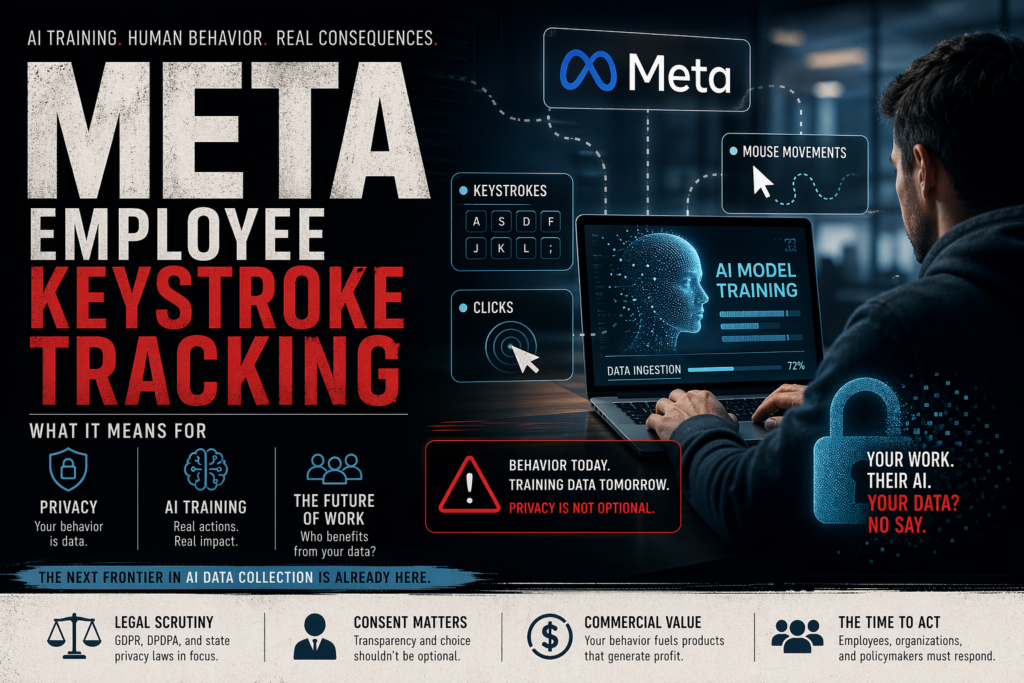
Meta is recording the mouse movements and keystrokes of its own employees to train its AI models — and this signals a seismic shift in where tech giants are willing to look for data. If you work at a major tech company, your typing habits may already be part of someone’s AI roadmap.
What Is Meta Employee Keystroke Tracking — And Why It Matters Now
Definition: Meta employee keystroke tracking refers to Meta Platforms’ newly announced internal program that captures how employees move their cursors, click buttons, and navigate software interfaces — and feeds that raw behavioral data directly into AI model training pipelines.
This is not a security audit tool. It is not HR surveillance for productivity monitoring. It is a deliberate data-harvesting initiative designed to teach Meta’s AI agents how real humans interact with computers.
Reported first by Reuters and confirmed by TechCrunch on April 21, 2026, the initiative represents one of the most direct examples yet of a tech giant mining its own workforce to fuel its artificial intelligence ambitions. For anyone tracking the intersection of workplace rights and AI development, Meta employee keystroke tracking is the story of 2026.
How Meta Plans to Collect and Use Employee Data
What Data Is Being Captured
According to Meta’s official statement, the company is launching an internal tool that captures:
- Mouse movements — the physical path a cursor takes across a screen
- Button clicks — which interface elements employees interact with
- Dropdown navigation — how employees traverse menus, settings, and workflows
- Application-level inputs — behavioral signals within specific, designated software
The goal, Meta says, is to give its AI models “real examples of how people actually use” computers. The company argues that if it wants to build AI agents capable of completing everyday computer-based tasks, the models need authentic human behavioral data — not synthetic approximations.
This is a legitimate AI engineering argument. Teaching a model to navigate a spreadsheet by watching thousands of real humans do it is fundamentally different from programming a set of deterministic rules.
What Safeguards Has Meta Announced
Meta’s spokesperson stated there are “safeguards in place to protect sensitive content” and that the data “is not used for any other purpose” beyond AI model training.
However, the company has not publicly specified:
- Which applications are included in the capture scope
- Whether employees can opt out
- How long raw behavioral data is retained before anonymization or deletion
- What third-party audits, if any, govern the program
The lack of granular transparency is precisely what has raised alarms among privacy advocates and labor rights experts.
The Bigger Picture — A Growing AI Training Data Crisis
Meta employee keystroke tracking does not exist in isolation. It is the latest symptom of an industry-wide scramble for novel training data — what AI researchers sometimes call the “data hunger” problem.
Large language models and multimodal AI systems require enormous volumes of high-quality, diverse data to improve. The low-hanging fruit — publicly available web text, books, Wikipedia, open-source code — has largely been consumed by the first generation of frontier models. The industry is now looking inward.
Where Else Is Big Tech Sourcing Training Data
The week before the Meta keystroke story broke, Forbes reported that defunct startups were being mined for their corporate communications archives: Slack messages, Jira tickets, internal memos, email threads. The implicit logic is identical — authentic human communication in professional contexts is richer and more task-relevant than generic internet text.
This creates a pattern worth naming:
| Data Source | Type of Signal | Privacy Risk Level |
|---|---|---|
| Public web scraping | Language, facts, opinions | Low–Medium |
| Licensed book/article datasets | Long-form reasoning, style | Low |
| Corporate Slack/email archives | Professional communication | High |
| Employee keystroke/mouse data | Computer-use behavior | Very High |
| Synthetic data generation | Programmatic patterns | Very Low |
Meta employee keystroke tracking occupies the highest-risk tier on this spectrum because it captures behavior from identified, living individuals in an employment relationship — where the power dynamics around consent are inherently complicated.
What This Means for Workplace Privacy Rights
Are Employees Truly Consenting
This is the central ethical question, and it does not have a comfortable answer.
Employment relationships are not peer relationships. When a company installs a data-collection tool on work hardware and an employee continues to use that hardware, is that meaningful consent? Legal scholars have long debated the distinction between informed consent and coerced compliance in employment contexts.
Several factors complicate the consent picture here:
- Asymmetric power: Employees may fear professional consequences for objecting to a company initiative framed as an AI advancement project
- Opacity of scope: Without a clear public opt-out mechanism, employees may not fully understand what is being captured or when
- Commercial repurposing: The data collected from everyday work tasks is being transformed into a commercial asset — AI model weights — that Meta will monetize indefinitely
- Residual risk: Even with anonymization, behavioral biometrics like typing cadence and mouse movement patterns have been shown in academic research to be re-identifiable
Legal and Regulatory Risks
The regulatory landscape around employee monitoring and AI training data is actively evolving. Key jurisdictions to watch:
European Union: The GDPR imposes strict requirements on the processing of personal data, including behavioral data, even in employment contexts. Legitimate interest arguments are increasingly challenged by data protection authorities. Meta’s EU operations will face scrutiny.
United States: The U.S. lacks a comprehensive federal employee privacy law, but several states — California (CPRA), Colorado, and Virginia — have enacted consumer privacy frameworks that may apply to employee data depending on interpretation. Additionally, the National Labor Relations Board has historically treated certain forms of workplace monitoring as potential unfair labor practices.
India: Given India’s Digital Personal Data Protection Act (DPDPA) of 2023 now in enforcement phase, multinational firms with Indian employees face compliance obligations that specifically address consent mechanisms for data collection.
Comparison — Internal Data Harvesting vs. Public Data Scraping
Why is Meta employee keystroke tracking more controversial than scraping the public web? The answer lies in four structural differences:
1. Identifiability Public web data is typically pseudonymous or anonymous at the point of collection. Employee behavioral data is tied, at least initially, to a specific person with an employment record, HR file, and corporate identity.
2. Contextual Integrity The philosopher Helen Nissenbaum’s concept of “contextual integrity” holds that information flows appropriately when they match the norms of the context in which data was shared. An employee navigating a project management tool did not share that behavior with the expectation it would become training data for a commercial AI product.
3. The Relationship of Dependency Web publishers who object to scraping can implement robots.txt restrictions, legal challenges, or paywalls. Employees who object to keystroke capture have no analogous technical recourse on company-owned hardware.
4. Monetization Without Compensation When employee behavior becomes embedded in AI model weights, it generates commercial value. The employee receives no share of that value, no royalty, and no credit.
What Should Employees and Organizations Do Now
For Individual Employees
If you work at Meta or at any company signaling a similar initiative, here are concrete steps to take:
- Read your employment agreement carefully, particularly clauses related to intellectual property, data collection, and consent to monitoring. Many modern tech employment contracts contain broad data-rights provisions that employees sign without scrutiny.
- Ask HR or legal directly whether a keystroke or mouse-tracking program exists and request a written policy document.
- Document your objections in writing if you choose to raise them — both for your own records and to create an audit trail.
- Consult an employment lawyer if you believe the scope of collection violates applicable state or national privacy laws.
For Organizations Considering Similar Programs
Companies thinking about implementing internal behavioral data collection for AI training should proceed with caution and rigor:
- Conduct a Data Protection Impact Assessment (DPIA) before deployment, even if not legally required in your jurisdiction
- Establish a genuine opt-out mechanism — not just a nominal one — and communicate it clearly before rollout
- Define strict data minimization principles: capture only what is necessary for the stated training purpose
- Engage employees as stakeholders, not just data sources. Explain the purpose, scope, retention period, and downstream use in plain language
- Involve legal, HR, and ethics review as co-owners of the initiative, not just advisors
For Policymakers
Meta employee keystroke tracking illustrates a gap that lawmakers must address: the absence of clear rules governing the use of employee-generated behavioral data as AI training material. Existing frameworks were not designed for this use case.
Regulators should consider:
- Explicit consent requirements before behavioral biometric data can be used for AI training
- Mandatory disclosure of which data types are collected and their retention schedule
- Compensation frameworks or at minimum transparency mechanisms when employee data generates commercial AI value
The Ethical Fault Line in AI Development
Meta employee keystroke tracking crystallizes a tension that will define the next decade of AI development: the insatiable data appetite of AI systems versus the privacy and dignity rights of the people whose behavior feeds them.
This is not a question with easy answers. The case for behavioral training data is technically sound — AI agents that can operate computers need to learn from real computer use, not just from text descriptions of it. The capability gains that flow from authentic behavioral data are real and significant.
But capability is not the only value at stake.
The precedent being set matters. If it becomes normalized for employers to treat employee behavior — keystrokes, mouse movements, communication patterns — as raw material for commercial AI products without meaningful consent and compensation, the employment relationship is fundamentally altered. Workers become unwitting data contributors to systems that may eventually automate their own roles.
The story of Meta employee keystroke tracking is therefore not just a privacy story. It is a story about power, about who benefits from AI advancement, and about whether the humans who generate the data that makes AI possible will have any say in how that data is used.
As AI training data becomes scarcer and more valuable, the pressure on companies to find new sources — including from within their own walls — will only intensify. The question is whether the regulatory and ethical frameworks we build now will be strong enough to protect the people caught in the middle.
Frequently Asked Questions (FAQ)
1. What is Meta employee keystroke tracking?
Meta employee keystroke tracking refers to an internal initiative where Meta records how employees interact with their computers—capturing mouse movements, keystrokes, clicks, and navigation patterns. Unlike traditional monitoring tools used for productivity or security, this system is designed specifically to collect behavioral data for training AI models. The purpose of Meta employee keystroke tracking is to help AI systems learn from real human interactions instead of relying only on synthetic datasets or generalized internet data.
2. Why is Meta using employee behavior data for AI training?
The main goal behind Meta employee keystroke tracking is to improve AI performance using real-world behavioral data. AI systems that interact with software interfaces need practical examples of how humans navigate tasks. By using Meta employee keystroke tracking, the company can train models to replicate natural workflows, decision-making patterns, and user behavior. This approach helps build smarter AI agents capable of handling real tasks more efficiently.
3. Is Meta employee keystroke tracking legal?
The legality of Meta employee keystroke tracking depends on regional laws and compliance frameworks. In the European Union, GDPR requires transparency and explicit consent for behavioral data collection. In the United States, laws vary by state, while India’s Digital Personal Data Protection Act (DPDPA) emphasizes consent and purpose limitation. Meta employee keystroke tracking may face regulatory scrutiny if it lacks clear disclosure or proper safeguards.
4. Are employees required to consent to Meta employee keystroke tracking?
Consent is a major concern in Meta employee keystroke tracking. While companies may include consent clauses in employment contracts, the reality is more complex. Employees may feel obligated to accept such policies due to job security concerns. This raises ethical questions about whether participation in Meta employee keystroke tracking is truly voluntary or influenced by workplace power dynamics.
5. What kind of data is collected through Meta employee keystroke tracking?
Meta employee keystroke tracking collects several types of behavioral data, including typing patterns, cursor movements, clicks, and navigation flows within software applications. This data helps AI models understand how users interact with digital systems. However, even without capturing actual content, Meta employee keystroke tracking can reveal sensitive behavioral patterns that may be unique to individuals.
6. Can data from Meta employee keystroke tracking be anonymized?
Although Meta claims to apply safeguards, anonymizing data from Meta employee keystroke tracking is challenging. Behavioral signals like typing rhythm and mouse movement patterns can act as identifiers. This means that even anonymized datasets from Meta employee keystroke tracking could potentially be re-identified using advanced analytics, raising serious privacy concerns.
7. How is Meta employee keystroke tracking different from traditional monitoring?
Traditional monitoring focuses on productivity, attendance, or security, while Meta employee keystroke tracking is aimed at AI development. Instead of evaluating employee performance, it transforms behavioral data into training material for AI models. This makes Meta employee keystroke tracking fundamentally different, as it converts everyday work actions into long-term commercial assets.
8. What are the privacy risks of Meta employee keystroke tracking?
Meta employee keystroke tracking introduces multiple privacy risks. These include over-collection of data, lack of transparency, and potential misuse. Behavioral data collected through Meta employee keystroke tracking can expose patterns about how individuals think and work. If this data is breached or misused, it could have serious implications for employee privacy and security.
9. Could Meta employee keystroke tracking become an industry trend?
Yes, Meta employee keystroke tracking may set a precedent for other companies. As AI systems demand more high-quality training data, organizations may adopt similar approaches. This could lead to widespread adoption of behavioral data collection practices inspired by Meta employee keystroke tracking, especially in tech-driven industries.
10. Do employees benefit from Meta employee keystroke tracking?
Currently, employees do not receive direct compensation from Meta employee keystroke tracking. While companies benefit from improved AI systems, the individuals generating the data often see no financial return. This raises concerns about fairness and whether employees should share in the value created through Meta employee keystroke tracking.
11. What can employees do about Meta employee keystroke tracking?
Employees concerned about Meta employee keystroke tracking should review company policies and employment agreements carefully. Asking for transparency about data collection practices is important. If necessary, employees can document concerns or seek legal advice. Awareness is key when dealing with systems like Meta employee keystroke tracking.
12. What does Meta employee keystroke tracking mean for the future of work?
Meta employee keystroke tracking highlights a major shift in how companies use data. As AI continues to evolve, human behavior is becoming a valuable resource. This could reshape workplace dynamics, where employees are not just workers but also contributors to AI training. The long-term impact of Meta employee keystroke tracking will depend on how organizations balance innovation with privacy and ethics.
Key Takeaways
- Meta is deploying an internal tool to capture mouse movements, keystrokes, and navigation behavior from employees to train its AI models
- The initiative is part of a broader industry trend as AI companies exhaust traditional public data sources
- Employee consent in corporate monitoring contexts is structurally complicated by power dynamics and contract opacity
- The program faces potential regulatory scrutiny under GDPR (EU), state privacy laws (US), and India’s DPDPA
- Behavioral biometric data poses higher re-identification risks than most other training data categories
- Employees, organizations, and policymakers each have distinct and urgent responsibilities to address this new frontier