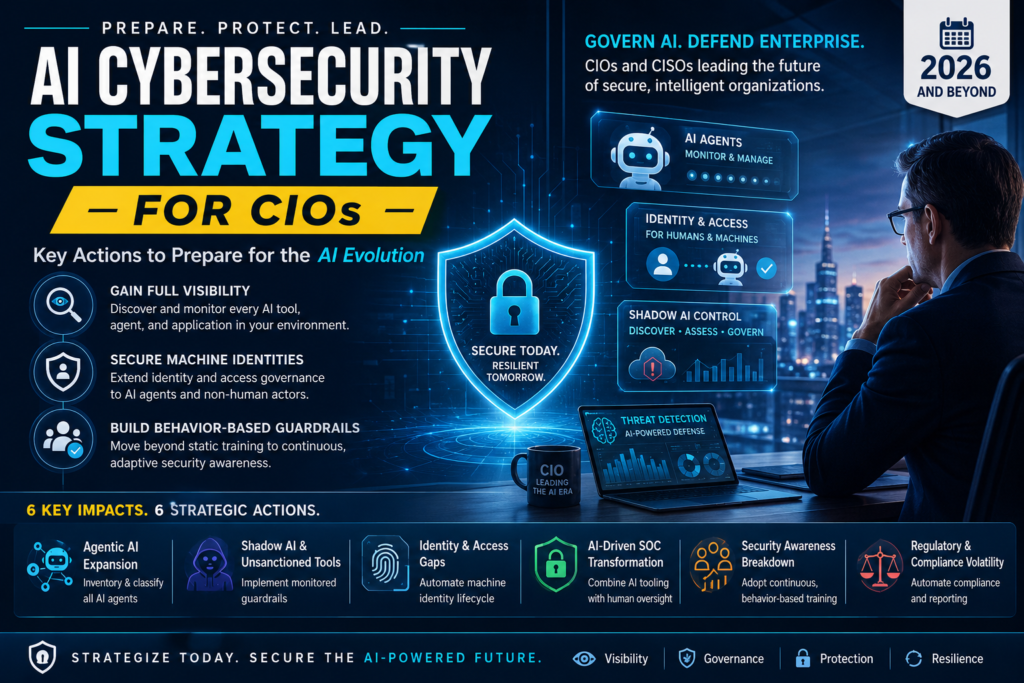
AI hasn’t just changed the tools your organization uses — it has changed the entire threat landscape. A strong AI cybersecurity strategy starts with three moves: gain full visibility into every AI tool and agent running in your environment, extend identity governance to machine actors, and replace static security awareness training with behavior-based guardrails.
That’s the short answer. The longer answer — the one CIOs and CISOs actually need to act on in 2026 — involves understanding exactly how AI is reshaping attack surfaces, where the biggest governance gaps sit today, and which specific actions close them. This guide walks through all of it.
What Is an AI Cybersecurity Strategy (and Why CIOs Need One Now)
An AI cybersecurity strategy is a coordinated framework — jointly owned by the CIO and CISO — for governing how artificial intelligence is used, secured, and monitored across an organization, while also defending against AI-powered attacks from outside the organization.
This is a broader mandate than a traditional security roadmap. A conventional cybersecurity strategy focuses on protecting infrastructure, applications, and data. This governance layer has to do that and also cover a new category of actor: the AI agent. Autonomous systems now scan network traffic, analyze logs, initiate responses, and make data-sharing decisions with little or no human review. Gartner’s own research frames this shift bluntly: AI has moved from being a tool inside cybersecurity to being a variable that reshapes cybersecurity itself.
Why now? Because the numbers have crossed a threshold that CIOs can no longer treat as a future problem:
- A Gartner poll of 147 CIOs found that 24% had already deployed AI agents and 50% were actively experimenting with them.
- Gartner projects that 40% of enterprise applications will include task-specific AI agents by the end of 2026, up from under 5% in January.
- Global information security spending is projected to reach $244.2 billion in 2026, up 13.3% year-over-year, yet enterprises are investing roughly 17 times more in AI-powered security tools than in securing the AI those tools depend on.
That gap — heavy investment in AI-powered defense, minimal investment in AI governance — is the single biggest reason CIOs need a dedicated AI cybersecurity strategy rather than treating AI as one more item on the existing roadmap.
How AI Is Reshaping the Cybersecurity Threat Landscape
Before building a strategy, it helps to understand precisely what has changed. Four shifts stand out.
Attackers Are Using AI to Scale and Refine Attacks
Bad actors now use generative AI to write more convincing phishing emails, automate reconnaissance, and iterate on attack techniques faster than defenders can patch for them. This lowers the barrier to entry for less sophisticated attackers while letting advanced groups operate at greater scale, which is part of why traditional, signature-based defenses increasingly fall behind.
Attack Surfaces Have Expanded Across Digital, Physical, and Sensor Environments
AI adoption isn’t confined to software. Sensor-based systems, IoT devices, and physical infrastructure connected to AI models all introduce new points of entry. Every new AI-enabled application, browser plugin, or personal assistant effectively resets the security perimeter CIOs are responsible for.
Shadow AI Is Creating Governance Blind Spots
Employees are adopting generative AI tools faster than IT departments can approve, monitor, or secure them. This single trend — usually called shadow AI — has become one of the most urgent problems inside any modern AI security program, and it deserves its own section below.
Regulations Are Shifting Faster Than Security Teams Can Respond
Data sovereignty rules, AI-specific disclosure requirements, and incident reporting windows (in some jurisdictions as short as 24 hours) are evolving quickly. Cybersecurity leaders now need cross-functional coordination with legal, procurement, and compliance teams just to keep pace with obligations tied to AI use.
The Six AI-Driven Impacts on Enterprise Cybersecurity
Gartner’s cybersecurity research groups the effects of AI on the enterprise into six connected impact areas, spanning attacker behavior, agent proliferation, identity, security operations, and workforce readiness. Each requires a distinct, paired response from the CIO and CISO.
| AI-Driven Impact | What’s Happening | Primary CIO/CISO Action |
|---|---|---|
| Agentic AI expansion | AI agents built via no-code/low-code tools and “vibe coding” proliferate faster than governance can track them | Inventory every agent; classify by autonomy and access level |
| Shadow AI & unsanctioned tools | Employees use personal AI accounts and unapproved apps for work tasks | Replace blanket bans with monitored, collaborative guardrails |
| Identity & access management gaps | Machine identities (agents) need credentials, but IAM wasn’t built for non-human actors | Extend IAM to agents; automate credential lifecycles |
| AI-driven SOC transformation | AI-enabled security operations centers change staffing, triage, and cost models | Pair AI tooling with human-in-the-loop oversight and upskilling |
| Breakdown of security awareness training | Static, once-a-year training can’t keep pace with GenAI-driven social engineering | Shift to continuous, behavior-based awareness programs |
| Regulatory and compliance volatility | AI-specific rules and short reporting windows increase compliance exposure | Build automated compliance workflows with legal and procurement |
This table is the core of an effective AI governance framework: it maps each systemic shift to a concrete, ownable action rather than leaving CIOs to react impact by impact.
Shadow AI: The Governance Gap CIOs Can’t Ignore
Of the six impact areas, shadow AI deserves particular attention because of how widespread it already is — and because it’s the area most directly within a CIO’s control.
Recent industry data paints a consistent picture:
- 79% of organizations report that employee use of AI tools is not aligned with acceptable use policy, and 53% have deployed custom-built AI agents.
- A Gartner survey found 57% of employees use personal GenAI accounts for work purposes, while 33% admit to uploading sensitive information to tools their organizations haven’t sanctioned.
- Only 20% of cybersecurity teams report highly beneficial results from their GenAI use cases so far, meaning most organizations are absorbing shadow AI risk without yet seeing proportional value.
The instinct to simply block unsanctioned AI tools tends to backfire. Gartner’s own guidance is to treat shadow AI as inevitable and design around it: replace control-heavy, centrally mandated policies with collaborative models that increase business accountability, monitor behavior and exception patterns, and co-create guardrails that employees will actually follow rather than route around. An AI cybersecurity strategy built on outright prohibition tends to just push usage further underground; one built on visibility and shared accountability has a much better chance of reducing real exposure.
Building an AI Cybersecurity Strategy: Key Actions for CIOs
With the landscape and the six impact areas in view, here’s what this looks like in practice for CIOs.
1. Establish Risk-Based Governance for AI Agents
Not every AI agent carries the same risk. A chatbot answering FAQs is not the same as an autonomous agent with write access to financial systems. Classify every agent — sanctioned or shadow — by autonomy level, data sensitivity, business criticality, and system access. Use that classification to determine which agents need human-in-the-loop approval, which need continuous monitoring, and which can run with lighter oversight. This risk-based approach is the foundation Gartner recommends for scaling governance without slowing the business down.
2. Extend Identity and Access Management to Machine Identities
Traditional IAM was built for human users. AI agents now need their own identity registration, automated credential lifecycles, and policy-driven authorization. Treat every agent as a machine identity requiring least-privilege access, not as an extension of the human who built it. Skipping this step is one of the fastest ways to create access-related incidents as autonomous agents multiply across the business.
3. Replace Static Awareness Training with Behavior-Based Guardrails
Annual security awareness training was already struggling before generative AI arrived; AI-generated phishing and deepfake-driven social engineering have made it close to obsolete on its own. Pair ongoing, scenario-based training with real-time monitoring of risky behavior — unusual data uploads, unsanctioned tool usage, unusual login patterns — so guardrails activate at the moment of risk rather than months after a training session.
4. Calibrate Security Investment Against Real, Current Threats
Given that enterprises are currently spending far more on AI-powered security tools than on securing the AI those tools rely on, CIOs should audit where AI security budget is actually going before approving new tools. A useful gut-check: does this investment address a governance gap identified in your agent inventory, or is it responding to hype? Gartner has explicitly warned that AI adoption driven by fear of missing out leads to wasteful spending and disappointing results.
5. Build Cross-Functional Collaboration Between CIO, CISO, Legal, and Procurement
No single leader can own every AI-related risk. The most effective governance model treats the CISO as an influence-driven partner to the business rather than the sole owner of every control — establishing frameworks and standards, then distributing accountability to business units, legal, procurement, and the CDAO. This also matters for compliance: with incident reporting windows sometimes as tight as 24 hours, coordination has to be built into the process ahead of time, not improvised during a breach.
The Parallel Deadline: Post-Quantum Cryptography
AI isn’t the only force compressing CIO timelines. Quantum computing has moved from a ten-year planning horizon to a 2030 action deadline, and it needs to sit inside the same roadmap as your AI security work rather than a separate track.
The logic is straightforward: once quantum computers can break current public-key encryption, any sensitive data captured today — and stored by an adversary for later decryption — becomes retroactively exposed. Long-lived data (health records, financial histories, trade secrets, government files) is most at risk, because “harvest now, decrypt later” attacks only need to succeed once.
Three moves belong on the CIO’s roadmap this year:
- Inventory cryptography across systems, applications, and vendor contracts to identify where traditional encryption is used.
- Build cryptographic agility so systems can swap in post-quantum algorithms without a full rebuild.
- Prioritize migration for long-lived, high-sensitivity data and systems first, since these carry the greatest exposure if quantum decryption arrives before migration is complete.
Security spending confirms this isn’t theoretical anymore: dedicated quantum-security investment is projected to pass 5% of overall IT security budgets in 2026, up from a research line item just a couple of years earlier. Early movers get ahead of the cost curve; late movers face rip-and-replace bills that compound with every quarter of delay.
A 90-Day Roadmap for CIOs
Turning all of this into action doesn’t require a multi-year transformation program before results start showing up. A focused first 90 days looks like this:
Days 1–30: Get visibility. Inventory every AI tool, model, and agent in use — sanctioned and shadow. Include no-code and low-code platforms, since these are where unmanaged agents tend to multiply fastest. You cannot govern what you cannot see, and this discovery phase is the prerequisite for every action that follows.
Days 31–60: Classify and prioritize. Score each discovered agent and tool by autonomy, data sensitivity, and system access. Use that scoring to decide where to apply human-in-the-loop controls immediately versus where lighter monitoring is sufficient. This is also the point to start extending identity and access management to machine identities, beginning with the highest-risk agents first.
Days 61–90: Formalize governance and communicate. Publish clear, usable AI guidance that maps to existing security policy rather than creating a parallel bureaucracy. Brief the board and executive team on where the organization is exposed and what’s being prioritized next, using plain evidence rather than hype-driven language. Establish the recurring cross-functional cadence — CIO, CISO, legal, procurement — that will keep governance current as new AI tools and agents continue to appear.
This roadmap won’t close every gap in a quarter, but it converts an overwhelming, organization-wide problem into a sequence of ownable steps — which is exactly what a durable AI cybersecurity strategy needs to hold up over time.
AI Cybersecurity Strategy vs. Traditional Cybersecurity Strategy: What’s Different?
| Dimension | Traditional Cybersecurity Strategy | AI Cybersecurity Strategy |
|---|---|---|
| Primary actors defended against | Human attackers, malware | Human attackers plus AI-scaled attacks and rogue/shadow agents |
| Identity scope | Human user accounts | Human users and machine/agent identities |
| Governance model | Centralized policy, periodic review | Collaborative, continuous, behavior-based monitoring |
| Awareness training | Annual or quarterly sessions | Continuous, scenario-based, tied to real-time behavior |
| Investment focus | Perimeter and endpoint tools | Perimeter tools and dedicated AI/agent governance |
| Regulatory pressure | Established, relatively stable | Fast-moving, AI-specific, shorter reporting windows |
The pattern across every row is the same: this approach doesn’t replace traditional cybersecurity fundamentals — it extends them to cover a new class of actor (the AI agent) and a new pace of change that static, annual-cycle programs weren’t designed for.
Frequently Asked Questions
What is shadow AI, and why is it a cybersecurity risk? Shadow AI refers to employees using AI tools — chatbots, coding assistants, personal GenAI accounts — without IT approval or oversight. It’s risky because sensitive data can be uploaded to unvetted platforms, and security teams have no visibility into what’s happening, making it impossible to monitor or contain a leak.
How many CIOs have already deployed AI agents in production? According to a Gartner poll of 147 CIOs, 24% had already deployed AI agents and 50% were actively experimenting with them — meaning the majority of large organizations are already somewhere on this path, not just considering it.
What is a “guardian agent” in an AI cybersecurity strategy? A guardian agent is an AI system specifically designed to monitor and govern other AI agents — essentially an automated layer of oversight. Guardian agents are projected to capture 10-15% of the agentic AI market by 2030, reflecting growing demand for automated governance as agent volume outpaces what human teams can review manually.
Do CIOs and CISOs need to jointly own AI security, or is this a CISO-only responsibility? It needs to be jointly owned. AI adoption decisions (which tools, which platforms, which vendors) typically sit with the CIO, while risk and control decisions sit with the CISO. Splitting these responsibilities without close coordination is exactly how governance gaps like shadow AI form in the first place.
Should organizations just block unsanctioned AI tools to reduce risk? Outright blocking tends to push usage underground rather than eliminate it. A more effective governance approach replaces blanket bans with monitored, collaborative guardrails — giving employees approved alternatives while tracking behavior and exception patterns.
Key Takeaways
- AI has fundamentally expanded the cybersecurity threat landscape across digital, physical, and sensor-based environments — not just added new tools to defend.
- A functioning AI cybersecurity strategy requires joint ownership between the CIO and CISO, not a single owner trying to control every risk.
- Shadow AI is already widespread — most organizations report employee AI use falling outside approved policy — and is best addressed with visibility and collaborative guardrails rather than outright bans.
- Identity and access management must extend to AI agents as machine identities, with least-privilege access and automated credential lifecycles.
- Static, annual security awareness training is no longer sufficient against AI-driven social engineering; continuous, behavior-based monitoring is the more resilient model.
- Security spending should be calibrated against actual governance gaps, not adoption hype — enterprises currently spend far more securing AI-powered tools than securing the AI infrastructure underneath them.