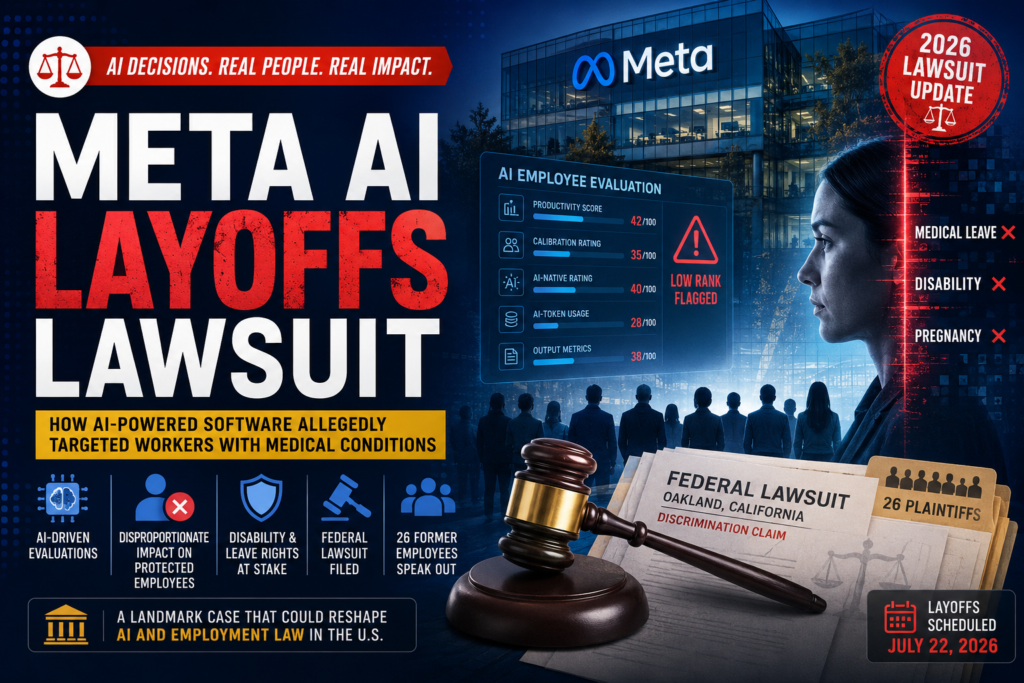
The Meta AI layoffs lawsuit centers on a discrimination claim filed by 26 former employees who allege the company’s AI-powered evaluation tools disproportionately flagged workers with disabilities, medical leave history, or pregnancy for termination. Filed in federal court in Oakland, California, the case is one of the first major legal tests of how AI-driven workforce decisions intersect with disability and family-leave protections in the United States.
If you’re trying to understand what happened, who’s involved, and why this case could reshape how companies use AI in layoff decisions, this guide breaks it all down.
What Is the Meta AI Layoffs Lawsuit About?
The Meta AI layoffs lawsuit is a discrimination case filed by 26 anonymous former Meta employees who claim the company relied on AI-generated productivity scores and internal “AI-native” ratings to decide who would lose their jobs during a wave of 2026 layoffs. The suit was filed late Monday in federal court in Oakland, and it argues that these AI-driven metrics structurally disadvantaged people who had taken medical or family leave, or whose work output was affected by a disability.
Definition: In simple terms, the lawsuit alleges that Meta built layoff decisions around inputs — like productivity scores, calibration ratings, and AI-token consumption — that someone on medical leave or living with a disability could never accumulate at the same rate as an active, full-time employee. Expansion: Because these metrics don’t account for protected absences, the plaintiffs argue the system was discriminatory by design, even if no individual manager intended to target anyone based on health status.
The plaintiffs are seeking a preliminary court ruling to pause their layoffs — originally scheduled to take effect July 22 — while they pursue their claims through private arbitration, since Meta’s employment agreements generally require individual arbitration for workplace disputes.
How Did Meta Allegedly Use AI to Select Employees for Layoffs?
According to the complaint, Meta used what plaintiffs describe as a “constellation of internal artificial-intelligence systems” to evaluate employees ahead of its 2026 restructuring. This is the core allegation driving the Meta AI layoffs lawsuit forward.
The AI Inputs at the Center of the Claims
The lawsuit points to several specific data inputs that Meta’s tools reportedly used to rank employees:
- Performance ratings generated or influenced by internal review software
- Calibration scores used to compare employees against peers
- Productivity and output metrics tracked across projects and tasks
- “AI-native” ratings, which reportedly measured how effectively employees integrated AI tools into their workflow
- AI-token consumption, a measure of how much an employee used Meta’s internal AI systems
The plaintiffs argue that all five of these inputs share a common flaw: none of them can be fully accumulated by someone who was out on protected medical leave, caring for a family member, or working at reduced capacity because of a disability. That structural gap, they claim, is what makes the Meta AI layoffs lawsuit different from a typical wrongful-termination case — it’s not about a single biased manager, but about a system that produces biased outcomes at scale.
Meta’s Response to the Allegations
Meta has pushed back on the claims. A company spokesperson told Reuters that workforce decisions were made by people, not AI software, directly disputing the central premise of the lawsuit. Meta has not yet filed a formal legal response addressing the specific allegations in detail.
Who Are the Plaintiffs and What Are They Seeking?
The 26 plaintiffs filed the case anonymously and come from several states, including California, New York, and the District of Columbia. They were notified in May 2026 that their positions would be eliminated, with a termination date of July 22.
Rather than seeking damages first, the plaintiffs are asking the court for a preliminary injunction — a temporary order that would block Meta from finalizing their layoffs while the underlying discrimination claims proceed through private arbitration. Their argument for going to court first, rather than arbitration, is that requests for temporary emergency relief fall outside the scope of Meta’s mandatory arbitration agreements, even though the underlying discrimination claims do not.
The plaintiffs allege violations of both federal and state laws that prohibit discrimination or retaliation against employees who:
- Have a qualifying disability
- Have taken medical or family leave
- Are pregnant
They also claim Meta failed to test its AI evaluation systems for bias, which they say violates recently adopted algorithmic accountability laws in California and New York City.
Why This Case Matters: AI Bias and Employment Discrimination Law
The Meta AI layoffs lawsuit arrives at a moment when employers across the tech industry are leaning heavily on AI tools for hiring, performance management, and workforce planning. What makes this case significant is that it directly tests whether existing disability and leave-protection laws apply cleanly to AI-mediated decisions — or whether new legal frameworks are needed.
California and New York City AI Bias Testing Laws
Both California and New York City have adopted rules in recent years requiring employers to audit automated employment decision tools for discriminatory impact before using them in hiring or personnel decisions. The plaintiffs in the Meta AI layoffs lawsuit argue that Meta skipped this bias-testing step entirely, which — if proven — could expose the company to liability independent of whether any individual employee can show intentional discrimination.
Question: Does using AI in layoffs automatically violate anti-discrimination law?
Direct Answer: No. Using AI tools in workforce decisions is not illegal on its own. The legal exposure comes from how those tools are built and validated — specifically, whether they were tested for disparate impact on protected groups and whether the inputs they rely on inadvertently penalize people for legally protected absences or conditions.
Comparison Table: Traditional Layoffs vs. AI-Assisted Layoffs
| Factor | Traditional Manager-Led Layoffs | AI-Assisted Layoffs (as alleged in this case) |
|---|---|---|
| Decision inputs | Manager judgment, tenure, role redundancy | Productivity scores, AI-token usage, calibration ratings |
| Bias testing required | Not always mandated | Required under CA/NYC algorithmic accountability laws |
| Impact on medical leave | Case-by-case, subject to individual bias | Systemic, per plaintiffs’ claims — leave time can’t be “earned back” |
| Transparency to employees | Often explained directly by managers | Frequently opaque; employees may not know which metrics were used |
| Legal exposure | Individual discrimination claims | Both individual and systemic/disparate-impact claims |
| Documentation trail | Manager notes, HR records | Auditable but often proprietary AI system logs |
Timeline of Meta’s 2026 Layoffs
- Earlier in 2026: Meta announced plans to cut approximately 10% of its global workforce, roughly 8,000 employees.
- May 2026: Meta began notifying affected employees, including the 26 plaintiffs.
- Mid-2026: CEO Mark Zuckerberg said he did not expect additional company-wide layoffs for the rest of the year.
- July 22, 2026: Scheduled effective date for the plaintiffs’ terminations.
- July 14, 2026: The lawsuit was filed in federal court in Oakland, California.
What Happens Next in the Meta AI Layoffs Lawsuit?
The court must first decide whether to grant a preliminary injunction blocking the July 22 terminations — a ruling likely to hinge on narrow procedural questions about arbitration agreements rather than the discrimination claims themselves. If granted, the broader claims move into individual private arbitration. If denied, the layoffs proceed while arbitration continues separately. Either way, the Meta AI layoffs lawsuit is likely to influence how other large employers document and audit AI-driven workforce tools going forward.
Frequently Asked Questions
What is the Meta AI layoffs lawsuit about? A discrimination lawsuit filed by 26 former Meta employees alleging AI-powered software disproportionately targeted people with disabilities or medical leave history during 2026 layoffs.
How many people are suing Meta? Twenty-six former employees, filed anonymously in Oakland federal court.
What is Meta’s response? A spokesperson told Reuters that workforce decisions were made by people, not AI.
What are the plaintiffs asking for? A preliminary injunction blocking their layoffs while they pursue arbitration.
Did this lawsuit stop Meta’s broader layoffs? No — it covers only these 26 plaintiffs, not the full ~8,000-person reduction.
Why does AI bias testing matter here? California and NYC require bias audits of automated employment tools; plaintiffs claim Meta skipped this step.
Key Takeaways
The Meta AI layoffs lawsuit is an early test case for how U.S. employment law handles AI-mediated workforce decisions. As more companies fold AI metrics into performance reviews and restructuring, this case will likely shape norms around transparency, bias auditing, and documentation — regardless of how the court ultimately rules.