Apple rarely gets surprised by its own customers. But in Q2 2026, something remarkable happened: AI-driven Mac demand grew so fast that even Apple’s own forecasters couldn’t keep up. The result was a Mac earnings beat no one on Wall Street predicted — and a supply shortage that could last months.
If you’ve been watching the PC market drift into irrelevance, Apple’s latest earnings report is a sharp wake-up call. The Mac is no longer just a productivity machine for creatives and developers. It has quietly become one of the most sought-after platforms for running local AI models — and that shift is reshaping the hardware landscape faster than anyone, including Apple, expected.
What Happened: Apple’s Q2 2026 Mac Earnings Beat
The Numbers That Surprised Wall Street
Going into Apple’s second quarter results (ended March 28, 2026), analysts had penciled in Mac revenue in the low $8 billion range, with growth expected to be roughly flat year-over-year. What Apple actually reported was a different story entirely.
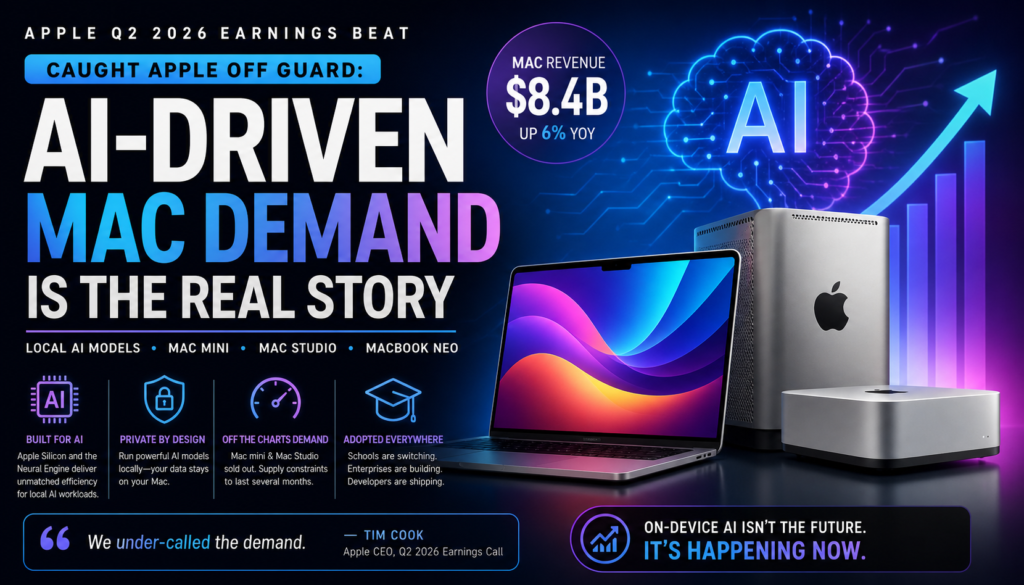
Mac revenue came in at $8.4 billion — a meaningful beat for a segment that most investors treat as a sideshow to iPhone and Services. More strikingly, Mac sales were up 6% on an annual basis, defying expectations of stagnation. Apple’s total revenue for the quarter was $111.2 billion, representing a 17% increase from the same period a year earlier.
To put the Mac beat in context: a 6% annual growth rate in the PC segment, in a market still recovering from a post-pandemic inventory hangover, is not a small thing. It signals a structural shift in who is buying Macs and, critically, why.
Tim Cook’s Admission: “We Under-Called the Demand”
On the Q2 earnings call, Apple CEO Tim Cook did something executives rarely do publicly: he admitted Apple was caught off guard. Speaking about Mac mini and Mac Studio sales, Cook said the company “just under-called the demand” and that it was “not at the point where we’re saying this constraint is going to end anytime soon.”
Cook attributed a significant portion of the unexpected growth directly to AI-driven Mac demand — specifically, the surge in customers using Mac hardware to run local AI models. He described the Mac mini and Mac Studio as “amazing platforms for AI and agentic tools” and noted that “customer recognition of that is happening faster than what we had predicted.”
This is not a typical demand story. Apple wasn’t caught off guard by a viral marketing moment or a celebrity endorsement. It was caught off guard by a fundamental change in how professionals, enterprises, and developers are choosing to run AI.
The Real Driver — Running Local AI Models on Mac
What Is OpenClaw and Why Is It Selling Mac Minis?
The specific catalyst Cook cited for AI-driven Mac demand was the rise of OpenClaw, a local AI model that has gained significant traction — particularly in markets like China, where it has triggered what the BBC described as a “frenzy.” OpenClaw is designed to run inference locally, meaning users can operate a capable AI assistant without routing their data through a cloud server.
This matters enormously for several reasons: privacy, latency, cost, and control. For businesses and developers who need AI capabilities but cannot (or will not) send sensitive data to external servers, a local model running on powerful hardware is the only viable option.
The Mac mini — especially the M-series variants — has emerged as a natural home for these workloads. Its combination of unified memory, the Neural Engine in Apple Silicon, and a compact, affordable form factor makes it an unusually competitive platform for local AI inference. The result: Mac mini units sold out in recent weeks, with Apple unable to satisfy demand fast enough.
Tim Cook noted the Mac mini was the top-selling desktop in China in the quarter — a market where OpenClaw demand has been particularly intense. That is a remarkable data point for a machine that many had written off as niche.
Why the Mac Has Become the Preferred Platform for AI Workloads
AI-driven Mac demand is not a coincidence. It’s the result of several technical advantages that Apple Silicon provides, combined with a growing ecosystem of local AI tooling that runs exceptionally well on macOS.
Here’s why the Mac has become a serious contender for AI workloads:
- Unified Memory Architecture: Apple Silicon uses shared memory between CPU, GPU, and Neural Engine. This eliminates memory bottlenecks that cripple other platforms when handling large language models.
- Neural Engine: The dedicated on-chip processor for machine learning tasks dramatically accelerates inference for models like OpenClaw, Llama variants, and other locally deployable models.
- Power Efficiency: Mac hardware runs AI workloads at a fraction of the power consumption of traditional GPU-based setups, making it more practical for always-on or office-based inference use cases.
- macOS Tooling: Frameworks like MLX — Apple’s open-source machine learning framework optimized for Apple Silicon — have made it dramatically easier to deploy local models on Mac hardware.
- Privacy Guarantees: On-device processing means data never leaves the machine, a critical requirement for enterprise, legal, medical, and government use cases.
Together, these factors have created a situation where the Mac is not just a plausible option for running local AI models — it’s increasingly the preferred one.
MacBook Neo — A Surprise Hit That Went Far Beyond Expectations
Apple’s Q2 quarter also saw the launch of the MacBook Neo, a colorful, consumer-focused laptop that began shipping in mid-to-late March following March 4 preorders. Cook described customer demand for the Neo as “off the charts” — higher than Apple had anticipated.
The MacBook Neo set a record for customers new to the Mac platform in the quarter, suggesting it is pulling in buyers who would not previously have considered Apple hardware. It is supply-constrained, and Apple is actively working to balance production with demand.
Schools and Enterprises Are Switching
What makes the MacBook Neo story particularly interesting is where the new demand is coming from. Cook noted that school systems — including Kansas City Public Schools — are dropping Chromebooks in favor of the Neo. That is a significant signal. Chromebooks have dominated K-12 education for years on the strength of their low cost and simplicity. The fact that schools are switching to a Mac platform suggests that the price-performance calculus has shifted.
On the enterprise side, Cook also cited companies like Perplexity as having adopted Mac as their preferred platform for building enterprise-grade AI assistants. When an AI-native company chooses Mac as its hardware standard for AI development, it is a powerful endorsement of the platform’s technical credentials.
AI-driven Mac demand is therefore showing up across segments that have historically been dominated by Windows or ChromeOS — a shift that has real implications for the broader PC market.
Mac Mini vs. Mac Studio: Which Is the Better Platform for Local AI?
Both the Mac mini and Mac Studio have become the go-to machines for local AI model deployment, but they serve different use cases. Here’s a direct comparison to help you decide which platform fits your AI workload needs.
| Feature | Mac Mini (M4 Pro) | Mac Studio (M4 Max/Ultra) |
|---|---|---|
| Starting Price | ~$799 | ~$1,999 |
| Unified Memory (Max) | Up to 64GB | Up to 192GB (Ultra) |
| Best For | Light-to-medium local AI inference, development, small teams | Large model deployment, enterprise AI pipelines, research |
| Power Consumption | Very low (~30–40W typical) | Moderate (~100–200W typical) |
| Neural Engine | 38-core (M4 Pro) | 32-core per die (Ultra = 64-core total) |
| Port Selection | Moderate | Extensive (more Thunderbolt, USB-A) |
| Availability (May 2026) | Supply-constrained | Supply-constrained |
| Ideal User | Developer, small business, AI enthusiast | Enterprise, AI researcher, production inference server |
Bottom line: If you’re running models up to 13B–30B parameters and need an affordable, efficient entry point into local AI, the Mac mini is the clear starting point. If you’re running 70B+ parameter models, building multi-agent pipelines, or deploying inference at scale for a team, the Mac Studio — especially with the M4 Ultra configuration — offers significantly more headroom.
Both machines are currently sold out or backordered through Apple’s online store, which itself is a testament to the scale of AI-driven Mac demand in the current market.
What AI-Driven Mac Demand Signals for the Broader Tech Industry
The Rise of On-Device AI Computing
Apple’s surprise demand story is part of a much larger shift happening across the technology landscape: the movement of AI inference from the cloud to the edge. For years, the dominant AI deployment model was cloud-based — send data to a remote server, process it, return the result. That model is fast, scalable, and convenient. It is also expensive, latency-prone, and raises serious data privacy concerns.
Local AI inference — running models directly on user hardware — is gaining ground as an alternative. It is not a replacement for cloud AI in every scenario. But for specific use cases (legal document analysis, medical record processing, confidential enterprise data, real-time agentic tasks), on-device inference is not just a preference — it’s a requirement.
Apple Silicon has made the Mac the most capable consumer-grade platform for this workload. And as model sizes become more efficient and quantization techniques improve, the range of tasks that can be handled by a Mac mini or MacBook Neo expands significantly.
What This Means for Developers and Enterprises
For developers, the practical implication of AI-driven Mac demand is clear: if you are building applications that involve local model inference, macOS and Apple Silicon deserve serious evaluation. The MLX framework, growing community support for popular model families on Mac, and the competitive cost-per-token of on-device inference make the Mac an increasingly attractive development and deployment target.
For enterprises, the signal from companies like Perplexity — choosing Mac as a platform for building AI assistants — suggests that the Mac is entering serious consideration in IT procurement decisions where it previously would not have featured. The combination of performance, privacy, and energy efficiency makes a compelling case for AI-intensive workloads, particularly in regulated industries.
For investors and analysts, the takeaway is more fundamental: AI demand is becoming a meaningful hardware driver, not just a software story. Apple’s Q2 results are an early data point in what may become a broader re-evaluation of which hardware platforms benefit most from the local AI era.
Key Takeaways: Why AI-Driven Mac Demand Is a Turning Point
AI-driven Mac demand in Q2 2026 is more than an earnings beat. It represents a convergence of hardware capability, software ecosystem maturity, and shifting user priorities that is likely to have durable effects on the PC market. Here are the essential points to remember:
- Apple’s Mac revenue of $8.4B in Q2 2026 beat analyst expectations of the low $8B range, with 6% year-over-year growth defying flat projections.
- Tim Cook directly attributed the surprise to AI workloads, specifically the use of Mac mini and Mac Studio for running local AI models like OpenClaw.
- AI-driven Mac demand is coming from multiple segments — individual developers, enterprise AI teams, and even K-12 schools replacing Chromebooks with the MacBook Neo.
- Apple Silicon’s unified memory architecture and Neural Engine give the Mac a structural technical advantage for local AI inference, particularly for large language model workloads.
- Supply is constrained on both Mac mini and Mac Studio, with Cook saying it may take “several months” to reach balance — indicating that demand is not a one-quarter blip.
- The Mac mini is the top-selling desktop in China, driven by OpenClaw adoption — a striking result for a product many considered a niche category.
- The MacBook Neo set a new-customer record for the Mac platform in a single quarter, with schools and enterprises adopting it at unexpected rates.
- On-device AI inference is becoming a category driver, not just a feature — and Apple Silicon is currently the most capable consumer hardware for this workload.
- This trend is likely to intensify as open-source model ecosystems grow, quantization techniques improve, and enterprise privacy requirements become more stringent.
Frequently Asked Questions
Why is AI-driven Mac demand happening now?
AI-driven Mac demand is accelerating now because of a combination of factors: the maturity of Apple Silicon (particularly the M4 generation with its large unified memory ceiling and powerful Neural Engine), the rise of efficient open-source local models like those in the Llama family and OpenClaw, and growing enterprise concern about data privacy in cloud-based AI deployments. These trends converged in early 2026 to create demand that exceeded even Apple’s internal forecasts.
Which Mac is best for running local AI models?
For most developers and small teams, the Mac mini with M4 Pro is the most cost-effective starting point — offering strong inference performance for models up to roughly 30B parameters at a sub-$1,000 price point. For larger models, multi-agent pipelines, or production enterprise deployments, the Mac Studio with M4 Max or M4 Ultra configuration offers significantly more memory headroom and throughput.
Will AI-driven Mac demand continue beyond Q2 2026?
Based on Tim Cook’s commentary, Apple does not expect the supply-demand imbalance to resolve quickly, which implies that demand is not a one-time event. The structural drivers — growing local AI model ecosystems, privacy concerns, and Apple Silicon’s technical advantages — are not short-term trends. AI-driven Mac demand is likely to remain a meaningful growth factor for the Mac segment throughout 2026 and into 2027.
Is the MacBook Neo an AI machine?
The MacBook Neo was launched primarily as a consumer-focused, colorful laptop — similar in spirit to the original iMac G3 in its emphasis on design and accessibility. However, it runs on Apple Silicon with a Neural Engine and shares the same architectural advantages as the Mac mini and Mac Studio. While it is not explicitly marketed as an AI device, its hardware is fully capable of local AI inference for lighter workloads, and it has attracted attention from both consumers and enterprises looking for an accessible entry point to on-device AI.
Conclusion: AI-Driven Mac Demand Is Just Getting Started
Apple’s Q2 2026 results revealed something much bigger than a routine earnings beat. What looked like a modest Mac revenue surprise on paper is actually evidence of a major shift in how users are thinking about computing in the AI era. The sudden rise in AI-driven Mac demand shows that the Mac is no longer viewed only as a premium productivity machine for designers, developers, and creative professionals. Instead, it is rapidly evolving into a preferred platform for local AI workloads, enterprise experimentation, and privacy-first machine learning.
The growing popularity of tools like OpenClaw and other local AI models has created a new hardware requirement: users now want machines capable of running powerful models directly on-device without relying entirely on cloud infrastructure. This demand aligns perfectly with Apple Silicon’s strengths, including unified memory architecture, power efficiency, Neural Engine acceleration, and strong software optimization through frameworks like MLX. These technical advantages have transformed products like Mac mini and Mac Studio into practical AI machines rather than traditional desktops.
Even more importantly, Apple is now seeing demand from audiences that historically leaned toward other ecosystems. Schools replacing Chromebooks, enterprises exploring AI-native workflows, and developers prioritizing privacy-focused inference all point toward a broader expansion of the Mac ecosystem. The success of the MacBook Neo further suggests that Apple is not only benefiting from professional AI demand but also attracting first-time Mac buyers at scale.
Looking ahead, this trend is unlikely to slow down anytime soon. As local AI models become smaller, faster, and more capable, the appeal of running AI directly on personal hardware will continue to grow. This makes AI-driven Mac demand more than a temporary revenue boost—it signals the beginning of a new hardware cycle centered on on-device intelligence.
For Apple, this could mark one of the most important strategic transitions since the launch of Apple Silicon itself. And for consumers, developers, and businesses, it confirms one thing clearly: the future of AI is not only in the cloud. Increasingly, it is running directly on your desk.