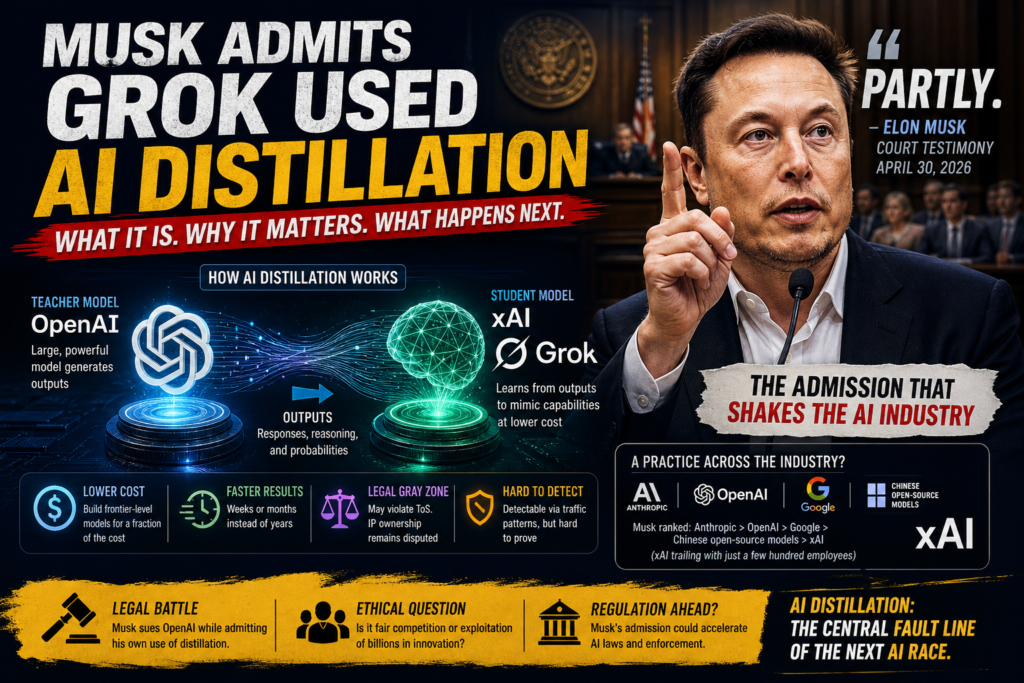
Elon Musk just confirmed on the witness stand what the AI industry has long suspected: xAI used AI distillation — the practice of training a new model by learning from an existing one’s outputs — to build Grok. This single admission has cracked open one of the most consequential debates in modern AI: who owns what a model learns, and what happens when competitors train on each other?
What Musk Actually Said in Court
On April 30, 2026, Elon Musk was called to testify in a California federal court in the ongoing lawsuit he filed against OpenAI, CEO Sam Altman, and co-founder Greg Brockman. The suit alleges that OpenAI violated its original nonprofit mission by transitioning to a for-profit structure.
During cross-examination, Musk was asked directly whether xAI had used AI distillation techniques on OpenAI models to train Grok. His response was telling: he characterized it as a general practice across the industry. When pressed on whether that meant “yes,” he replied — “Partly.”
That one word is now reverberating across boardrooms, legal teams, and research labs worldwide.
Musk also offered an impromptu ranking of the world’s top AI labs during his testimony, placing Anthropic at the top, followed by OpenAI, Google, and Chinese open-source models, with xAI trailing far behind as a company with just a few hundred employees.
What Is AI Distillation? A Clear Definition
AI distillation — also called model distillation — is a technique in which a smaller or newer AI model is trained using the outputs of a larger, more capable “teacher” model. Instead of learning from raw human-generated data alone, the student model learns to mimic the behavior and responses of the teacher.
Think of it this way: rather than taking years to study every textbook ever written, a student sits next to a genius and practices giving the same kinds of answers that genius gives. Over time, the student develops similar reasoning capabilities, often at a fraction of the cost.
How AI Distillation Works Technically
In practice, AI distillation typically involves one or more of the following approaches:
- Output mimicry: The new model is trained on question-and-answer pairs generated by querying the teacher model’s API or public chatbot interface.
- Logit matching: In more technical implementations, the student model is trained to reproduce not just the final answer but the internal probability distributions of the teacher — capturing deeper reasoning patterns.
- Systematic querying: Operators send large volumes of carefully crafted queries to the target model to map its capabilities, then use those responses as training data.
The result is a model that behaves similarly to the original — sometimes nearly indistinguishably — but was built at dramatically lower compute cost.
Why AI Distillation Is So Attractive to Smaller Labs
Building a frontier AI model from scratch requires billions of dollars in compute, years of data collection, and massive research teams. AI distillation short-circuits that process significantly. For a company like xAI, which started in 2023 — years behind OpenAI — the temptation to accelerate development through distillation is understandable from a competitive standpoint.
It’s not just smaller players either. As Musk suggested under oath, the practice appears to be widespread throughout the industry.
Why the Grok Admission Matters for the AI Industry
Musk’s “partly” carries enormous weight — not just for the xAI vs. OpenAI lawsuit, but for the entire competitive structure of the AI industry.
The Threat to Frontier Model Moats
For years, leading AI labs have justified their massive infrastructure investments by arguing they’re building proprietary capabilities that competitors cannot easily replicate. AI distillation fundamentally undermines that thesis.
If a well-resourced lab can query a frontier model’s public API at scale and distill its capabilities into a competing product, then the moat built by billions in compute spend becomes far more porous. This threatens the core business logic behind labs like OpenAI, Anthropic, and Google DeepMind.
OpenAI and Anthropic have already been aggressively combating AI distillation by Chinese AI firms, which have used the technique to build open-weight models that rival U.S. offerings at a fraction of the cost. The Musk admission reveals the practice cuts closer to home than previously acknowledged publicly.
The Legal Gray Zone Around AI Distillation
Here’s where things get complicated: AI distillation is not clearly illegal. It may, however, violate the terms of service that AI companies set for users of their platforms and APIs.
OpenAI’s terms of service, for example, prohibit using its outputs to train competing AI models. But enforcement is notoriously difficult. Detecting whether a query is a legitimate user interaction or a systematic distillation attempt requires sophisticated traffic analysis, and even then, the legal recourse is murky.
OpenAI and Anthropic have reportedly partnered through the Frontier Model Forum to share intelligence on distillation attempts, particularly those originating from China. The forum’s work includes developing systems to detect and block suspicious mass-querying patterns. Musk’s admission now forces a harder question: are those same defenses being applied to domestic competitors?
AI Distillation vs. Traditional Model Training: A Comparison
Understanding the difference between building a model from scratch and using AI distillation helps clarify why this issue is so commercially significant.
| Factor | Traditional Training | AI Distillation |
|---|---|---|
| Data Source | Human-generated text, licensed datasets | Outputs from an existing AI model |
| Compute Cost | Very high (billions of dollars for frontier models) | Significantly lower |
| Time to Capability | Years | Weeks to months |
| Legal Status | Clearly permissible | Potentially violates ToS; legal status contested |
| Model Quality | Full-capability frontier performance | Near-frontier, depending on technique |
| IP Ownership Risk | Low | High — ownership of derived outputs disputed |
| Detectability | N/A | Detectable via traffic pattern analysis |
| Examples | GPT-4, Claude 3, Gemini Ultra | DeepSeek (alleged), Grok (admitted, partly) |
The table above illustrates why AI distillation is so disruptive: it dramatically compresses the cost and time required to produce competitive AI systems, while introducing serious legal and ethical exposure.
Which Labs Are Doing This? The Broader Context
Musk’s admission didn’t come out of nowhere. The broader context of AI distillation has been building for months:
- Chinese AI labs such as those behind DeepSeek have been accused of systematically distilling OpenAI and Anthropic models to produce competitive open-weight alternatives that are available at a fraction of the cost.
- Anthropic publicly accused Chinese AI developers of mining Claude’s outputs in early 2026, as the U.S. debated tightening AI chip exports.
- OpenAI, Anthropic, and Google launched a coordinated initiative through the Frontier Model Forum specifically to counter distillation attempts from abroad.
- xAI, as Musk admitted, has also engaged in AI distillation — at least partially — in building Grok, the chatbot integrated into X (formerly Twitter).
The uncomfortable reality emerging from Musk’s testimony is that AI distillation may be an industry-wide norm, not an exception. Every lab that fell behind the frontier had an incentive to use it. The question is no longer whether it happened — but what the industry does now that it’s been publicly acknowledged.
What Happens Next: Legal, Ethical, and Competitive Fallout
Will This Affect the Musk vs. OpenAI Trial?
Musk’s admission creates a fascinating irony at the center of his own lawsuit. He is suing OpenAI in part for allegedly compromising the organization’s integrity — while simultaneously having partially built Grok on OpenAI’s outputs. OpenAI did not publicly respond to the admission at press time, but legal observers expect this to become a significant element of OpenAI’s defense strategy.
What This Means for AI Terms of Service Enforcement
The admission will likely accelerate industry-wide efforts to make AI distillation explicitly and legally — not just contractually — prohibited. Legislation in the U.S. and EU is already being discussed around AI training transparency. Musk’s public confirmation may provide the concrete example policymakers needed to act.
The Ethical Dimension of AI Distillation
Beyond legality, AI distillation raises a fundamental ethical question: if a company spends billions developing a breakthrough model, and a competitor replicates those capabilities by querying the public API, is that fair competition or exploitation?
There’s a layered irony here that legal scholars are already noting. Frontier AI labs themselves trained their models on vast quantities of copyrighted human content — often without explicit permission. Now those same labs are objecting when competitors train on their outputs, using strikingly similar arguments about intellectual property and fair use.
The principle seems to be: distillation is fine when you’re the one doing it, and theft when someone does it to you.
Key Takeaways for AI Watchers
Here is a summary of the core facts and implications from the Musk testimony:
- What happened: Elon Musk testified under oath that xAI used AI distillation on OpenAI models — at least partially — to train Grok.
- What AI distillation is: A technique where a new model learns from the outputs of an existing model, drastically reducing training cost and time.
- Why it matters: It undermines the competitive moats frontier labs have built through massive compute investments.
- Is it illegal? Not clearly — but it likely violates OpenAI’s terms of service and creates significant IP exposure.
- Who else is doing it? Likely many labs; Chinese AI developers have been publicly accused, and Musk’s admission suggests it’s widespread among American companies too.
- What comes next: Increased legal scrutiny, potential legislation, and more aggressive technical countermeasures from frontier labs.
- The irony: Labs that trained on human content without consent are now objecting to others using their outputs — raising uncomfortable parallels.
Frequently Asked Questions About AI Distillation
Is AI distillation the same as “stealing” a model?
Not exactly. AI distillation doesn’t copy a model’s weights or architecture — it trains a new model on the outputs of an existing one. This distinction is important legally, but it doesn’t eliminate IP concerns. The debate is whether the knowledge transferred through outputs constitutes a protectable form of intellectual property.
Can companies detect when their models are being distilled?
Yes, to a degree. Unusual query patterns — extremely high volume, systematic topic coverage, queries designed to probe edge cases — can signal distillation attempts. OpenAI and Anthropic are actively building systems to detect and block these patterns.
Does AI distillation produce models as good as the original?
It depends on the technique and scale. Simple output mimicry produces models that are good but not quite as capable as the teacher. More sophisticated techniques can get remarkably close to frontier-level performance at a significantly lower cost — which is precisely what makes the practice so commercially attractive and competitively threatening.
What should AI companies do to protect against distillation?
Key protective strategies include: tightening API rate limits, requiring enterprise contracts with explicit anti-distillation clauses, deploying traffic monitoring to detect systematic querying, and advocating for legislation that gives legal teeth to ToS provisions around training data use.
The Bigger Picture: AI Distillation Is Reshaping Competition
Elon Musk’s “partly” may be one of the most consequential single words spoken in a courtroom in the history of the AI industry. It has confirmed that AI distillation is not just a threat from foreign competitors — it is woven into the competitive fabric of Silicon Valley itself.
As AI systems become more powerful and more expensive to build, the temptation to distill will only grow. The labs that can detect, deter, and legally combat AI distillation will hold significant competitive advantages. Those that cannot may find their billion-dollar training runs commoditized within months of deployment.
For anyone watching the AI industry — investors, developers, policymakers, or curious observers — understanding AI distillation is no longer optional. It is the central fault line of the next phase of the AI race.