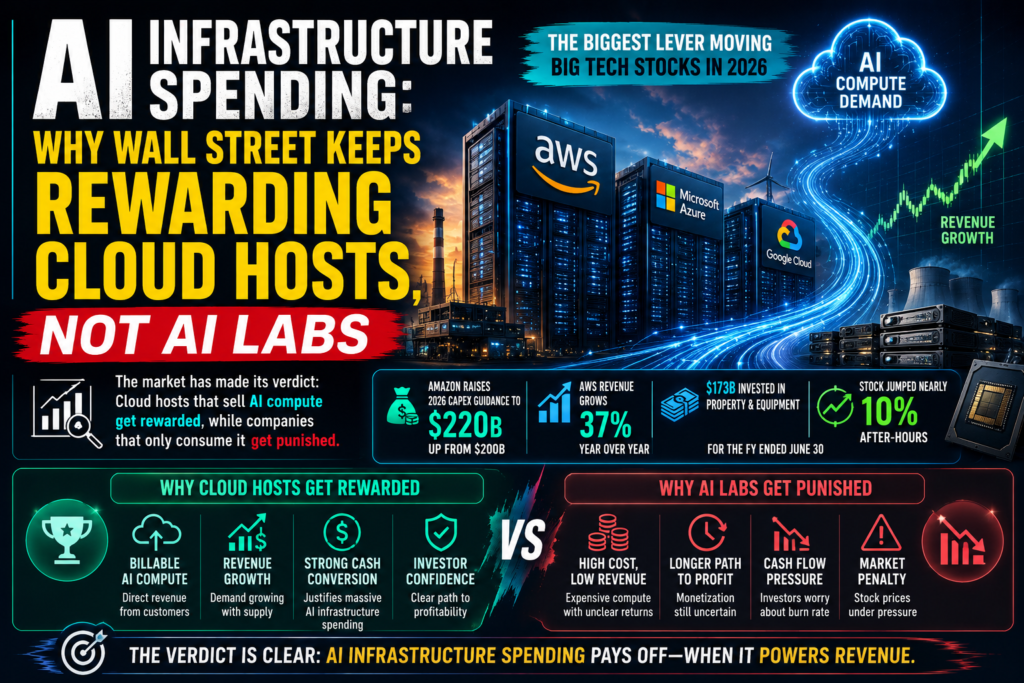
AI infrastructure spending is now the single biggest lever moving Big Tech stock prices , and the market has made its verdict clear: cloud hosts that sell AI compute get rewarded, while companies that only consume it get punished. Amazon’s July 2026 earnings report is the clearest proof yet. The company raised its 2026 capital expenditure forecast to $220 billion, dipped into cash reserves for the first time this year, and still saw its stock jump nearly 10% in after-hours trading. Understanding why requires looking past the raw dollar figures and into how investors are actually pricing the AI economy.
This isn’t a one-off story about one company’s earnings call. It’s a pattern playing out across every major hyperscaler, and it tells you almost everything you need to know about where the smart money believes the AI boom is , and isn’t , creating durable value.
What Counts as AI Infrastructure Spending?
AI infrastructure spending refers to the capital a company puts into the physical and technical foundation needed to build, train, and run AI models at scale. This includes data centers, GPUs and custom AI chips, networking equipment, power infrastructure like natural gas turbines, and the land these facilities sit on.
For hyperscalers , the cloud giants like Amazon, Microsoft, and Google , AI infrastructure spending shows up primarily as capital expenditures (capex) on property and equipment. It’s the line item analysts watch most closely on every earnings call, because it signals how aggressively a company is betting on future AI demand.
Why This Spending Category Matters So Much Right Now
Three forces have converged to make AI infrastructure spending the defining financial story of 2026:
- Scale: The dollar amounts involved have grown so large that they now materially affect free cash flow at even the biggest companies in the world.
- Time lag: There’s a multi-year gap between breaking ground on a data center and selling its capacity, which forces investors to make bets on demand that hasn’t fully materialized yet.
- Divergent outcomes: Companies with similar spending levels are getting wildly different reactions from the market, depending on whether they can point to revenue that justifies the outlay.
That third point is where the real story lives.
Amazon’s Q2 2026 Earnings: A Case Study in Investor Confidence
Amazon’s most recent quarter is a near-perfect illustration of how AI infrastructure spending gets judged by the market when there’s revenue to back it up.
The Numbers Behind the Headline
Amazon reported net sales growth of 20% for the quarter, with cloud revenue as the standout category. On the spending side, the company put $173 billion into property and equipment for the fiscal year ended June 30 , up sharply from $107.65 billion the year before. It also raised its full-year 2026 capex guidance from $200 billion to $220 billion.
That level of AI infrastructure spending came at a real cost: Amazon ended the quarter with $7.6 billion less cash than it had 12 months earlier, marking its first period of negative free cash flow this year. Under normal circumstances, that kind of cash burn would spook investors.
The Revenue Engine That Changed the Math
AWS revenue rose 37% year over year to $42 billion for the quarter. On paper, that doesn’t fully offset the capex spend , but it demonstrates something investors care about more than a single quarter’s arithmetic: demand growing in lockstep with supply. CEO Andy Jassy reinforced this framing on the earnings call, noting that AWS and Amazon Bedrock don’t need a single dominant model to succeed, because he doesn’t expect one model to serve every use case.
Amazon is also investing in custom silicon , the Trainium AI chip and the Arm-based Graviton processor , which doesn’t show up directly in capex figures but can materially improve margins across the cloud business over time. This combination of aggressive AI infrastructure spending paired with visible, fast-growing revenue is exactly what turned a quarter of negative free cash flow into a stock price gain of nearly 10%.
Why Do Investors Reward Cloud Hosts but Punish AI-First Companies?
Investors reward cloud hosts because their AI infrastructure spending converts directly into billable revenue, while AI-first companies often carry the same cost structure without a comparably clear or immediate revenue engine. This single distinction explains most of the divergence in stock performance across the AI sector in 2026.
The pattern isn’t limited to Amazon. Microsoft and Google both saw their shares rise after reporting strong cloud revenue growth alongside heavy AI infrastructure spending. Meta tells the opposite story: despite significant capex commitments, the company lacks an equivalent, clearly attributable revenue line, and its stock fell 8% after its most recent earnings report as investors zeroed in on cash flow pressure and continued spending.
Cloud Hosts vs. AI-First Companies: A Side-by-Side Comparison
| Factor | Cloud Hosts (Amazon, Microsoft, Google) | AI-First / Consumer AI Companies (e.g., Meta’s AI bets) |
| Revenue attribution | Direct , cloud/API revenue is billed per customer usage | Indirect , AI spend supports products without a dedicated AI revenue line |
| Investor reaction to Q2 2026 earnings | Stock prices rose after earnings | Stock price fell roughly 8% |
| AI infrastructure spending | Extremely high and rising (Amazon: $220B 2026 capex guidance) | Also high, but harder to map to returns |
| Cash flow trend | Negative free cash flow, but offset by revenue growth story | Cash flow crunch draws direct investor skepticism |
| Underlying business model | Sells AI compute/infrastructure to others | Builds AI features for its own products |
| Investor framing | “Picks-and-shovels” bet on AI demand | Bet on AI monetization within existing products |
The Simple Explanation Investors Are Using
Markets reward revenue and penalize unexplained expense , that’s not unique to AI. What’s notable is how cleanly this principle is separating the AI stack into layers:
- Layer 1 , Infrastructure providers: Cloud hosts selling compute capacity, currently viewed as the most reliable and de-risked part of the AI economy.
- Layer 2 , AI labs and model providers: Companies whose economics are harder to verify from public markets, since much of their spending flows through private funding rounds and cloud contracts rather than public earnings reports.
- Layer 3 , AI-dependent product companies: Firms layering AI features on top of existing products, where the payoff timeline is murkier and harder to defend to shareholders.
The Hidden Risk Behind the AI Infrastructure Spending Boom
Here’s the part of the story that gets lost in quarterly headlines: AI infrastructure spending by cloud hosts isn’t happening in a vacuum. It’s the flip side of AI labs’ compute bills.
The Circular Dependency Problem
Amazon’s hosting revenue is, in a very literal sense, someone else’s AI expense. In Anthropic’s case, the compute spending and Amazon’s revenue are the same transaction, tied to Amazon’s own investment in the company. This creates a dependency chain: if spending by AI labs and their enterprise customers isn’t sustainable long-term, the revenue currently propping up cloud hosts’ AI infrastructure spending story won’t be stable either.
Cloud hosts sit a few steps removed from the ultimate question of whether AI demand is real and durable , but “a few steps removed” doesn’t mean insulated.
The $3 Trillion Question
This dynamic is often distilled into what’s become known in tech and finance circles as the $3 trillion question: is there enough real-world demand to justify the current scale of global AI infrastructure spending, or isn’t there? Every hyperscaler earnings report is effectively a fresh data point in that ongoing debate. Right now, the data points from Amazon, Microsoft, and Google suggest enough demand exists to keep investors comfortable , but comfort isn’t the same as certainty, and the gap between the two layers of the AI stack (infrastructure sellers vs. infrastructure buyers) is where the real risk is concentrated.
How to Evaluate AI Infrastructure Spending Claims (A Practical Checklist)
Whether you’re an investor, a journalist, or just trying to make sense of headlines, use this checklist when a company reports new AI infrastructure spending:
- Check the capex trend line, not just the number. A single large figure means less than the year-over-year growth rate and how it compares to guidance.
- Look for a matching revenue line. Spending without a directly attributable revenue category (like AWS or Azure) is harder to evaluate and often draws more investor skepticism.
- Watch free cash flow, not just net income. Companies can report strong earnings while burning cash reserves to fund AI infrastructure spending , Amazon’s negative free cash flow this quarter is a case in point.
- Separate capex from chip R&D. Custom silicon investments (like Trainium or Graviton) often don’t appear directly in capex figures but can meaningfully affect long-term margins.
- Ask who’s actually paying the bill. Some AI infrastructure spending is subsidized by strategic investment relationships between cloud hosts and the AI labs that rent their compute, which can blur the line between “revenue” and “internal transfer.”
- Compare stock reaction to spending level. As the Amazon-vs-Meta divergence shows, the market isn’t punishing spending itself , it’s punishing spending without a clear payoff story.
Frequently Asked Questions
Is AI infrastructure spending sustainable?
It depends on whether enterprise and consumer demand for AI services continues to grow at a pace that matches the buildout. Cloud hosts currently have revenue growth (like AWS’s 37% year-over-year increase) that supports continued AI infrastructure spending, but that revenue is itself dependent on AI labs and their customers continuing to pay for compute.
Why did Amazon’s stock rise despite negative free cash flow?
Amazon’s stock rose because investors weighed strong AWS revenue growth (37% year over year) and overall net sales growth (20%) more heavily than the cash flow hit from record AI infrastructure spending. The revenue growth signaled that demand is scaling alongside the new capacity being built.
Why did Meta’s stock fall despite also investing heavily in AI?
Meta’s AI infrastructure spending isn’t tied to a clearly attributable revenue category the way AWS is for Amazon. Investors focused on Meta’s cash flow crunch and continuing spending commitments without an equally visible revenue offset, which drove an 8% stock decline after earnings.
What is the “$3 trillion question” in AI investing?
It refers to the broader debate over whether global demand for AI products and services is large enough to justify the total scale of AI infrastructure spending happening across the industry. It’s a way of framing the central uncertainty behind every hyperscaler earnings report.
Which companies benefit most from current AI infrastructure spending trends?
Cloud hosts with a direct, billable AI revenue stream , currently Amazon (AWS), Microsoft (Azure), and Google (Google Cloud) , are seeing the most favorable investor reactions to their AI infrastructure spending, compared to companies building AI features without a dedicated revenue line.
The Bottom Line
AI infrastructure spending has become the clearest dividing line in how markets value the AI economy. Cloud hosts that can point to fast-growing, directly attributable revenue , like AWS’s 37% growth , are being given room to spend aggressively, even at the cost of negative free cash flow. Companies without that same revenue clarity are facing a much tougher audience. But the entire structure rests on a shared assumption: that real, durable demand for AI exists to eventually justify hundreds of billions of dollars in AI infrastructure spending. Until that question is definitively answered, every hyperscaler earnings report will keep functioning as a fresh referendum on it.