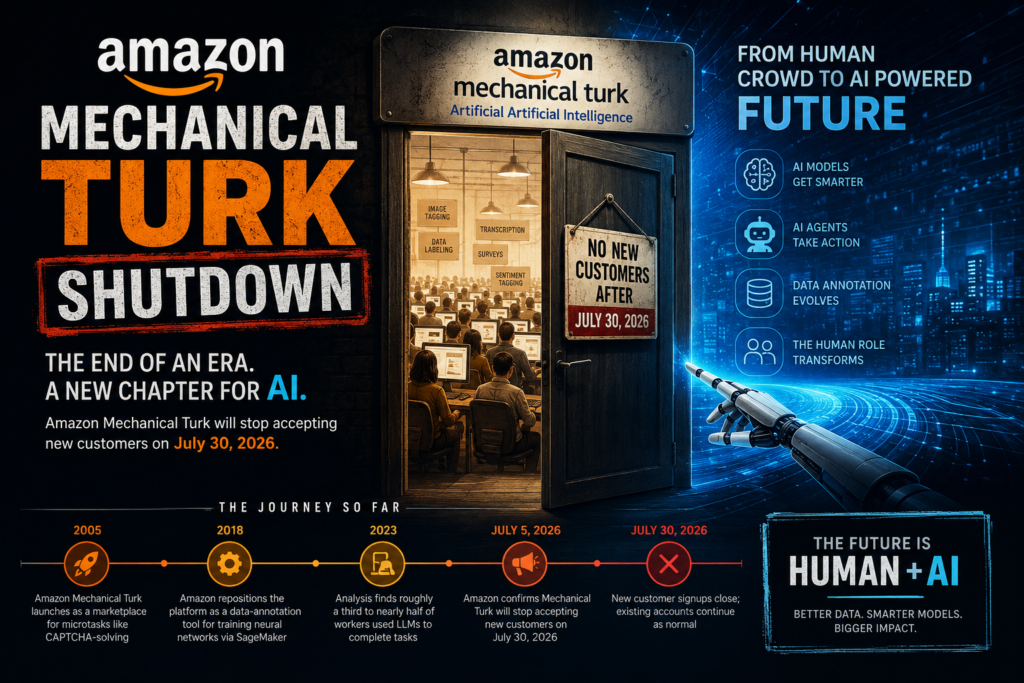
Amazon Mechanical Turk is closing its doors to new customers on July 30, 2026, effectively ending nearly two decades as the internet’s most famous “artificial artificial intelligence” marketplace. Existing accounts can keep running tasks, but the platform will receive no new features going forward — a slow wind-down rather than an abrupt shutdown.
If you’ve ever wondered how “AI-powered” products actually got trained, tested, or quietly kept running behind the scenes, Amazon Mechanical Turk is a big part of that answer. Its closure to new sign-ups is a milestone worth understanding, both for what it says about the AI industry today and for what comes next for anyone who relied on crowdsourced human labor to build machine learning systems.
What Happened: The Amazon Mechanical Turk Shutdown Explained
On its website, Amazon Mechanical Turk announced that it will stop accepting new customers starting July 30, 2026. Amazon Web Services described the move as the result of “careful consideration,” clarifying that current customers can continue operating as normal. AWS also said it will keep investing in security and availability for the platform, but has no plans to add new features.
In practical terms, this means:
- New businesses cannot sign up to post tasks (called “HITs,” or Human Intelligence Tasks) on Mechanical Turk after July 30, 2026.
- Existing customers are unaffected for now and can continue requesting work from the platform’s crowd of workers.
- No further product development is planned, signaling that Amazon Mechanical Turk is being maintained rather than grown.
This is less a hard shutdown and more a freeze — the digital equivalent of a store that stops letting new customers walk through the door while it still serves the regulars already inside.
Timeline of the Amazon Mechanical Turk Shutdown
| Date | Milestone |
|---|---|
| 2005 | Amazon Mechanical Turk launches as a marketplace for microtasks like CAPTCHA-solving |
| 2018 | Amazon repositions the platform as a data-annotation tool for training neural networks via SageMaker |
| 2023 | Independent analysis finds roughly a third to nearly half of workers were using large language models to complete “human” tasks |
| July 5, 2026 | Amazon confirms Mechanical Turk will stop accepting new customers on July 30, 2026 |
| July 30, 2026 | New customer signups close; existing accounts continue as normal |
What Is Amazon Mechanical Turk? A Quick History
Amazon Mechanical Turk is a crowdsourcing marketplace where requesters pay individual workers small amounts of money to complete short, simple tasks that computers historically struggled to do on their own. Think image labeling, transcription, sentiment tagging, or solving CAPTCHAs — jobs that need a human eye but not much time.
The name itself is a wink at history. The original “Mechanical Turk” was an 18th-century chess-playing machine that was actually a hoax: a human chess master hid inside the cabinet, secretly operating the “automaton.” Amazon’s version updated the joke for the internet age — a system that looked automated from the outside but ran on real people behind the curtain.
From CAPTCHA Solving to AI Training Data
When Amazon Mechanical Turk first launched in 2005, most tasks were mundane: identifying objects in photos, moderating content, or solving puzzles that separated humans from bots. Over time, the platform became something bigger. Starting in 2018, Amazon began marketing Mechanical Turk as a way for companies to annotate the datasets used to train neural networks, folding it into the broader SageMaker AI ecosystem.
This shift mattered because machine learning models are only as good as their training data, and someone has to label that data before a model can learn from it. Amazon Mechanical Turk became a go-to source for that labeled data at scale, quietly powering a huge share of the AI boom’s underlying training pipelines.
Amazon Mechanical Turk also had a rockier side of its history. During its early years, the platform sat at the center of debates about the ethics of crowdsourced labor — low pay, lack of benefits, and murky working conditions for the people completing tasks. It also had a small, strange cameo in the Facebook–Cambridge Analytica scandal, illustrating how far its reach extended beyond simple data labeling.
Why Is Amazon Shutting Down Mechanical Turk to New Customers?
Amazon hasn’t spelled out a single root cause, but the public record points to a few converging pressures that made Amazon Mechanical Turk harder to justify as a growth product.
The Bot and Fraud Problem
Crowd workers on Amazon Mechanical Turk were supposed to provide something machines couldn’t: genuine human judgment. But by 2023, an independent analysis estimated that between roughly a third and nearly half of workers were using large language models to complete their assignments. That’s a fundamental problem for a platform whose entire value proposition was “real humans doing what AI can’t yet do.”
If a meaningful chunk of “human-annotated” data is actually AI-generated by workers quietly outsourcing their tasks to a chatbot, the resulting datasets become far less reliable for training the next generation of models. It’s a feedback loop: AI tools got good enough that people used them to fake being human on a platform whose whole purpose was proving humans were still needed.
The Rise of AI Agents Replacing Human Crowd Workers
At the same time, many of the simple tasks Amazon Mechanical Turk workers used to handle — labeling images, basic sentiment analysis, short transcriptions — are now things modern AI models can do directly, often faster and cheaper than a human crowd worker. As models improved, the economic case for routing simple annotation work through a global human workforce weakened considerably.
Community reaction to the news reflected this shift. One Reddit user in the Mechanical Turk community argued the platform had effectively “died years ago” as researchers and workers abandoned it due to bots and fraud, predicting Amazon would eventually decide that keeping the servers running wasn’t worth the cost.
Amazon Mechanical Turk vs Other Crowd Work and Data Annotation Platforms
Amazon Mechanical Turk doesn’t operate in a vacuum. Here’s how it compares with other well-known platforms in the crowdsourced labor and AI data annotation space.
| Platform | Primary Use Case | Status (2026) | Worker Pool | AI Data Focus |
|---|---|---|---|---|
| Amazon Mechanical Turk | Microtasks, general crowdsourcing | Closed to new customers as of July 30, 2026 | Global, self-directed | Moderate (via SageMaker integration) |
| Scale AI | Enterprise-grade data labeling | Actively growing | Managed, vetted contractors | High — core business |
| Appen | Data annotation, AI training data | Actively operating | Global, managed workforce | High — core business |
| Amazon SageMaker Ground Truth | Managed labeling workflows | Actively supported | Mix of Mechanical Turk, vendors, private workforce | High — integrated AI pipeline |
| Prolific | Research studies, surveys | Actively operating | Vetted participant panel | Low — research-oriented |
The table makes one thing clear: Amazon Mechanical Turk’s decline doesn’t mean the demand for human-labeled data has disappeared. It means that demand has shifted toward platforms built with more oversight, better fraud controls, and tighter integration with enterprise AI pipelines.
What Happens to Existing Mechanical Turk Customers and Workers?
If you’re already using Amazon Mechanical Turk, the July 30, 2026 change doesn’t shut you out. AWS has been explicit that current customers can continue operating as normal, and the company says it will keep investing in security and availability. What’s off the table is new feature development — Amazon Mechanical Turk is being kept alive for continuity, not expansion.
For workers, the near-term reality also stays largely the same: existing requesters can keep posting HITs, and workers can keep completing them. The bigger risk isn’t an immediate cutoff — it’s the long-term trajectory. A platform that stops accepting new customers and stops shipping new features tends to shrink gradually as existing customers migrate elsewhere, rather than disappearing overnight.
The Bigger Picture: What the Mechanical Turk Shutdown Means for AI
The story of Amazon Mechanical Turk is really the story of “human-in-the-loop” AI — the idea that even the most advanced machine learning systems have long depended on hidden human labor to function, improve, or simply appear more capable than they are.
The “Potemkin AI” Problem
Critics have used Amazon Mechanical Turk as a case study in what’s sometimes called “Potemkin AI”: products marketed as fully automated intelligence that are, behind the scenes, partly or entirely powered by human workers completing tasks in real time. Given that the original 18th-century “Mechanical Turk” was itself a hoax involving a hidden human operator, the parallel to Amazon’s crowdsourcing platform is almost too neat — a machine that looks autonomous but runs on people you’re not meant to see.
The Mechanical Turk shutdown to new customers arrives at an interesting moment for that narrative. AI models have grown capable enough to handle many of the tasks that once required a human crowd, which cuts both ways: it’s a sign of real technical progress, and it’s also a reminder that plenty of “AI” products over the past two decades leaned on human labor far more than their marketing suggested.
Why This Matters for Data Quality and Model Training
For anyone building or buying AI systems, the Mechanical Turk shutdown is a useful prompt to ask harder questions about data provenance. If a dataset was labeled through a crowdsourcing platform where a large share of workers may have used AI tools to complete their tasks, how confident can you be that the labels reflect genuine human judgment? This is exactly the concern raised by the 2023 findings on LLM usage among Mechanical Turk workers, and it’s a concern that extends well beyond any single platform.
Alternatives to Amazon Mechanical Turk for AI Data Annotation
If your organization used Amazon Mechanical Turk for data labeling, crowdsourced research, or microtask work, here are the categories worth exploring as replacements:
- Managed data-labeling vendors (Scale AI, Appen, Sama) — better suited for enterprise AI training data, with vetted workforces and quality-control pipelines built specifically for machine learning.
- Amazon SageMaker Ground Truth — Amazon’s own managed labeling service, which can route work to private workforces, vendor workforces, or (for now) Mechanical Turk itself.
- Research-focused panels (Prolific, CloudResearch) — a better fit if your use case is closer to academic surveys or user studies than raw data annotation.
- Synthetic and AI-assisted labeling — increasingly used to pre-label data before a smaller human team reviews and corrects it, reducing reliance on large crowdsourced workforces.
- In-house annotation teams — some companies are bringing labeling work internal for sensitive or high-stakes datasets where data provenance and quality control matter most.
Frequently Asked Questions About the Amazon Mechanical Turk Shutdown
Is Amazon Mechanical Turk shutting down completely? No. Amazon Mechanical Turk is closing to new customers as of July 30, 2026, but existing customers can continue using the service as normal. AWS says it will keep investing in security and availability, just not new features.
When does Amazon Mechanical Turk stop accepting new customers? July 30, 2026, according to an announcement on the Mechanical Turk website and confirmed by Amazon Web Services.
Why is Amazon shutting down Mechanical Turk to new customers? Amazon hasn’t given a single detailed explanation beyond “careful consideration,” but industry observers point to years of declining engagement, rising bot and fraud problems, and the growing ability of AI models to handle tasks that once required human crowd workers.
What was Amazon Mechanical Turk originally used for? Launched in 2005, it was originally a marketplace for simple tasks like CAPTCHA-solving and basic content moderation. From 2018 onward, Amazon repositioned it primarily as a tool for annotating data used to train AI models.
Can I still use Amazon Mechanical Turk if I’m already a customer? Yes. Existing customers are not affected by the July 30, 2026 change and can continue posting tasks and paying workers as usual.
What should businesses use instead of Amazon Mechanical Turk? Depending on the use case, alternatives include managed data-annotation vendors like Scale AI and Appen, Amazon’s own SageMaker Ground Truth service, research panels like Prolific, or building an in-house labeling team for sensitive datasets.
Final Takeaway
The Amazon Mechanical Turk shutdown to new customers marks the end of an era for one of the internet’s earliest and most influential crowdsourcing platforms. What began in 2005 as a marketplace for CAPTCHA-solving grew into a critical, if controversial, engine for training the AI systems we use today — and its gradual decline says as much about how far AI has come as it does about the human labor that quietly made much of that progress possible. For businesses and researchers who relied on Amazon Mechanical Turk, now is the time to evaluate alternatives, audit existing datasets for data-quality risk, and plan for a future where human-in-the-loop AI work looks very different from the crowdsourced model that defined the last two decades.