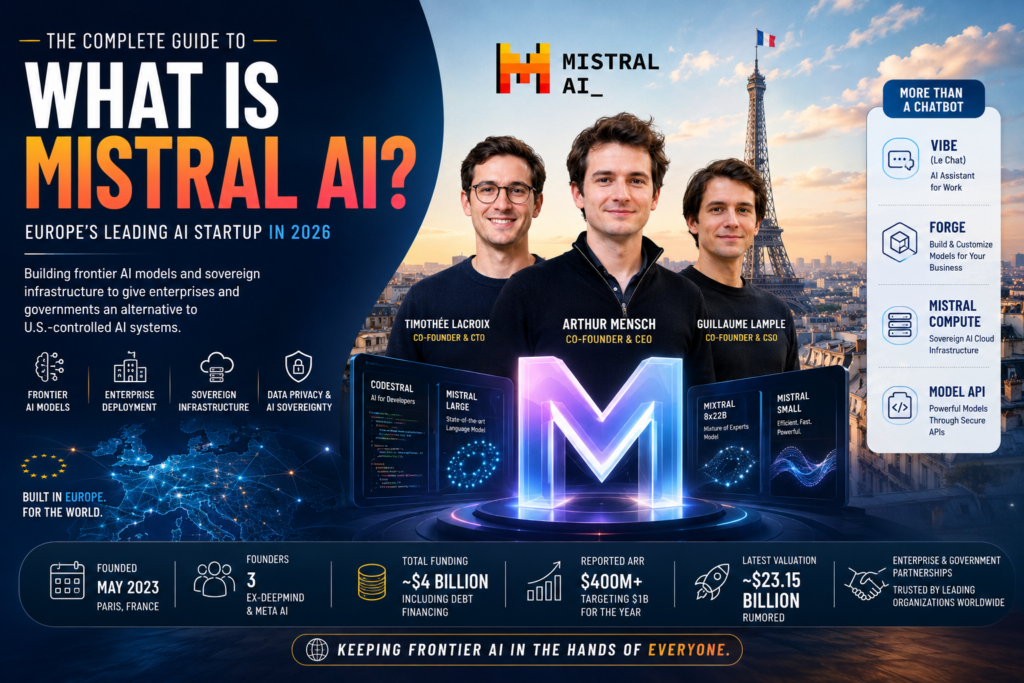
Mistral AI is a Paris-based artificial intelligence company that builds large language models and enterprise AI infrastructure, founded in 2023 to give organizations an alternative to U.S.-controlled AI systems. Unlike a pure consumer chatbot play, the French startup has grown into a hybrid research lab and enterprise deployment partner — closer to Palantir’s “forward-deployed engineer” model than to a direct copy of ChatGPT.
That distinction matters, because most quick explainers stop at “the French OpenAI rival” and leave it there. This guide breaks down who built the company, how its business actually works, what models it ships, how much money it has raised, and where it’s headed next — including an open-weight model the startup is preparing to release this summer.
What Is Mistral AI, Exactly?
Definition + Expansion
The company is a French artificial intelligence startup founded in May 2023 that designs large language models (LLMs), multimodal systems, and an AI agent platform, while also helping governments and large corporations deploy and customize those models on their own infrastructure. Its stated mission is to keep frontier AI “in the hands of everyone,” positioning the business against what its leadership describes as centralized control of AI by a small number of states or corporations.
What sets this apart from most foundation-model labs is the balance between two businesses running side by side:
- Model development — building general-purpose and specialized LLMs, some open-weight and some proprietary.
- Enterprise deployment — sending engineers into client organizations to fine-tune, host, and integrate models using the customer’s own data, a strategy closer to a systems-integration business than a chatbot company.
- Infrastructure — increasingly, building the data centers and cloud platform needed to run all of the above independently of U.S. hyperscalers.
That second and third line of business are arguably more important right now, since revenue and government relationships have grown fastest around deployment and infrastructure rather than around the consumer chat product.
Quick Facts
| Attribute | Detail |
|---|---|
| Founded | May 2023, Paris, France |
| Founders | Arthur Mensch, Timothée Lacroix, Guillaume Lample |
| CEO | Arthur Mensch |
| Headquarters | Paris, France |
| Core products | Vibe (formerly Le Chat), Forge, Mistral Compute, model API |
| Reported ARR | Over $400 million (disclosed February 2026), targeting $1 billion for the year |
| Latest reported valuation | Rumored to be raising at roughly $23.15 billion |
| Total funding raised | Roughly $4 billion, including debt financing |
Who Founded the Company?
The Founding Team
Three researchers who cut their teeth at major U.S. tech labs operating out of Paris started the business in 2023. CEO Arthur Mensch previously worked at Google DeepMind, while CTO Timothée Lacroix and Chief Scientist Officer Guillaume Lample are former Meta AI researchers. That pedigree gave the young company instant credibility with investors — and it closed what was, at the time, Europe’s largest-ever seed round within a single month of being founded.
Two additional figures carry the title of co-founding advisers: Charles Gorintin and Jean-Charles Samuelian-Werve, the co-founders of French health insurance startup Alan. Samuelian-Werve also sits on the company’s board of directors.
Recent Executive Additions
As the enterprise business has scaled, leadership has added seasoned operators to the bench, including a Chief Financial Officer, a Chief Marketing Officer, and a senior vice president overseeing partners and alliances. Bringing in this kind of commercial leadership is typically a signal that a startup is shifting from a research-first culture toward disciplined go-to-market execution — exactly the phase this company appears to be in as it chases a billion dollars in annual recurring revenue.
What Makes This Company Different From OpenAI?
Question: Is it really “the European OpenAI”?
Direct answer: Not quite. The company’s chat and agent product has nowhere near ChatGPT’s brand recognition, and by its own CEO’s admission, it does not currently field the best-performing language models in the world. Its real differentiation is a services-and-sovereignty strategy: helping governments and enterprises run AI on infrastructure they control, rather than chasing consumer mindshare.
Side-by-Side Comparison With OpenAI
| Dimension | Mistral AI | OpenAI |
|---|---|---|
| Founded | 2023, Paris | 2015, San Francisco |
| Primary business model | Enterprise deployment + open-weight and proprietary models | Consumer subscriptions + enterprise API |
| Openness | Mix of open-weight and closed models | Primarily closed, proprietary models |
| Flagship consumer product | Vibe (formerly Le Chat) | ChatGPT |
| Reported ARR | Over $400 million, targeting $1 billion | Reported in the tens of billions |
| Strategic positioning | European AI sovereignty, government partnerships | Global consumer and enterprise scale |
| Infrastructure approach | Building its own AI cloud (Mistral Compute) via an Nvidia partnership | Relies on Microsoft Azure and its own data center buildout |
The Palantir Playbook
What casual observers tend to miss is that this business has effectively adopted Palantir’s forward-deployed engineering model: rather than selling a self-serve product and hoping enterprises figure out how to use it, engineers embed directly with government agencies and corporations to tailor models to specific workflows. CEO Arthur Mensch has described this directly, explaining that the core activity has been deploying models and the agent platform on customers’ own infrastructure and helping them build custom models through a platform called Forge, which lets organizations train on their own data rather than send it to a third party.
This approach suits the company’s financial position. It is reportedly raising new funding at nearly double its prior valuation, yet that figure still trails the capital available to U.S. frontier labs by a wide margin — making a capital-light, high-touch enterprise strategy more realistic than an all-out consumer arms race against much better-funded rivals.
What Are the Company’s Main Models?
The model portfolio spans far beyond a single flagship chatbot. Current offerings include:
- General-purpose LLMs — including the compact “Mistral Small” line, aimed at efficient, cost-effective deployment for everyday tasks.
- Les Ministraux — a family of models specifically optimized to run on edge devices such as phones, rather than requiring constant cloud access.
- Multimodal and vision models — for tasks that combine text with images or documents.
- Reasoning models — designed for more complex, multistep problem-solving where a single-pass answer isn’t enough.
- Audio models — for voice-based applications, from transcription to voice agents.
- OCR models — document- and text-recognition tools, an area where the company claims a state-of-the-art position.
- Leanstral — an open-source code agent released to help developers automate software engineering tasks.
Several of these are released as open-weight models, meaning developers can download and run them independently rather than only accessing them through an API — a deliberate contrast to the closed-model approach favored by some U.S. rivals. Notably, Arthur Mensch has said the company does not yet field the top-performing language model in the world, but has been steadily closing that gap, and has teased a new open-weight model with early access opening in July 2026. He has also pointed to voice, vision, and document processing — areas that are less dependent on massive compute budgets — as domains where the lab already believes it holds a state-of-the-art position.
How Much Funding Has Been Raised?
Funding Timeline
Capital raising has moved in fast, large increments since the company’s founding:
| Round | Date | Amount | Reported Valuation | Lead Investor(s) |
|---|---|---|---|---|
| Seed | June 2023 | $113 million | $260 million | Lightspeed Venture Partners |
| Series A | December 2023 | ~$415 million (€385M) | $2 billion | Andreessen Horowitz (a16z) |
| Series A extension | February 2024 | $16.3 million (Microsoft) | Unchanged | Microsoft |
| Equity + debt round | June 2024 | ~$640 million (€600M) | $6 billion | General Catalyst |
| Series C | September 2025 | ~$2 billion (€1.7B) | ~$13.8 billion (€11.7B) | ASML |
| Rumored round | 2026 | ~$3.5 billion | ~$23.15 billion | Reportedly in progress |
Beyond these headline equity rounds, most of the capital raised to date has actually come from debt financing rather than traditional venture rounds — a notable detail given how capital-intensive AI infrastructure and data center construction has become. Total funding across debt and equity sits at roughly $4 billion, according to Crunchbase data.
Why the Revenue Story Matters More Than the Valuation
A rising valuation is only half the picture. What has genuinely impressed observers is the pace of revenue growth: annual recurring revenue reportedly jumped from around $20 million to more than $400 million within a single year, with leadership targeting $1 billion in annual recurring revenue by the end of the year. That kind of growth curve is part of why the founders have earned a seat at forums like Davos and even addressed the French Parliament directly on AI policy — a rare position for a three-year-old startup to hold.
What Partnerships Has the Company Signed?
Rather than building every layer of the stack alone, the business has stitched together a wide partner network across cloud, defense, telecom, and public-sector clients:
- Microsoft — a 2024 strategic deal, including an investment and distribution of the company’s models through Azure.
- Nvidia — backing for Mistral Compute, a European AI cloud platform powered by Nvidia processors, plus participation in a Paris-region AI campus alongside UAE investment firm MGX and France’s Bpifrance.
- ASML — a strategic partnership exploring AI use across the chip equipment maker’s operations, and lead investor in the Series C round.
- Accenture, IBM, Orange, Stellantis, and CMA CGM — enterprise partnerships spanning consulting, telecom, automotive, and shipping.
- Helsing — a defense AI partnership with the German startup.
- France’s army and national job agency, and the government of Luxembourg — public-sector deployments.
- Agence France-Presse (AFP) — a deal to bring current news information into the company’s chat product.
This spread illustrates the core bet behind Mistral AI: that governments and regulated industries in Europe and beyond want AI infrastructure that isn’t solely dependent on U.S. hyperscalers, and are willing to pay a partner that will help them build it rather than simply license a black-box API.
What Companies Has It Acquired?
The acquisition history so far is short but strategically pointed. The first deal was Koyeb, an infrastructure startup picked up to accelerate ambitions of building what leadership calls “a true AI cloud.” A second acquisition brought in Emmi, an Austrian startup focused on physics AI, aimed at better supporting industrial enterprises through their AI transformations. Both deals reinforce the same theme: building out infrastructure and industrial-grade tooling rather than simply acquiring talent or consumer-facing features.
Will It Build Its Own Chips?
Question: Are there plans to design custom AI chips?
Direct answer: Not yet, but the CEO hasn’t ruled it out. Arthur Mensch has said that owning chip design “may come” and probably should at some point, but for now the business continues to rely on Nvidia as a partner while testing early-stage ideas in the space. For a company still scaling its core model and deployment business, custom silicon remains a longer-term ambition rather than a near-term roadmap item.
Is an IPO or a Sale on the Table?
Question: Could the business be acquired instead of going public?
Direct answer: Leadership has stated publicly that the company is “not for sale,” with an IPO described as the plan instead. Given the scale of funding already raised — nearing $4 billion — even a high-profile acquirer would likely struggle to offer a premium that satisfies existing investors, and any acquisition by a non-European buyer would run directly against the sovereignty rationale the brand has built its identity around.
Why Mistral AI Is Getting More Attention in 2026
Renewed scrutiny of U.S. AI policy and growing European interest in reducing dependence on American software have put a spotlight back on Mistral AI as a homegrown alternative. The company has used that moment to clarify its own identity: not a scrappy ChatGPT clone, but an infrastructure and deployment partner pursuing what its CEO calls a commodity view of AI — the idea that every organization needs a secure, affordable supply of AI capability, similar to electricity or cloud computing.
Recent moves reinforcing that positioning include a multibillion-euro investment plan for new data centers in France and Sweden, continued momentum behind the open-weight model releases, and a growing public profile for Arthur Mensch, who has become something of a public ambassador for a European vision of AI development — one built on sovereignty and openness rather than pure scale.
How Does the Enterprise Business Actually Work?
It’s worth spending a little more time on the mechanics of the deployment business, since it’s easy to underestimate from the outside. Rather than shipping a single generic model and letting customers figure out integration themselves, teams work directly alongside a client’s own engineers, embedded for weeks or months at a time. The goal is a model that’s been fine-tuned on the client’s proprietary data, hosted inside the client’s own security perimeter, and wired into existing workflows — whether that’s a shipping company’s logistics software or a government agency’s citizen-services portal.
This is a fundamentally different sales motion than a self-serve API. It’s slower to close and more expensive to staff, but it produces stickier customers, deeper data moats, and — crucially for a company still ramping revenue — contracts that are hard for a rival to underbid on price alone. It also explains why growth in annual recurring revenue has tracked closely with the pace of new government and enterprise partnerships rather than with consumer app downloads.
What This Means for Buyers Evaluating AI Vendors
For a CIO or public-sector technology lead comparing vendors, the practical takeaway is that not every AI provider is selling the same thing. Some are selling a model. Others are selling a deployment relationship, where the model is only the starting point. Understanding which category a vendor falls into changes how you should evaluate price, lock-in risk, and long-term data control — questions that matter as much as raw benchmark performance.
Frequently Asked Questions
What does Mistral AI actually sell? The company sells access to its language, vision, audio, and OCR models through an API, a consumer and agent product called Vibe, and enterprise deployment services that let organizations fine-tune and host custom models on their own infrastructure through its Forge platform.
Is Mistral AI open source? Some of its models are released as open-weight, meaning the underlying model weights can be downloaded and run independently, while others remain proprietary. Its code agent, Leanstral, was released as fully open source.
How big is Mistral AI compared to OpenAI? It is meaningfully smaller by both revenue and valuation. Its annual recurring revenue was reported above $400 million in early 2026, while a rumored funding round would value the business at roughly $23 billion — both figures well below OpenAI’s scale.
Who leads the company? Arthur Mensch, a former Google DeepMind researcher, co-founded and currently leads the business as CEO.
Does the company work with governments? Yes. Active partnerships include public-sector bodies such as France’s army, its national job agency, and the government of Luxembourg, alongside a broader “AI for Citizens” initiative aimed at public institutions transforming their services with AI.
Why does Mistral AI matter if it isn’t the biggest AI lab? Scale isn’t the only axis that matters in AI. For governments, regulated industries, and companies wary of routing sensitive data through U.S.-controlled infrastructure, a partner offering deployable, customizable, and partly open models is often more valuable than access to the single most powerful model on the market.
The Bottom Line
Mistral AI isn’t trying to out-ship OpenAI on consumer chat features — at least not yet. Its bet is that European governments, regulated industries, and sovereignty-minded enterprises will pay a premium for AI they can deploy, customize, and control on their own terms. Between a fast-growing enterprise revenue base, an expanding partner network, and an open-weight model on the way this summer, the French company has built a distinct lane rather than a direct copy of the U.S. AI race — and that lane appears to be widening.