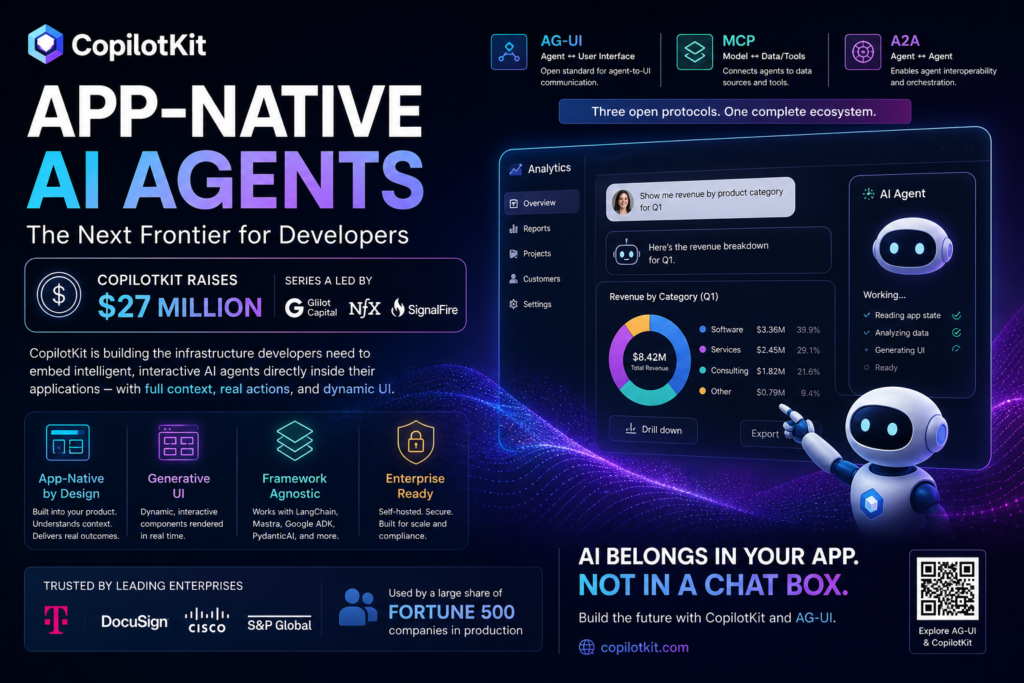
App-native AI agents are about to replace the clunky chatbot box sitting in the corner of your SaaS app — and CopilotKit just raised $27 million to make that transition happen. If you’re a developer, product leader, or enterprise architect trying to understand where AI integration is headed in 2026, this funding round is one of the clearest signals yet.
On May 5, 2026, TechCrunch exclusively reported that Seattle-based CopilotKit closed a Series A led by Glilot Capital, NFX, and SignalFire. The capital will fuel the company’s mission: give developers the tools to deploy app-native AI agents that live inside applications, understand user context, take real actions, and respond with dynamic, interactive interfaces — not walls of text.
What Are App-Native AI Agents?
Definition: An app-native AI agent is an AI system that is embedded directly within a software application, capable of perceiving the app’s current state, executing actions within it, and rendering context-aware user interfaces — all without routing users through a separate chat window.
This is a meaningful departure from how most companies have deployed AI so far. The dominant pattern has been to bolt a chatbot onto an existing product: the user types a question, the LLM returns a paragraph, and the user tries to interpret that paragraph in the context of whatever task they were trying to accomplish.
App-native AI agents flip that model. Instead of the user explaining their context to the AI, the agent already knows the context. Instead of returning text, it can return a pie chart, a booking widget, a data table, or any interactive UI component — rendered in real time, inside the product experience the user already knows.
How They Differ from Chatbot-Style AI
The distinction matters more than it might seem at first glance.
| Feature | Chatbot AI (e.g., embedded GPT) | App-Native AI Agent |
|---|---|---|
| Awareness of app state | None — relies on user describing context | Full — agent reads live UI state |
| Response format | Text only | Text + dynamic, interactive UI components |
| UI control | Cannot modify the interface | Can render and update components in context |
| Human-in-the-loop | Basic — prompt/response | Rich — streaming, state sharing, front-end tools |
| Enterprise self-hosting | Rarely supported | First-class feature (CopilotKit Enterprise) |
| Framework lock-in | Often tied to one vendor | AG-UI supports LangChain, Mastra, Google ADK, etc. |
The difference in user experience is dramatic. Imagine asking a travel app to “book a weekend trip to Lisbon under €800.” A chatbot returns a list of options. An app-native AI agent renders an interactive itinerary card, shows real-time pricing, and lets you swap hotels — inside the same screen you were already using.
The AG-UI Protocol: The Open Standard Powering the Shift
CopilotKit’s most important infrastructure contribution isn’t just its commercial product — it’s the open-source AG-UI protocol (Agent-User Interface protocol), which the company created and stewards.
What AG-UI Does Technically
AG-UI is an open standard that defines how AI agents connect to and communicate with user interfaces. Think of it as the missing handshake layer between the world of LLM-powered agent frameworks and the world of front-end applications.
Before AG-UI, every team that wanted to embed an agent into their app had to build that connection from scratch — different schemas, different streaming formats, different state models. AG-UI standardizes this into a shared protocol with specific features: streaming chat, front-end tool calls, and bidirectional state sharing between the agent and the UI. This is precisely what makes scalable, production-grade app-native AI agents possible.
The protocol is designed to complement — not compete with — two other major agent communication standards:
- MCP (Model Context Protocol): Anthropic’s standard for connecting AI models to external data sources and tools
- A2A (Agent2Agent Protocol): Google’s protocol for agent-to-agent communication and interoperability
AG-UI completes the picture by handling the agent-to-UI layer that MCP and A2A don’t address.
AG-UI vs. MCP vs. A2A: What Each Protocol Does
| Protocol | Created By | Primary Function | Layer It Operates On |
|---|---|---|---|
| AG-UI | CopilotKit | Agent ↔ User Interface communication | Frontend / UI layer |
| MCP | Anthropic | Agent ↔ Data sources and tools | Backend / data layer |
| A2A | Agent ↔ Agent interoperability | Orchestration layer |
All three are open standards. All three are increasingly being adopted together. AG-UI’s unique role is in making app-native AI agents visible and interactive to end users — the part of the stack that humans actually see and touch.
Major infrastructure providers have already adopted AG-UI: Google, Microsoft, Amazon, and Oracle all support the protocol. Popular frameworks including LangChain, Mastra, PydanticAI, and Agno have also integrated with it. CopilotKit reports millions of installs per week, and a large share of Fortune 500 companies using AG-UI in production.
What CopilotKit’s $27M Means for the Developer Ecosystem
A $27 million Series A in the current funding climate isn’t just a vote of confidence in one company — it’s a signal about which bets the venture community thinks will win in enterprise AI. The round was led by Glilot Capital, NFX, and SignalFire, all firms with strong track records in developer tools and infrastructure.
Who Led the Round and Why It Matters
Glilot Capital is an Israeli-founded growth fund with a focused thesis around security and infrastructure software. NFX is known for backing network-effect businesses early — a fitting choice for a startup whose value compounds as more developers adopt AG-UI as a standard. SignalFire bets heavily on technical founders and developer platforms.
The composition of the syndicate suggests the investors see CopilotKit not just as a product company but as a platform play: the more enterprises build on AG-UI, the more defensible CopilotKit’s commercial offering becomes.
Enterprise Customers and Adoption at Scale
CopilotKit isn’t at the “promising pilot” stage. Its enterprise customer list includes Deutsche Telekom, DocuSign, Cisco, and S&P Global — organizations that do not deploy experimental infrastructure at production scale.
The company’s new commercial offering, CopilotKit Enterprise Intelligence, is a self-hostable bundle designed to give enterprise teams everything they need to deploy app-native AI agents in production: infrastructure hardening, self-hosted deployment options, and enterprise-grade support layered on top of the open-source AG-UI stack.
Generative UI: The Visual Layer of App-Native Agents
One of the most technically interesting aspects of CopilotKit’s approach is what the company calls generative UI — the ability for an AI agent to compose and render interactive interface components dynamically, based on what a user is asking.
This is distinct from static UI. In a traditional app, every screen is designed and coded by a human engineer before the user ever sees it. With generative UI, an agent can assemble UI components at runtime — from a library of components your team has already defined — and present them in context.
What Generative UI Looks Like in Practice
Consider a business intelligence dashboard. A user asks, “Show me revenue by product category for Q1.” With a standard AI integration, the agent might return a markdown table or a text summary. With a generative UI approach, the agent renders a branded, interactive pie chart — one designed by your company’s own design system — that the user can click, drill into, and modify.
CopilotKit’s CEO Atai Barkai described it directly: developers provide the specifications and building blocks, and the agent selects and composes the right components for each moment. Critically, developers retain control over how much creative latitude the agent has — from pixel-perfect fidelity to a more flexible “build from blocks” approach, depending on the use case.
This makes app-native AI agents feel like a natural part of the product rather than a bolt-on feature. The agent speaks the visual language of your app.
CopilotKit vs. the Competition
CopilotKit operates in a competitive space. Several well-funded alternatives are targeting similar developer needs:
- Vercel AI SDK — A popular open-source SDK for building AI-powered web applications. Strong in the React/Next.js ecosystem, but tied more closely to Vercel’s own infrastructure. Less suitable for enterprises that need self-hosting or multi-cloud flexibility.
- Assistant-UI — Focused on UI components for AI chat interfaces. A narrower scope than CopilotKit’s full agent framework.
- OpenAI Apps SDK — Enables richer interfaces for AI interactions, but only within the ChatGPT product ecosystem. Not suitable for teams building their own products.
The Open vs. Closed Stack Debate
This is where CopilotKit’s positioning sharpens into a genuine strategic differentiator. The company’s co-founder Uli Barkai put it plainly: enterprise buyers want two things above almost everything else — optionality and self-hosting.
Enterprises that have already invested in Google’s ADK, Amazon’s Strands Agents, Microsoft’s agent framework, or LangChain don’t want to rip out their existing stack to adopt a new AI UI layer. CopilotKit’s framework is designed to work with whatever agent runtime and cloud provider an enterprise already uses.
This horizontal, framework-agnostic approach is fundamentally different from what vertically integrated platforms like Vercel offer. And because the underlying AG-UI protocol is fully open — not a proprietary API — enterprises can adopt it without betting their architecture on one vendor.
The commercial product (CopilotKit Enterprise Intelligence) sits on top of this open foundation. The company’s strategy is to be the default open standard, then earn revenue by hardening that standard for enterprise deployment — a model that has worked well for companies like HashiCorp, Elastic, and Confluent.
What This Means for Developers Building Today
If you’re a developer evaluating how to embed AI into your product in 2026, here is a practical framework for thinking about where app-native AI agents fit:
When app-native AI agents make sense:
- Your users perform multi-step, context-dependent tasks inside your product (project management, financial workflows, data analysis, logistics coordination)
- You want AI actions to feel native — not like a separate AI product layered on top
- Your enterprise customers require self-hosting or data residency controls
- You need the AI to render product-specific UI components, not generic text responses
When a simpler chatbot integration might suffice:
- Your AI use case is primarily question-and-answer or content generation
- Users interact with AI outside the context of a structured application workflow
- Speed to market matters more than depth of integration
For the first category — which covers a large and growing share of B2B software — the CopilotKit / AG-UI stack is worth serious evaluation. The combination of an open protocol, broad framework support, and enterprise-ready commercial tooling puts it in a strong position as the market for app-native AI agents matures.
The $27 million round gives CopilotKit the runway to grow its 25-person team, accelerate enterprise sales, and deepen the AG-UI ecosystem. For developers, that means more integrations, more supported frameworks, and a more robust open standard to build on.
Frequently Asked Questions
What is CopilotKit? CopilotKit is an open-source developer platform that enables teams to build and deploy app-native AI agents — AI systems embedded inside applications that can understand app state, take actions, and render dynamic UI components. The company also created and maintains the AG-UI protocol.
What is the AG-UI protocol? AG-UI (Agent-User Interface protocol) is an open standard that defines how AI agents communicate with user interfaces. It provides streaming chat, front-end tool calls, and state sharing capabilities, and is supported by Google, Microsoft, Amazon, Oracle, LangChain, and other major platforms.
How does CopilotKit differ from Vercel’s AI SDK? Vercel’s AI SDK is tightly integrated with Vercel’s infrastructure and works best in the Next.js ecosystem. CopilotKit is framework-agnostic and emphasizes enterprise self-hosting and multi-stack optionality — supporting whatever agent runtime, cloud provider, or backend an enterprise already uses.
What is generative UI? Generative UI is the capability for an AI agent to compose and render interactive UI components at runtime, based on user context and intent. Instead of returning text, the agent returns a pie chart, a form, or a data widget — drawn from a catalog of components defined by your design system.
Who are CopilotKit’s enterprise customers? CopilotKit counts Deutsche Telekom, DocuSign, Cisco, and S&P Global among its enterprise customers. The company reports that a large portion of Fortune 500 companies use AG-UI in production.
What is CopilotKit Enterprise Intelligence? It is CopilotKit’s new self-hostable commercial product that bundles infrastructure hardening, enterprise support, and deployment tooling on top of the open-source AG-UI stack — designed for organizations that need to deploy app-native AI agents in production at scale.