Amazon Web Services just posted its fastest growth rate in nearly four years. If you want to understand why AWS cloud growth is accelerating — and what it means for the broader AI and cloud industry — this post breaks it all down with the latest Q1 2026 data.
What Is AWS Cloud Growth?
Definition: AWS cloud growth refers to the year-over-year increase in net sales generated by Amazon Web Services, Amazon’s cloud computing division. It is the primary metric analysts and enterprise buyers use to gauge the health and competitive positioning of the world’s largest cloud provider.
Expansion: AWS cloud growth matters beyond Amazon’s stock price. Because AWS powers a vast slice of the global internet — from startups to Fortune 500 enterprises — its growth rate is widely treated as a leading indicator of enterprise technology adoption, AI investment trends, and the overall appetite for outsourcing compute infrastructure. When AWS cloud growth accelerates, it typically signals that businesses are spending more aggressively on digital transformation, AI workloads, and data processing at scale.
AWS Q1 2026 Results: The Numbers That Matter
Amazon reported its Q1 2026 earnings on April 29, 2026, beating Wall Street’s expectations across the board. For investors, cloud watchers, and enterprise technology buyers, the AWS segment was the standout story.
Revenue Breakdown
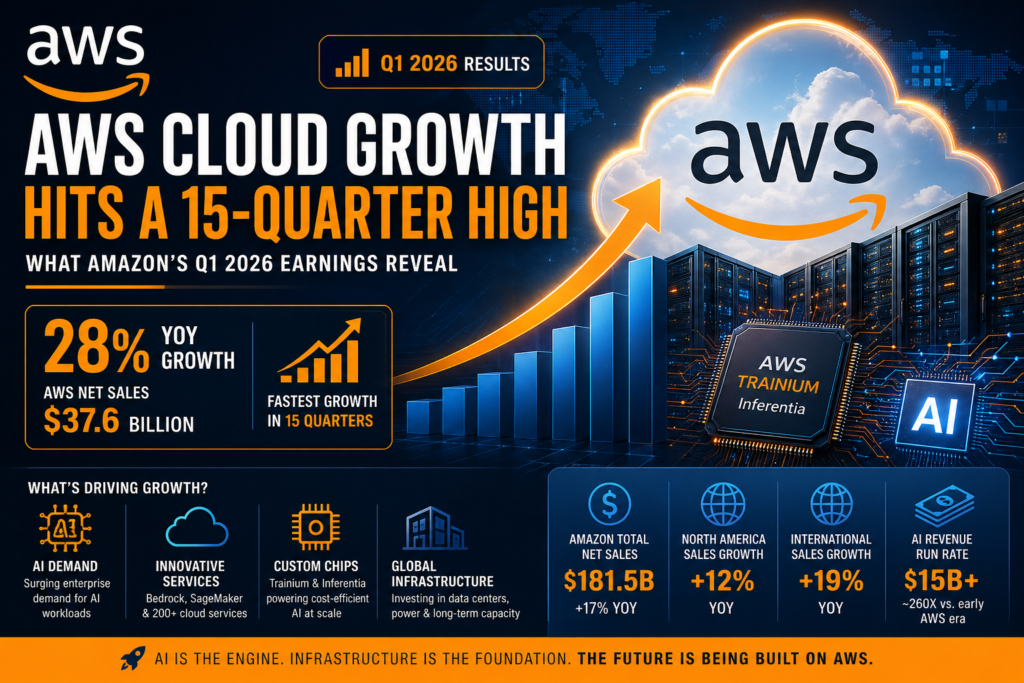
AWS cloud growth came in at 28% year-over-year, with net sales climbing to $37.6 billion for the quarter. According to Amazon’s CEO Andy Jassy, this marks the fastest AWS cloud growth rate in 15 quarters — roughly since late 2022.
To put that in context: AWS was already a massive business before this acceleration. As Jassy noted on the earnings call, it is “very unusual for a business to grow this fast on a base this large.”
Amazon’s overall business also performed strongly. Total company net sales rose 17% year-over-year to $181.5 billion, with North America growing 12% and international markets expanding 19%.
Key AWS Q1 2026 Metrics at a Glance
| Metric | Q1 2026 Value | Year-Over-Year Change |
|---|---|---|
| AWS Net Sales | $37.6 billion | +28% |
| AWS Growth Rate | 28% | Fastest in 15 quarters |
| Amazon Total Net Sales | $181.5 billion | +17% |
| North America Sales Growth | — | +12% |
| International Sales Growth | — | +19% |
| Free Cash Flow (TTM) | $1.2 billion | Decreased YoY |
| AI Revenue Run Rate | $15 billion+ | ~260x vs. early AWS era |
Why Is AWS Growing So Fast? The AI Factor
AI as the Primary Demand Driver
The single biggest driver of the current AWS cloud growth cycle is artificial intelligence. Enterprises across every sector are rushing to build, fine-tune, and deploy AI models — and that requires massive amounts of compute. AWS has positioned itself as a preferred platform for this work, offering GPU clusters, foundation model access through Amazon Bedrock, and deep integrations with tools like SageMaker.
Jassy was direct about the connection: “Companies continue to choose AWS for AI.” This is not just marketing language. The surge in AI workloads — from training large language models to running inference at scale — is translating directly into AWS cloud growth in a way that is measurable, durable, and accelerating.
Andy Jassy’s Bold Comparison
Jassy offered a striking historical comparison to illustrate how extraordinary the current AWS cloud growth moment really is:
“Three years after AWS launched, it had a $58 million revenue run rate. During the first three years of this AI wave, AWS’s AI revenue run rate is over $15 billion — nearly 260 times larger.”
That comparison is remarkable. The first era of AWS cloud growth was itself considered a technological revolution. The AI-driven second wave, by this measure, is operating at a completely different order of magnitude. The implication is clear: AI is not just a feature on AWS — it is the engine of AWS cloud growth for the foreseeable future.
The Capital Expenditure Trade-Off
What Amazon Is Spending Capex On
Rapid AWS cloud growth does not come for free. Amazon is investing aggressively in the physical infrastructure required to serve AI workloads: land, power, data center buildings, chips, servers, and networking gear. Jassy was explicit that this capex cycle will continue and even intensify in the near term.
“The faster AWS grows, the more short-term capex we’ll spend,” he said on the earnings call.
Here is a breakdown of the major infrastructure categories Amazon is investing in to support AWS cloud growth:
- Land and real estate — Securing sites for new data center campuses globally
- Power infrastructure — Locking in electricity capacity, including long-term utility agreements and renewable energy deals
- Custom AI chips — Developing Trainium and Inferentia chips to reduce dependency on Nvidia and lower compute costs
- Servers and GPU clusters — Buying and deploying thousands of high-performance AI accelerators
- Networking gear — High-speed interconnects that reduce latency inside data center clusters
- Long-lived assets — Data centers themselves have a useful life exceeding 30 years; servers and chips run 5–6 years
Free Cash Flow Impact
Here is the honest trade-off: all of this capital spending is temporarily pressuring Amazon’s free cash flow. The company reported that free cash flow for the trailing twelve months fell to $1.2 billion, down significantly year-over-year, driven primarily by the infrastructure investment surge.
Jassy framed this as an intentional, cyclical pattern rather than a structural problem. He pointed to Amazon’s experience during the first major AWS cloud growth wave: “We’ve been through this cycle with the first big AWS growth wave, and like the results.”
The logic follows a familiar technology industry arc: spend heavily on infrastructure today, monetize it through cloud revenue for decades. The long-lived nature of data centers (30+ years) makes the math work over time — but it creates near-term pressure on free cash flow that investors must understand and price accordingly.
Q: Will Amazon’s free cash flow recover? A: Yes, historically — once capex growth stabilizes relative to revenue growth. Jassy explicitly said Amazon expects “much larger potential downstream revenue and free cash flow” from the AI infrastructure buildout. The near-term pain is the price of positioning for long-term dominance.
AWS vs. Azure vs. Google Cloud: The Cloud Growth Comparison
AWS cloud growth at 28% is impressive, but how does it compare to its two major rivals? Microsoft Azure and Google Cloud have both been reporting strong AI-driven growth as well, making the cloud market competitive despite AWS’s scale advantage.
| Cloud Provider | Parent Company | Recent Growth Rate | AI-Focused Products |
|---|---|---|---|
| AWS | Amazon | +28% YoY (Q1 2026) | Bedrock, Trainium, SageMaker |
| Azure | Microsoft | ~35% (Q4 2025 est.) | Azure OpenAI, Copilot stack |
| Google Cloud | Alphabet | ~28–30% (Q4 2025 est.) | Vertex AI, Gemini APIs |
Note: Azure and Google Cloud figures are estimated from prior quarter reports; Q1 2026 figures pending their earnings releases.
A few important nuances about this comparison:
- Scale matters. AWS operates on a significantly larger revenue base than either Azure or Google Cloud. Growing 28% on $37.6 billion in quarterly revenue is harder than growing 30% on a smaller base.
- Profitability leadership. AWS consistently runs at higher operating margins than its competitors, meaning its AWS cloud growth translates more directly into operating income.
- Breadth of services. AWS offers the broadest catalog of cloud services — over 200 products — giving enterprises more reasons to consolidate workloads on a single platform.
What This Means for Businesses Using AWS
Whether you are a startup building on AWS or an enterprise CTO making multi-year cloud commitments, the Q1 2026 AWS cloud growth numbers have practical implications.
For Enterprise Buyers
- Capacity is being prioritized for AI workloads. Amazon’s infrastructure investment signals that GPU and AI compute availability will improve over the next 12–24 months, easing constraints that have frustrated developers.
- Pricing is unlikely to fall sharply in the near term. Strong demand and heavy capex investment mean AWS has limited incentive to aggressively discount core services.
- AI-native services will proliferate. Amazon is clearly betting that Bedrock, SageMaker, and its custom chip ecosystem will be central to enterprise AI strategies. Expect continued product investment in this area.
For Startups and Developers
- AWS Activate and credits programs remain a priority. With AWS cloud growth heavily dependent on capturing the next generation of AI-native companies early, Amazon continues to invest in developer relationships.
- Multi-cloud and cost optimization still matter. Even as AWS cloud growth accelerates, the capex pressure on free cash flow is a reminder that cloud costs are real — and optimizing spend remains a competitive advantage for any engineering team.
Frequently Asked Questions About AWS Cloud Growth
What drove AWS cloud growth in Q1 2026? The primary driver was enterprise demand for AI compute and services. Companies building and deploying AI models — particularly large language models and inference infrastructure — have been flocking to AWS for its GPU clusters, Bedrock model access, and SageMaker tooling.
How does AWS cloud growth affect Amazon’s stock? Strong AWS cloud growth is the most important driver of Amazon’s stock valuation because AWS generates the majority of Amazon’s operating income. A 28% growth rate — the fastest in 15 quarters — is a significant positive signal for investors.
What is Amazon spending its capex on for AWS? Amazon is building out data center campuses, securing power infrastructure, deploying custom AI chips (Trainium, Inferentia), and purchasing GPU servers and networking gear — all to support AWS cloud growth driven by AI workloads.
Will the heavy capex spending hurt AWS long-term? Jassy and Amazon’s leadership argue no. They compare the current cycle to the first AWS cloud growth wave, during which heavy early spending yielded decades of high-margin revenue. Data centers last 30+ years; the economics improve significantly once the initial buildout phase stabilizes.
Key Takeaways: AWS Cloud Growth in 2026
The Q1 2026 earnings report delivers a clear signal: AWS cloud growth is re-accelerating, and AI is the fuel. Here is the summary picture:
- AWS grew 28% year-over-year to $37.6 billion in Q1 2026 — its fastest rate in 15 quarters
- AI is the primary demand driver, with AWS’s AI revenue run rate already exceeding $15 billion annually
- Capital expenditure is surging to build the infrastructure required to serve AI workloads — land, power, chips, and data centers
- Free cash flow is temporarily compressed as capex growth outpaces revenue growth in the short term
- Amazon’s long-term thesis is that AI infrastructure investment today will generate dramatically larger revenue and free cash flow for decades
For anyone tracking the cloud computing industry, the enterprise technology market, or the AI infrastructure buildout, AWS cloud growth is the most important data point to watch throughout 2026 and beyond. Amazon has made its bet — and Q1 suggests it is paying off.
Conclusion
AWS cloud growth in Q1 2026 sends a strong message to the technology market: the next phase of cloud competition is being defined by artificial intelligence, infrastructure scale, and long-term capital commitment. With AWS reporting 28% year-over-year growth and reaching $37.6 billion in quarterly revenue, Amazon has demonstrated that enterprise demand for cloud services remains far from saturated. Instead, AI is creating an entirely new layer of demand that is accelerating infrastructure spending across the industry.
What makes this moment especially important is not just the growth percentage itself, but the scale at which it is happening. AWS is already the largest cloud provider in the world, so maintaining and accelerating growth at this size is far more difficult than for smaller competitors. This reinforces Amazon’s continued dominance in enterprise cloud infrastructure while showing that customers are increasingly choosing AWS as the foundation for AI development, model deployment, and large-scale data operations.
However, this growth story also comes with short-term financial trade-offs. Amazon’s aggressive spending on data centers, AI chips, servers, networking, land, and power infrastructure has compressed free cash flow, signaling that the company is prioritizing long-term strategic positioning over near-term profitability optimization. For investors, this is a familiar Amazon playbook: spend heavily today to build infrastructure moats that generate revenue for decades.
For businesses, startups, and enterprise decision-makers, AWS cloud growth is more than an earnings metric—it is a signal of where technology investment is heading. AI workloads are becoming central to cloud strategy, and providers capable of delivering scalable compute, custom silicon, and integrated AI platforms are likely to dominate the next decade.
Ultimately, Amazon’s Q1 2026 earnings confirm one thing clearly: AWS cloud growth is no longer just about cloud migration. It is now deeply tied to the global AI race. As enterprises continue scaling AI initiatives, AWS appears well-positioned to remain one of the biggest beneficiaries of this transformation throughout 2026 and beyond.