Why Did Canada Impose Retaliatory Tariffs on US Goods?
Why did Canada impose retaliatory tariffs?
Direct answer: Canada introduced new tariffs on $20 billion of US goods in response to US tariffs covering a similar value of Canadian exports. Ottawa’s objective is to increase economic pressure on Washington while creating leverage for stalled trade negotiations.
The new Canada retaliatory tariffs are part of an escalating trade dispute that Reuters described as an 18-month-old trade war between the neighboring countries.
Canada’s government had previously warned that its countermeasures would take effect on September 8 after negotiations failed to produce an agreement. Canadian Prime Minister Mark Carney has said Ottawa remains prepared to reach a trade deal that benefits both countries.
But negotiations have become increasingly difficult.
US and Canadian officials have blamed one another for the collapse of talks that appeared close to producing an agreement only weeks earlier. A Canadian government source told Reuters that there were currently no talks between ministers or government officials from the two sides.
What are retaliatory tariffs?
Retaliatory tariffs are import taxes imposed by one country in response to tariffs or other trade restrictions imposed by another country.
In simple terms, Country A puts a tariff on Country B’s products. Country B responds by placing tariffs on products from Country A.
The goal is usually to create economic and political pressure. The country imposing retaliation hopes the additional cost will encourage the other side to reconsider its original trade policy.
However, retaliation can also produce an escalation cycle.
If both countries repeatedly increase tariffs, companies may face higher costs, consumers can see higher prices and businesses may begin changing their suppliers or investment plans.
That is precisely the concern raised by Michael Harvey, executive director of the Canadian Agri-Food Trade Alliance and a member of Carney’s advisory committee on bilateral US economic relations.
Harvey warned about the possibility of an “escalatory spiral”, while acknowledging that the Canadian government needs areas of leverage in negotiations.
What Are Canada’s New Retaliatory Tariffs?
How large are Canada’s new tariffs?
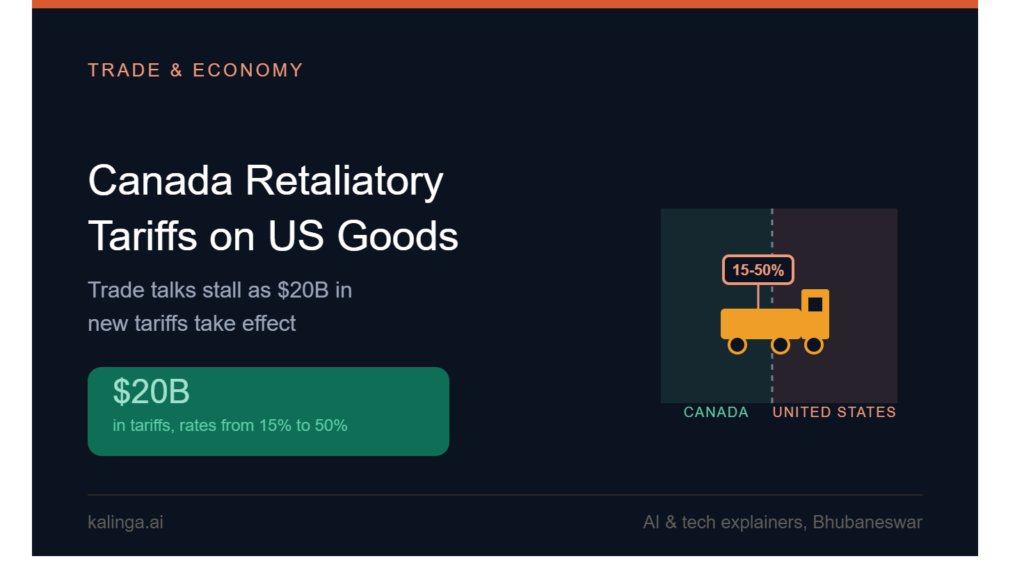
Direct answer: Canada’s new measures cover approximately $20 billion of US goods, with tariff rates ranging from 15% to 50%, depending on the product.
The measures affect a range of American products, including goods such as:
- Steel
- Furniture
- Clothing
- Electronics
- Other targeted consumer and industrial products
The policy is designed as a dollar-for-dollar response to the US tariffs imposed on Canadian goods.
This makes the Canada retaliatory tariffs significant even though the affected products represent only part of the enormous Canada-US trading relationship.
Why the size of the targeted goods matters
Canada is highly dependent on trade with the United States.
According to Canadian and US government data cited by Reuters, Canada sent almost 68% of its total exports to the United States in 2026 through July.
That concentration means Canadian companies can be particularly exposed to changes in US trade policy.
At the same time, the United States also depends heavily on Canadian suppliers for many products and raw materials. That interdependence makes tariffs complicated because the economic effects can travel in both directions.
A tariff imposed on an imported product does not necessarily mean the foreign producer simply absorbs the entire cost.
Depending on market conditions, companies may raise prices, reduce margins, change suppliers or pass some of the additional cost to customers.
What US Tariffs Triggered Canada’s Response?
What caused Canada’s latest tariff retaliation?
Direct answer: The Canadian measures respond to US tariffs imposed last month on approximately $20 billion of Canadian exports, affecting products including wine, furniture, dairy products, cement, clothing, fishing rods and hockey equipment.
Reuters reported that the US measures covered about 5% of Canada’s exports to the United States.
That figure illustrates an important feature of the dispute: the tariff fight is concentrated on specific categories rather than applying uniformly to every Canadian export.
Approximately 80% of Canadian exports to the US have moved duty-free because of exemptions under the USMCA, according to Canadian and US government data cited by Reuters.
That existing preferential access has provided some protection for the Canadian economy.
But the future of that arrangement is now uncertain.
Why are Canadian exporters worried?
Canadian exporters face a basic problem: the United States is their dominant foreign market.
When tariffs increase the cost of selling products into that market, businesses have several choices.
They can absorb the cost, increase prices, search for new customers elsewhere or reduce production.
None of those options is necessarily easy.
For industries built around integrated North American supply chains, simply switching markets can be especially difficult.
A Canadian manufacturer may depend on US customers, US components or transportation networks that cross the border multiple times.
That means a tariff dispute can affect a product at several stages of its journey.
How Could the Canada Retaliatory Tariffs Affect Businesses?
How could Canada’s new tariffs affect companies?
Direct answer: The tariffs can increase the cost of importing affected US products into Canada, potentially squeezing business margins, raising prices or encouraging companies to find alternative suppliers.
The impact will vary significantly by industry.
A company that relies heavily on a targeted American product may feel the effect almost immediately. Another business that has alternative suppliers in Canada, Mexico, Asia or Europe may have more flexibility.
This is where supply-chain strategy becomes important.
Tariffs can change business decisions
Consider a Canadian furniture retailer that imports products from the United States.
If the imported goods face a higher tariff, the retailer might:
- Pay the additional import cost.
- Increase the retail price.
- Negotiate lower prices with the US supplier.
- Find a Canadian supplier.
- Search for suppliers in another country.
- Reduce the number of affected products it sells.
The actual response depends on customer demand, competition and the availability of alternatives.
The broader supply-chain effect
Supply-chain diversification means reducing dependence on a single supplier, country or transportation route.
Trade disputes can accelerate diversification because businesses become more aware of the risks of relying too heavily on one market.
For Canada, the current dispute could therefore have consequences extending beyond the immediate value of the tariffs.
Companies may begin asking whether they should maintain the same level of dependence on US customers and suppliers.
For American companies, the calculation can work in reverse.
A Canadian tariff on US products may encourage American exporters to look for customers elsewhere.
Why Have US-Canada Trade Talks Stalled?
Why are Canada and the United States struggling to reach a trade deal?
Direct answer: Negotiations have stalled after both governments blamed the other side for the collapse of talks that had appeared close to an agreement. Reuters reported that there were currently no negotiations between ministers or government officials.
The breakdown is particularly important because Canada and the United States have one of the world’s most deeply integrated trading relationships.
The dispute is therefore not simply about individual tariffs.
It also involves the future rules governing North American commerce.
Prime Minister Carney has said Canada is ready to sign a trade agreement that benefits both countries. But the lack of active official talks means businesses are operating with considerable uncertainty.
Why uncertainty can be worse than a single tariff
Businesses can often adapt to a known cost.
Uncertainty is different.
If a company does not know whether tariffs will increase, decrease or disappear, it becomes harder to decide whether to build a factory, hire workers, sign long-term contracts or establish new supply chains.
That is why the ongoing dispute could influence investment even beyond the products directly covered by Canada retaliatory tariffs.
Investors may ask whether North American trade rules will remain stable over the next several years.
What Is the USMCA and Why Does It Matter?
What is the USMCA?
Direct answer: The USMCA, or United States-Mexico-Canada Agreement, is the North American trade agreement governing much of the commercial relationship between the three countries and providing preferential market access for qualifying goods.
The agreement replaced NAFTA and has become a central part of North American supply chains.
For Canadian businesses, one of its most important features is the ability to move qualifying goods across the US border under preferential conditions.
Reuters reported that approximately 80% of Canadian exports to the United States moved duty-free under USMCA exemptions this year.
That makes the agreement particularly valuable during a period of trade tension.
Why is the USMCA facing uncertainty?
Trump declined to extend the agreement for another decade, according to Reuters, increasing uncertainty around its future.
The countries are also approaching annual reviews of the agreement.
That creates an additional layer of complexity.
Companies are not only watching today’s tariff rates. They are also watching whether the rules governing North American trade will remain predictable.
For manufacturers, that question can influence where they source components and where they build production facilities.
For investors, it can influence the attractiveness of North American manufacturing.
For consumers, it can eventually affect prices and product availability.
How Does the Trade War Affect Canada and the US Differently?
Is the economic impact the same for Canada and the United States?
Direct answer: No. The two economies are deeply connected, but they differ greatly in size and dependence on bilateral trade. Reuters noted that Canada’s economy is roughly 13 times smaller than the US economy, making prolonged tariff pressure particularly challenging for Canada.
Canada’s dependence on the US market is one of the central vulnerabilities in the dispute.
Almost 68% of Canadian exports went to the United States through July this year, according to government data cited by Reuters.
That concentration gives Washington substantial economic leverage.
But Canada’s retaliation can still hurt American businesses.
US exporters affected by Canadian tariffs may face higher costs or reduced demand.
The political consequences can also matter.
A tariff dispute can affect public opinion, relationships between governments and perceptions of economic security.
Canada versus the United States
| Factor | Canada | United States |
| Relative economic size | Smaller economy | Much larger economy |
| Dependence on US market | Very high | Lower relative dependence on Canada |
| Immediate tariff response | Counter-tariffs on US goods | Existing tariffs on selected Canadian goods |
| Main business concern | Export access and investment uncertainty | Export demand and supply-chain costs |
| Strategic challenge | Diversifying trade while maintaining US access | Managing trade pressure without disrupting integrated supply chains |
| Key agreement | USMCA | USMCA |
The imbalance does not mean the United States is unaffected.
North American production is highly integrated, particularly in sectors such as automobiles, manufacturing, energy and agriculture.
A disruption at one point in the supply chain can create problems elsewhere.
Why Could the Tariffs Affect Consumers?
Will consumers feel the impact of the tariffs?
Direct answer: Consumers could face higher prices for imported products affected by the new tariffs if businesses pass some of the additional costs through to customers.
The exact impact depends on the product, supplier, retailer and competitive environment.
Suppose an imported American product becomes more expensive because of a 25% tariff.
A retailer might absorb some of the cost to remain competitive. Alternatively, it might increase the product’s selling price.
In some cases, the retailer could switch to a different supplier.
This is why the final consumer impact cannot be calculated simply by looking at the headline tariff rate.
The tariff pass-through problem
Tariff pass-through describes how much of an import tax ultimately becomes a cost for businesses or consumers rather than being absorbed elsewhere in the supply chain.
A 25% tariff does not automatically mean every consumer will pay 25% more.
The final effect depends on:
- Supplier pricing
- Currency movements
- Retail margins
- Consumer demand
- Availability of alternative products
- Competition between suppliers
- Whether businesses absorb part of the tariff
That uncertainty makes trade disputes difficult for consumers to understand.
The headline number is important, but the real-world impact depends on how companies respond.
Why Is the Gordie Howe Bridge Important to This Story?
The dispute is unfolding across one of the world’s most important economic borders.
The Gordie Howe International Bridge, connecting Windsor, Ontario, with Detroit, Michigan, represents the scale of physical integration between Canada and the United States.
Thousands of businesses depend on the ability to move products, components and people across the border efficiently.
That is why border infrastructure matters during a tariff dispute.
A tariff increases the cost of crossing the border economically. Delays, paperwork and uncertainty can increase the cost operationally.
When those factors combine, businesses can face a much more complicated trading environment.
The lesson is broader than this particular dispute: trade policy and infrastructure are closely connected.
A modern bridge can move goods efficiently, but government policy determines how expensive and predictable that movement becomes.
What Does the Dispute Mean for Global Trade?
Could the Canada-US tariff dispute affect countries beyond North America?
Direct answer: Yes. A prolonged dispute could encourage companies to diversify supply chains, reconsider investment locations and search for alternative international markets.
Canada and the United States are major participants in global commerce.
When their trade relationship becomes less predictable, multinational companies may reconsider how they organize production.
For example, a manufacturer that previously relied heavily on US-Canada trade might investigate additional production in Mexico or other countries.
That does not mean companies will immediately abandon North America.
Instead, trade tensions can gradually influence long-term investment decisions.
A possible shift toward diversification
Businesses increasingly think about supply chains in terms of resilience as well as efficiency.
The cheapest supplier is not always the best supplier if a sudden tariff, geopolitical dispute or transportation disruption can interrupt access to the market.
The Canada-US dispute therefore fits into a much larger global trend.
Companies are balancing:
- Cost
- Market access
- Political stability
- Tariff exposure
- Logistics
- Supply-chain resilience
For students entering business, technology or economics, this is an important concept.
Globalization does not necessarily mean companies will maintain one simple global supply chain forever. Increasingly, companies are designing networks that can adapt when trade conditions change.
Could the Canada Retaliatory Tariffs Escalate Further?
Could the tariff dispute get worse?
Direct answer: Yes. The central risk is further escalation, particularly if either government responds to new tariffs with additional trade restrictions.
Canadian trade representatives have already described the possibility of an escalating cycle as a concern.
The situation is particularly sensitive because Trump has previously threatened to raise US tariffs on all Canadian cars, trucks and automotive parts to 50% starting January 1, according to Reuters.
The automotive sector is especially important because vehicle manufacturing relies on highly integrated cross-border supply chains.
A single vehicle can contain components produced in multiple countries before final assembly.
Why automobiles matter
If tariffs were significantly increased across the automotive sector, manufacturers could face pressure to redesign supply chains, change production locations or adjust prices.
That could have effects far beyond the companies directly paying the tariff.
Suppliers, transport companies, dealerships and consumers could all be affected.
This is one reason the future of the USMCA remains so important.
What Role Does Politics Play in the Trade Dispute?
Is this only an economic disagreement?
Direct answer: No. The tariff dispute also has significant political dimensions, with both governments seeking leverage while responding to domestic public opinion.
Prime Minister Carney has maintained support among Canadians, according to polling cited by Reuters.
However, political analysts warned that public support could decline if the economic consequences of the trade war become more visible.
In the United States, a Reuters/Ipsos poll found that only 20% of Americans approved of Trump’s tariffs on Canadian goods.
That suggests tariff policy can create political costs as well as economic ones.
Governments therefore have to balance several objectives at once.
They need to protect domestic industries, negotiate with their trading partner, maintain public support and avoid economic damage.
Those goals do not always point in the same direction.
What Happens Next in the Canada-US Trade Dispute?
What should businesses and consumers watch next?
Direct answer: The next major developments will depend on whether negotiations restart, whether additional US tariffs are introduced and whether Canada expands or adjusts its retaliation.
Several indicators will be particularly important.
1. Whether formal talks resume
The most immediate question is whether Canadian and US officials return to the negotiating table.
A restart could reduce uncertainty even before a final agreement is reached.
2. Whether tariffs expand
Businesses will closely monitor whether either side adds new products or increases existing rates.
Further escalation would make long-term planning more difficult.
3. The future of USMCA
The agreement’s annual reviews and uncertainty about its longer-term future could become increasingly important.
Any changes to preferential access could affect investment and supply-chain decisions.
4. Canadian consumer prices
If businesses pass tariff costs through to consumers, price increases could become more visible.
That could influence public support for the government’s approach.
5. Business investment
Companies may delay investments while waiting for greater clarity.
Alternatively, some businesses could accelerate diversification efforts to reduce exposure to US trade policy.
6. Automotive tariffs
Trump’s threat to impose 50% tariffs on Canadian cars, trucks and automotive parts from January 1 remains a major potential escalation point.
If implemented, the impact could extend throughout North American manufacturing networks.
What Can Businesses Learn From the Canada-US Tariff Dispute?
The immediate story is about Canada and the United States, but the underlying lessons apply to businesses everywhere.
Lesson 1: Market concentration creates risk
Canada’s heavy dependence on US exports demonstrates the risks of relying on one dominant market.
Diversification can make companies more resilient when political or economic conditions change.
Lesson 2: Trade policy is a business issue
Tariffs are not just matters for governments and economists.
They can influence product prices, supplier selection, manufacturing locations and investment decisions.
Lesson 3: Infrastructure and policy work together
A bridge can make physical trade easier, but tariffs and regulations determine how commercially attractive that route is.
Lesson 4: Uncertainty has a cost
Even before tariffs directly affect a company, uncertainty can cause businesses to postpone investments and rethink long-term plans.
Lesson 5: Supply chains need contingency plans
Companies operating internationally should understand how quickly their supply chains can adapt if a major trading relationship changes.
For young professionals, this is increasingly valuable knowledge.
Whether you work in technology, finance, logistics, manufacturing or consulting, understanding trade policy can help you understand why companies make seemingly expensive strategic decisions.
Why the Canada Retaliatory Tariffs Matter Beyond Canada
The new Canada retaliatory tariffs are significant because they represent more than another round of import taxes.
They are a test of how two closely connected economies manage disagreement.
Canada needs access to the enormous US market. The United States benefits from Canadian goods, resources and integrated supply chains.
That mutual dependence creates an incentive to negotiate.
But it also creates leverage.
The central challenge is finding a balance between using tariffs as negotiating tools and avoiding a cycle in which each side responds to the other with increasingly damaging measures.
For now, the biggest uncertainty is not simply how much companies will pay in tariffs.
It is whether the current dispute changes the structure of North American trade.
If the conflict is resolved through negotiation, the tariffs may eventually become a temporary disruption.
If tensions continue, businesses could begin making permanent changes to supply chains and investment decisions.
That distinction could determine the long-term economic significance of the dispute.
Key Takeaways
The latest developments can be reduced to several important points:
- Canada’s retaliatory tariffs took effect just after midnight on September 8, 2026.
- The measures cover approximately $20 billion of US goods.
- Tariff rates range from 15% to 50%, depending on the product.
- The tariffs respond to US measures covering a similar value of Canadian exports.
- Canada sent almost 68% of its total exports to the United States through July 2026.
- Roughly 80% of Canadian exports to the US moved duty-free under USMCA exemptions.
- Canadian and US trade negotiations have stalled, with both sides blaming the other for the breakdown.
- The future of the USMCA is an important source of uncertainty for businesses and investors.
- Further US tariffs on Canadian vehicles and automotive parts could create another major escalation.
- The biggest long-term question is whether companies permanently change their supply chains because of the dispute.
The simplest way to understand the situation is this: Canada is using tariffs as leverage because negotiations with its biggest trading partner have stalled, but the longer the dispute continues, the greater the risk that temporary trade measures create permanent economic changes.
FAQ: Canada Retaliatory Tariffs and US Trade
What are Canada’s retaliatory tariffs?
Canada’s retaliatory tariffs are import duties imposed on selected US goods in response to US tariffs on Canadian products. The latest measures cover approximately $20 billion of US goods, with rates ranging from 15% to 50%.
When did Canada’s new tariffs take effect?
Canada’s new retaliatory tariffs took effect just after midnight on September 8, 2026, according to Reuters. The measures were introduced after US-Canada trade negotiations stalled.
Why is Canada imposing tariffs on US goods?
Canada is imposing tariffs to respond to US tariffs on Canadian exports and create economic leverage in trade negotiations. The government has said it remains prepared to reach a mutually beneficial trade agreement.
How much trade does Canada conduct with the United States?
According to Canadian and US government data cited by Reuters, Canada sent almost 68% of its total exports to the United States in 2026 through July, demonstrating the country’s heavy dependence on the US market.
What is the USMCA?
The USMCA, or United States-Mexico-Canada Agreement, is the North American trade agreement governing much of the commercial relationship between Canada, the United States and Mexico. Approximately 80% of Canadian exports to the US moved duty-free under USMCA exemptions this year, according to data cited by Reuters.
Could the Canada-US trade war get worse?
Yes. Further escalation is possible if either government introduces additional tariffs. President Donald Trump has already threatened to raise US tariffs on Canadian cars, trucks and automotive parts to 50% starting January 1, according to Reuters.
Will Canada’s tariffs increase prices for consumers?
They could. Businesses importing affected US goods may absorb the additional cost, reduce margins, switch suppliers or pass some of the tariff cost to consumers. The final impact will vary by product and market conditions.
Why does the trade dispute matter to businesses?
The dispute creates uncertainty around prices, supply chains, investment and market access. Companies that rely heavily on US-Canada trade may need to consider alternative suppliers, customers or production locations if tariff tensions persist.
What should happen next?
The most important developments to watch are whether formal negotiations resume, whether either country expands its tariffs, how the USMCA evolves and whether businesses begin making permanent changes to North American supply chains. keep exploring kalinga.ai for more.