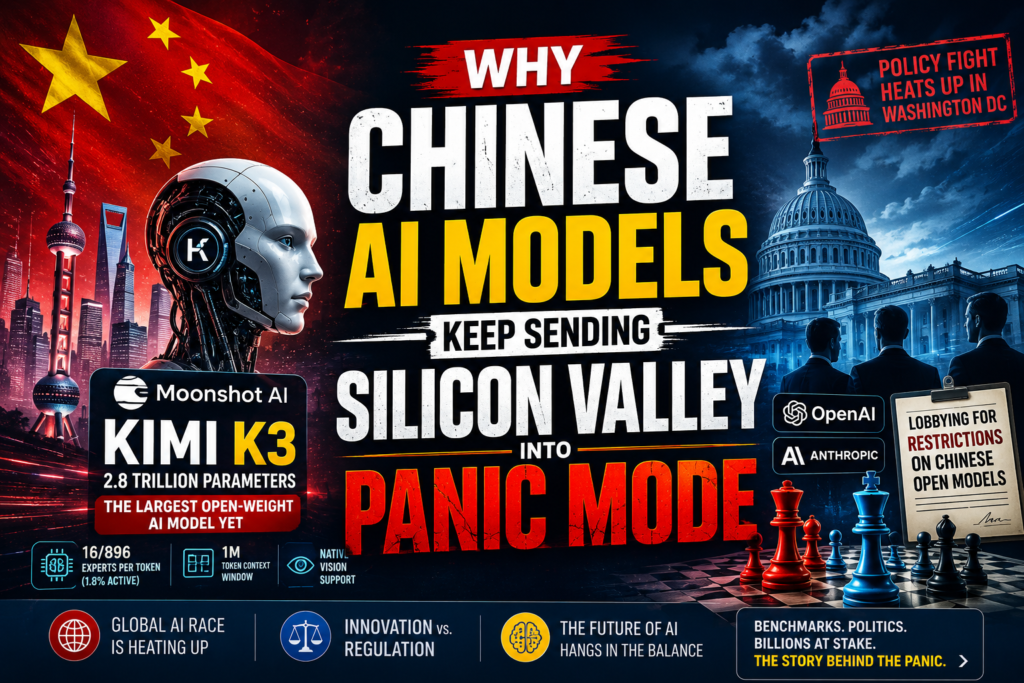
Chinese AI models have once again triggered a wave of anxiety in Silicon Valley and Washington, D.C. — this time thanks to Moonshot AI’s Kimi K3, a 2.8-trillion-parameter open-weight system that benchmarked competitively against top American labs and reignited a lobbying fight over whether the US should restrict open models from China.
If that sentence feels familiar, it should. This is the third or fourth time in under two years that a release from a Beijing-based lab has set off the same cycle: stunned social media threads, breathless comparisons to frontier US systems, and finally a policy scramble in Washington. This post unpacks what actually happened this time, why the reaction keeps repeating itself, and who stands to gain if the US clamps down on models built outside American borders.
What Triggered the Latest Panic Over Chinese AI Models
The immediate spark was the July 2026 release of Kimi K3 from Moonshot AI, a startup backed by Alibaba. <cite index=”3-1″>Moonshot released Kimi K3 as a 2.8-trillion-parameter model the company describes as the largest open-source AI model in the world, with benchmarks showing it performing neck-and-neck with the most powerful proprietary systems from Anthropic and OpenAI.</cite> The timing wasn’t accidental — <cite index=”3-1″>the release landed just ahead of the 2026 World Artificial Intelligence Conference in Shanghai, marking what many called a watershed moment for the open-source AI movement.</cite>
On a technical level, the numbers were genuinely striking. <cite index=”5-1″>Kimi K3 activates just 16 of its 896 experts per token — roughly 1.8% of the total pool — while offering a 1 million token context window and native vision support, with full weights due by July 27, 2026.</cite> According to one benchmark report, <cite index=”5-1″>Kimi K3 ranked first in the Frontend Code Arena, surpassing Claude Fable 5, though Moonshot itself acknowledged the model still trails Claude Fable 5 and GPT 5.6 Sol on overall performance while outperforming other frontier systems on coding and agentic tasks.</cite>
Just as importantly, the debate didn’t stay confined to tech Twitter. <cite index=”1-2″>OpenAI and Anthropic have reportedly lobbied regulators in Washington, D.C., expressing concern about open Chinese AI models.</cite> That’s the detail that turns a viral benchmark story into an actual policy fight — one with real consequences for pricing, licensing, and competition across the entire AI industry.
The macOS Demo That Wasn’t What It Seemed
Part of what fueled the panic wasn’t the benchmark data at all — it was a viral demo. During TechCrunch’s Equity podcast, reporter Sean O’Kane described watching people online marvel that Kimi had replicated the look of macOS in under 30 minutes. He was quick to point out the catch: it was a convincing graphical mockup, not a functioning operating system. That distinction — impressive visual output mistaken for a deeper technical leap — captures much of the current discourse. The reaction to releases like this one often outruns the underlying reality of what the systems can actually do.
Is This Panic Really New, or Just the Latest Round?
Short answer: No, it isn’t new. This is roughly the third or fourth major cycle of anxiety around competitive releases from China since DeepSeek’s early breakthrough, and each one has followed a nearly identical script.
Equity podcast host Anthony Ha noted that the pattern is instantly recognizable to anyone who followed the DeepSeek launch: a lab in China ships a model, it performs competitively with frontier systems on certain benchmarks, and a portion of the US tech industry reacts as though the balance of global AI power has shifted overnight. Sean O’Kane framed it more bluntly on the podcast, arguing that the industry is perpetually primed to expect a single release that “blows everything else away,” which makes every strong showing from a rival lab feel like a five-alarm fire rather than one data point in a fast-moving field.
A Recurring Cycle, Not a One-Time Shock
Zooming out, the release history shows this has been a steady drumbeat rather than a single surprise. Each entry below represents a moment when Moonshot’s models briefly dominated the AI news cycle:
- July 2025 — Kimi K2 launches as a 1-trillion-parameter open-weight model, immediately drawing attention for strong coding performance.
- January 2026 — Kimi K2.5 adds native multimodal training and agent-swarm capabilities, expanding what open-weight systems can realistically do.
- April 2026 — Kimi K2.6 ties GPT-5.5 on a major coding benchmark while costing roughly 80% less per million tokens, intensifying price-performance concerns among US labs.
- June 2026 — Kimi K2.7-Code focuses on token efficiency for agentic coding workflows, cutting reasoning-token usage by roughly 30%.
- July 2026 — Kimi K3 arrives as a 2.8-trillion-parameter model, described by Moonshot as the largest open-weight release to date.
Each release has produced a smaller-scale version of the same reaction, which suggests the panic says as much about Silicon Valley’s psychology as it does about any single system’s capabilities.
The Real Debate Behind Chinese AI Models: Open Weights vs. Proprietary Systems
Underneath the social media noise is a substantive policy question, and it’s one with real financial stakes for US labs. The core tension isn’t really about nationality at all — it’s about business model. Open-weight releases threaten the pricing power that closed, API-only providers have relied on since the launch of the first commercial LLMs.
Definition: What Makes a Model “Open-Weight”?
An open-weight model is one where the trained parameters (the “weights”) are published for anyone to download, run, fine-tune, and self-host — as opposed to a proprietary model that’s only accessible through a paid API controlled by the company that built it. Kimi K2 and its successors have shipped under a modified MIT license, meaning developers can use, modify, and redistribute them commercially with minimal restriction. This is precisely why open releases from Chinese labs unsettle proprietary US providers: they compress the pricing and licensing advantages that closed systems have traditionally relied on, and they hand outside researchers a level of transparency that closed competitors simply don’t offer.
Why This Feels Like the TikTok Debate All Over Again
Podcast co-host Anthony Ha drew a direct comparison to the TikTok controversy of a few years earlier: the underlying concerns weren’t fabricated, but the moment any discussion adds “China” to it, the intensity of the reaction spikes disproportionately. He argued that this dynamic is now attached to the open-weight debate, layered on top of an existing argument that AI is powerful enough that only proprietary American frontier labs can be trusted to control it responsibly. In other words, the geopolitical framing does a lot of rhetorical work that the technical evidence alone might not support.
A Side-by-Side Comparison: Open Releases From China vs. American Frontier Systems
| Factor | Open-Weight Releases from China (e.g., Kimi K3) | US Proprietary Frontier Models |
|---|---|---|
| Access model | Weights published publicly, self-hostable | API-only, closed weights |
| Licensing | Modified MIT license (commercial use allowed) | Proprietary terms of service |
| Cost per token | Typically far lower (K2.6 ran ~80% cheaper) | Premium pricing tied to closed infrastructure |
| Benchmark standing (mid-2026) | Competitive on coding/agentic tasks; trails top proprietary systems on overall performance | Generally leads on overall reasoning and safety evaluations |
| Regulatory exposure | Subject to proposed US restrictions | Beneficiary of any restrictions placed on foreign competitors |
| Transparency | Architecture and weights inspectable by outside researchers | Internal architecture largely undisclosed |
This comparison is exactly why the debate isn’t purely about national security — it’s also about which companies get to set the price and terms for enterprise AI adoption going forward. A restriction framed as a safety measure would, in practice, also function as a market-share intervention.
Who Actually Benefits If the US Restricts Chinese AI Models?
This is the question Equity co-host Kirsten Korosec pushed hardest on during the podcast discussion, and it’s worth sitting with directly. If Washington imposed across-the-board bans on open Chinese systems, the practical effects would likely include:
- Reduced competition for US frontier labs. Enterprises currently evaluating cheaper, open alternatives like Kimi would be pushed back toward closed offerings from OpenAI, Anthropic, and other domestic providers.
- Higher effective costs for developers and startups. Open-weight releases have driven down per-token pricing across the industry; removing them from the option set would likely reverse that trend.
- Less independent scrutiny of model internals. Open weights let outside researchers inspect architecture, routing, and training claims — a form of transparency proprietary systems don’t offer.
- Concentrated advantage for a small number of frontier labs, rather than a broad win for the US AI sector as a whole.
- Slower enterprise adoption in cost-sensitive sectors, since many mid-market companies have leaned on cheaper open models to make AI deployment financially viable.
Korosec put the underlying tension plainly on the podcast: restricting these open releases raises the question of whether the goal is genuinely ensuring the US wins the broader AI race, or whether it mainly ensures that a handful of frontier labs face less competitive pressure at home. That distinction — competitiveness for the country versus competitiveness for a few companies — is the crux of the entire policy fight.
The Protectionism Argument Nobody Wanted Said Out Loud
Much of the current lobbying push traces back to a single viral post from Dean Ball, OpenAI’s head of strategic futures, who argued the US should deliberately introduce regulatory uncertainty to slow down open-weight competitors from abroad. Sean O’Kane suggested on the podcast that part of the backlash wasn’t really about disagreement with the substance, but about the fact that Ball said the strategy out loud instead of leaving it implied. Ball later walked back the argument publicly, but the episode exposed how much of the “threat from China” framing may be doing double duty as a competitive argument for tighter domestic regulation, dressed up as a national security concern.
None of this means legitimate concerns don’t exist. Questions about embedded bias, security guardrails, and data provenance in systems trained overseas are real and worth investigating. But as Kirsten Korosec noted, the loudest driver of the current panic appears to be protectionism — the race to determine whether the US or China “wins” — more than any single, well-documented technical risk.
What Enterprises Should Actually Watch For
For companies evaluating whether to adopt an open-weight model regardless of its country of origin, the more useful questions tend to have little to do with geopolitics:
- Does the license genuinely permit commercial use and redistribution, or are there hidden restrictions?
- Are the published weights verifiable against the benchmarks the company advertises?
- What does independent, third-party evaluation show once a model has been out for a few weeks rather than a few days?
- How does total cost of ownership compare once self-hosting, fine-tuning, and support are factored in?
Those questions apply whether the lab is in Beijing, San Francisco, or anywhere else — and they tend to produce more durable decisions than reacting to a single viral weekend of debate.
What Comes Next in the US Policy Fight
The lobbying effort from OpenAI and Anthropic doesn’t guarantee legislative action, but it does signal where the next phase of this fight is headed. A few threads are worth watching over the coming months.
First, expect the debate to move from social media into formal regulatory proposals. Lobbying at this scale typically precedes draft legislation or agency rulemaking rather than staying purely rhetorical, so the next milestone is likely a specific policy proposal — an import restriction, a procurement rule for federal agencies, or export-control language aimed at model weights themselves rather than just chips.
Second, the enterprise market will likely keep adopting open-weight systems regardless of the political noise, simply because the cost savings are too large to ignore for cost-sensitive deployments. Procurement teams tend to move slower than the news cycle, and many have already built evaluation pipelines that treat any open-weight release, regardless of origin, as a legitimate option worth testing against closed alternatives.
Third, watch for how independent researchers respond once Moonshot’s full technical report and weights are published. Open weights allow outside groups to check claims about training data, benchmark methodology, and architecture that closed labs simply don’t have to disclose. If the published materials hold up to scrutiny, it will weaken the argument that these releases can’t be trusted; if they don’t, it will hand ammunition to the labs pushing for restrictions.
Finally, it’s worth remembering that this fight isn’t purely bilateral. The European Union, India, and other markets are watching how the US handles open-weight competition and may set their own rules independent of whatever Washington decides — which means a US restriction wouldn’t necessarily slow global adoption so much as redirect where that adoption happens.
Frequently Asked Questions
Why are Chinese AI models causing panic in the US tech industry right now? The July 2026 release of Moonshot AI’s Kimi K3, a 2.8-trillion-parameter open-weight model with benchmarks rivaling top American systems, reignited longstanding fears about US competitiveness and prompted OpenAI and Anthropic to lobby Washington regulators.
Is this the first time a release from China has caused this kind of reaction? No. DeepSeek’s early 2025 release triggered a nearly identical cycle, and subsequent Kimi releases (K2, K2.5, K2.6, K2.7-Code, K3) have each produced smaller versions of the same reaction throughout 2025 and 2026.
What does “open-weight” mean for models like Kimi? It means the trained model parameters are published publicly, allowing developers to download, self-host, fine-tune, and commercially deploy the model — typically under a modified MIT license — rather than accessing it only through a paid, closed API.
Would restricting Chinese AI models actually help US companies win the AI race? It’s contested. Critics argue restrictions would mainly benefit a small number of proprietary frontier labs by removing lower-cost, open competitors, rather than meaningfully strengthening the broader US AI ecosystem.
Are the security and bias concerns about Chinese AI models legitimate? Some concerns — including potential embedded bias and gaps in safety guardrails — are considered genuine and worth scrutiny. However, commentators note that protectionist motives appear to be a larger driver of the current policy push than any single documented technical risk.
The Bottom Line on Chinese AI Models
The panic around Chinese AI models tends to follow the same arc every time: a strong release, an overheated reaction, a lobbying push in Washington, and then, a few weeks later, a return to relative calm once the initial shock wears off. Kimi K3 is a genuinely significant technical release — the largest open-weight model shipped to date — but the policy response it has triggered is shaped as much by competitive self-interest among US labs as by sober risk assessment. Anyone trying to make sense of the next release out of Beijing would do well to separate the benchmark numbers from the noise, and to ask, as Kirsten Korosec did, who actually benefits from the proposed restrictions on Chinese AI models.