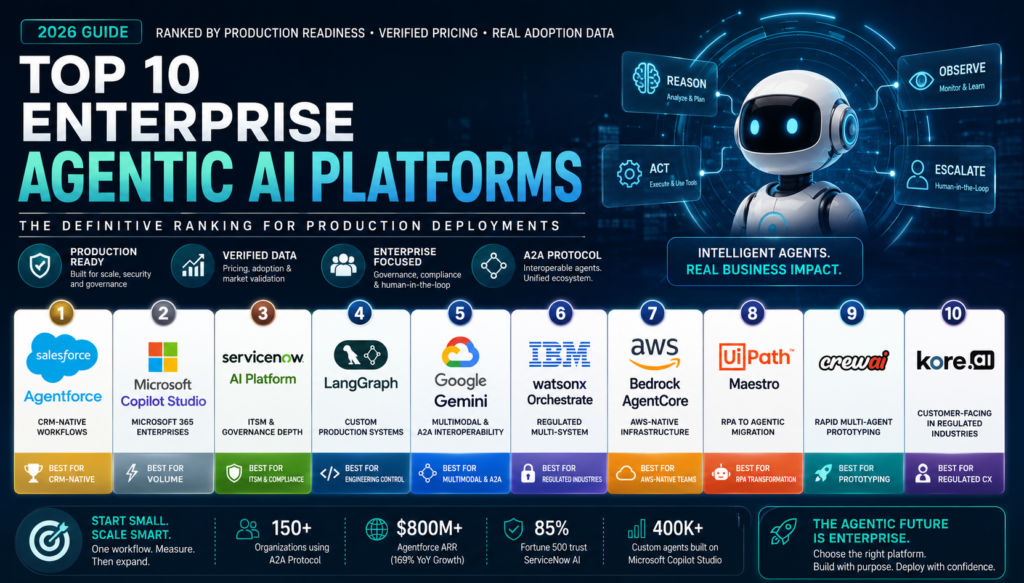
The short answer: In 2026, the best enterprise agentic AI platforms are Salesforce Agentforce (CRM-native), Microsoft Copilot Studio (Microsoft 365 ecosystems), ServiceNow (ITSM and regulated industries), LangGraph (custom production engineering), and Google Gemini Enterprise Agent Platform (multimodal and cross-framework workloads). Which one is right for you depends entirely on your existing stack, governance requirements, and in-house engineering capacity.
Enterprise agentic AI has crossed the threshold from pilot budgets to full production commitments — Salesforce is closing Agentforce deals with $800M ARR, Microsoft Copilot Studio has 160,000+ organizations running 400,000+ custom agents, and ServiceNow has restructured its entire commercial model around autonomous AI tiers. The question is no longer whether to deploy. It is which enterprise agentic AI platform fits which workflow — and what it will actually cost you to find out.
This guide ranks the top 10 enterprise agentic AI platforms by production readiness, with verified pricing, adoption data, and honest constraints for each.
What Is an Enterprise Agentic AI Platform?
Definition: An enterprise agentic AI platform is a system that enables AI agents to autonomously plan, reason across multiple steps, use external tools, and recover from errors — all within the governance and security requirements of large organizations.
The distinction matters because most vendor marketing conflates three very different things: traditional chatbots, robotic process automation (RPA) scripts with an AI wrapper, and genuine agentic systems. Genuine agentic AI requires four capabilities that separate it from these predecessors:
- Autonomous decision-making — the agent selects its next action without a human scripting each step.
- Multi-step reasoning — the agent maintains context and plans across a sequence of tasks.
- Dynamic tool use — the agent calls APIs, queries databases, or triggers other agents as needed.
- Failure recovery — the agent detects when a step has failed and adapts, rather than halting.
If a platform cannot demonstrate all four in a live workflow — not a demo — it is a chatbot with branding, not an enterprise agentic AI platform. Practitioners call this gap “agent washing,” and it is the most common reason enterprise evaluations go wrong.
Two Risks Every Enterprise Must Address Before Evaluating Platforms
Risk 1: Agent Washing
Most vendors in the 2026 market are rebranding chatbots, RPA scripts, and linear workflow tools as “agents.” The practical implication: feature checklists from vendor marketing decks are unreliable. Test every shortlisted platform against real workflows that require branching logic, tool use, context retention across steps, and failure recovery. If the demo only shows linear, pre-scripted sequences, it is not an agentic system.(enterprise AI agents agentic AI platforms 2026 AI agent platforms for enterprises enterprise autonomous AI systems
)
Risk 2: Deployment Failure from Structural Gaps
Enterprise teams that have moved beyond pilots into production consistently report that agent projects fail not because of model capability, but because of:
- Data quality gaps — agents hallucinate or produce inconsistent outputs when source data is incomplete or unstructured.
- Unclear ownership of edge cases — no human-in-the-loop process for when the agent reaches a decision boundary it was not trained on.
- Governance infrastructure that was never built — no audit trails, no rollback procedures, no compliance mapping.
The organizations succeeding with enterprise agentic AI deployment in 2026 deploy one agent against one well-defined, data-rich workflow, measure it rigorously, then expand. Not the reverse.
The Top 10 Enterprise Agentic AI Platforms for 2026 (Ranked by Production Readiness)
1. Salesforce Agentforce — Best for CRM-Native Workflows
What it is: A native enterprise agentic AI platform built directly on Salesforce’s Data 360 stack, using the Atlas Reasoning Engine (Reason–Act–Observe loop) to break tasks into steps, identify data sources, execute actions, and escalate to humans only when predefined criteria are met.
Best for: Customer service, sales automation, order management, field service — all where Salesforce is already the system of record.
Verified pricing: Two billing models exist and cannot coexist in the same org. First, $2 per conversation (customer-facing agents only). Second, Flex Credits at $500 per 100,000 credits ($0.10 per standard action, $0.15 per voice action). Agentforce 1 Editions start at $550/user/month and include 2.5M Flex Credits per org per year.
Adoption data: $800M ARR (up 169% YoY), 29,000+ deals, 18,500+ customers in 124 countries.
Key constraint: Value narrows sharply outside the Salesforce ecosystem. SAP-heavy or mixed-stack environments face integration overhead that low-code marketing understates. Enterprise Edition or higher is a prerequisite.
2. Microsoft Copilot Studio — Best for Microsoft 365 Enterprises by Volume
What it is: An enterprise agentic AI platform embedded natively into Teams, SharePoint, Dynamics 365, and the Microsoft Graph — covering roughly one billion Microsoft 365 seats worldwide.
Best for: Employee-facing IT, HR, and knowledge workflows; Teams-embedded automation.
Verified pricing: $200 per 25,000 Copilot Credits per month, available prepaid or pay-as-you-go. Agent messages draw from the credit pool.
Adoption data: 160,000+ organizations, 400,000+ custom agents — the highest volume of any agentic platform in 2026. GPT-5 Chat is generally available in Copilot Studio; GPT-5.5 Reasoning is experimental only and not production-ready.
Key constraint: Deepest value inside the Microsoft ecosystem. Cross-stack integrations outside Microsoft Graph add configuration complexity. Note: Microsoft Foundry Agent Service is a distinct developer-runtime platform — evaluate it separately for custom, engineering-led agent architectures.
3. ServiceNow AI Platform — Best for ITSM and Governance Depth
What it is: An enterprise agentic AI platform restructured in April 2026 into three AI-native tiers (Foundation, Advanced, Prime), with AI Control Tower, Workflow Data Fabric, and the Moveworks integration bundled across all tiers by default. The Context Engine grounds agent decisions in 85 billion workflows and seven trillion transactions.
Best for: IT service management, HR service delivery, regulated enterprise operations.
Verified pricing: Custom enterprise pricing only. The April 2026 restructuring ended AI as an add-on — AI and governance tooling are now embedded at every tier. Fully autonomous AI Specialists for the L1 Service Desk require the Prime tier.
Adoption data: 85% of Fortune 500 customers, 98% renewal rate, $12.8B subscription revenues (21% YoY growth in FY2025).
Key constraint: No public pricing; every contract requires a full sales cycle. Independent procurement consultancies estimate total cost of ownership at 3–5× annual license fees when implementation, customization, and training are included. Designed exclusively for large enterprises.
4. LangGraph — Best Developer Framework for Production Multi-Agent Systems
What it is: An open-source framework that models agents as nodes in a directed graph with a typed state schema flowing between them — giving engineering teams explicit, auditable control over every execution step.
Best for: Stateful, branching workflows requiring explicit audit trails, human-in-the-loop checkpoints, and rollback capability.
Verified pricing: Open-source (free). LangSmith observability has paid tiers. Hosting costs vary by environment.
Adoption data: LangChain at 97,000+ GitHub stars. LangGraph surpassed CrewAI in stars in early 2026. It underlies deployments on Google Vertex AI, AWS Bedrock, and Azure Foundry Agent Service.
Key constraint: Engineering-intensive by design. No support contracts, no pre-built templates, no governance dashboards out of the box. Workflows that take minimal code in higher-abstraction frameworks require significantly more code in LangGraph.
5. Google Gemini Enterprise Agent Platform — Best for Multimodal and Cross-Framework Workloads
What it is: Announced at Google Cloud Next 2026, this platform unifies Vertex AI and Agentspace into a single product. It includes Agent Studio (no-code builder), Model Garden (200+ models including Anthropic Claude), Agent Garden (pre-built partner agents), and native A2A protocol support.
Best for: Multimodal agent workflows (image, audio, video); cross-framework interoperability via the A2A protocol.
Verified pricing: Consumption-based on Vertex AI compute and model usage.
Key differentiator: The A2A (Agent-to-Agent) protocol v1.0, now under the Linux Foundation and in production at 150+ organizations, enables a Salesforce agent to hand off to a Google agent, which can query a ServiceNow agent for IT asset data — all through a standardized interface with no internal architecture dependencies between systems.
Key constraint: Google’s enterprise support has historically created deployment friction at scale. Apigee as an API-to-agent bridge adds architectural complexity requiring dedicated platform engineering.
6. IBM watsonx Orchestrate — Best for Regulated Industry Multi-System Orchestration
What it is: An enterprise agentic AI platform providing connectivity to 700+ enterprise systems, with native support for importing LangGraph agents into production, IBM Granite models (indemnified for enterprise use), and a deep compliance stack covering audit trails, model explainability, and data provenance.
Best for: Banking, healthcare, insurance, government; multi-system agent orchestration under compliance requirements.
Production evidence: IBM cites Honda as a production example — watsonx.ai is projected to reduce Honda’s documentation modeling time by 67% by applying a large multimodal model to extract knowledge from engineering diagrams.
Key constraint: Requires significant technical investment to deploy at scale. Not suited to organizations without dedicated AI operations and data engineering teams. Enterprise sales cycles are long.
7. AWS Bedrock AgentCore — Best for AWS-Native Engineering Teams
What it is: Managed runtime infrastructure for deploying stateful agents at scale, offering unified API access to Anthropic Claude, Meta Llama, Mistral, Cohere, Amazon’s own models, and OpenAI models (limited preview as of April 2026).
Best for: AWS-native engineering teams building scalable agent infrastructure.
Key constraint: Bedrock provides infrastructure; orchestration logic still needs to be built or imported from a framework like LangGraph or CrewAI. Not a low-code business-user platform.
8. UiPath Maestro — Best for RPA-to-Agentic Migration
What it is: UiPath Maestro coordinates bots, AI agents, and human workers in a unified control plane, with both low-code and pro-code Agent Builder options across a connector ecosystem spanning hundreds of enterprise applications.
Best for: Organizations extending existing RPA investments into agentic workflows.
Honest constraint: Enterprise practitioners flag limited transparency of AI-driven decision logic as a current gap. Treat UiPath as a strong roadmap investment for organizations already running RPA at scale — not a first-choice for net-new agentic architectures.
9. CrewAI — Best for Rapid Multi-Agent Prototyping
What it is: An open-source framework that defines agents by role, goal, and backstory, then infers coordination patterns — requiring less explicit state-management code than LangGraph and offering a faster path from concept to working prototype.
Best for: Rapid multi-agent prototyping; workflows that map cleanly to role-based team structures (content pipelines, market analysis, customer support escalation).
Key constraint: The basic crew abstraction is not built for durable execution. Teams that prototype with CrewAI frequently migrate to LangGraph when production requirements for conditional routing and auditable state emerge.
10. Kore.ai — Best for Customer-Facing Agents in Regulated Industries
What it is: A specialized enterprise conversational AI platform with pre-built agent templates for banking, insurance, and healthcare that embed domain-specific process logic, compliance controls, and regulatory workflows out of the box.
Best for: Customer-facing agents in financial services, healthcare, insurance, and telecom.
Key constraint: Outside customer-facing conversational workflows in its core verticals, differentiation over horizontal platforms narrows. It is a vertical-depth platform, not a horizontal one.
Side-by-Side Platform Comparison: 2026 Enterprise Agentic AI Platforms
| Platform | Best For | Deployment Speed | Governance Depth | Pricing Model | Ecosystem Dependency |
|---|---|---|---|---|---|
| Salesforce Agentforce | CRM-native workflows | Fast (4–6 weeks) | Strong | Per-conversation / Flex Credits | High (Salesforce) |
| Microsoft Copilot Studio | M365 enterprises | Fastest | Moderate–Strong | Credit-based | High (Microsoft) |
| ServiceNow AI Platform | ITSM / regulated ops | Moderate | Strongest | Custom enterprise | High (ServiceNow) |
| LangGraph | Custom production | Slow (engineering-led) | Full control | Free (OSS) | None |
| Google Gemini Enterprise | Multimodal / A2A | Moderate | Strong | Consumption-based | Moderate (GCP) |
| IBM watsonx Orchestrate | Regulated multi-system | Slow | Very Strong | Custom enterprise | Moderate |
| AWS Bedrock AgentCore | AWS-native infra | Moderate | Strong | Consumption-based | High (AWS) |
| UiPath Maestro | RPA migration | Moderate | Moderate | Custom (volume) | High (UiPath) |
| CrewAI | Rapid prototyping | Fastest | Limited | Free (OSS) | None |
| Kore.ai | Regulated CX | Moderate | Strong (vertical) | Custom enterprise | Moderate |
How to Choose the Right Enterprise Agentic AI Platform: 4 Decision Rules
Rule 1: Match the Platform to Your Existing Ecosystem — Not the Feature Sheet
Question: Which system of record owns the workflow you want to automate?
Direct answer: If Salesforce is your system of record, Agentforce is the first choice. If your employees live in Microsoft 365 and Teams, Copilot Studio is the default. If IT service management is the priority, ServiceNow is irreplaceable. If you run SAP as your core ERP, SAP Joule Studio (GA expected Q3 2026) is worth evaluating before anything else. The worst enterprise agentic AI deployment mistake in 2026 is choosing a platform for its AI capabilities while ignoring its integration costs against your existing stack.
Rule 2: Address Governance Before Features
Question: Are you operating in a regulated industry or under EU AI Act high-risk classifications?
Direct answer: If yes, prioritize IBM watsonx Orchestrate and ServiceNow before evaluating anything else. Both embed audit trails, model explainability, and data provenance as core product features — not add-ons. Horizontal platforms can reach the same compliance baseline, but only after months of custom configuration. For regulated industries, that time and cost advantage is not recoverable.
Rule 3: Model Full Total Cost of Ownership — Not Just License Price
Question: What does this platform actually cost when deployed at production scale?
Direct answer: Agentforce and Copilot Studio have the fastest time-to-production (4–6 weeks for pre-built use cases) but consumption-based pricing scales with usage in ways that are difficult to predict before deployment. LangGraph is free but requires engineering headcount that carries its own fully-loaded cost. IBM watsonx carries high licensing costs but eliminates the governance tooling build that self-managed frameworks require. For Agentforce specifically: Flex Credits and Conversations cannot coexist in the same org — this billing model decision must be made at contract, not at deployment, and reversing it requires a new contract cycle.
Rule 4: Start with One Workflow, Not Ten
Question: How many workflows should we automate in the first deployment?
Direct answer: One. The dominant failure pattern in 2026 enterprise agentic AI deployment is organizations deploying agents across 10 workflows before validating that any single one delivers consistent value. Deploy one agent against one well-defined, data-rich workflow. Define success metrics before deployment. Measure. Then expand. Every platform on this list performs better in organizations that follow this sequence than in organizations that do not.
enterprise AI agents agentic AI platforms 2026 AI agent platforms for enterprises enterprise autonomous AI systems
What Separates Production-Ready Platforms from Pilots in 2026
Enterprise teams that have successfully moved enterprise agentic AI deployment from pilot to production share three structural characteristics — none of which are primarily about platform choice:
Data readiness precedes agent readiness. Every platform on this list performs better when the underlying data is clean, structured, and accessible. No reasoning engine compensates for missing or inconsistent data. Organizations that invest in data quality before agent deployment consistently outperform those that expect agents to resolve data problems. enterprise AI agents agentic AI platforms 2026 AI agent platforms for enterprises enterprise autonomous AI systems
The A2A protocol is reducing platform lock-in. The Agent-to-Agent (A2A) protocol v1.0, now under the Linux Foundation, is in production at 150+ organizations and is natively supported by Google ADK, Microsoft Semantic Kernel, LlamaIndex, and CrewAI. This means that platform choice is increasingly governed by data residency and ecosystem fit — not framework lock-in. An agent built on LangGraph can hand off to a Salesforce agent through a standardized interface. This interoperability layer is the single most important structural change in enterprise agentic AI deployment since 2024.
Human-in-the-loop design is not optional. Every enterprise agentic AI platform on this list supports human escalation and approval gates. The organizations that deploy them successfully define in advance which decision classes require human review — and build those escalation paths before agents go live, not after.
Frequently Asked Questions
What is the difference between an AI agent and an agentic AI platform?
An AI agent is a single autonomous unit — a software system that perceives its environment, makes decisions, and takes actions to achieve a goal without step-by-step human instruction. An enterprise agentic AI platform is the infrastructure layer that deploys, orchestrates, governs, and monitors one or many AI agents at scale. Platforms add the enterprise requirements that single agents lack: access controls, audit logging, human escalation paths, data governance, and multi-agent coordination.
Which enterprise agentic AI platform is best for a company with no existing AI infrastructure?
For organizations starting from scratch in 2026, Microsoft Copilot Studio or Salesforce Agentforce typically offer the lowest barrier to a first production deployment — assuming the organization already uses Microsoft 365 or Salesforce respectively. If neither applies, Google Gemini Enterprise Agent Platform’s Agent Studio provides a no-code builder with access to 200+ models and pre-built partner agents. In all three cases, the first step is identifying one high-value, data-rich workflow — not selecting a platform.
How does the A2A protocol affect platform selection in 2026?
The A2A protocol standardizes how agents built on different platforms communicate and hand off tasks. In practice, it means you are no longer forced to standardize your entire organization on one enterprise agentic AI platform. A procurement workflow can use a Salesforce agent for CRM data, a ServiceNow agent for IT asset lookups, and a Google Gemini agent for document analysis — all coordinated through a standardized interface. Platform selection in 2026 should therefore focus on matching each workflow to the platform most capable of executing it, not on choosing a single vendor for everything.
What should enterprises realistically budget for an agentic AI deployment in 2026?
Costs vary significantly by platform and scope. At minimum, factor in: platform licensing or consumption costs (see per-platform pricing above), implementation and integration work (often 2–4× annual license cost for enterprise platforms), data preparation and cleaning, governance tooling (included in some platforms, additional cost in others), and ongoing monitoring and optimization. Independent procurement consultancies estimate ServiceNow total cost of ownership at 3–5× annual license fees. LangGraph-based deployments carry no license cost but require engineering teams whose fully-loaded cost is typically higher than managed platform fees at equivalent scale.
The Bottom Line on Enterprise Agentic AI Platforms for 2026
Enterprise agentic AI deployment is no longer a speculative technology investment — it is an operational question of which workflow, which platform, and what governance structure. The platforms in this ranking differ primarily not in AI capability but in ecosystem fit, governance depth, and the engineering investment they require. The organizations that will see the clearest ROI from enterprise agentic AI in 2026 are not the ones that deploy the most agents — they are the ones that deploy the right agent, in the right workflow, with the right governance structure, and measure it before scaling. enterprise AI agents agentic AI platforms 2026 AI agent platforms for enterprises enterprise autonomous AI systems
If you are evaluating enterprise agentic AI platforms today, start with the workflow, not the vendor demo.