What Happened in the Florida Motor Vehicle Database Breach?
Question → Direct Answer:
What happened in the Florida motor vehicle database breach?
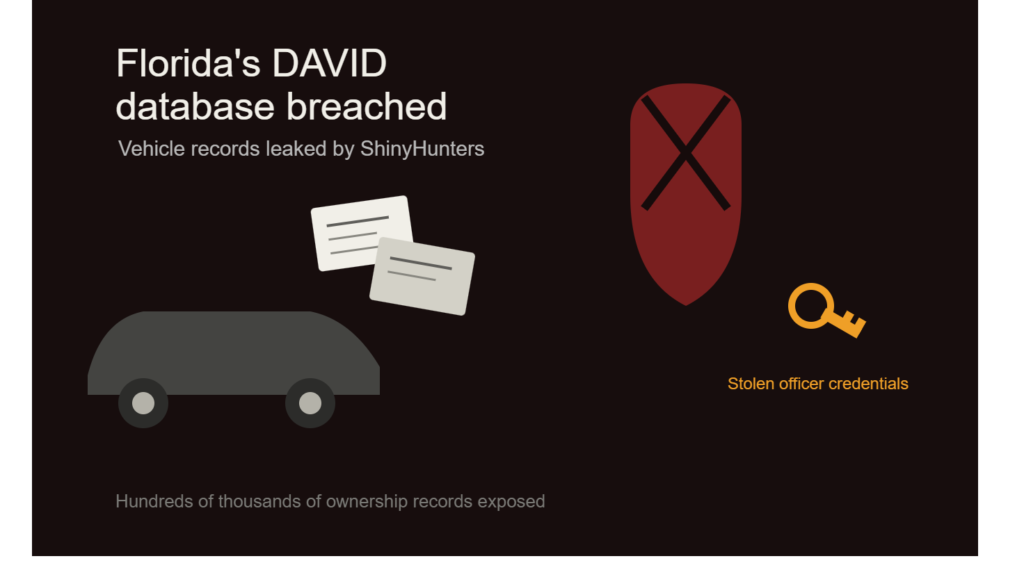
Hackers claiming to be ShinyHunters said they broke into Florida’s DAVID database earlier in September 2026 and subsequently published hundreds of thousands of files after saying the victim did not cooperate with their ransom demands.
TechCrunch reported that the hackers posted the stolen material on their leak site after claiming that the victim had refused to pay or cooperate. The hackers also published a screenshot that they said showed a record associated with deceased sex offender Jeffrey Epstein, who had a residence in Florida.
The Florida agency itself confirmed that a breach had occurred. FLHSMV said the incident involved the compromise of a police officer’s credentials that had been stored on a personal device.
That detail matters because it illustrates an important cybersecurity lesson: a highly sensitive government database does not necessarily have to be directly “cracked” through an obvious technical vulnerability for attackers to gain access. Compromised credentials can provide a pathway into systems containing enormous amounts of personal information.
Definition + Expansion: What Is DAVID?
DAVID, or Driver And Vehicle Information Database, is Florida’s system for storing and accessing driver and vehicle information.
The database is used by authorized personnel and contains information that can be highly sensitive because it connects people with vehicles, addresses, identification records, and other official information. Florida has previously documented controls around authorized access to DAVID information; state materials also describe restrictions on using or releasing personal information from the database for unauthorized purposes.
That makes DAVID different from a typical commercial database containing customer preferences or marketing information. A compromise can potentially expose records that have direct links to real-world identities and physical locations.
What Data Was Stolen From Florida Drivers?
The most important question is not simply how many files were published. It is what those files contain.
According to TechCrunch’s review of a copy of the stolen material, the hackers obtained hundreds of thousands of certificates of vehicle ownership. These documents contained information about vehicle buyers and sellers, including their names and addresses.
The records also contained vehicle identification numbers, commonly known as VINs.
A VIN is a unique identifier assigned to an individual vehicle. On its own, it is not equivalent to a password or Social Security number, but when combined with names, addresses, ownership records, and other information, it can create a much richer profile of an individual and their vehicle.
A smaller number of files reportedly contained more sensitive identity documents.
These included:
- Social Security numbers
- Non-U.S. passports
- Immigration documents
- Names and addresses of vehicle buyers and sellers
- Vehicle identification numbers
- Certificates of vehicle ownership
TechCrunch reported that the stolen material it reviewed did not appear to contain driver’s licenses or people’s photos.
That distinction is important. Headlines about a driver database breach can easily lead readers to assume that every person’s complete driver’s-license record was stolen. The available reporting does not support that conclusion.
Why Vehicle Ownership Records Matter
A vehicle ownership certificate may appear less sensitive than a driver’s license, but it can still reveal useful information to criminals.
Consider what happens when several data points are combined. A stolen record could potentially associate a person’s name with an address and a specific vehicle. If other leaked information exists elsewhere, those details can become part of a broader identity profile.
Question → Direct Answer:
Why are vehicle ownership records sensitive?
Because they can connect an individual’s identity and physical address with a specific vehicle, creating information that may be useful for identity fraud, targeted scams, social engineering, or other forms of abuse.
The risk does not mean every exposed record will automatically lead to fraud. It means the information has value when combined with other stolen or publicly available data.
How Did Hackers Gain Access to the Florida Database?
The reported access route is one of the most instructive parts of the Florida motor vehicle database breach.
FLHSMV said the breach followed the compromise of a police officer’s credentials that had been stored on a personal device. In other words, the incident highlights the security risks created when credentials capable of accessing sensitive government systems are exposed outside tightly controlled environments.
This is a recurring problem in cybersecurity.
A database can have strong encryption, firewalls, monitoring, and other technical defenses. But if an attacker obtains valid credentials belonging to an authorized user, some of those defenses may become less effective because the attacker can potentially appear to the system as a legitimate account.
Credential Security Is a Major Attack Surface
Question → Direct Answer:
Why are stolen credentials dangerous?
Stolen credentials can give attackers authenticated access without requiring them to defeat every technical barrier protecting the underlying system.
For organizations, this creates a difficult security challenge. Protecting databases is not only about securing servers and applications. It also requires protecting the people, devices, accounts, authentication systems, and access pathways connected to those databases.
Important controls can include:
- Multi-factor authentication
- Strong credential management
- Device security and endpoint monitoring
- Least-privilege access
- Regular credential rotation
- Monitoring for unusual account activity
- Restrictions on accessing sensitive databases from unmanaged devices
- Rapid revocation of compromised credentials
The exact controls required depend on the system and its operational environment. But the broader principle is straightforward: identity security is database security.
Why Did ShinyHunters Publish the Data?
The hackers claimed they published the stolen information because the victim did not pay a ransom or cooperate with their demands.
This reflects a familiar ransomware and extortion model.
Traditional ransomware often involves encrypting a victim’s files and demanding payment for a decryption key. Modern data-extortion attacks can work differently. Attackers may steal information first and then threaten to publish it if the victim refuses to pay.
The public leak becomes part of the pressure campaign.
Ransomware vs. Data Extortion
| Approach | What attackers do | Main pressure on victim |
| Traditional ransomware | Encrypt systems or files | Loss of access |
| Data theft | Copy sensitive information | Risk of exposure |
| Double extortion | Steal data and disrupt systems | Operational disruption + exposure |
| Leak-based extortion | Publish stolen information | Privacy, legal and reputational consequences |
ShinyHunters has previously been associated with large-scale data theft campaigns. TechCrunch’s recent review of major 2026 breaches described the group as having targeted numerous organizations and stolen millions of records across different sectors.
That broader history provides context, but it should not be confused with evidence about every detail of the Florida incident. The claims about the Florida breach, including the hackers’ explanation for publishing the data, should be attributed to the attackers unless independently confirmed.
Why This Breach Is Different From a Normal Data Leak
The Florida motor vehicle database breach involves information that has a strong connection to people’s physical identities.
An email address can be changed. A password can be reset. A vehicle ownership record connected to someone’s name and address is different.
Some of the information involved in the Florida incident can be difficult or impossible for individuals to change quickly.
For example, a person cannot simply replace the fact that they previously owned a particular vehicle. An address can change, but historical records may continue to exist elsewhere. A Social Security number is particularly sensitive because it is a persistent identifier used across many systems.
This is why breaches involving government databases deserve special attention.
Government Data Creates a Concentration Risk
Government systems often exist to consolidate information for legitimate administrative purposes. That concentration can improve efficiency, but it can also create a high-value target.
Instead of an attacker having to compromise thousands of individuals separately, one successful intrusion may provide access to a large collection of records.
Question → Direct Answer:
Why are government databases attractive targets?
They can contain large quantities of authoritative information about real people, vehicles, licenses, addresses, benefits, taxes, or other government services, making them valuable targets for criminals.
The Florida incident demonstrates that the problem is not limited to passwords or financial accounts. Information that looks administrative can become sensitive when aggregated at scale.
The Timing Matters: Another Huge Driver-License Breach
The Florida incident arrived during a particularly active period for identity-related cybersecurity incidents.
Earlier in September 2026, TechCrunch reported that identity verification company IDScan had confirmed a breach involving more than 150 million driver’s-license images.
The two incidents are different.
The Florida breach involves a government motor-vehicle database and, according to the stolen material reviewed by TechCrunch, large numbers of vehicle ownership records plus a smaller number of highly sensitive identity documents.
The IDScan incident involved a vastly larger collection of driver’s-license images.
Florida DAVID Breach vs. IDScan Breach
| Feature | Florida DAVID incident | IDScan incident |
| Affected system | Florida government motor-vehicle database | Identity verification company |
| Reported attacker | ShinyHunters | Reported separately |
| Major data type | Vehicle ownership records | Driver’s-license images |
| Scale reported | Hundreds of thousands of files/records | More than 150 million license images |
| Social Security numbers | Present in a smaller number of Florida files reviewed by TechCrunch | Different incident and data set |
| Driver’s-license photos | Did not appear in Florida files reviewed by TechCrunch | Central to the reported IDScan breach |
| Primary concern | Identity + vehicle ownership information | Massive exposure of identity documents |
The comparison shows why the word “driver” can be misleading when discussing breaches.
A driver’s-license database, a vehicle-registration database, an identity-verification platform, and a motor-vehicle information system can hold very different types of information.
Understanding the distinction is essential when assessing personal risk.
What Could the Florida Data Be Used For?
It is too early to say how every exposed record will be used. But the categories of information reported in the breach create several potential security concerns.
First, criminals could potentially use names and addresses to make targeted phishing or social-engineering attempts appear more convincing.
Second, vehicle information can provide additional context about a person. Someone who already has a victim’s name and address may gain another data point by learning which vehicle is associated with that person.
Third, Social Security numbers and identity documents can be significantly more sensitive because they can contribute to identity-theft attempts.
None of these possibilities means that every person whose information appears in the leaked material will become a victim of fraud. Exposure is not the same as confirmed misuse.
That distinction is particularly important during breaking cybersecurity stories, when online discussions can quickly move from “data was stolen” to assumptions about what criminals will do with it.
What Should People Do After a Government Data Breach?
If you are concerned that your information could have been exposed, the safest approach is to focus on monitoring and account security rather than assuming that a particular form of fraud has already occurred.
Useful steps include:
- Watch financial and account activity. Look for unfamiliar transactions, password-reset messages, or account notifications.
- Be cautious with unexpected messages. Attackers can use legitimate-looking personal details to make phishing attempts more convincing.
- Do not provide additional information simply because a message contains your name or address.
- Use multi-factor authentication on important online accounts whenever available.
- Use unique passwords for important services, particularly email and financial accounts.
- Monitor identity-related activity if you have reason to believe highly sensitive information such as a Social Security number was exposed.
- Follow official notifications. If FLHSMV or another relevant organization provides specific instructions, use those channels rather than relying on unverified social-media posts.
People should also avoid downloading or circulating stolen databases. Accessing leaked personal information can expose additional individuals to privacy risks and may create legal or security problems.
What Organizations Can Learn From the Florida Breach
For cybersecurity students and early-career professionals, the incident offers a practical example of why security has to extend beyond the database itself.
A secure architecture can still be undermined by compromised credentials, insecure personal devices, excessive permissions, or insufficient monitoring.
1. Protect the Identity Layer
Organizations need to know which users can access sensitive systems and whether those users are authenticating from trusted environments.
2. Limit Access
Not every employee or contractor needs access to every record. Least-privilege access limits the amount of information an account can reach if its credentials are compromised.
3. Monitor Unusual Behavior
A legitimate account suddenly accessing unusual volumes of records should trigger scrutiny.
Behavior-based monitoring can help identify suspicious activity that traditional password controls might miss.
4. Secure Personal Devices
If credentials capable of accessing government systems are stored on personal devices, those devices become part of the organization’s security boundary.
That means endpoint protection, credential storage policies, device management, and authentication controls all matter.
5. Prepare for Data Extortion
Organizations should assume that a successful intrusion can result in both operational disruption and data exposure.
Incident response plans therefore need to cover not only restoring systems but also determining what information was accessed, notifying affected parties where required, and coordinating legal and security responses.
What Does the Breach Mean for Cybersecurity Careers?
The incident also shows why cybersecurity is increasingly about more than simply “stopping hackers.”
Security teams need people who understand identity, cloud infrastructure, databases, incident response, privacy, authentication, network monitoring, and risk management.
For students and freshers entering technology careers, this creates several practical learning paths.
A beginner could start with:
- Networking fundamentals
- Authentication and access control
- Database security
- Security operations and monitoring
- Incident response
- Cloud security
- Privacy and data protection
- Threat modeling
- Vulnerability management
The Florida motor vehicle database breach is a useful case study because it connects several of these areas at once.
It demonstrates how a credential problem can become a database-security problem, how a database compromise can become a privacy problem, and how stolen data can become an extortion problem.
The Bigger Lesson: Sensitive Data Needs Layers of Protection
The Florida motor vehicle database breach is not simply a story about a hacker group publishing files.
It is a reminder that sensitive information can move through a chain of systems and people. A government database may depend on employee credentials; those credentials may depend on devices; those devices may depend on authentication controls; and every access event needs appropriate monitoring.
When one part of that chain fails, the consequences can spread.
The incident also demonstrates why organizations should avoid thinking of cybersecurity as a single product. A firewall alone cannot prevent credential theft. Multi-factor authentication alone cannot guarantee that a compromised account will not be abused. Monitoring alone cannot undo information that has already been stolen.
Security works as a system of layers.
Question → Direct Answer:
What is the biggest cybersecurity lesson from the Florida breach?
Protecting sensitive databases requires securing the entire access chain,from user credentials and devices to permissions, authentication, monitoring, incident response, and data governance.
That principle applies far beyond Florida or motor-vehicle records. It applies to hospitals, banks, universities, government agencies, startups, and any organization storing information that people cannot easily replace.
FAQ: Florida Motor Vehicle Database Breach
What is the Florida motor vehicle database breach?
The Florida motor vehicle database breach is a September 2026 cybersecurity incident involving Florida’s Driver And Vehicle Information Database, or DAVID. FLHSMV confirmed a breach, while TechCrunch reported that ShinyHunters later published stolen files after claiming the victim did not cooperate with its ransom demands.
What information was stolen from the Florida DAVID database?
According to TechCrunch’s review of stolen material, the hackers obtained hundreds of thousands of vehicle ownership certificates containing names, addresses, and vehicle identification numbers. A smaller number of files reportedly contained Social Security numbers, non-U.S. passports, and immigration documents.
Were Florida driver’s licenses stolen in the breach?
The stolen material reviewed by TechCrunch did not appear to contain driver’s licenses or people’s photos. The Florida incident should therefore not be described as a confirmed mass theft of driver’s-license images.
How did hackers reportedly access the Florida database?
FLHSMV said the breach followed the compromise of a police officer’s credentials that had been stored on a personal device. The incident highlights the importance of protecting credentials and controlling access to sensitive government systems.
Who is ShinyHunters?
ShinyHunters is a hacking group associated with large-scale data theft and extortion campaigns. TechCrunch has reported that the group has targeted organizations across multiple sectors and has been connected to breaches involving millions of records.
Is the Florida breach related to the IDScan driver-license breach?
They are separate incidents. The Florida incident concerns the state’s DAVID system and includes vehicle ownership information, while the IDScan incident reported by TechCrunch involved more than 150 million driver’s-license images.
What Comes Next?
The Florida motor vehicle database breach shows why protecting personal information requires more than securing a database. Credentials, devices, authentication, access permissions, monitoring, and incident response all have to work together.
For more practical cybersecurity explainers and technology career insights, keep exploring Kalinga.ai and build your understanding one real-world incident at a time.