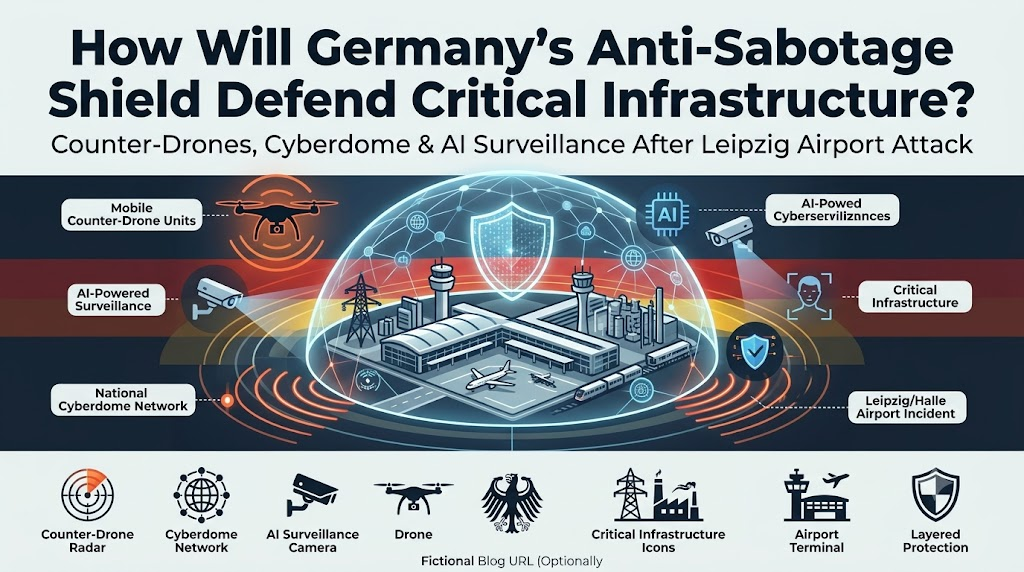
Why Is Germany Building an Anti-Sabotage Shield?
Germany is strengthening its security systems because authorities believe the country faces a growing combination of drone attacks, cyber intrusions, sabotage and other hybrid threats.
On September 6, 2026, Reuters reported that Germany was preparing a broad package of measures following the attempted drone attack at Leipzig/Halle Airport the previous month. The proposed measures include expanded mobile counter-drone capabilities, new protections for critical infrastructure, a national digital security network and greater use of AI-supported surveillance.
The objective is not simply to protect airports.
Germany wants a more integrated security architecture capable of defending transport infrastructure, government districts, electricity systems, defence companies and other strategically important facilities.
Definition + Expansion
Hybrid warfare is a form of conflict that combines conventional and unconventional methods, including cyberattacks, sabotage, disinformation, espionage and other actions designed to weaken an opponent without necessarily triggering a traditional military confrontation.
For modern governments, this creates a difficult security problem. A power substation can be attacked physically, an airport can be disrupted by a drone, or a government network can be targeted digitally. These incidents may look unrelated but can have similar strategic goals.
Germany’s new approach attempts to connect these different layers of defence.
Question: What is Germany’s anti-sabotage shield designed to protect?
Answer: It is intended to protect critical infrastructure and public spaces from threats ranging from drones and cyber intrusions to physical sabotage.
The proposed system would combine physical countermeasures, digital monitoring, law-enforcement capabilities and AI-supported detection technologies.
What Happened at Leipzig/Halle Airport?
The immediate trigger for the new measures was a serious drone incident at Leipzig/Halle Airport in August 2026.
Reuters reported that an explosive-laden drone was discovered near the airport, which is an important cargo and logistics hub. A second suspected drone was involved in an incident with a cargo aircraft, prompting investigators to examine the event as a potential national-security matter.
Germany subsequently said on September 1 that it had concluded Russian intelligence was responsible for the attempted attack, based on police investigations, intelligence findings and patterns connected with the incident. Russia has denied responsibility and rejected Germany’s allegations.
The disagreement over attribution is important because it illustrates the geopolitical stakes surrounding the incident.
Question: Did Germany officially blame Russia for the airport incident?
Answer: Yes. The German government said on September 1 that Russia was responsible, while Moscow denied the accusation and called it baseless.
That dispute remains part of the broader European debate over suspected Russian hybrid operations.
For Germany, however, the practical security lesson is broader: critical infrastructure needs to be capable of detecting and responding to threats before they cause significant disruption.
How Will Germany Defend Against Drone Attacks?
One of the clearest elements of Germany’s plan is an expansion of mobile drone-defence capabilities.
According to the German Interior Ministry spokesperson cited by Reuters, rapidly deployable counter-drone units would be stationed in cities so they can protect airspace around critical transport hubs and government districts.
This is significant because drones are relatively flexible compared with conventional aircraft.
They can potentially approach restricted areas at low altitude, operate without a traditional pilot on board and create security challenges for airports, power plants, military facilities and public events.
How Counter-Drone Defence Works
A modern counter-drone system can involve several stages:
- Detection , Sensors identify a potentially unauthorized aircraft.
- Tracking , The system determines its location, direction and movement.
- Identification , Authorities attempt to determine whether it is authorized.
- Assessment , Security personnel evaluate the potential threat.
- Response , Authorized countermeasures may be used where legally permitted.
- Investigation , Authorities collect evidence about the incident.
The exact technologies and operational rules used by Germany can vary by location and threat level.
The important point is that Germany wants these capabilities to become more mobile and rapidly deployable, rather than relying only on fixed security installations.
Question: Why are mobile counter-drone units important?
Answer: They allow authorities to move defensive capabilities to locations where threats are emerging instead of protecting only a small number of permanently defended sites.
That flexibility becomes especially valuable when potential targets include airports, railway stations, government buildings and other distributed infrastructure.
What Is Germany’s Proposed “Cyberdome”?
The physical threat from drones is only half of Germany’s proposed security response.
The government also plans what Reuters described as a national protective shield, or “cyberdome,” involving a network of digital sensors designed to detect and intercept attempted hacking attacks.
The concept is significant because critical infrastructure is increasingly dependent on computer networks.
Power grids, airports, railways, hospitals, telecommunications networks and industrial facilities all rely on digital systems. A cyberattack against one of these systems could potentially create disruption without physically destroying the underlying equipment.
Definition + Expansion
A cyberdome in this context is a proposed national network of digital monitoring and defensive capabilities designed to identify cyber threats against important systems.
Rather than treating cybersecurity as an isolated responsibility for individual organizations, the concept suggests a more coordinated national approach. Sensors and security systems could provide authorities with information about suspicious activity across multiple parts of the infrastructure ecosystem.
The idea is similar in principle to an early-warning network: detect a threat before it becomes a major incident.
Question: Why does Germany need a national cyber defence layer?
Answer: Because modern infrastructure depends heavily on interconnected digital systems, making cyberattacks capable of disrupting essential services without requiring physical access.
The proposed cyberdome is intended to strengthen detection and response capabilities across these systems.
Why Are AI and Facial Recognition Part of Germany’s Security Plan?
Another important part of the proposal is the increased use of AI-supported technologies, biometric facial recognition and video surveillance.
Reuters reported that Germany intends to expand these technologies, including at railway stations, to help identify suspected attackers preparing acts of sabotage.
This illustrates how artificial intelligence is increasingly being considered as an infrastructure-security technology rather than only a productivity or consumer tool.
AI can potentially help security systems process enormous quantities of video or sensor information faster than human operators alone.
Where AI Could Help
AI-supported security systems can potentially assist with:
- Identifying unusual movement patterns
- Detecting objects in restricted areas
- Analyzing large volumes of surveillance footage
- Flagging potentially suspicious activity
- Correlating information from multiple sensors
- Supporting human investigators
- Prioritizing alerts for security teams
However, AI does not automatically make a security system accurate.
A system that incorrectly identifies a person or activity can create serious consequences, particularly when biometric technologies are involved.
Question: Does AI replace human security officers?
Answer: The German proposal describes AI-supported technologies as part of a broader security system rather than as a complete replacement for human decision-making.
Human authorities still need to interpret alerts, investigate incidents and determine what action is legally justified.
That distinction matters because AI-generated alerts are not necessarily proof that someone has committed a crime.
The Biggest Challenge: Protecting Critical Infrastructure
Germany’s anti-sabotage strategy extends beyond airports and government buildings.
The government also wants companies operating critical infrastructure, including power utilities and defence manufacturers, to have stronger authority to defend themselves against unauthorized drones.
This represents an important change in how infrastructure security can be approached.
Traditionally, governments and law-enforcement agencies have carried much of the responsibility for responding to security threats. But modern infrastructure is frequently owned and operated by private companies.
What Counts as Critical Infrastructure?
Critical infrastructure can include systems and facilities that society depends on for essential services, such as:
- Electricity generation and distribution
- Airports and logistics hubs
- Railways and transportation
- Telecommunications
- Water systems
- Healthcare facilities
- Defence-related industries
- Government networks
- Digital infrastructure
A disruption in any one of these areas can potentially have consequences beyond the original target.
Question: Why are private companies being included in the defence strategy?
Answer: Because many critical infrastructure facilities are operated by private organizations, meaning national resilience depends partly on their ability to detect and respond to attacks.
Germany’s proposal would give certain critical-infrastructure operators greater legal authority to actively fend off drones rather than simply detect them.
Germany’s Security Model Is Becoming More Integrated
The most interesting aspect of Germany’s plan is that it does not treat each threat separately.
Instead, the proposed system connects physical security, cybersecurity, surveillance, AI and critical-infrastructure protection.
That integrated approach reflects how modern attacks can cross multiple domains.
Imagine a hypothetical attack on a transport hub. A drone could create a physical disruption while attackers simultaneously attempt to compromise the facility’s network. Security cameras might then be used to identify people involved.
The challenge is therefore not just stopping one drone or one cyberattack. It is coordinating information from multiple systems.
Germany’s Proposed Security Layers
| Security Layer | Main Threat | Proposed Response |
| Airspace | Unauthorized drones | Mobile counter-drone units |
| Cybersecurity | Hacking attempts | Digital sensors and cyberdome |
| Public spaces | Suspected sabotage | AI-supported surveillance |
| Biometrics | Identification challenges | Facial recognition |
| Critical infrastructure | Physical and digital attacks | Greater defensive authority |
| Government areas | Drone and security threats | Rapid-response protection |
This layered model is becoming increasingly relevant as governments reconsider what national security means in a highly connected economy.
Why the Airport Attack Is Part of a Bigger Security Story
The Leipzig/Halle incident did not occur in isolation.
Reuters has reported a series of security incidents in Germany involving suspected sabotage of infrastructure, including attacks or attempted attacks involving electricity systems and a suspected arson incident near defence technology company Rohde & Schwarz in Munich.
On September 3, German authorities investigated suspected arson at a construction site outside Rohde & Schwarz’s Munich headquarters. Two Bulgarian nationals were arrested in connection with the incident, although investigations into the motive continued.
There were also investigations into attempted sabotage of electricity infrastructure in Brandenburg and North Rhine-Westphalia.
Question: Does Germany believe every recent infrastructure incident is connected?
Answer: Not necessarily. Authorities are investigating individual incidents and possible connections, while Germany has described the broader environment as involving increasing hybrid threats.
That distinction is important. An individual incident may have a different cause even when it occurs during a period of heightened security concern.
Why Russia’s Denial Matters
Germany’s allegations have produced a sharp diplomatic response from Moscow.
German authorities said intelligence and police investigations pointed to Russian involvement in the Leipzig/Halle attack. Russia has rejected the accusation, and Russian Foreign Minister Sergei Lavrov described the allegations as the beginning of a “real war,” according to TASS reporting cited by Reuters.
This means the incident has consequences beyond airport security.
If European governments believe Russia is conducting coordinated hybrid operations, they may respond through stronger intelligence cooperation, sanctions, infrastructure protection and NATO coordination.
Russia’s denial, meanwhile, means the attribution itself remains a major geopolitical point of dispute.
Question: Why does attribution matter in a sabotage case?
Answer: Identifying who is responsible determines how governments may respond diplomatically, legally and strategically.
It can influence sanctions, intelligence cooperation, military preparedness and relationships between countries.
What Does Germany’s Plan Mean for Cybersecurity?
For cybersecurity professionals, one of the most important lessons is that security is moving toward continuous detection and response.
Older security models often focused heavily on protecting a defined perimeter: install a firewall, secure a building and control physical access.
Modern infrastructure is much more interconnected.
A railway station can depend on cloud systems. An airport can depend on networked logistics systems. A power facility can contain industrial control systems connected to digital networks.
That means security teams increasingly need to monitor both physical and digital environments.
The New Security Mindset
A resilient infrastructure strategy increasingly asks:
- Can we detect an attack early?
- Can we identify unusual activity?
- Can we isolate affected systems?
- Can we continue operating during an attack?
- Can we recover quickly?
- Can physical and digital security teams share information?
- Can authorities coordinate with private infrastructure operators?
Germany’s proposed cyberdome is an example of how governments are thinking about these questions at national scale.
What Does AI Surveillance Mean for Privacy?
There is another side to Germany’s proposed security expansion: privacy and civil liberties.
AI-supported surveillance and facial recognition can provide security benefits, but they also raise questions about how personal data is collected, processed and stored.
Facial recognition is particularly sensitive because it can identify people in public spaces.
The central policy challenge is therefore balancing security with appropriate safeguards.
Potential Benefits
- Faster identification of suspects
- Automated analysis of large video datasets
- Earlier detection of suspicious behavior
- Better coordination between security systems
Potential Concerns
- False identification
- Privacy violations
- Excessive surveillance
- Data retention
- Algorithmic bias
- Misuse of collected information
- Lack of transparency
Question: Is more surveillance automatically better security?
Answer: No. Surveillance can improve detection, but its effectiveness depends on accuracy, oversight, legal safeguards and how authorities respond to alerts.
A technically powerful system can still create problems if it produces excessive false positives or is used without appropriate controls.
For Germany, this means the debate around its anti-sabotage strategy is likely to involve both national security and digital rights.
Germany’s Approach vs. Traditional Infrastructure Security
The proposed changes represent a shift from protecting individual facilities toward creating a more connected national security architecture.
| Traditional Approach | Emerging Approach |
| Protect individual facilities | Protect interconnected infrastructure |
| Fixed security systems | Mobile and networked capabilities |
| Human monitoring | AI-assisted monitoring |
| Cybersecurity separated from physical security | Integrated physical-digital defence |
| Government-led response | Government and infrastructure operators |
| React after incidents | Detect and respond earlier |
This does not mean traditional security measures are disappearing.
Instead, Germany appears to be adding new layers to them.
The goal is resilience: if one defensive layer fails, another can detect the threat, limit its impact or support recovery.
What Can India Learn From Germany’s Anti-Sabotage Strategy?
Although Germany’s immediate security concerns are specific to Europe, the underlying technology challenge is global.
India has rapidly expanding digital infrastructure, airports, railway networks, data centers, telecommunications systems, energy facilities and manufacturing hubs.
As these systems become more connected, cybersecurity and physical security increasingly overlap.
For Indian students and young professionals, this creates a useful career lesson: the future of cybersecurity will not be limited to protecting websites and databases.
Emerging Areas to Watch
- AI-powered cybersecurity
- Critical infrastructure protection
- Industrial cybersecurity
- Drone detection systems
- Digital forensics
- Network monitoring
- Smart-city security
- Biometric security
- Data privacy
- Cyber-physical systems
- Security operations centers
A student interested in AI can therefore explore security applications without becoming a traditional cybersecurity specialist.
Similarly, someone studying electronics or embedded systems can work on technologies that detect physical threats to digital infrastructure.
Why Cyber-Physical Security Is Becoming So Important
Germany’s response highlights a broader technology trend: the boundary between the physical and digital worlds is disappearing.
A drone is physical, but its navigation and control can involve digital systems.
An electricity substation is physical, but its operation can depend on networked industrial control systems.
An airport is a physical location, but baggage systems, flight operations, logistics and communications rely heavily on software.
This creates what experts often call cyber-physical systems.
Definition + Expansion
Cyber-physical security means protecting systems where digital technologies directly control or interact with physical equipment and infrastructure.
This is especially important because a successful cyberattack can sometimes produce physical consequences, while a physical attack can damage digital systems.
Germany’s planned combination of counter-drone capabilities and cyber defence illustrates why governments increasingly need to think about both dimensions together.
What Should Germany Watch Next?
The success of Germany’s strategy will depend on implementation rather than announcements alone.
Several questions will determine whether the proposed anti-sabotage shield actually improves national resilience.
Five Questions to Watch
- How quickly can counter-drone units be deployed?
- How will the proposed cyberdome coordinate information across organizations?
- What legal powers will private infrastructure operators receive?
- What safeguards will govern AI surveillance and facial recognition?
- How effectively will Germany coordinate with European and NATO partners?
These questions matter because security systems can become complicated quickly.
A national network with thousands of sensors and multiple agencies must be interoperable, secure and capable of distinguishing genuine threats from ordinary activity.
What Germany’s Anti-Sabotage Shield Says About the Future of Security
Germany’s response to the Leipzig/Halle drone incident points toward a broader transformation in national security.
The old question was often: How do we protect this building?
The new question is increasingly: How do we protect an interconnected system of buildings, networks, people, machines and data?
That is a much harder problem.
It requires governments to combine cybersecurity, physical security, AI, telecommunications, intelligence, law enforcement and private-sector infrastructure management.
Question: What is the biggest takeaway from Germany’s new security plan?
Answer: Germany is moving toward a layered security model that combines counter-drone systems, cyber defence, AI-supported surveillance and stronger protection for critical infrastructure.
The strategy was prompted by a failed airport drone attack that Germany attributes to Russia, although Moscow denies involvement.
The bigger lesson is that modern security threats increasingly cross boundaries.
A drone can threaten an airport. A cyberattack can threaten a power grid. AI can help detect suspicious activity. And a coordinated defence system may need to bring all of these capabilities together.
Frequently Asked Questions
What is Germany’s anti-sabotage shield?
Germany’s anti-sabotage shield is a planned package of security measures designed to defend against drone attacks, cyber intrusions and other forms of sabotage. It includes mobile counter-drone units, digital sensors, stronger critical-infrastructure protections and expanded AI-supported surveillance.
Why is Germany increasing counter-drone capabilities?
Germany is expanding counter-drone capabilities following a failed drone attack at Leipzig/Halle Airport in August 2026. The plan includes rapidly deployable units intended to protect critical transport hubs and government districts.
What is Germany’s proposed cyberdome?
The proposed cyberdome is a national protective network involving digital sensors designed to detect and respond to attempted hacking attacks. It is intended to strengthen protection of critical digital infrastructure.
Why is Germany using AI surveillance?
Germany plans to expand AI-supported technologies, biometric facial recognition and video surveillance to help identify suspected attackers preparing acts of sabotage, including at railway stations.
Did Germany accuse Russia of the Leipzig airport drone attack?
Yes. On September 1, 2026, the German government said it had concluded that Russian state actors were responsible based on intelligence and police investigations. Russia denied involvement and rejected Germany’s allegations.
What does Germany’s plan mean for cybersecurity?
Germany’s strategy demonstrates the growing importance of integrating cybersecurity with physical infrastructure protection. Airports, power grids, railways and other critical systems increasingly depend on interconnected digital and physical technologies.
Key Takeaways
- Germany is planning a broad anti-sabotage security package after the Leipzig/Halle Airport drone incident.
- The proposed system combines counter-drone defence, cyber protection, AI surveillance and critical-infrastructure security.
- Germany plans to deploy mobile counter-drone units around important transport hubs and government districts.
- A proposed “cyberdome” would use digital sensors to detect attempted hacking attacks.
- AI-supported technologies and facial recognition could be expanded in public locations such as railway stations.
- Germany says Russia was responsible for the Leipzig/Halle attack, while Russia denies the accusation.
- The debate also raises important questions about privacy, surveillance and AI accountability.
- The strategy highlights the growing importance of cyber-physical security.
- For India, the trend is relevant to airports, railways, energy systems, telecommunications and other increasingly connected infrastructure.
Final Takeaway
Germany’s planned anti-sabotage shield shows how national security is evolving in the age of connected infrastructure. The next generation of security will increasingly combine AI, cybersecurity, sensors, physical protection and human intelligence rather than treating each threat separately.
For students and young professionals, that shift creates an expanding technology landscape,from AI cybersecurity and digital forensics to critical infrastructure and cyber-physical systems. Understanding how these technologies work together could be just as valuable as learning any single security tool. keep exploring kalinga.ai for more.