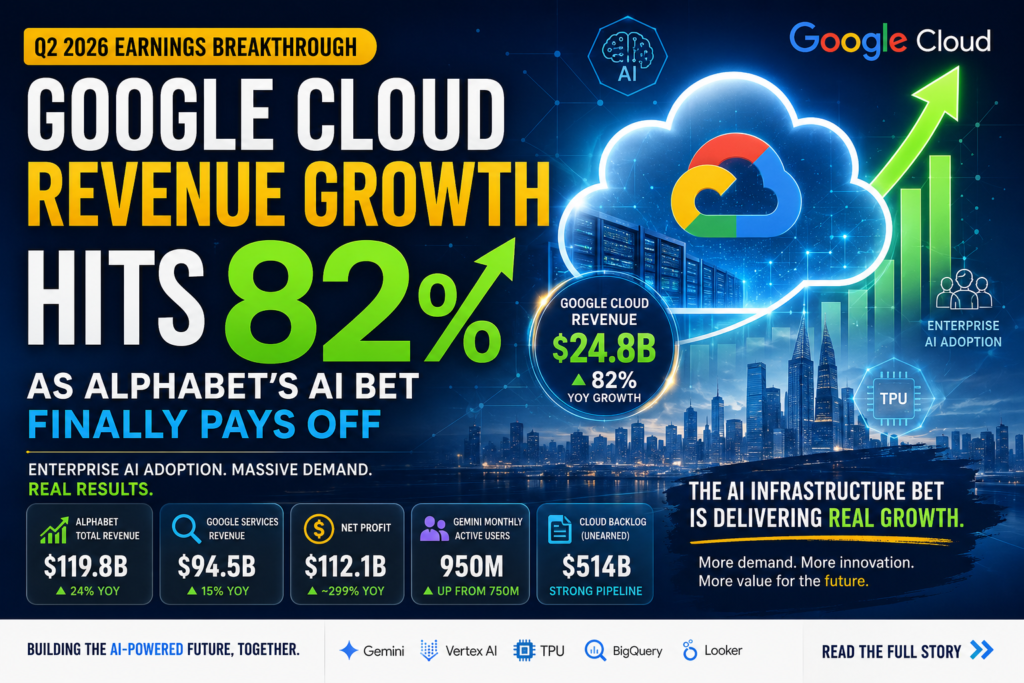
Google Cloud revenue growth hit 82% year-over-year in Q2 2026, climbing to $24.8 billion and silencing investors who feared Alphabet’s massive AI spending would never pay for itself. The number didn’t just beat expectations — it beat them by more than $2 billion, and it arrived alongside a company-wide profit of $112.1 billion that makes the AI bubble skeptics look, at least for now, premature.
This is the story of how a search company became a cloud powerhouse almost overnight, why enterprise AI adoption is the engine behind it, and what it actually means for the long-running debate about whether AI infrastructure spending will ever generate real returns.
For most of 2025 and early 2026, the narrative around Alphabet followed a predictable script: the company was spending tens of billions of dollars a quarter on data centers, custom chips, and networking gear, and investors kept asking the same uncomfortable question — where’s the payoff? Every earnings call brought a fresh round of skepticism, with some analysts openly worrying that Alphabet, along with the rest of the “Magnificent Seven,” was pouring money into an AI buildout that might never generate a proportional return. This quarter’s results are the first time the company has been able to point to a number, rather than a promise, and say: here’s the payoff.
Google Cloud Revenue Growth: The Headline Numbers
Alphabet’s latest earnings report, released Wednesday, put a hard number on something analysts had only been able to guess at for months: enterprise AI demand is translating directly into cloud dollars.
Quarterly Breakdown
Here’s what the company reported for the quarter:
- Google Cloud revenue: $24.8 billion, up 82% year-over-year
- Alphabet total revenue: $119.8 billion, up 24% year-over-year
- Google Services revenue: $94.5 billion, up 15% year-over-year
- Net profit: $112.1 billion, up from $28.1 billion a year earlier
- Cloud backlog (unearned contract value): $514 billion
To put that figure in context, the previous quarter had already looked strong: cloud revenue grew 63% year-over-year to $20 billion. An acceleration on top of that isn’t just a continuation of momentum — it’s genuinely unusual for a business already operating at this scale. Most companies see growth rates decelerate as their revenue base grows larger, simply because bigger numbers are harder to move by the same percentage. Google Cloud is doing the opposite, and that’s a big part of why this earnings report landed the way it did with investors.
Beating Wall Street Expectations
Analysts had modeled cloud revenue at roughly $22.46 billion for the quarter, according to Bloomberg’s tally of Wall Street forecasts. The actual result — $24.8 billion — came in well above consensus, and it’s part of a longer streak: this marks Alphabet’s 12th consecutive quarter of double-digit revenue growth companywide. Wall Street has gotten used to Google beating estimates. What’s changed is the margin by which it’s doing so on the cloud side specifically, and the fact that the beat came during a quarter when several other tech giants were also reporting strong AI-driven cloud results, meaning Google wasn’t just clearing a low bar — it was outperforming in a genuinely competitive field.
Why Google Cloud Revenue Growth Is Accelerating
The short answer: enterprises are buying AI infrastructure and AI-powered software faster than almost anyone predicted, and Google Cloud is capturing an outsized share of that spending.
Enterprise AI Adoption Is the Real Driver
What is driving enterprise AI adoption on Google Cloud? In simple terms, it’s companies moving AI projects out of pilot phase and into production — training custom models, running large-scale inference workloads, and buying managed AI infrastructure instead of building it themselves.
Alphabet was explicit about the cause behind this quarter’s results. The company said the cloud gains were driven largely by enterprise AI solutions and enterprise AI infrastructure adoption — not by legacy workloads like storage or basic compute migrating from on-premises data centers. That distinction matters a great deal for how investors should interpret the number. It means this isn’t a one-time catch-up effect, where companies simply moved existing workloads from their own servers onto Google’s cloud. It’s tied directly to how fast companies are deploying generative AI tools, training custom models on Google’s Tensor Processing Units (TPUs), and running inference at scale for customer-facing products.
This shift also reflects a broader change in how enterprises budget for technology. A year or two ago, AI spending inside most large companies was still experimental — a line item tucked inside an innovation budget, often run by a small team testing chatbots or internal copilots. That spending is increasingly becoming core infrastructure spending, approved by the same budget owners who sign off on databases, networking, and security. When AI spending graduates from “experiment” to “infrastructure,” the dollar amounts involved jump by an order of magnitude, and that’s precisely the transition Google Cloud appears to be capturing.
The $514 Billion Backlog Is the Bigger Story
Revenue already booked is only part of the picture, and arguably not even the most important part. Alphabet disclosed that its cloud backlog — contracted work that hasn’t yet been converted into recognized revenue — climbed to $514 billion. That figure gives investors something they’ve wanted for over a year: forward visibility into future quarters, rather than a snapshot of a single earnings period.
A backlog that size suggests continued strength isn’t likely to stall out anytime soon, because customers have already signed multi-year commitments that will convert into revenue gradually as the underlying infrastructure gets deployed and used. For a business that requires enormous upfront capital investment — building data centers takes years, not months — a large backlog is effectively a promise from customers that the capacity being built today will get used tomorrow. That’s exactly the kind of signal Sundar Pichai leaned on when analysts pressed him about the return on Alphabet’s spending, which we’ll get to below.
Alphabet’s Broader Financial Picture
Cloud is the headline, but it doesn’t exist in isolation. Here’s how the major segments compare against last year:
| Metric | This Quarter | Year-Ago Quarter | YoY Change |
|---|---|---|---|
| Google Cloud revenue | $24.8B | ~$13.6B | +82% |
| Alphabet total revenue | $119.8B | ~$96.6B | +24% |
| Google Services revenue | $94.5B | ~$82.2B | +15% |
| Net profit | $112.1B | $28.1B | ~+299% |
| Gemini monthly active users | 950M | — | — |
| Cloud backlog | $514B | — | — |
Figures are drawn from Alphabet’s Q2 2026 earnings report and Bloomberg’s coverage of analyst expectations.
The net profit jump looks especially dramatic, though it’s worth noting that year-ago profit figures can be affected by one-time items like tax adjustments or investment gains and losses, not operating performance alone. Still, the underlying trend is unmistakable: Google Services — the advertising, Search, and YouTube business that has historically funded everything else at Alphabet — is still growing at a healthy 15%, while cloud is now growing more than five times faster. That gap shows where Alphabet’s next growth engine actually sits, and it’s a meaningful shift for a company that has been almost entirely dependent on advertising revenue for two decades.
It’s also worth flagging why this matters beyond a single earnings cycle. Investors have long valued Alphabet primarily as an advertising business with a cloud division attached. If cloud revenue growth continues to outpace Services by this margin for several more quarters, the market’s entire framework for valuing Alphabet could shift — from “a search company that also does cloud” to “a diversified infrastructure company that also does search.”
Gemini’s User Growth Fuels the Cloud Story
Google Cloud revenue growth doesn’t happen in a vacuum — it’s closely tied to consumer and developer adoption of Google’s AI products, which builds the habits and integrations that eventually turn into enterprise contracts.
Question: How many people are using Google’s Gemini app? Direct answer: Gemini currently has 950 million monthly active users, up from 750 million reported in Q4 2025 — a jump of roughly 200 million users in about two quarters.
That kind of consumer-scale adoption matters for the cloud business because it demonstrates model quality and reliability at massive scale, which is exactly what enterprise buyers evaluate before committing to a cloud AI vendor. Gemini’s growth curve effectively functions as a public proof point for Google’s underlying AI infrastructure — if hundreds of millions of consumers are using it daily without major outages or quality complaints, that’s a far more convincing sales pitch to a CIO than any marketing deck.
There’s also a flywheel effect worth understanding. Every additional Gemini user generates usage data and interaction patterns that help Google refine its models. Better models make Google’s enterprise AI offerings more competitive against rivals like Microsoft’s Copilot (built on OpenAI’s models) and Amazon’s Bedrock. A more competitive enterprise offering wins more cloud contracts. And more cloud contracts fund the infrastructure that supports both the consumer app and the enterprise business. Understanding that loop helps explain why Alphabet has been willing to offer Gemini broadly, sometimes at aggressive pricing, even while its cloud infrastructure costs remain enormous.
The AI Spending Question: Is It Actually Paying Off?
This is the question investors have been asking for over a year, and it’s the reason Alphabet’s stock reaction to this earnings report matters so much.
The Capital Expenditure Numbers
Alphabet’s capital expenditures — spending on data centers, custom AI chips, and networking infrastructure — are projected to land between $180 billion and $190 billion for the year. That’s an enormous figure by any standard, and it’s the number that has made Wall Street nervous since Alphabet first disclosed plans to raise capital specifically to fund the buildout.
What Sundar Pichai Told Analysts
During Wednesday’s earnings call, CEO Sundar Pichai faced direct questions from analysts about the timing and scale of returns on that spending. His response focused on demand signals rather than a specific payback timeline:
- Compute capacity investments are expected to show returns “in ’27”
- Long-term deals are among the “strong demand indicators” the company is tracking
- Pichai described the current dynamics as “healthier” than a year ago, which he cited as the reason for continuing the spending
Pichai also framed the moment more broadly, telling analysts that the company’s AI investments are reshaping every part of the business — a statement that’s easy to dismiss as typical earnings-call language, except that this quarter’s results are the first hard evidence that backs it up at scale.
How Analysts and Investors Reacted
The response from Wall Street was notably more optimistic than it had been in prior quarters. For much of the past year, every disclosure of higher capex guidance from Alphabet triggered a wave of concern about margin compression and free cash flow. This time, the combination of a large revenue beat, an expanding backlog, and management’s willingness to give a rough timeline (2027) for when compute investments would show clearer payoff appears to have shifted the tone of the conversation. Rather than asking “why are you spending so much,” several analysts on the call focused their questions on capacity constraints — essentially asking whether Google could build data centers fast enough to keep up with demand, which is a fundamentally different, and far more comfortable, problem for a company to have.
Google Cloud vs AWS vs Azure: How Does the Growth Compare?
Google Cloud revenue growth of 82% doesn’t happen in a competitive vacuum — it’s worth stacking against the other two hyperscalers to understand whether Google is closing the gap or just growing off a smaller base.
| Provider | Latest Reported Growth | Latest Reported Revenue | Reporting Period |
|---|---|---|---|
| Google Cloud | 82% YoY | $24.8B | Q2 2026 |
| Microsoft Azure | ~39-40% YoY | Part of $32.9B+ Intelligent Cloud segment | Recent FY2026 quarters |
| AWS | 28% YoY | $37.6B | Q1 2026 |
A few things stand out from that comparison. AWS is still the largest cloud provider by absolute revenue, commanding roughly 30% of the global cloud infrastructure market according to industry trackers, and Azure has posted the most consistent growth rate over consecutive quarters, making it the most predictable of the three for investors. But Google Cloud is now outpacing both rivals by a wide margin on a percentage basis, even if it’s starting from a smaller revenue base and a market share estimated around 13%. That’s a meaningful shift in a market that AWS dominated almost unchallenged for the better part of a decade.
It’s worth being careful about what this comparison does and doesn’t show. Percentage growth rates favor smaller bases — it’s mathematically easier to grow 82% off a $13-14 billion prior-year quarter than it is to grow 82% off AWS’s much larger revenue base. Even so, the acceleration itself is the more telling signal. Google Cloud didn’t just grow fast; it grew faster than the quarter before, at a point in its scale where deceleration would have been the more expected outcome. That’s the detail competitors and analysts are watching most closely heading into the rest of 2026.
What This Means for Enterprise AI Buyers
For companies evaluating cloud AI vendors, this earnings report offers a few practical signals worth paying attention to:
- Google’s AI infrastructure is scaling fast, which historically translates into more competitive pricing and capacity availability over time as fixed costs get spread across a larger customer base
- The backlog growth suggests strong retention, since a $514 billion pipeline implies existing customers are signing bigger, longer contracts rather than churning to competitors
- Capacity could remain tight in the near term, given that Alphabet’s own capex guidance ($180-190 billion) is being outpaced by demand growth, according to Pichai’s comments about capacity constraints
- Competitive pressure on AWS and Azure pricing is likely to intensify, which is generally good news for enterprise buyers shopping across multiple cloud providers
Frequently Asked Questions
Q: What caused the spike in Google Cloud revenue growth this quarter? A: Alphabet attributed the 82% jump primarily to enterprise AI adoption — companies buying AI infrastructure and AI software services from Google Cloud, rather than growth from legacy cloud workloads.
Q: How does Alphabet’s cloud backlog affect future Google Cloud revenue growth? A: The $514 billion backlog represents contracted work not yet recognized as revenue. It functions as a forward indicator, suggesting continued growth in upcoming quarters as those contracts convert into billed revenue.
Q: Is Alphabet’s AI spending sustainable given the size of its capital expenditures? A: Alphabet’s 2026 capex guidance sits between $180 billion and $190 billion. Pichai pointed to demand signals and long-term customer deals as justification, and this quarter’s cloud results are the strongest evidence yet that the spending is generating revenue, though full payback is a multi-year proposition management has tied to 2027.
Q: How does Google Cloud’s growth rate compare to AWS and Microsoft Azure? A: Google Cloud’s 82% year-over-year growth this quarter outpaces both AWS (28% in its most recent report) and Azure (roughly 39-40% in recent quarters), though Google Cloud remains smaller than both in absolute revenue.
Q: Does this earnings report settle the debate about an “AI bubble”? A: Not entirely. This report is company-specific evidence that Alphabet’s AI infrastructure spending is converting into real, growing revenue with a large forward backlog. It doesn’t resolve broader industry-wide questions about whether every company investing heavily in AI infrastructure will see similar returns, since Alphabet’s combination of search-driven cash flow, custom TPU chips, and consumer-scale distribution through Gemini and Search gives it advantages that smaller or less diversified players may not have.
Key Takeaways
- Google Cloud revenue growth hit 82% year-over-year, reaching $24.8 billion and beating analyst estimates by more than $2 billion
- Enterprise AI adoption — not legacy cloud workloads — is the primary driver behind the acceleration
- A $514 billion cloud backlog gives investors forward visibility into future Google Cloud revenue growth
- Gemini’s monthly active users grew from 750 million to 950 million in roughly two quarters
- Alphabet’s capex guidance remains at $180-190 billion for the year, with Pichai pointing to 2027 as when compute investments should show clearer returns
- Google Cloud’s growth rate now outpaces both AWS and Microsoft Azure on a percentage basis
Google Cloud revenue growth this quarter doesn’t settle the broader debate about whether the AI infrastructure buildout across the entire industry is rational or overheated. But for Alphabet specifically, it’s the clearest evidence yet that the spending is converting into a real, fast-growing business — not just a bet on the future.