Mecka AI Valuation: Why Is the Startup Near $500 Million?
What if the biggest problem holding back humanoid robots isn’t the robot itself, but the lack of useful data to teach it what to do? Mecka AI is betting exactly on that problem, and its valuation is now approaching $500 million in a new Sequoia Capital-led financing round.
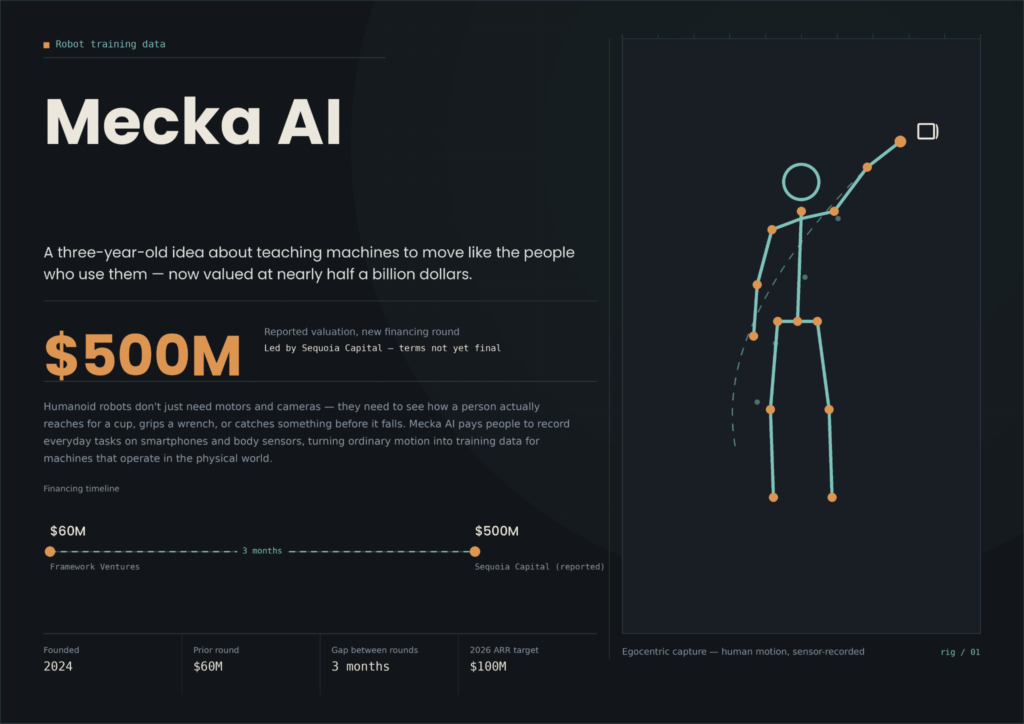
According to TechCrunch, citing two people familiar with the deal, the startup is nearing a new funding round at a valuation of about $500 million. The financing comes only three months after Mecka AI announced a $60 million round led by Framework Ventures, showing just how quickly investor interest is moving toward companies supplying data for the physical AI boom.
The precise size and final terms of the new financing were not available when TechCrunch reported the development on September 11, 2026, and the deal could still change.
But the bigger story goes beyond one startup or one funding round. Mecka AI is targeting a problem that could become central to the next phase of artificial intelligence: how do you collect enough real-world human behavior data to train robots that operate in the physical world?
What Is Mecka AI and What Does It Do?
Question: What does Mecka AI actually do?
Mecka AI collects and analyzes human motion and real-world interaction data that can be used to train humanoid robots and other robotic systems. Instead of focusing primarily on building the robot hardware, the startup is building a data layer around the physical world.
TechCrunch reports that Mecka AI was founded in 2024 by four entrepreneurs: Josh Gao, Mogen Cheng, Jason Chong, and Duy Nguyen. Gao, Cheng, and Chong had previously worked in areas including restaurant fintech and cryptocurrency rather than robotics.
That background is important because Mecka AI’s founders identified a problem that can be easy to overlook when discussing humanoid robots.
Robots need more than powerful motors, cameras, processors, and artificial intelligence models. They also need examples of how humans interact with the world.
A robot that is expected to make coffee needs to understand more than the concept of “coffee.” It needs to learn how a person reaches for a cup, grasps it, moves it without knocking it over, operates a machine, pours liquid, and responds when something goes slightly wrong.
That creates demand for a new category of physical-world AI data.
Definition + Expansion: Physical-World AI Data
Physical-world AI data is information collected from real interactions between people, objects, environments, and machines that can help AI systems learn how to act in the physical world.
Large language models can learn from enormous collections of text, images, code, and other digital information. Robots face a different challenge because physical actions are connected to movement, space, timing, force, balance, and changing environments.
This means the data required for robotics cannot simply be copied from the internet at the same scale as text.
Mecka AI’s business is built around collecting that missing information.
Why Robot Training Data Has Become a Major Bottleneck
Question: Why is robot training data so important for humanoid robots?
Humanoid robots need large amounts of information about real-world behavior because their AI systems must translate perception into physical action. A shortage of high-quality physical data can therefore limit how quickly robots become capable and reliable.
This is where Mecka AI’s strategy becomes interesting.
The AI industry has already demonstrated that data can become a valuable infrastructure layer. Companies such as Scale AI and other human-data platforms have helped AI developers prepare, label, evaluate, and generate data for large language models and other AI systems.
Mecka AI is applying a similar concept to robotics.
The difference is that the data is no longer simply text on a screen.
A robot may need to learn:
- How humans pick up and manipulate objects.
- How people move around kitchens, garages, factories, and other environments.
- How different objects are handled.
- How actions change depending on context.
- How people perform multi-step everyday activities.
- How physical movements correspond with specific tasks.
- How humans respond when an action does not go according to plan.
These examples can help robotics companies train models that connect what a robot sees with what it should do.
That connection is crucial.
An AI model might recognize a screwdriver in an image. A useful robot, however, needs to know how to approach the screwdriver, grasp it, orient it correctly, move it toward a screw, apply appropriate force, and complete the task.
The difference between recognizing an object and physically manipulating it is enormous.
How Mecka AI Collects Data for Robots
Question: How does Mecka AI collect physical-world data?
Mecka AI pays people to record themselves performing everyday tasks using body sensors and smartphones, according to TechCrunch. Those recordings create datasets containing information about human movement and interaction.
The tasks can range from relatively ordinary activities such as making coffee to more complex physical work such as fixing cars.
This approach is often described as egocentric data collection.
Definition + Expansion: Egocentric Data
Egocentric data is information captured from a first-person perspective, focusing on what a person sees, does, or interacts with while performing a task.
For robotics, this can provide a valuable connection between human perception and human action. Instead of simply showing a robot thousands of photographs of a coffee cup, a dataset can potentially show the sequence of movements and interactions involved in using that cup during a real task.
Imagine a person preparing breakfast.
A camera or smartphone can capture the scene. Sensors can provide additional information about movement. The resulting data can potentially show the relationship between the person’s environment and physical actions.
That is much closer to the information a robot needs when learning how to perform the same activity.
It also explains why the shortage of physical-world data could become a major business opportunity.
Why Mecka AI’s Founders Focused on Data Instead of Robots
Question: Why did Mecka AI enter robotics despite its founders not having traditional robotics backgrounds?
The founders reportedly recognized that the shortage of physical-world data could become the primary bottleneck for general-purpose robots, including humanoids.
That is a different way of looking at the robotics industry.
When people hear “humanoid robot,” they often think about hardware companies developing arms, legs, batteries, actuators, cameras, and processors. But increasingly capable hardware is only one part of the equation.
The robot also needs a sufficiently capable intelligence system.
And intelligence systems require training data.
This creates a potentially powerful position for companies that can build datasets before the market fully matures.
In that sense, Mecka AI is trying to become part of the infrastructure behind robotics rather than compete directly with every company building a humanoid machine.
Its name itself reflects the company’s focus. TechCrunch reports that “Mecka” comes from “mecha,” the fictional giant robots controlled by humans in science fiction.
The company’s business model, however, is firmly grounded in real-world data collection.
Mecka AI Valuation: Why Are Investors Moving So Quickly?
Question: Why is Mecka AI nearing a $500 million valuation so soon after its previous funding round?
The most obvious reason is the rapidly increasing investor interest in robot training data as humanoid robotics moves toward commercialization.
According to TechCrunch, Mecka AI is nearing a new round led by Sequoia Capital at a valuation of approximately $500 million. The company had announced its previous $60 million financing just three months earlier.
The exact size of the new financing has not been disclosed, and the terms were not final at the time of reporting.
That distinction matters.
A reported valuation in an ongoing financing negotiation is not the same thing as a completed transaction. The final valuation could be different once the deal closes.
Still, the reported figure highlights the speed at which investor attention is shifting toward robotics infrastructure.
Mecka AI reportedly projected an annual run rate of $100 million by the end of 2026, according to Josh Gao’s comments to Fortune when the company announced its previous fundraise.
An annual run rate is an estimate of what a company’s revenue would look like over a full year if its current revenue pace continued. It is not necessarily the same as revenue already earned during that year.
The combination of rapid fundraising, ambitious revenue expectations, and growing demand for robot data helps explain the enthusiasm around the company.
Mecka AI Funding: What Has Happened So Far?
The company’s recent financing history shows how quickly its perceived value has changed.
| Development | Reported detail |
| Company founded | 2024 |
| Previous major funding | $60 million |
| Previous round lead | Framework Ventures |
| Other participants | Menlo Ventures, SV Angel, Kindred Ventures |
| New reported financing | Sequoia Capital-led |
| Reported new valuation | About $500 million |
| New round size | Not disclosed |
| Projected 2026 annual run rate | $100 million |
The new financing reportedly arrives only three months after the $60 million round.
That short gap is arguably more significant than the headline valuation itself.
It suggests that investors may be competing for exposure to a rapidly developing market in which the availability of high-quality robot training data could become strategically important.
Why the Robotics Industry Needs More Than Internet Data
Question: Can’t robotics companies simply train robots using existing AI datasets?
Not completely. Digital datasets are useful, but robots also need information about physical actions, environments, objects, movement, and real-world interactions.
This is one reason physical AI differs from software-only AI.
A language model can learn that a cup is an object by encountering countless references to cups in text and images. A robot needs additional information about how cups behave when they are picked up, tilted, dropped, moved, filled, or placed on different surfaces.
Physical environments are also unpredictable.
A table can be crowded. A cup can be slippery. A person can move into the robot’s path. An object can be in an unexpected position.
Training systems to deal with these variations requires data that reflects real conditions.
This makes data collection potentially as important as model architecture.
In fact, the robotics industry may increasingly resemble the AI industry’s earlier development, where access to specialized data became a competitive advantage.
Mecka AI vs Other Robot Training Data Approaches
There isn’t just one way to generate data for robots. Different approaches capture different kinds of information.
| Approach | What it captures | Major advantage | Potential limitation |
| Egocentric data | Human first-person activity and movement | Captures natural human behavior | Requires large-scale real-world collection |
| Teleoperation | Human-controlled robot actions | Directly connects actions to robot hardware | Can be expensive and time-consuming |
| Synthetic data | Computer-generated environments and actions | Highly scalable and controllable | May not perfectly represent real-world conditions |
| Traditional datasets | Images, video, sensor information | Existing infrastructure and volume | May lack detailed action information |
Mecka AI’s strategy focuses heavily on collecting human activity data.
Other robotics companies and AI labs can combine that type of information with teleoperation and other physical data collection methods.
The approaches are therefore not necessarily competitors.
A sophisticated robotics model could eventually require a mixture of all of them.
Why Human Data Can Be Valuable
Human beings are remarkably efficient at navigating complicated physical environments.
We can pick up unfamiliar objects, adjust our grip, avoid obstacles, and modify our actions without explicitly calculating every movement.
Capturing examples of these behaviors gives AI researchers a source of information about how intelligent physical actions happen.
That doesn’t mean a robot can simply copy a person’s movements and immediately become capable.
Robotic hardware has different dimensions, joints, sensors, strength limits, and control systems.
But human demonstrations can still provide useful information about task structure and interaction.
This is one reason the demand for human-generated robotics data could expand alongside humanoid robot development.
XDOF Shows How Hot Robot Data Has Become
Question: Is Mecka AI the only startup attracting major investment for robot training data?
No. TechCrunch reported shortly before the Mecka AI story that XDOF was nearing a Series B at a reported $1.2 billion valuation, only three months after emerging from stealth.
That comparison puts the reported Mecka AI valuation into perspective.
Both companies are operating in a market where investors appear increasingly interested in the data infrastructure required for physical AI.
The broader pattern also includes companies that originally focused on AI data for language models and are expanding into robotics.
This is an important shift.
For years, much of the AI industry’s data economy centered around text, images, coding, and human feedback. As AI moves into warehouses, factories, homes, vehicles, and other physical environments, the data economy may expand with it.
The opportunity could therefore extend beyond companies actually building robots.
It could include companies providing:
- Human demonstrations.
- Sensor datasets.
- Robot teleoperation.
- Data labeling and evaluation.
- Simulation environments.
- Robotics model training infrastructure.
- Physical AI testing and benchmarking.
Mecka AI is positioning itself in one of these emerging layers.
What Does Mecka AI’s Rise Mean for Humanoid Robots?
Question: Does Mecka AI’s funding prove that humanoid robots are ready for mass adoption?
No. The financing shows investor confidence in the potential importance of robot data, but it does not prove that humanoid robots have solved their technical, economic, or safety challenges.
That distinction is essential.
Humanoid robotics still faces difficult problems involving hardware reliability, battery life, manipulation, navigation, safety, manufacturing costs, and useful autonomy.
However, better data could help improve the intelligence layer that controls those machines.
Think of it this way: a robot can have excellent hardware, but without enough useful training information, its capabilities may remain limited.
Better data can potentially help models learn more tasks and handle more variations.
That is why the market for physical-world AI data could grow even if individual robot companies succeed or fail.
The underlying need for data may remain.
What Could Determine Whether the $500 Million Valuation Holds?
A high valuation creates expectations.
For Mecka AI, one major question will be whether it can turn demand for physical-world data into durable revenue.
Several factors could influence that outcome.
1. Data Quality
More data isn’t automatically better data.
Robotics companies need datasets that are accurate, diverse, relevant, and useful for training models. Poor-quality recordings may have limited value even when collected at enormous scale.
2. Data Diversity
A robot trained on people performing one task in one environment may struggle when conditions change.
The value of Mecka AI’s approach could therefore depend partly on how diverse its datasets become.
3. Customer Demand
Mecka AI has not publicly disclosed its customer list, according to TechCrunch.
That makes external visibility into its commercial traction limited.
If major robotics companies and AI labs increasingly purchase this kind of data, the market could expand quickly.
4. Revenue Growth
The company’s reported goal of reaching a $100 million annual run rate by the end of 2026 sets an ambitious benchmark.
If achieved, it could strengthen the investment case. If growth falls substantially short, investors may reassess how quickly the robot-data market can scale.
5. Competition
Mecka AI is entering a competitive market.
XDOF and other startups are pursuing real-world robotics data, while established AI-data companies are also expanding beyond language-model applications.
That means the company will need to demonstrate why its data collection approach provides lasting value.
Why This Matters for India’s AI and Robotics Ecosystem
The Mecka AI story also has implications beyond Silicon Valley.
India has a large engineering workforce, expanding AI ecosystem, manufacturing base, and growing interest in robotics and automation. As physical AI develops, demand could increase for people who understand both AI models and physical-world systems.
For students and freshers, this creates an emerging area worth watching.
Traditional AI skills such as Python, machine learning, computer vision, and data analysis remain useful. But robotics adds another layer involving sensors, control systems, simulation, human-machine interaction, and real-world data.
The rise of companies like Mecka AI suggests that the future AI workforce may not be limited to people building models.
There could also be opportunities in collecting, evaluating, labeling, managing, and analyzing physical-world datasets.
That is particularly relevant because AI infrastructure increasingly depends on specialized data pipelines.
What Is the Bigger AI Investment Trend Behind Mecka AI?
Mecka AI’s story fits into a broader transition from digital AI to physical AI.
The first major wave of generative AI largely transformed activities such as writing, coding, search, image generation, and customer support.
The next wave aims to make AI systems capable of interacting with the physical world.
That means the AI stack could increasingly include:
Sensors → Data collection → Training datasets → AI models → Robot control → Real-world feedback
Each part of that pipeline creates potential opportunities.
Mecka AI is focused on the data-collection and training-data side.
Its bet is straightforward: if humanoid robots become an important computing platform, the datasets used to teach them could become valuable infrastructure.
The reported $500 million Mecka AI valuation is therefore less interesting as a standalone number than as a signal about where investors believe the next AI bottlenecks may appear.
Mecka AI Valuation: What Should Investors and Tech Professionals Watch?
The most important takeaway is not that Mecka AI has reached a particular valuation.
It is that physical-world data is becoming an investable AI infrastructure category.
The reported Sequoia-led financing shows that investors are willing to place substantial bets on startups addressing this problem.
At the same time, the company’s funding history demonstrates how quickly valuations can move in emerging AI markets.
For technology professionals, the lesson is equally important: AI progress is not just about bigger models.
It also depends on the data those models learn from.
For humanoid robots, that data increasingly needs to come from the physical world.
FAQ: Mecka AI and Robot Training Data
What is Mecka AI?
Mecka AI is a startup founded in 2024 that collects and analyzes human motion and physical-world interaction data for training humanoid robots and other robotics systems. It uses methods including smartphones and body sensors to record people performing everyday tasks.
What is Mecka AI’s reported valuation?
The reported Mecka AI valuation is about $500 million, according to TechCrunch, which cited two people familiar with the company’s new financing. The deal was described as being led by Sequoia Capital, but the terms were not final and could still change.
How much funding has Mecka AI raised?
Mecka AI announced a $60 million funding round three months before the reported new Sequoia-led financing. The earlier round was led by Framework Ventures and included Menlo Ventures, SV Angel, and Kindred Ventures.
Why does robotics need human-generated data?
Robots need information about physical actions and real-world interactions, not just text or images. Human-generated data can provide examples of how people move, manipulate objects, and perform tasks in real environments.
What is egocentric data in robotics?
Egocentric data captures activity from a first-person perspective, recording what a person sees and does while completing a task. In robotics, this can provide useful information about the relationship between human perception, movement, and physical interaction.
Is Mecka AI building humanoid robots?
Mecka AI’s reported focus is on collecting and analyzing data used to train humanoid robots and other robotics systems, rather than building a humanoid robot itself. Its strategy is to provide a data layer for companies developing robotic systems.
The Bottom Line
Mecka AI’s reported near-$500 million valuation reflects a growing belief that robot training data could become as strategically important to physical AI as specialized human data has been to generative AI. Its rapid fundraising comes as robotics companies and AI labs search for better ways to teach machines how humans interact with the real world.
The bigger question now is whether startups collecting physical-world data can turn that demand into durable businesses. If humanoid robots continue advancing, the companies that supply the data behind their intelligence could become an increasingly important part of the AI economy.
For readers tracking the next phase of AI, robot training data may be one of the most important emerging categories to watch. KEEP EXPLORING KALINGA.AI FOR MORE.