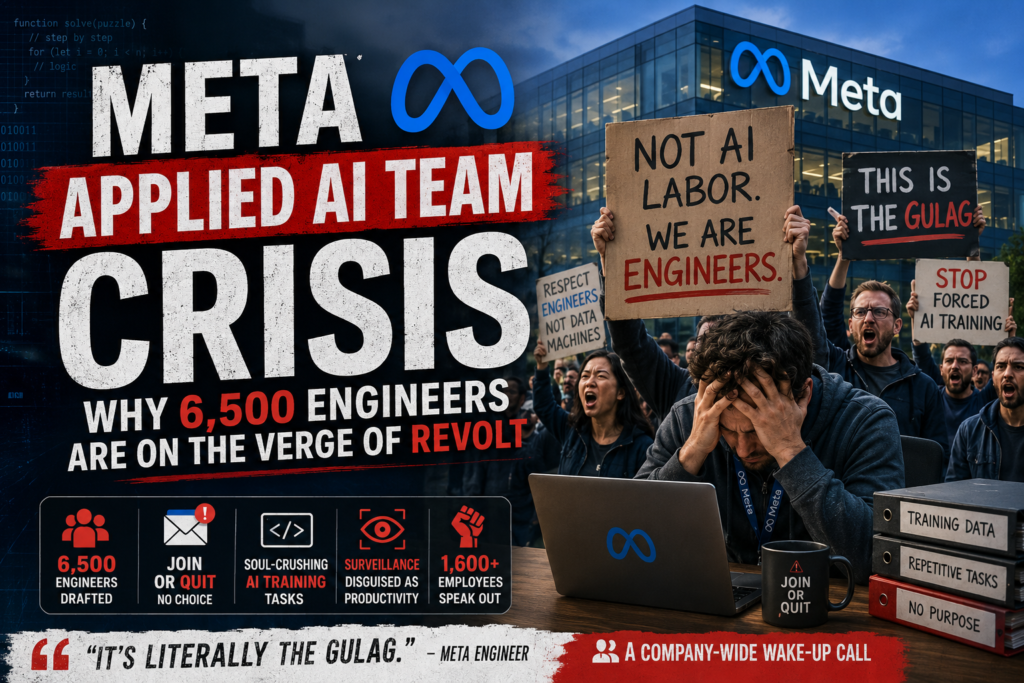
Meta’s Applied AI team — a 6,500-person unit stood up just three months ago — is already facing a full-scale internal rebellion. Engineers forced into the group describe it as a “gulag,” and the rage is now spilling into public view.
What Is Meta’s Applied AI Team?
Definition: The Meta Applied AI team is a newly formed internal unit created in early 2026 to generate training data for Meta’s large language models. It reports to Meta CTO Andrew Bosworth and is led by Maher Saba, a 12-year Meta veteran previously based in Reality Labs.
The unit’s primary mandate is to produce high-quality examples of how humans complete technical tasks — coding problems, logic puzzles, and step-by-step computer interactions — so that Meta’s AI agents can learn to replicate them. The theory is straightforward: for AI models to match or exceed human performance on technical tasks, they need training data that reflects how actual experts think and work.
What makes this unit unusual is not what it does, but who does it. Rather than outsourcing to third-party data-labeling contractors, Meta drafted its own engineers and product managers — many of whom had no say in the matter.
How Did Engineers End Up in the Meta Applied AI Team?
Short answer: Many employees were reassigned via a surprise email, with the choice framed as “join or quit.”
The “Draft” Process Explained
According to reporting by Business Insider and Wired, employees across Meta received unexpected notifications informing them they would be moved into the new unit. One self-described draftee later described the process on Reddit as “quite random.” There was no application process, no performance-based selection, and no opt-out mechanism beyond leaving the company. Employees began calling themselves “draftees” — a term that captures both the involuntary nature of the transfer and the military connotation of being deployed somewhere you didn’t choose.
The group’s structure compounded the frustration. Initially, as many as 50 employees reported to a single manager — a span of control that makes meaningful mentorship or career development almost impossible to sustain.
Why Meta Chose Its Own Engineers Over Contractors
In a leaked internal audio recording from April 2026, Mark Zuckerberg explained the reasoning directly. Alexandr Wang — who sold his data-labeling startup Scale AI to Meta for $14.3 billion before becoming Meta’s chief AI officer and heading up Meta Superintelligence Labs — knows the contractor data-labeling world inside out. His conclusion, shared with Zuckerberg, was that Meta’s average employee has “significantly higher” intelligence than outside contractors.
The logic follows a straightforward efficiency argument: better-quality engineers produce better-quality training data, and better training data produces better AI models. From a pure model-performance standpoint, it’s hard to argue with that reasoning. But from a human resources and morale standpoint, the execution has been a disaster.
Inside the Discontent: What Engineers Are Actually Saying
The Meta Applied AI team has become a flashpoint for a broader culture of dissatisfaction at the company. Here is what employees and observers have reported:
- “It’s literally the gulag.” — an employee quoted in Wired, describing the day-to-day reality of the unit.
- “Most people find the work soul-crushing.” — a second employee, also quoted in Wired, referring to the repetitive nature of generating training puzzles and coding problems.
- A live-streamed meltdown disrupted an internal presentation this week when an unknown employee hijacked the event’s audio with an expletive-laden outburst demanding attendees tell a senior AI executive he was “a piece of sh_t.” One presenter reportedly covered their face with their hands.
- More than 1,600 Meta employees company-wide have signed a petition protesting a related program that monitors employees’ clicks and keystrokes for AI training data — a practice employees describe as invasive surveillance disguised as productivity measurement.
- Meta’s chief product officer Chris Cox was compelled to address the “brutal” work environment directly on a company-wide call this week, an unusually candid acknowledgment of the scale of the discontent.
The pattern here is not isolated frustration from a handful of unhappy workers. It is a systemic signal that the Meta Applied AI team’s structure, mission, and rollout created conditions hostile to the very talent it was designed to leverage.
Meta Applied AI Team vs. Typical Big Tech AI Units
How does Meta’s approach compare to how other major technology companies have structured their AI research and training operations?
| Factor | Meta Applied AI Team | Typical Big Tech AI Unit |
|---|---|---|
| Staffing method | Involuntary internal draft | Voluntary hiring or internal transfer |
| Worker profile | Engineers & PMs (not data specialists) | Mix of ML engineers, researchers, specialists |
| Primary task | Generating AI training data | Research, model development, product integration |
| Span of control | Up to 50:1 (initial) | Typically 6–10:1 |
| Employee sentiment | Active revolt; petition signers | Generally mixed but not organized revolt |
| Transparency of mission | Low (surprise email deployment) | High (job descriptions, career ladders) |
| External contractor use | Replaced by internal engineers | Typically supplemented by contractors |
| Leadership background | Reality Labs (metaverse division) | Usually AI/ML or product backgrounds |
The contrast is striking. Where other companies use AI units as destinations engineers aspire to join, the Meta Applied AI team was built by conscription. The table above shows that virtually every structural dimension diverges from industry norms — and each deviation compounds the morale problem.
The Surveillance Problem: Monitoring Clicks and Keystrokes
A parallel crisis is unfolding alongside the Applied AI team revolt. More than 1,600 Meta employees across the broader organization have signed a petition objecting to a program that records their mouse clicks and keystrokes to generate AI training data.
What is the program? It is an initiative to capture real-world computer usage behavior from Meta employees, ostensibly to teach AI agents how humans actually navigate software, perform tasks, and solve problems on a computer.
Why are employees objecting? The monitoring is perceived as a form of covert surveillance — tracking not just outputs but every micro-behavior during the workday. Employees who signed the petition argue that using their own behavior as training fodder, without meaningful consent or compensation, crosses a fundamental line between employer oversight and involuntary data extraction.
The petition also reflects a broader anxiety: if Meta is willing to monitor employees’ keystrokes today in the name of AI training, what are the limits of what the company may demand from workers as AI development intensifies?
This question sits at the intersection of labor rights, AI ethics, and corporate governance — and it is one that regulators, unions, and courts may ultimately need to answer.
What Zuckerberg Said — and What He Didn’t
Zuckerberg addressed the situation in an internal memo distributed on Friday, June 12, 2026. According to Wired, the memo acknowledged that recent organizational changes had “caused distress” and admitted that Meta had made mistakes it intends to correct. He reaffirmed the company’s aspiration to be “the best place for the most talented people in the world to make an impact.”
What the memo reportedly did not include:
- A commitment to make reassignments voluntary going forward.
- Any specifics on restructuring the 50:1 reporting ratio.
- Clarification on whether the keystroke-monitoring program would be modified or ended.
- Any timeline for when engineers could return to their previous roles.
The gap between the apology and the actionable remedy is precisely where employee trust erodes. Acknowledging distress while declining to name the structural changes needed to address it reads, to many workers, as damage control rather than genuine course correction.
What This Crisis Reveals About Big Tech’s AI Training Strategy
The Meta Applied AI team revolt is not just an internal HR story. It is a window into a fundamental tension running through every major AI lab in 2026: the insatiable demand for high-quality training data is colliding with the finite supply of expert human labor willing to produce it.
The Data Labeling Paradox
Here is the core problem every frontier AI company faces: the better the AI needs to become, the higher the quality of training data required. Low-skill annotation — labeling images, transcribing audio — can be outsourced cheaply. But generating the kinds of complex coding examples, logical reasoning chains, and domain-specific problem-solving scenarios needed to push models toward artificial general intelligence requires real experts.
Meta’s bet was that its own engineers could produce that data more efficiently than outside contractors. The bet may be correct from a data-quality standpoint. But it ignored the fact that expert engineers are not interchangeable with data annotators — in motivation, identity, or expectations about how their careers should progress.
The Retention Risk
The engineers and product managers now inside the Meta Applied AI team were hired to build products, not to generate training datasets. When the work they are doing fails to match the work they were hired for, retention risk spikes. The most talented engineers — the very people Meta is counting on to produce superior training data — are precisely the ones with the most outside options. The “draftee” framing makes this worse: it signals to employees that their agency over their own careers has been removed, which is antithetical to the autonomy high-performers typically require.
What the $14.3 Billion Scale AI Acquisition Says
Meta paid $14.3 billion to acquire Scale AI — the world’s leading data-labeling company — and install its founder as chief AI officer. The message embedded in that acquisition is that Meta views training data as a strategic asset on par with model architecture. The Meta Applied AI team is the operational expression of that belief. The crisis it has generated suggests that treating human experts as a data-production resource, without restructuring the incentives and working conditions to match, is a strategy with serious structural weaknesses.
What Happens Next? Key Questions for Meta’s AI Ambitions
The Meta Applied AI team’s near-term trajectory depends on how leadership responds to the revolt. Several outcomes are plausible:
Scenario A — Structural reform: Meta redesigns the unit with smaller team sizes, clearer career pathways back to product roles, and voluntary participation mechanisms. Morale stabilizes. Data quality improves because willing participants produce better outputs than resentful ones.
Scenario B — Attrition accelerates: The most talented draftees exit the company or negotiate transfers to other units. Meta’s training data quality suffers precisely when it needs high-quality examples to close the gap with OpenAI and Google DeepMind.
Scenario C — External pressure forces change: Regulatory scrutiny of the keystroke-monitoring program, combined with continued media coverage, forces Meta to revise its approach publicly and materially.
Scenario D — Status quo persists: Zuckerberg’s memo absorbs the immediate pressure. The unit continues largely unchanged. Discontent becomes a chronic feature of Meta’s AI workforce culture rather than an acute crisis.
Each scenario carries different implications for Meta’s competitive position in the AI race. But all of them reinforce the same underlying lesson: you cannot build a world-class AI training operation by treating expert engineers as reluctant conscripts.
Conclusion: The Human Cost of the AI Race
The Meta Applied AI team crisis is a case study in what happens when aggressive AI strategy outpaces thoughtful workforce planning. The data Meta needs to build superintelligent systems is real. The urgency Zuckerberg feels is genuine. The $14.3 billion bet on Scale AI reflects a considered view of where AI development is heading.
But data pipelines are built by people. And people — especially highly skilled engineers with strong outside options — do not produce their best work when they feel drafted, surveilled, and trapped.
If Meta’s AI ambitions are to succeed, the company will need to close the gap between its data strategy and its people strategy. The revolt inside its months-old Applied AI team is the clearest possible signal that, right now, that gap is dangerously wide.