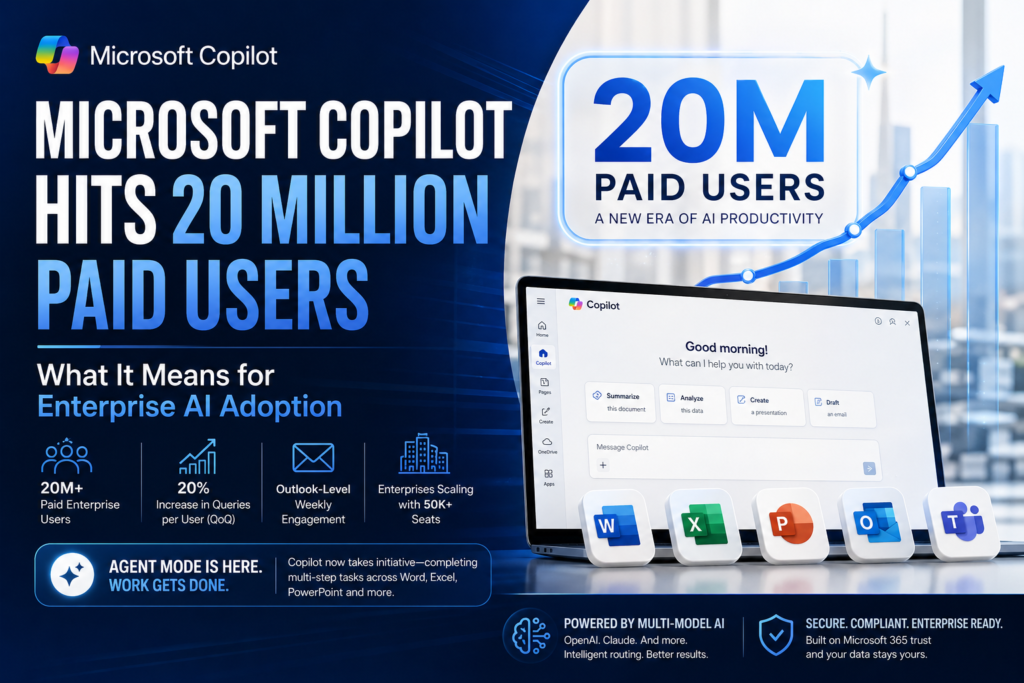
Microsoft Copilot has crossed 20 million paid enterprise seats, and users are engaging with it as intensely as they do with email. If you’re evaluating AI productivity tools for your organization, this milestone reshapes the conversation about which platform is actually winning the enterprise.
For years, skeptics questioned whether anyone was genuinely using Microsoft Copilot beyond the novelty phase. Microsoft CEO Satya Nadella’s April 2026 earnings call put that narrative to rest — not just with seat counts, but with behavioral engagement data that tells a far more compelling story.
What Is Microsoft Copilot?
Microsoft Copilot is an AI-powered assistant embedded natively across Microsoft 365 (M365) applications, including Word, Excel, PowerPoint, Outlook, and Teams. It leverages large language models — including OpenAI’s GPT family and Anthropic’s Claude — to help users draft documents, analyze data, summarize emails, and now autonomously complete multi-step tasks through what Microsoft calls “agent mode.”
Think of it not as a chatbot bolted onto your apps, but as a co-worker who lives inside every tool you already use — and who just got a significant promotion.
The 20 Million User Milestone — By the Numbers
During Microsoft’s Q3 2026 earnings call, CEO Satya Nadella confirmed that M365 Copilot has now reached 20 million paid enterprise seats. That headline number is significant, but the supporting data points are even more telling.
Here is what Microsoft disclosed:
- Copilot queries per user climbed nearly 20% quarter over quarter.
- Weekly engagement has reached the same level as Outlook — what Nadella described as “a daily habit of intense usage.”
- The number of companies paying for more than 50,000 seats has quadrupled.
- Major enterprises including Bayer, Johnson & Johnson, Mercedes, and Roche have each deployed more than 90,000 seats.
- Accenture signed on for over 740,000 seats — what Nadella called Microsoft’s “largest Copilot win to date.”
Morgan Stanley analyst Keith Weiss, speaking on the earnings call, called the M365 Copilot numbers “super impressive” and noted they were “way ahead of most people’s expectations.”
Why Engagement Metrics Matter More Than Seat Count
Seat counts alone are a vanity metric. Enterprise software history is littered with licensed-but-unused tools. What makes the Microsoft Copilot story credible is the query-per-user growth and the Outlook comparison.
Outlook is the single most habitual application in the modern workplace. Saying that Copilot engagement is now at parity with email usage is a claim that, if accurate, represents a genuinely historic shift in enterprise software behavior. It suggests that Microsoft Copilot has cleared the most difficult hurdle in enterprise AI adoption: moving from “something people try” to “something people depend on.”
What’s Actually Driving Microsoft Copilot Adoption?
Agent Mode Is the Game-Changer
The biggest structural change to Microsoft Copilot in early 2026 is the general availability of agent mode — and then, crucially, making it the default experience.
As of late April 2026, agent mode became the default across Copilot in Word, Excel, and PowerPoint. This is not a minor UX tweak. It represents a philosophical shift: Copilot is no longer waiting for you to ask it a question — it is now positioned to take initiative.
What is agentic AI? Agentic AI refers to systems that can break down a goal into steps, execute those steps autonomously, and iterate based on intermediate results — without requiring a human prompt at every stage. In Microsoft’s implementation, this means Copilot can now perform multi-step actions directly inside documents.
Nadella described it as a “new way to delegate and complete work using Copilot.” For enterprise teams managing complex workflows in spreadsheets or long-form documents, this is the difference between a smart autocomplete and an actual productivity multiplier.
Multi-Model Support Sets Copilot Apart
One of the less-discussed but strategically important aspects of Microsoft Copilot is its model-agnostic architecture.
Nadella emphasized that Copilot is not dependent on any single model — users now have access to multiple models by default, with intelligent auto-routing in agents. Microsoft 365 supports Anthropic’s Claude alongside OpenAI models, and the system routes queries to the model best suited for each task.
This matters for enterprise AI adoption for three reasons:
- Risk diversification — enterprises aren’t locked into a single AI vendor’s reliability or pricing changes.
- Task optimization — different models have different strengths; auto-routing means better outputs.
- Regulatory flexibility — organizations in sensitive sectors can choose models with specific compliance profiles.
No comparable competitor currently offers this kind of native multi-model orchestration baked directly into a productivity suite.
Microsoft Copilot vs. the Competition
How does Microsoft Copilot stack up against the other enterprise AI productivity platforms in 2026? Here’s a structured comparison:
| Feature | Microsoft Copilot (M365) | Google Gemini for Workspace | Salesforce Einstein Copilot | Notion AI |
|---|---|---|---|---|
| Native app integration | Word, Excel, PowerPoint, Outlook, Teams | Docs, Sheets, Gmail, Meet | Salesforce CRM suite | Notion workspace |
| Agentic / multi-step tasks | Yes (GA, default) | Limited beta | Yes (CRM-focused) | No |
| Multi-model support | Yes (OpenAI + Claude + others) | Gemini models only | OpenAI + Einstein | OpenAI |
| Paid enterprise users | 20M+ (Q1 2026) | Not disclosed | Not disclosed | Not disclosed |
| Engagement benchmark | Comparable to Outlook usage | Not disclosed | Not disclosed | Not disclosed |
| Pricing (per user/month) | ~$30 (M365 Copilot add-on) | ~$24 (Gemini Business) | Varies by edition | ~$10 |
| Best for | Broad enterprise productivity | Google-native orgs | Sales/CRM teams | SMBs, knowledge workers |
The clearest differentiator for Microsoft Copilot is the combination of depth (it’s inside the apps where work already happens), scale (20M+ users provides network and feedback effects), and architectural openness (multi-model support). Google’s Gemini for Workspace is its most direct rival, but Microsoft’s engagement data is currently unmatched in public disclosure.
What This Means for Enterprise AI Strategy
The Window for “Wait and See” Is Closing
Enterprise AI adoption has followed the classic technology S-curve. The early 2023–2024 era was experimentation. Mid-2025 was pilot programs. By Q1 2026, with 20 million paying users and engagement at Outlook-level intensity, Microsoft Copilot has entered the mainstream adoption phase.
Organizations still in “evaluation mode” are no longer being cautious — they are falling behind competitors who have already built institutional muscle memory around AI-assisted workflows.
Key Takeaways for Business Leaders
Here is what the 20M-user milestone signals for enterprise strategy:
- Copilot is a workflow infrastructure decision, not a software trial. At Outlook-level engagement, it becomes part of how work gets done — which means adoption or non-adoption affects hiring, training, and operational design.
- Agentic AI is the new standard. The shift to agent mode as default means the baseline expectation for enterprise AI tools will increasingly be autonomous task completion, not assisted drafting.
- Multi-model flexibility is a procurement criterion. As AI models continue to differentiate in capability and compliance, the ability to switch or blend models will become a material advantage over locked ecosystems.
- Seat count growth signals institutional commitment. When companies like Accenture deploy 740,000 seats, it creates organizational momentum — internal training, process redesign, and incentive structures all align around the tool. That is very hard to reverse.
- The ROI conversation has shifted. Early Copilot discussions centered on “will people use it?” The 2026 conversation is “how do we maximize output per user?” — a much healthier place to be.
Is the Skepticism About Microsoft Copilot Finally Dead?
The short answer: largely, yes — at least at the enterprise level.
The skepticism was always rooted in two concerns: adoption rates (would employees actually use it?) and value delivery (would it justify the ~$30/user/month premium?). The April 2026 earnings data addresses both directly.
Queries per user are up 20% quarter-over-quarter. Engagement rivals Outlook. The largest deals are scaling into hundreds of thousands of seats. Despite persistent doubts in some quarters that Copilot was more hype than habit, the usage numbers now tell a different story.
That said, healthy skepticism at the individual workflow level remains warranted. Not every job function benefits equally from Microsoft Copilot. Knowledge workers doing document-heavy, communication-heavy, or data-analysis-heavy work see the clearest gains. Frontline workers or highly specialized technical roles may find the value proposition thinner.
The mature view is not “Copilot works for everyone” but “Copilot has definitively proven it works at enterprise scale, and the question now is optimizing deployment within your specific workforce.”
The Road Ahead for Microsoft Copilot
Microsoft’s trajectory points toward three near-term developments worth tracking:
1. Deeper agentic integration. Now that agent mode is the default in Word, Excel, and PowerPoint, expect Microsoft to extend autonomous capabilities into Teams meetings, email threads, and cross-app workflows. The logical endpoint is a Microsoft Copilot that can coordinate work across the entire M365 stack without explicit per-task prompting.
2. More third-party model partnerships. The Claude integration is a proof of concept. Microsoft has commercial and strategic incentive to expand its model marketplace — adding specialized models for legal, medical, financial, or multilingual use cases. Enterprises want the best model for each job, not one model for all jobs.
3. Enterprise customization at scale. As deployment scales, the competitive battleground shifts from “does it work?” to “how well does it know our business?” Expect Microsoft to invest heavily in tools that let enterprises fine-tune Copilot’s behavior using their own data, terminology, and processes — without requiring engineering resources to do so.
Frequently Asked Questions (FAQs)
What is Microsoft Copilot and why is it important for businesses?
Microsoft Copilot is an AI-powered productivity assistant integrated directly into Microsoft 365 applications such as Word, Excel, PowerPoint, Outlook, and Teams. Unlike standalone AI chatbots, Copilot works inside the software businesses already use every day, making it easier to summarize emails, draft content, analyze spreadsheets, generate presentations, and automate repetitive workflows.
Its importance comes from reducing manual workload and improving operational efficiency. Instead of switching between multiple tools, employees can use AI where their work already happens. For organizations investing in digital transformation, Microsoft Copilot represents a practical step toward enterprise AI adoption rather than just experimental AI usage.
Why is Microsoft Copilot reaching 20 million paid users a big milestone?
The 20 million paid user milestone is significant because it signals large-scale enterprise trust in AI productivity tools. Many AI platforms attract attention but struggle with long-term business adoption. In contrast, Microsoft Copilot is showing both strong paid growth and increasing usage intensity.
This milestone also demonstrates that AI has moved beyond pilot programs and proof-of-concept experiments. When major enterprises purchase tens of thousands of seats and expand deployments, it suggests AI is becoming part of standard workplace infrastructure.
For business leaders, this is evidence that enterprise AI adoption is accelerating globally and no longer limited to early adopters.
How does Microsoft Copilot differ from ChatGPT or other AI assistants?
While ChatGPT and similar tools function primarily as standalone conversational assistants, Microsoft Copilot is deeply embedded into workplace applications. This integration gives it a practical advantage for business users.
For example, Microsoft Copilot can:
- Summarize long Outlook email threads
- Generate PowerPoint presentations from Word documents
- Analyze Excel data and create formulas
- Assist with Teams meeting recaps and action items
Additionally, Microsoft Copilot now supports agentic AI capabilities, meaning it can handle multi-step tasks with less user prompting. This makes it more workflow-oriented than traditional chat interfaces.
Is Microsoft Copilot worth the cost for enterprises?
For organizations with document-heavy, communication-heavy, or data-intensive workflows, Microsoft Copilot can justify its pricing through productivity gains. Businesses often evaluate ROI based on time savings, faster document creation, reduced repetitive work, and better employee efficiency.
However, value depends on deployment strategy. Organizations that provide employee training, clear use cases, and workflow integration tend to see stronger returns. Simply purchasing licenses without adoption planning may reduce effectiveness.
The real value of Microsoft Copilot comes from treating it as an operational productivity layer, not just another software subscription.
What does Microsoft Copilot mean for the future of enterprise AI?
The rapid growth of Microsoft Copilot suggests the future of enterprise AI will center around embedded productivity, automation, and agentic workflows. Businesses increasingly want AI systems that do more than answer prompts—they want systems that help execute work.
As Microsoft expands agent mode, multi-model support, and enterprise customization, Copilot is likely to become a central operating layer for digital workplaces. For enterprises, the question is shifting from “Should we use AI?” to “How do we integrate AI effectively at scale?”
Conclusion
Microsoft Copilot has moved decisively from “promising experiment” to “enterprise standard.” The 20 million paid user milestone, combined with Outlook-level engagement rates, agent mode as the default experience, and mega-deals like Accenture’s 740,000-seat deployment, represents a qualitative shift — not just a quantitative one.
For enterprises, the strategic question is no longer whether to adopt Microsoft Copilot, but how fast and how deeply to integrate it into the workflows that drive competitive advantage. The organizations building that institutional fluency now will have a durable edge over those still debating the pilot phase.
The AI productivity era is not coming. For 20 million users, it is already here.