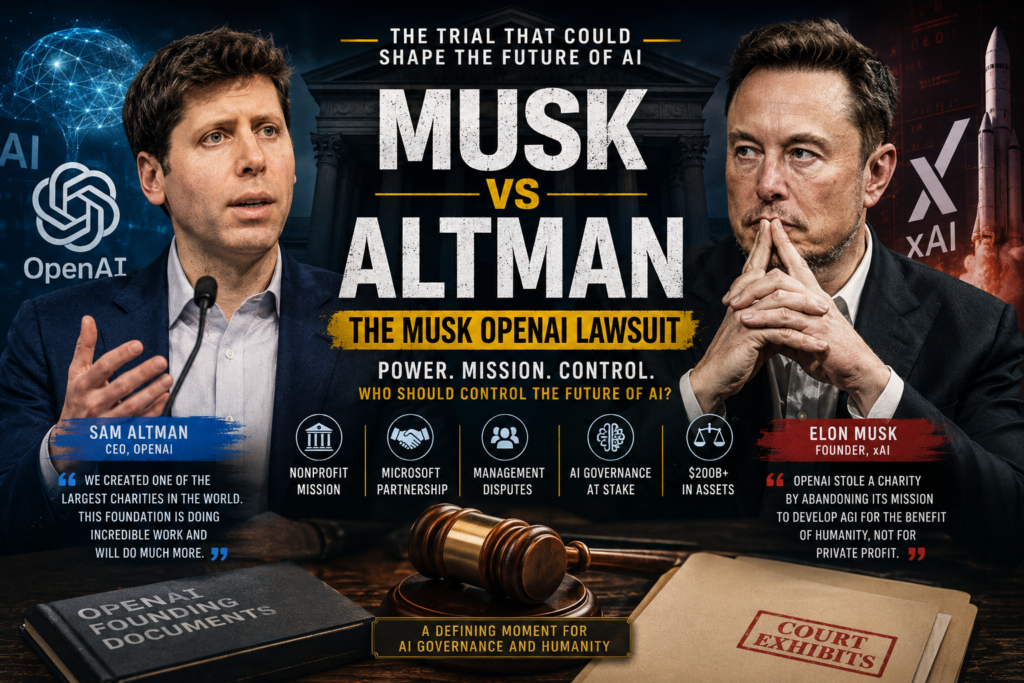
Sam Altman took the witness stand on May 12, 2026, and what he said stopped Silicon Valley in its tracks. The Musk OpenAI lawsuit — one of the most consequential legal battles in the history of artificial intelligence — finally got its most dramatic chapter, as OpenAI’s CEO testified about dynastic succession plans, alleged management malpractice, and the foundational question of who should control the most powerful technology ever built.
What Is the Musk OpenAI Lawsuit About?
Definition: The Musk OpenAI lawsuit is a legal challenge filed by Elon Musk against OpenAI, its leadership, and its board, alleging that the company’s transition from a pure nonprofit to a commercial enterprise violated the founding mission to develop artificial general intelligence (AGI) for the benefit of all humanity — not for private profit.
Musk, a co-founder who departed OpenAI’s board in 2018, argues that when OpenAI launched a for-profit subsidiary and partnered with Microsoft for billions in investment, it effectively “stole a charity.” His legal team contends that the commercialization of OpenAI’s AI models — including ChatGPT and GPT-4 — betrayed the original agreement between co-founders to keep advanced AI out of the hands of any single controlling entity.
At its core, the Musk OpenAI lawsuit isn’t just about money or contracts. It’s a proxy war over the soul of AI development: who gets to govern it, who profits from it, and who, ultimately, controls it.
What Did Sam Altman Actually Say on the Stand?
Altman’s testimony was notable for three things: restraint, precision, and a few carefully placed rhetorical grenades.
When asked about Musk’s claim that OpenAI’s founders “stole a charity,” Altman paused for several seconds before responding: “It feels difficult to even wrap my head around that framing. We created one of the largest charities in the world. This foundation is doing incredible work and will do much more.”
That framing — OpenAI as charity-builder, not charity-thief — is central to how OpenAI’s legal team is positioning the defense in the Musk OpenAI lawsuit.
The “Hair-Raising” Succession Moment
The most explosive moment in Altman’s testimony came when he recounted a 2017 conversation about the governance of a hypothetical OpenAI for-profit entity. Altman testified that when Musk was asked what would happen to the organization if Musk were to die while controlling it, Musk allegedly replied that “maybe OpenAI should pass to my children.”
Altman described this as a “particularly hair-raising moment.” The anecdote cuts directly at the Musk OpenAI lawsuit’s central irony: Musk is suing OpenAI for concentrating power, yet Altman’s testimony suggests Musk himself once contemplated a dynastic handover of control over one of the world’s most powerful AI organizations.
For Altman, this was more than a rhetorical point. He testified that OpenAI was “dedicated to keeping advanced AI out of the hands of a single person,” and that his experience running Y Combinator had taught him that “founders who had control usually did not give it up.” Musk’s apparent willingness to envision hereditary control, Altman argued, is precisely why he grew concerned about Musk’s vision for the company’s future.
Altman’s Critique of Musk’s Management Style
Altman did not stop at the succession anecdote. He also offered a pointed critique of how Musk operated inside OpenAI before his 2018 departure.
“I don’t think Mr. Musk understood how to run a good research lab,” Altman testified. He alleged that Musk had “demotivated some of our most key researchers” and had at one point required co-founders Greg Brockman and Ilya Sutskever to produce a ranked list of researchers, ordered by their accomplishments, with the instruction to “take a chainsaw through a bunch.”
Altman said this approach “did huge damage for a long time to the culture of the organization.” The implication for the Musk OpenAI lawsuit is significant: Musk’s management style, Altman argued, was incompatible with the collaborative, research-first culture that defines a world-class AI laboratory.
The Core Legal Question: Did OpenAI Abandon Its Mission?
Musk’s attorneys have framed the Musk OpenAI lawsuit around a single thesis: that as OpenAI’s commercial power grew, its commitment to safety and its nonprofit mission was quietly left behind. This is the legal and philosophical crux of the case.
The Nonprofit Foundation’s Status
One data point Musk’s legal team has hammered is that OpenAI’s foundation — which now controls assets worth approximately $200 billion — did not have full-time employees until earlier in 2026. That gap, they argue, is evidence of neglect toward the nonprofit’s charitable obligations.
OpenAI board chair Bret Taylor pushed back on this interpretation in his own testimony, arguing the delay stemmed from the practical challenge of converting OpenAI equity into liquid cash. That conversion, he said, was only accomplished through the company’s 2025 restructuring.
The 2025 Restructuring Explained
In 2025, OpenAI completed a significant corporate restructuring that reorganized its relationship between the nonprofit parent and the commercial for-profit entity. The restructuring was designed to allow OpenAI to raise the enormous capital required to continue frontier AI research — training large models costs hundreds of millions of dollars per run — while preserving the nonprofit’s ultimate governance role.
OpenAI’s lawyers noted during the trial that Musk was kept informed of major investment decisions during his time as a co-founder, including a 2018 Microsoft investment. Altman testified that, unlike many difficult meetings, that particular session was a “good vibes meeting,” with Musk spending a “long conversation showing us memes on his phone.” The implication: Musk’s current objections to the Microsoft relationship were not raised at the time.
Musk vs. Altman: A Comparison of Claims
The competing narratives in the Musk OpenAI lawsuit can be distilled into a direct comparison of the two parties’ positions on the key disputes.
| Issue | Musk’s Position | Altman / OpenAI’s Position |
|---|---|---|
| Core Allegation | OpenAI “stole a charity” by commercializing its AI | OpenAI built one of the largest charities in the world |
| Nonprofit Mission | Abandoned when for-profit subsidiary launched | Preserved through 2025 restructuring; nonprofit retains control |
| Microsoft Partnership | Corrupted the nonprofit’s independence | Musk was kept informed and did not object at the time |
| Safety Commitment | Eroded by commercial pressures | Central to all operations and governance |
| Musk’s Departure | He left because OpenAI strayed from its mission | He left after governance disputes; then started competing AI ventures |
| Control of AI | OpenAI concentrated power improperly | Musk himself contemplated handing OpenAI to his children |
| Management Conduct | Altman and board pushed Musk out to gain control | Musk’s tactics demotivated researchers and damaged culture |
This table captures why the Musk OpenAI lawsuit is so difficult to adjudicate: nearly every factual dispute has a credible counter-narrative, and the resolution will likely hinge on documentary evidence from the 2015–2018 founding period.
Why AI Governance Is at the Heart of This Trial
Question: Why does it matter who controls OpenAI?
Direct Answer: Because OpenAI builds the models that increasingly power global information infrastructure. The organization that controls OpenAI — or its successors — may control AI systems capable of performing scientific research, writing legislation, running businesses, and waging cyberwarfare. That is not hyperbole; it is the stated ambition of AGI.
This is precisely why the Musk OpenAI lawsuit has attracted global attention far beyond the courtroom. The legal arguments about nonprofit bylaws and investor rights are proxies for a much larger civilizational question: should transformative AI be governed by a single company, a state actor, a nonprofit, or something more distributed?
The founding premise of OpenAI — enshrined in its original charter — was that no single entity should control AGI. The bitter irony embedded in Altman’s testimony is that both sides in the Musk OpenAI lawsuit claim to be the true defenders of that principle, while accusing the other of being the threat.
The Broader Stakes for AI Policy
The outcome of the Musk OpenAI lawsuit is likely to have ripple effects well beyond the parties in the courtroom:
- Nonprofit AI governance: A ruling against OpenAI could embolden regulators to impose stricter controls on how AI nonprofits commercialize their research.
- Founder control norms: Altman’s testimony about Musk’s management style and succession comments could reshape how Silicon Valley thinks about founder authority in mission-driven organizations.
- Microsoft’s position: A ruling that finds OpenAI’s structure violated its founding charter could complicate Microsoft’s $13 billion investment and its deep integration of OpenAI models into its product ecosystem.
- xAI and Grok: Musk’s competing AI venture, xAI, and its Grok model stand to benefit commercially if OpenAI is forced into structural changes or loses key talent during a prolonged legal battle.
- Regulatory precedent: Government agencies watching the trial may use its findings to justify new AI oversight legislation targeting the governance structures of frontier AI labs.
What Happens Next in the Musk OpenAI Lawsuit?
As of May 2026, the trial is active, with Altman’s cross-examination expected to continue. Several additional witnesses and depositions are anticipated before the case moves to closing arguments. Legal analysts note that the documentary record from OpenAI’s founding years — including emails, board minutes, and investment term sheets — will be decisive.
Musk’s legal team faces a structural challenge: proving that a loosely worded founding mission constitutes an enforceable legal obligation is difficult under U.S. nonprofit law. OpenAI’s lawyers, meanwhile, must reconcile the organization’s extraordinary commercial success with its stated charitable purpose in a way that satisfies both the court and the broader public.
Whatever the verdict, the Musk OpenAI lawsuit has already accomplished something remarkable: it has forced the most powerful AI organization in the world to publicly defend its governance choices in a court of law — a transparency that the AI industry rarely faces and that regulators and civil society have long demanded.
Key Takeaways
Here is a concise summary of everything established so far in the Musk OpenAI lawsuit and Altman’s testimony:
- The lawsuit’s core claim is that OpenAI’s commercialization betrayed its nonprofit mission to develop AGI for humanity’s benefit.
- Altman testified that Musk once suggested OpenAI could pass to his children, undermining Musk’s stated concern about concentrated AI control.
- Musk’s management tactics, including forcing ranked lists of researchers, allegedly damaged OpenAI’s research culture.
- OpenAI’s foundation now controls roughly $200 billion in assets; the lack of full-time staff until 2026 is a point of contention.
- The 2025 restructuring was designed to preserve nonprofit governance while enabling commercial-scale fundraising.
- Microsoft’s investment was made with Musk’s knowledge; his current objections were not raised at the time, according to Altman.
- The broader stakes include AI governance norms, nonprofit law, and the precedent for how frontier AI labs are structured globally.
- The Musk OpenAI lawsuit is not just a courtroom drama — it is a defining moment for how humanity decides to govern its most consequential technology.
Frequently Asked Questions
What is Elon Musk suing OpenAI for? Musk is suing OpenAI, its board, and CEO Sam Altman, alleging that the company’s pivot to a commercial for-profit model violated the nonprofit charter and founding mission he co-signed when OpenAI was established in 2015.
What did Sam Altman say in his testimony? Altman testified that Musk once suggested OpenAI should pass to his children if Musk died, criticized Musk’s management of researchers, and defended OpenAI’s commercial structure as consistent with its mission to benefit humanity.
Is OpenAI still a nonprofit? OpenAI operates through a nonprofit parent entity that governs a for-profit subsidiary. After a 2025 restructuring, the nonprofit retains ultimate governance authority, though the exact nature of that control is contested in the Musk OpenAI lawsuit.
What is at stake in the Musk OpenAI lawsuit? The case could set legal precedents for AI governance, nonprofit law in tech, and the permissible boundaries of commercializing research funded through charitable structures. It could also affect OpenAI’s relationship with Microsoft and the company’s future fundraising ability.