What Is Nscale’s $3.5 Billion Pre-IPO Financing Plan?
What if a two-year-old AI infrastructure company needed $3.5 billion more just before potentially going public?
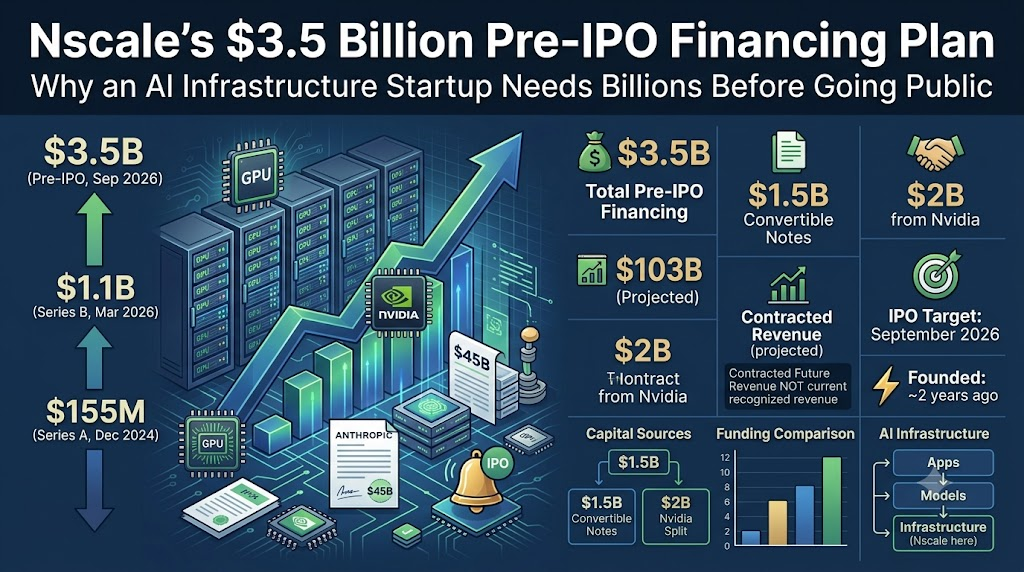
That is the situation surrounding British AI compute provider Nscale, which is reportedly seeking $3.5 billion in pre-IPO financing ahead of a possible U.S. stock-market debut as early as September 2026. Bloomberg reported on September 4 that Nscale is discussing $1.5 billion in convertible notes with investors and seeking another $2 billion from Nvidia.
The proposed financing is significant even by the standards of today’s AI boom. It also highlights a bigger trend: companies building the computing infrastructure behind artificial intelligence are attracting enormous amounts of capital because access to GPUs, data centers, power, and AI-ready infrastructure has become strategically important.
Nscale’s story is particularly notable because the company was founded only about two years ago, yet it has already raised more than $1 billion in venture funding, secured a major long-term agreement with Anthropic, and is reportedly preparing for an IPO.
So, what exactly is happening,and why are investors willing to put billions behind AI infrastructure?
What Is Nscale’s $3.5 Billion Pre-IPO Financing?
Nscale pre-IPO financing refers to the capital the company is reportedly trying to raise shortly before entering the public markets. The proposed package would combine convertible debt financing with a large financing arrangement involving Nvidia.
Bloomberg reported that Nscale is seeking:
- $1.5 billion through convertible notes from a group of investors.
- $2 billion in additional financing from Nvidia.
- Approximately $3.5 billion total in new pre-IPO capital.
- A potential U.S. IPO that could happen as early as September 2026, based on Nscale’s previously stated plans.
What are convertible notes?
Convertible notes are loans that can later be converted into company shares, usually under agreed conditions. Instead of simply receiving interest and getting their money back, investors may eventually receive equity in the company.
This type of financing can be useful for a rapidly growing private company approaching an IPO because it can provide substantial capital without requiring the company to immediately determine a final public-market valuation.
Question → Direct Answer: Why would Nscale use convertible notes before an IPO?
Convertible notes can give Nscale access to capital while postponing some of the valuation mechanics associated with issuing ordinary shares. For investors, the notes can also provide a potential path to equity if the company proceeds with an IPO or another qualifying financing event.
The reported $1.5 billion convertible-note component is therefore more than just another fundraising round. It could be part of the financial bridge between Nscale’s private-company phase and its potential public-market future.
Why Does Nscale Need So Much Capital Before Its IPO?
The simplest answer is that AI infrastructure is extraordinarily capital-intensive.
Building AI compute capacity requires more than buying a few powerful servers. Companies need access to advanced GPUs, networking equipment, data-center facilities, electricity, cooling systems, storage, and the software infrastructure needed to operate large-scale computing environments.
Question → Direct Answer: Why has AI compute become so valuable?
AI models require enormous amounts of computing power during both training and operation. As companies deploy increasingly capable AI systems, demand for reliable access to high-performance computing has grown, making AI infrastructure a strategic resource rather than simply another IT expense.
AI compute has become a strategic resource
Think about the AI industry as a three-layer stack.
At the top are applications and AI products that people interact with. Underneath them are foundation models and AI systems. Supporting those models is the infrastructure layer: GPUs, data centers, networking, electricity, storage, and cloud platforms.
Without that bottom layer, the rest cannot operate at scale.
This is why companies such as Nscale are attracting attention. They are positioned closer to the physical and computational foundation of the AI economy.
The business opportunity can be compared with building roads during a transportation boom. You may not know which individual cars will become the biggest successes, but the companies providing essential infrastructure can potentially benefit from broad demand across the industry.
Nscale’s Anthropic deal changes the scale
Nscale’s financing story became even more interesting after the company signed a large deal with AI company Anthropic reportedly worth approximately $45 billion.
That agreement dramatically changes the way investors may look at Nscale.
Instead of being viewed simply as a young infrastructure startup searching for customers, Nscale can point to substantial contracted demand. However, there is an important distinction between contracted future revenue and revenue already earned.
That distinction matters when interpreting the numbers being discussed around the company.
How Will Nscale Raise the $3.5 Billion?
The reported Nscale pre-IPO financing consists of two very different pieces.
The first is a $1.5 billion convertible-note transaction involving outside investors. The second is a reported $2 billion financing from Nvidia, the world’s dominant supplier of AI accelerators.
$1.5 billion in convertible notes
The proposed $1.5 billion in notes would provide Nscale with significant capital before its expected IPO.
For a company expanding AI infrastructure, that money could potentially support additional computing capacity, data-center expansion, equipment purchases, and other infrastructure requirements. The exact use of proceeds, however, should not be assumed unless Nscale provides those details publicly.
Question → Direct Answer: Is convertible-note financing the same as selling stock?
No. Convertible notes begin as debt rather than ordinary equity. Under specified conditions, they can later convert into shares, meaning investors may ultimately become shareholders.
This distinction becomes particularly important when a private company is approaching an IPO. The eventual conversion terms, valuation mechanics, interest rate, and other conditions can influence how much ownership investors ultimately receive.
$2 billion from Nvidia
The second reported component is even more strategically interesting.
Nvidia has already invested in Nscale, including participation in Nscale’s $1.1 billion Series B round in March 2026. Bloomberg now reports that Nscale is seeking an additional $2 billion in financing from Nvidia.
That creates a relationship between a major AI infrastructure provider and the company supplying many of the chips used to power AI computing.
Question → Direct Answer: Why is Nvidia’s involvement important?
Nvidia is central to the AI computing ecosystem because its GPUs are widely used for AI training and inference. Its financial involvement with an AI infrastructure company therefore has significance beyond a normal venture investment: it connects capital, computing hardware, and infrastructure expansion.
Still, Nvidia’s reported financing should not automatically be interpreted as a guarantee that Nscale will succeed. Financing discussions can change, and the final terms may differ from reported proposals.
Nscale’s Funding Journey: From $155 Million to Billions
The scale of Nscale’s growth becomes clearer when its funding history is placed on a timeline.
Nscale raised $155 million in its Series A round in December 2024.
Then, in March 2026, the company announced a $1.1 billion Series B round, led by investment fund Aker. Nscale described that financing as the largest Series B in European history.
Nvidia participated in that round.
Now, the company is reportedly seeking another $3.5 billion before a potential IPO.
| Stage | Timing | Reported amount | Significance |
| Series A | December 2024 | $155M | Major early institutional financing |
| Series B | March 2026 | $1.1B | Nscale described it as Europe’s largest Series B |
| Proposed pre-IPO financing | September 2026 | $3.5B | Reportedly combines convertible notes and Nvidia financing |
| Potential IPO | As early as September 2026 | , | Would move Nscale into public markets |
The acceleration is striking.
Nscale went from a $155 million Series A to a $1.1 billion Series B in roughly 15 months. The proposed $3.5 billion pre-IPO package would then represent another enormous increase in financing scale.
Key takeaway: Nscale’s funding trajectory illustrates how quickly capital requirements can expand when an AI infrastructure company moves from startup experimentation toward large-scale deployment.
What Is an AI Compute Provider and Why Does It Matter?
An AI compute provider supplies the computing infrastructure required to train and run artificial intelligence models. That infrastructure can include GPUs, servers, data centers, networking systems, storage, and associated cloud services.
Imagine an AI company wants to train a sophisticated model.
It needs thousands,or potentially far more,of specialized processors working together. It also needs the electricity, cooling, networking, storage, and physical facilities to keep those systems running.
An AI compute provider helps supply that foundation.
Question → Direct Answer: Is an AI compute provider simply another cloud company?
Not necessarily. There is significant overlap, but AI-focused providers can specialize heavily in GPU infrastructure, AI workloads, high-performance networking, and the specific requirements of large model training and inference.
This specialization is becoming more important as AI workloads become larger and more demanding.
Traditional cloud computing was built around a wide range of workloads: websites, databases, enterprise applications, file storage, and software development. AI computing adds a different set of requirements, particularly around accelerators and high-speed communication between computing nodes.
That is where companies such as Nscale see an opportunity.
Nscale vs. Traditional Cloud Infrastructure
The difference between conventional cloud infrastructure and AI-focused infrastructure is not absolute, but the priorities can be very different.
| Factor | Traditional Cloud | AI Compute Infrastructure |
| Main workloads | Websites, databases, enterprise software | AI training and inference |
| Core hardware | CPUs plus general-purpose infrastructure | GPUs and AI accelerators |
| Networking | Important | Often extremely important for distributed AI |
| Power demand | Significant | Can be exceptionally high |
| Cooling | Required | Increasingly critical at high compute density |
| Growth driver | Broad digital transformation | Rapid AI adoption |
| Customer needs | Flexible general computing | Large-scale specialized compute |
The most important difference is specialization.
AI systems can require large clusters of accelerators to communicate rapidly. That means the performance of the overall system depends not only on individual chips but also on networking, memory, storage, software, power, and cooling.
Question → Direct Answer: Why can’t AI companies simply buy more GPUs and stop there?
Because GPUs are only one component of an AI data-center system. Large AI workloads require the surrounding infrastructure to deliver power, connect processors efficiently, move data quickly, remove heat, and keep systems available.
This is why AI infrastructure companies can require billions of dollars in capital.
Why Nscale’s $103 Billion Revenue Figure Needs Context
One of the most eye-catching claims surrounding Nscale is a reported figure of approximately $103 billion in revenue.
But that wording can easily create confusion.
The figure reportedly represents projected revenue based on signed customer leases and agreements. It does not mean Nscale has already generated $103 billion in sales.
That distinction is critical.
Current revenue vs. contracted future revenue
Consider a simple example.
Suppose a company signs a customer contract worth $10 billion over several years. It would be misleading to say that the company has already earned $10 billion simply because the contract has been signed.
Instead, the agreement represents future economic potential subject to its terms, delivery, timing, accounting treatment, and other conditions.
The same principle applies to Nscale’s reported figure.
Question → Direct Answer: Has Nscale already made $103 billion in revenue?
No. Based on the reporting provided, the approximately $103 billion figure is a projection associated with signed customer leases and contracts, rather than $103 billion of revenue already recognized as sales.
This distinction is particularly important for students and new investors learning how startup financial stories work.
A large contract can be a powerful signal of future demand, but it is not identical to cash already collected or revenue already recognized.
What the Anthropic Deal Could Mean for Nscale
The reported approximately $45 billion Anthropic agreement is central to understanding the enthusiasm around Nscale.
Anthropic is an important AI model developer, and large AI companies need enormous amounts of compute to train and operate their systems.
A long-term infrastructure agreement with a major AI company can therefore potentially provide an infrastructure provider with predictable demand.
Question → Direct Answer: Why would an AI model company sign a huge compute agreement?
AI models require sustained access to computing resources. A long-term agreement can help an AI company secure capacity while giving the infrastructure provider greater visibility into future demand.
But again, the headline value of a deal should not be confused with immediate revenue.
The real business question is how much infrastructure Nscale must build to fulfill those commitments, how quickly that capacity becomes operational, what the economics of the contracts look like, and whether the company can generate attractive returns after accounting for hardware, energy, facilities, financing, and operating costs.
That is one reason the reported $3.5 billion financing plan matters.
Why Does Nscale Need Billions When It Already Raised $1.1 Billion?
A natural question is: if Nscale already raised $1.1 billion in its Series B, why does it need another $3.5 billion?
The answer is scale.
A software startup can sometimes grow rapidly without making enormous physical investments. An infrastructure company cannot expand computing capacity without spending heavily on physical resources.
Nscale’s business model requires infrastructure capable of supporting customers with large computing requirements.
Question → Direct Answer: Does more funding necessarily mean Nscale is losing money?
No. Large funding requirements do not automatically indicate financial weakness. Capital-intensive companies may raise large amounts because they need significant upfront investment to build capacity that supports future contracts and growth.
The more important question is whether the infrastructure being financed can generate enough revenue and cash flow over time to justify its cost.
That is a fundamental issue for AI infrastructure companies across the industry.
What Could Nscale’s IPO Mean for the AI Infrastructure Market?
The potential Nscale IPO could become an important test for investor appetite for AI infrastructure companies.
The public markets have already shown enormous interest in artificial intelligence, but investors eventually need to distinguish between companies benefiting from AI enthusiasm and companies capable of building durable businesses.
Nscale’s potential public listing would give investors another way to evaluate the economics of AI infrastructure.
Investors may focus on several questions
- How much revenue has Nscale actually recognized?
- How much of its future revenue is backed by signed contracts?
- How much capital is required to fulfill those contracts?
- What are the company’s operating margins?
- How dependent is Nscale on a small number of major customers?
- How quickly can new infrastructure become operational?
- What are its power and data-center costs?
- How much debt or convertible financing will remain after the IPO?
- What role will Nvidia play in its future infrastructure strategy?
These questions matter because AI infrastructure is fundamentally a capital-intensive business.
A company can have enormous demand and still face challenges if the cost of serving that demand is too high.
Why Nvidia’s Relationship With Nscale Matters
The Nvidia Nscale funding relationship deserves particular attention because Nvidia sits at a crucial point in the AI hardware ecosystem.
Nvidia supplies GPUs and other technologies that power many AI workloads. Nscale, meanwhile, is building infrastructure designed to provide computing capacity to AI customers.
That relationship potentially creates a powerful ecosystem.
Definition + Expansion: AI infrastructure ecosystem
An AI infrastructure ecosystem is the network of hardware suppliers, data-center operators, cloud providers, power providers, software platforms, and AI companies that collectively make large-scale AI possible. No single company needs to provide every component. Instead, value can flow across the ecosystem as each layer supports the next.
Nvidia supplies critical computing technology. Infrastructure providers deploy that technology. AI companies consume the resulting compute capacity to train and operate models.
This helps explain why financing arrangements in the AI infrastructure sector can involve strategic investors rather than only conventional venture capital firms.
What Can Students and Young Professionals Learn From Nscale?
You do not need to be a finance expert to learn something important from Nscale’s story.
The biggest lesson is that the AI economy is much larger than chatbots and AI applications.
Behind every AI application is an infrastructure chain.
Question → Direct Answer: What is the career lesson from the Nscale story?
AI is creating opportunities across hardware, cloud computing, data centers, networking, energy, cybersecurity, software infrastructure, and operations,not just model development.
For students and freshers, that means AI skills can be useful even if you never train a foundation model yourself.
Areas worth exploring include:
- Cloud computing
- GPU computing
- Data-center operations
- Networking
- AI infrastructure engineering
- DevOps and MLOps
- Distributed systems
- Energy and power management
- AI cybersecurity
- Cloud economics and FinOps
- Semiconductor technology
The rise of AI compute providers demonstrates how multidisciplinary the AI industry has become.
A person who understands both AI workloads and infrastructure economics can potentially see opportunities that are invisible when AI is viewed only as a software trend.
What Are the Biggest Risks in Nscale’s Growth Story?
Rapid growth can be exciting, but it also creates risks.
First, infrastructure requires enormous upfront spending. A company can sign large contracts but still face execution challenges when it has to build the physical capacity required to serve them.
Second, AI technology changes quickly.
A data center designed around one generation of hardware may eventually need upgrades as newer accelerators become available. Companies therefore need to manage the risk of hardware becoming less competitive over time.
Third, customer concentration matters.
If a large percentage of future revenue depends on a small number of AI companies, changes in those customers’ strategies could have an outsized effect.
Fourth, financing itself creates obligations.
Convertible notes and other forms of capital can affect the company’s future ownership structure and financial position.
Question → Direct Answer: Does a huge AI contract eliminate business risk?
No. A large contract can reduce uncertainty about demand, but the provider still has to finance, build, operate, and maintain the infrastructure needed to fulfill the agreement profitably.
That is why Nscale’s eventual financial disclosures, if and when it becomes a public company, could be more informative than headline fundraising numbers alone.
What Happens Next for Nscale?
The immediate question is whether Nscale completes the reported $3.5 billion financing and proceeds with its potential IPO.
The company has already demonstrated an extraordinary fundraising trajectory: $155 million in Series A funding in December 2024, followed by a $1.1 billion Series B in March 2026.
Now it is reportedly seeking $3.5 billion more.
If completed, the financing would give Nscale additional resources at a crucial point in its expansion.
But the IPO will ultimately shift attention from fundraising headlines to public-company metrics.
Investors will likely want to understand actual revenue, profitability, cash flow, capital expenditure, customer commitments, infrastructure utilization, and the economics of the company’s long-term contracts.
That transition,from startup narrative to measurable public-company performance,is where Nscale’s next chapter could become particularly interesting.
Key Takeaways: Nscale Pre-IPO Financing Explained
Here are the most important points to remember:
- Nscale is reportedly seeking $3.5 billion in pre-IPO financing.
- The proposed package includes $1.5 billion in convertible notes.
- Nscale is reportedly seeking another $2 billion from Nvidia.
- Nvidia previously participated in Nscale’s $1.1 billion Series B round.
- Nscale raised $155 million in Series A funding in December 2024.
- The company has reportedly signed an approximately $45 billion deal with Anthropic.
- A reported $103 billion revenue figure represents projected revenue associated with signed customer leases and contracts, not $103 billion of current sales.
- Nscale has indicated that it could pursue a U.S. IPO as early as September 2026.
- The broader story reflects the growing importance of AI infrastructure and compute capacity.
- The company’s future success will depend not only on demand but also on its ability to build and operate infrastructure economically.
FAQ: Nscale Pre-IPO Financing Explained
What is Nscale?
Nscale is a British AI infrastructure company focused on providing computing infrastructure for artificial intelligence workloads. The company was founded roughly two years before its reported 2026 IPO plans and has raised substantial private funding as demand for AI compute has accelerated.
How much money is Nscale reportedly trying to raise before its IPO?
Nscale is reportedly seeking $3.5 billion in pre-IPO financing. Bloomberg reported that the proposed package includes $1.5 billion in convertible notes and approximately $2 billion in financing from Nvidia.
What are Nscale convertible notes?
Nscale’s reported convertible notes are a form of debt that can potentially be converted into company shares under specified conditions. They allow investors to provide capital before an IPO while preserving a future pathway to equity ownership.
Why is Nvidia investing in Nscale?
Nvidia is a major supplier of AI computing hardware, while Nscale provides AI infrastructure. Nvidia’s reported investment therefore connects a key AI chip supplier with an infrastructure provider that can deploy computing capacity for AI customers.
Did Nscale actually generate $103 billion in revenue?
No. The reported approximately $103 billion figure is a projection tied to signed customer leases and contracts, rather than $103 billion of revenue already generated. Contracted future revenue and recognized current revenue are financially different concepts.
Why is Nscale’s potential IPO important?
Nscale’s potential IPO could provide public-market investors with another opportunity to evaluate the economics of AI infrastructure. It could also offer insight into whether enormous AI compute demand can translate into sustainable, profitable infrastructure businesses.
The Bigger Picture: AI Is Becoming an Infrastructure Race
The most interesting part of the Nscale story may not be the $3.5 billion number itself.
It is what that number represents.
AI is moving from an experimental technology into an industrial-scale computing industry. As models become more capable and businesses deploy AI across more applications, the demand for computing power creates opportunities far beyond model developers.
Companies need chips.
They need data centers.
They need electricity.
They need networking.
They need cooling.
They need cloud platforms.
And they need enormous amounts of capital to build all of it.
That is why Nscale pre-IPO financing is worth watching. It is not merely a story about one startup trying to raise money before an IPO. It is a snapshot of how quickly the infrastructure supporting the AI economy is expanding.
For students and young professionals in India, the message is equally important: the AI opportunity is not limited to building the next chatbot. Understanding the infrastructure underneath AI,from GPUs and cloud computing to distributed systems and data centers,could become increasingly valuable as the industry matures.
The next phase of the AI boom may be less about who has the most exciting demo and more about who can build, finance, and operate the computing infrastructure required to run AI at global scale. keep exploring kalinga.ai .