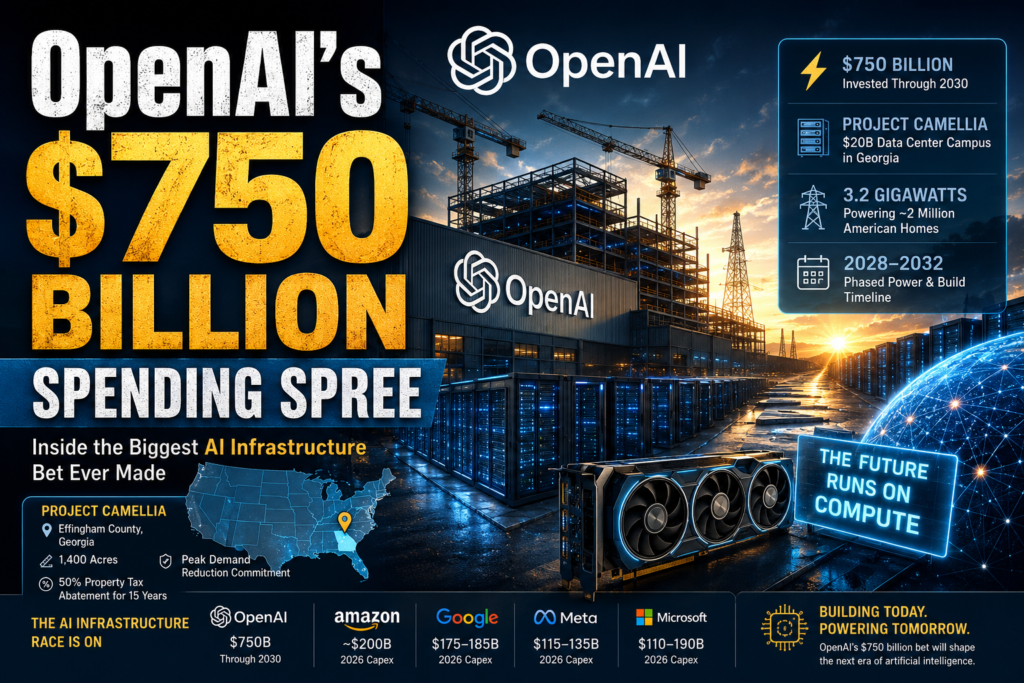
OpenAI’s $750 billion spending spree is now official: the company confirmed on July 22, 2026, that it will spend $750 billion on data center infrastructure through 2030 — a 25% jump from its earlier estimate. The first concrete move is a $20 billion Georgia campus called Project Camellia, and it signals that OpenAI intends to out-build every rival in the race to control AI compute.
If you’re trying to understand what this number actually means, why it grew so fast, and how it stacks up against Microsoft, Google, Amazon, and Meta, this guide breaks it all down in plain terms.
What Is OpenAI’s $750 Billion Spending Spree, Exactly?
OpenAI’s $750 billion spending spree refers to the company’s total committed infrastructure spending — data centers, power contracts, chips, and related buildout — running through 2030. The figure was first reported by the Wall Street Journal and represents roughly a 25% increase over what OpenAI had estimated just months earlier.
To put that in perspective, $750 billion is close to the entire annual GDP of Sweden. It’s not a single check OpenAI is writing; it’s a multi-year commitment spread across dozens of sites, partners, and financing structures — including the existing Stargate data center project with SoftBank and Oracle, plus new standalone developments the company is funding more directly.
The core idea behind OpenAI’s $750 billion spending spree is simple: training and running frontier AI models requires an enormous, continuously expanding supply of compute, and OpenAI believes that whoever controls the most reliable, largest-scale infrastructure wins the next phase of the AI race.
Definition: What Counts as “AI Infrastructure Spending”?
When analysts talk about AI infrastructure spending, they generally mean:
- Data center construction — the physical buildings, land, and cooling systems
- Power procurement — contracts with utilities or independent power producers to guarantee electricity supply
- Compute hardware — GPUs, custom AI chips, and networking equipment
- Long-term service commitments — multi-year cloud contracts, like OpenAI’s deals with Microsoft Azure and Oracle
OpenAI’s $750 billion spending spree touches all four categories, though the company has not broken out exactly how the total splits between them.
Project Camellia: The First Concrete Move in OpenAI’s $750 Billion Spending Spree
The opening chapter of OpenAI’s $750 billion spending spree has a name: Project Camellia. This is a $20 billion data center campus set to rise on 1,400 acres northwest of Savannah, Georgia, and it’s the clearest signal yet of how the company plans to deploy this money on the ground.
How Much Power Will Project Camellia Draw?
Project Camellia will draw at least 3.2 gigawatts of power from Georgia Power, the region’s utility, once fully built out. That generating capacity is expected to come online in phases between 2028 and 2032. For context, 3.2 gigawatts is enough to power roughly two million average American homes — dedicated to a single AI data center campus.
What Tax Breaks Is OpenAI Getting?
OpenAI is receiving a 50% property tax abatement for 15 years from Effingham County, where the campus is located. In exchange, OpenAI has agreed to “pay the full cost of the infrastructure and electric-service costs” for the new facility, which matters because Georgia’s Public Service Commission adopted a rule last year specifically to stop utilities from passing new large-user infrastructure costs onto everyday ratepayers.
Georgia Power has also secured a commitment from OpenAI to reduce its power draw by up to 1 gigawatt during periods of peak grid demand — a concession aimed at protecting local residents and businesses from strain during heat waves or winter cold snaps.
Who’s Building It?
OpenAI recently hired Brett Mayo to lead its data center construction efforts. Mayo previously oversaw xAI’s Colossus data center in Memphis, a facility built at record speed but one that has since drawn a lawsuit from the NAACP and the Southern Environmental Law Center over allegedly running dozens of unpermitted natural gas turbines. That track record matters, because it hints at how fast — and how controversially — OpenAI might try to move with Project Camellia.
Why Has OpenAI’s Infrastructure Bill Grown by 25%?
Question: Why did OpenAI’s infrastructure budget jump from roughly $600 billion to $750 billion so quickly?
Direct answer: OpenAI’s $750 billion spending spree grew largely because its original flagship initiative, the Stargate data center project, has struggled to gain traction — pushing the company to pursue new, independently funded sites like Project Camellia on top of its existing commitments, rather than instead of them.
Stargate — the $500 billion joint venture between OpenAI, SoftBank, and Oracle announced with considerable fanfare in early 2025 — was supposed to be the centerpiece of OpenAI’s compute strategy. But reports throughout the year pointed to funding disagreements, tariff-related delays, and slower-than-promised construction. Rather than scale back its ambitions, OpenAI appears to be diversifying: layering new, self-funded projects on top of Stargate to keep pace with demand for ChatGPT, enterprise API usage, and its next generation of models.
There’s also a simple demand story here. Every major AI lab is discovering that compute constraints — not model architecture — are the binding limit on how fast they can grow. OpenAI’s $750 billion spending spree is, in that sense, a bet that raw infrastructure capacity will be the deciding factor in the AI race over the next four years.
How Does OpenAI’s Spending Compare to Big Tech’s AI Capex?
OpenAI’s $750 billion spending spree looks enormous in isolation, but it’s worth putting it side-by-side with what the major hyperscalers are already spending in 2026 alone.
| Company | 2026 Capex Guidance | Notable Detail |
|---|---|---|
| OpenAI | $750B through 2030 | Includes Project Camellia ($20B) and the Stargate data center project |
| Amazon | ~$200B | Largest single-year hyperscaler spender, driven by AWS and Trainium chips |
| Alphabet (Google) | ~$175–185B | Fueled by Gemini demand and custom TPU expansion |
| Meta | ~$115–135B | Includes a 1GW Ohio site and a Louisiana facility that could scale to 5GW |
| Microsoft | ~$110–190B (guidance varies by report) | OpenAI itself committed $250B of incremental Azure spend as part of this |
A few things stand out in this comparison. First, OpenAI’s figure is spread across five years (through 2030), while the hyperscaler numbers are single-year 2026 guidance — so they aren’t perfectly apples-to-apples. Second, there’s real overlap: a meaningful chunk of OpenAI’s total spending flows through Microsoft and Oracle as cloud service commitments, meaning some dollars get counted on both sides of the ledger. Third, combined hyperscaler AI capex for 2026 alone is already estimated near $725 billion — which means OpenAI’s $750 billion spending spree, spread over four to five years, is roughly comparable in scale to what the four biggest tech companies plan to spend in a single year.
Where Will the Power for OpenAI’s Data Centers Come From?
This is the question regulators, environmental groups, and local communities are asking most urgently about OpenAI’s $750 billion spending spree — and so far, neither OpenAI nor Georgia Power has given a direct answer for Project Camellia specifically.
Regulatory filings offer the best clues available right now:
- Georgia Power received approval in December to produce an additional 9,885 megawatts of capacity, and the OpenAI deal accounts for roughly a third of that total.
- The utility told regulators it expects to have all of that new capacity contracted by the end of 2026.
- Most of the new generation will come from natural gas — about 5.8 gigawatts worth, roughly a quarter of it from more polluting simple-cycle turbines.
- That new fossil fuel capacity will more than double Georgia Power’s existing natural gas fleet.
- The remainder of the new capacity will come from grid-scale batteries and solar.
This matters because it echoes a pattern already seen at xAI’s Colossus facility, where unpermitted gas turbines became the subject of a federal lawsuit. If OpenAI’s $750 billion spending spree follows a similar playbook — build fast, worry about permitting later — it could face comparable legal and environmental pushback as Project Camellia and future sites come online.
What Does OpenAI’s $750 Billion Spending Spree Mean for Everyone Else?
Does This Affect ChatGPT Users Directly?
Not immediately. OpenAI’s $750 billion spending spree is aimed at expanding capacity for training future models and serving growing demand, so in the short term it should mean fewer outages and faster response times as usage scales. Over the longer term, though, infrastructure costs at this scale eventually show up somewhere — either in enterprise API pricing, subscription tiers, or continued reliance on outside investors to cover the gap between spending and revenue.
Is This Sustainable for OpenAI Financially?
That’s the open question dividing analysts. OpenAI’s revenue, while growing quickly, remains a fraction of $750 billion. The company has leaned heavily on external capital — including a 2026 funding round exceeding $122 billion with investors like Amazon, Nvidia, SoftBank, and Microsoft — to help close that gap. Whether OpenAI’s $750 billion spending spree pays off depends almost entirely on whether enterprise and consumer AI adoption keeps accelerating fast enough to justify it.
Why Does Georgia Matter So Much to This Story?
Georgia has become a flashpoint for the broader AI infrastructure boom because of its relatively fast-growing power grid and comparatively accommodating regulatory environment — combined with real local pushback over electricity costs and pollution. Project Camellia, as the first tangible piece of OpenAI’s $750 billion spending spree, is likely to become a bellwether for how these tensions play out elsewhere as OpenAI adds more sites in the years ahead.
Key Risks to Watch
As OpenAI’s $750 billion spending spree unfolds through 2030, a handful of risk factors are worth tracking:
- Permitting and environmental lawsuits — especially around gas turbine use, given the precedent set by xAI’s Colossus facility
- Grid strain and local electricity costs — even with tax abatements and peak-demand concessions, community pushback over rising utility bills remains a real possibility
- Revenue-to-capex gap — OpenAI’s spending still vastly outpaces its current revenue, making continued fundraising essential
- Execution risk on Stargate — the original flagship project’s stalled progress is part of why the new spending spree exists in the first place
- Competitive response — Amazon, Google, Meta, and Microsoft are all expanding just as aggressively, which could tighten the market for power, land, chips, and skilled construction labor
The Bottom Line
OpenAI’s $750 billion spending spree marks a decisive shift from cautious infrastructure planning to an all-in bet on compute as the deciding factor in the AI race. Project Camellia is just the opening move — a $20 billion, 3.2-gigawatt campus in rural Georgia — but it previews the pattern likely to repeat across future sites: large tax incentives, heavy reliance on natural gas, and mounting scrutiny from environmental and community groups. Whether OpenAI’s $750 billion spending spree ultimately pays off will depend less on construction speed and more on whether the company’s revenue can catch up to the scale of what it’s building.