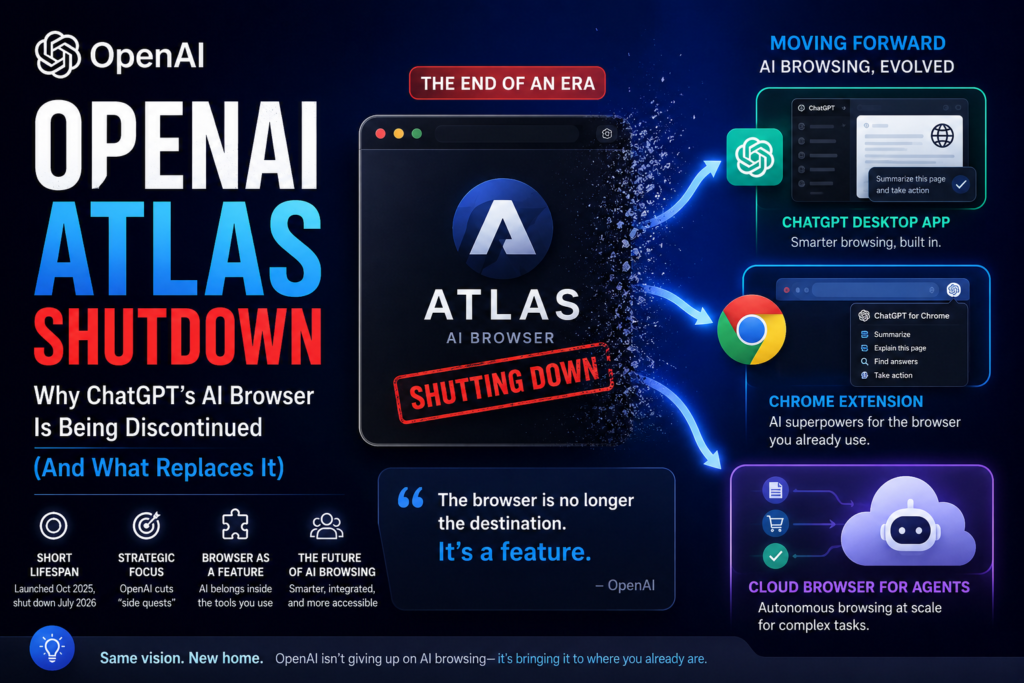
The OpenAI Atlas shutdown is official: less than a year after launch, OpenAI is sunsetting its standalone AI-powered browser. In its place, the company is folding Atlas’s agentic browsing features directly into the ChatGPT desktop app and a new Google Chrome extension — a strategic bet that AI browsing works better as a feature than as a destination.
If you use ChatGPT, build browser-based AI tools, or track the AI browser wars, here’s everything you need to know about this decision, why it happened, and what comes next.
Key takeaways:
- OpenAI is discontinuing Atlas, its standalone AI browser, less than a year after launch.
- Atlas’s agentic browsing features are moving to a new ChatGPT Chrome extension, a stronger ChatGPT desktop app browser, and a remote cloud browser for autonomous agents.
- The OpenAI Atlas shutdown follows a company-wide push to cut “side quests,” the same directive that led to the shutdown of Sora in March 2026.
- OpenAI now believes the browser itself should be a feature layered onto Chrome, not a separate destination competing against it.
- The move reshapes the wider AI browser wars, putting new pressure on standalone challengers like Perplexity’s Comet and The Browser Company’s Dia.
What Was ChatGPT Atlas?
Before diving into the OpenAI Atlas shutdown itself, it helps to remember what Atlas actually was. ChatGPT Atlas launched in October 2025 as OpenAI’s first full-fledged web browser, built with ChatGPT embedded at its core rather than bolted on as an add-on. The pitch was ambitious: instead of opening a browser and separately opening ChatGPT in a tab, users would get a single unified experience where the AI could see, understand, and act on whatever page they were viewing.
Atlas arrived at a moment when the browser itself had become one of the most contested pieces of real estate in tech. For decades, the browser was treated as a commodity — a mostly interchangeable window onto the web. AI changed that calculus almost overnight, turning the browser into a potential new home for assistants that could summarize, research, shop, and complete tasks on a user’s behalf. OpenAI wanted Atlas to be that home for ChatGPT. Nine months later, this reversal suggests that bet didn’t pay off the way the company hoped.
What Is the OpenAI Atlas Shutdown? (Quick Answer)
The OpenAI Atlas shutdown refers to OpenAI’s decision to discontinue ChatGPT Atlas, the standalone AI browser it launched in October 2025. Rather than abandoning AI-powered web browsing altogether, OpenAI is redistributing Atlas’s core capabilities — page-context awareness, task automation, and autonomous browsing — into two places people already use: the ChatGPT desktop app and a new Chrome extension.
In short: the browser is gone, but the browsing ambitions aren’t. OpenAI concluded that most people don’t want to switch their entire default browser for AI features; they want AI features layered on top of the browser they already use.
Timeline: From Launch to Shutdown
Understanding what happened requires a quick look at the product’s short life:
- October 2025: OpenAI launches ChatGPT Atlas, a full AI-powered browser built with ChatGPT at its core, entering a crowded field of AI browsing tools.
- Early-to-mid 2026: OpenAI applications CEO Fidji Simo directs teams to cut back on “side quests,” a directive that also led to the shutdown of OpenAI’s video generation tool Sora in March 2026.
- July 9, 2026: OpenAI confirms the Atlas shutdown, announcing that agentic browsing features will move to the ChatGPT desktop app and a Chrome extension instead.
That’s a lifespan of roughly nine months — a strikingly fast reversal for a product OpenAI once positioned as a flagship consumer release. For context, most major browser products get years, not months, to prove themselves. Chrome itself took several years to meaningfully dent Internet Explorer’s dominance after its 2008 launch. The speed of the OpenAI Atlas shutdown says less about the underlying technology and more about how quickly OpenAI is now willing to cut products that aren’t hitting internal targets.
It’s also worth noting what this decision does not mean. OpenAI isn’t saying agentic browsing is a bad idea — quite the opposite. The company is simultaneously investing in a more capable ChatGPT desktop browser and a cloud-hosted browser for autonomous agents. The shutdown is a statement about packaging and distribution, not about the underlying value of AI-assisted browsing.
Why Is OpenAI Shutting Down Atlas?
The “Side Quests” Strategy Shift
This decision didn’t happen in isolation. It’s part of a broader internal push at OpenAI to narrow focus and cut peripheral projects that don’t directly reinforce ChatGPT’s core value proposition. This same directive from Fidji Simo previously led OpenAI to shut down Sora, its AI video generation tool, in March 2026. Atlas appears to be the latest casualty of that same discipline.
Browser as a Feature, Not a Destination
The deeper strategic insight behind the OpenAI Atlas shutdown is about user behavior. After months of experimentation, OpenAI concluded that the browser is a feature, not a destination — so it’s folding Atlas’s agentic capabilities into the places people already work, including Chrome itself.
This matters because it reframes the entire premise of standalone AI browsers. Getting users to abandon Chrome — which still commands the vast majority of global browser market share — is an enormous switching-cost problem. Browsers carry years of saved passwords, bookmarks, extensions, and muscle memory. Asking someone to walk away from all of that for a smarter address bar is a much harder sell than simply adding AI to the browser they already trust. OpenAI’s pivot suggests it would rather meet users inside Chrome than compete against it head-on.
There’s also a distribution math problem underneath this move. A standalone browser needs to win on every dimension simultaneously — speed, security, extension support, sync across devices — before AI features even enter the equation. A Chrome extension, by contrast, inherits all of that infrastructure for free and only has to win on the AI layer itself. That’s a dramatically lower bar to clear, and it likely explains why OpenAI is redirecting resources toward the extension and desktop app rather than continuing to iterate on Atlas as a full browser.
What This Says About OpenAI’s Broader Product Philosophy
This decision, paired with the earlier Sora shutdown, suggests a company that’s becoming more willing to admit when a product isn’t gaining the traction it hoped for — even a high-profile one — rather than continuing to fund it indefinitely. That’s a notable shift for a company that spent much of 2024 and 2025 rapidly expanding its product lineup. It suggests OpenAI is now prioritizing depth in ChatGPT itself over breadth across a growing family of standalone apps.
What Replaces Atlas? OpenAI’s New Agentic Browsing Strategy
This shutdown comes with a clear replacement roadmap. Instead of one browser, OpenAI is now spreading agentic browsing across three surfaces.
ChatGPT Chrome Extension
OpenAI is launching a ChatGPT extension for Chrome that gives it access to the context of the page a user is viewing, letting people ask questions about webpages, summarize content, or kick off longer tasks directly from the browser. This positions it as a direct competitor to Google’s own Gemini Side Panel, which performs many of the same functions.
For everyday users, this is arguably the most consequential piece of the transition. Instead of downloading and switching to an entirely new browser, someone can keep using Chrome exactly as they always have and simply add a ChatGPT panel alongside it. That removes almost all of the friction that likely limited Atlas’s growth in the first place, and it puts ChatGPT’s assistant capabilities in front of Chrome’s enormous existing user base rather than asking that base to migrate elsewhere.
ChatGPT Desktop App Browser
OpenAI is also strengthening its ChatGPT desktop app with a more robust built-in browser that lets users browse websites, log into accounts, download files, and interact with web pages without ever leaving ChatGPT. This keeps the “everything in one workspace” appeal of Atlas without requiring a dedicated browser install.
This approach effectively preserves the best part of Atlas — a unified environment where chat and browsing coexist — while removing the requirement that it be a user’s default browser. People who liked the all-in-one feel of Atlas can get a similar experience inside the desktop app whenever they choose to open it, without giving up Chrome, Safari, or Edge as their daily driver.
Cloud Browser for Autonomous Agents
A separate cloud browser will run remotely on OpenAI’s own servers, giving the app’s agents a place to complete tasks autonomously on a user’s behalf. This is arguably the most forward-looking piece: it decouples “browsing” from any single local device, letting agents work in the background while a person does something else entirely.
This cloud browser component signals where OpenAI thinks the real long-term value lies — not in who controls the browser chrome (the buttons, tabs, and address bar), but in who can run the most reliable autonomous agents behind the scenes. A cloud browser can research a topic, fill out forms, compare prices, or monitor a webpage for changes without tying up a user’s own machine or requiring them to keep a browser tab open at all. That’s a meaningfully different value proposition than what Atlas originally offered, and it’s a strong hint about where OpenAI’s post-Atlas roadmap is headed.
Together, these updates turn ChatGPT into a continuous workspace that spans Chrome, the desktop app, and an AI agent — rather than a single browser window.
OpenAI Atlas Shutdown vs. the AI Browser Wars: Comparison Table
This shutdown lands in the middle of an increasingly crowded field of AI-powered browsing tools. Here’s how OpenAI’s new post-Atlas approach compares to competitors:
| Product | Company | Format | Core Approach |
|---|---|---|---|
| ChatGPT (post-Atlas) | OpenAI | Chrome extension + desktop app + cloud agent | Layer agentic AI onto existing browsers instead of replacing them |
| Comet | Perplexity | Standalone browser | Full browser rebuilt around AI search and agents |
| Dia | The Browser Company | Standalone browser | AI-native browser built for tab and context management |
| Gemini Side Panel | Chrome sidebar | AI assistant embedded inside the default Chrome experience | |
| Copilot in Edge | Microsoft | Built into Edge | AI assistant layered into Microsoft’s existing browser |
The pattern is clear: while some players (Perplexity, The Browser Company) are still betting on standalone AI browsers, OpenAI’s retreat from Atlas signals a shift toward embedding AI into browsers people already trust — much like Google and Microsoft have done from day one.
Notice, too, that two very different philosophies are now competing head-on. Comet and Dia are essentially betting that AI is significant enough a shift to justify rebuilding the browser from the ground up. Gemini Side Panel, Copilot in Edge, and now the post-Atlas ChatGPT approach are betting the opposite: that the browser chrome itself barely matters, and the real fight is over whose assistant sits inside it. This is the clearest evidence yet that even a company with ChatGPT’s scale and brand recognition sees more upside in the second approach.
How This Reshapes the AI Browser Wars
For much of the past year, the AI industry had been engaged in a race to unseat Chrome as the place where people spend most of their time online, with Perplexity launching Comet, The Browser Company launching Dia, and Google and Microsoft updating Chrome and Edge with new AI features respectively. The OpenAI Atlas shutdown is the clearest signal yet that unseating Chrome outright may be far harder than building compelling features on top of it.
This shift has several downstream implications:
- Standalone AI browsers face a tougher sell. If OpenAI — with ChatGPT’s enormous user base — couldn’t convert enough people to a new default browser, smaller competitors face an even steeper climb.
- Chrome extensions become the new battleground. Expect more AI companies to prioritize extensions and side panels over full browser replacements, since they lower the switching cost to nearly zero.
- Agentic capability, not browser ownership, is the real prize. OpenAI’s cloud browser for autonomous agents suggests the next competitive frontier is background task completion, not who owns the address bar.
- Google’s Gemini Side Panel gains a direct, well-resourced rival. The ChatGPT Chrome extension puts OpenAI in more direct competition with Google on Google’s own turf.
What This Means for Users, Developers, and Marketers
This shutdown has practical implications well beyond OpenAI’s own roadmap:
- Atlas users will need to migrate their workflows to the ChatGPT desktop app or the new Chrome extension once Atlas is officially retired.
- Developers building on top of Atlas-specific APIs or extensions should watch for OpenAI’s migration guidance to the desktop app and Chrome extension frameworks.
- Marketers and content strategists should note that agentic browsing — AI reading, summarizing, and acting on web pages — is becoming a default behavior across major browsers, not a niche feature. This reinforces the importance of structuring content (clear headers, direct answers, structured data) so AI agents can parse and act on it accurately.
- Enterprises evaluating AI browsing tools now have one less standalone option to consider, but gain a lower-friction alternative in the ChatGPT Chrome extension that doesn’t require replacing existing browser infrastructure.
Why the OpenAI Atlas Shutdown Matters for Content and SEO Strategy
For content creators and SEO teams specifically, this development is a useful reminder of where AI browsing is actually headed. Agentic browsers and extensions don’t read pages the way humans do — they parse structure, extract direct answers, and act on clearly organized information. As ChatGPT’s browsing capabilities move into Chrome extensions and desktop agents used by potentially hundreds of millions of people, content that’s structured for AI comprehension (clear headers, direct answers near the top of each section, well-labeled tables) becomes more likely to be surfaced, summarized, and cited accurately by these tools. The shutdown of Atlas doesn’t reduce that need — if anything, distributing agentic browsing more widely across Chrome and desktop surfaces increases the number of AI systems that will be reading and acting on web content in the months ahead.
Frequently Asked Questions About the OpenAI Atlas Shutdown
Is ChatGPT Atlas completely shutting down? Yes. OpenAI is discontinuing Atlas as a standalone browser, but it is not abandoning AI browsing — those capabilities are moving into the ChatGPT desktop app and a new Chrome extension.
When did OpenAI announce the Atlas shutdown? OpenAI announced the shutdown on July 9, 2026, roughly nine months after Atlas launched in October 2025.
Why did OpenAI shut down Atlas instead of continuing to improve it? OpenAI concluded after months of experimentation that the browser is a feature rather than a destination, choosing instead to embed agentic browsing into products people already use, including Chrome. This decision also follows a broader internal push to cut secondary projects, which previously led to Sora’s shutdown.
What replaces Atlas’s browsing features? Three things: a ChatGPT Chrome extension for page-aware Q&A and tasks, a more powerful browser built into the ChatGPT desktop app, and a cloud-based browser that lets AI agents complete tasks remotely on a user’s behalf.
Does this shutdown affect the broader AI browser wars? Yes. It signals that standalone AI browsers face real adoption challenges, and it strengthens the case for embedding AI directly into existing browsers like Chrome — a strategy Google and Microsoft have already pursued with Gemini Side Panel and Copilot in Edge.
Is OpenAI still competing with Perplexity’s Comet and The Browser Company’s Dia? Indirectly, yes — but through a Chrome extension and desktop app rather than a rival standalone browser. Comet and Dia remain standalone products, while OpenAI has chosen a lower-friction, extension-based path.
Was the OpenAI Atlas shutdown related to the Sora shutdown? They share a common cause. Both decisions trace back to OpenAI applications CEO Fidji Simo’s directive to cut back on “side quests” — secondary products that pull focus away from ChatGPT’s core experience. Sora was shut down in March 2026, and Atlas followed roughly four months later under the same rationale.
What should current Atlas users do now? Atlas users should plan to shift their workflows to the ChatGPT desktop app’s browsing features or install the new ChatGPT Chrome extension once it’s available, since these will carry forward the page-context and task-automation capabilities Atlas offered.
Conclusion
The OpenAI Atlas shutdown marks a pivotal moment in the AI browser wars — not because OpenAI is retreating from agentic browsing, but because it’s rethinking how that browsing should reach users. Rather than asking people to give up Chrome, OpenAI is meeting them inside it, while also building a cloud-based agent layer for tasks that don’t need a human at the keyboard at all. As the OpenAI Atlas shutdown plays out over the coming months, expect the real competition to shift from “whose browser is better” to “whose AI agent gets more done inside the browser you already use.”