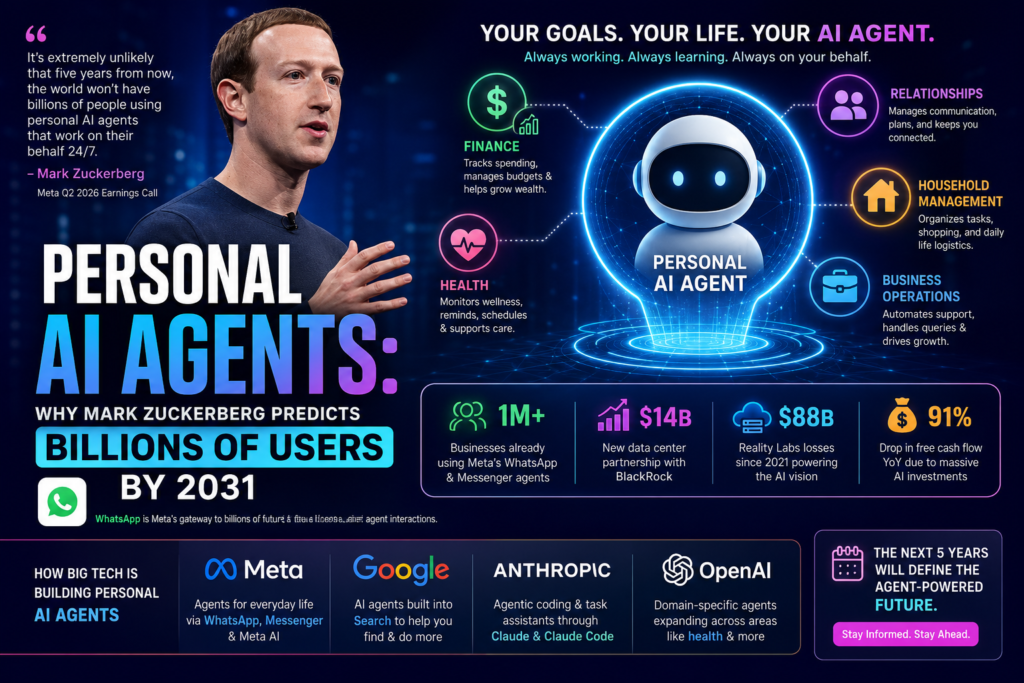
Mark Zuckerberg says billions of people will have their own personal AI agents within five years, working around the clock on their finances, health, relationships, and household management. He made this prediction during Meta’s Q2 2026 earnings call, positioning personal AI agents as the foundation of the company’s “next wave of products and revenue lines.”
That single sentence from Zuckerberg has reignited a debate that touches every major AI company: are personal AI agents actually going to reach mainstream, billion-user scale, or is this another round of Silicon Valley hype riding on eye-watering infrastructure spending? This article breaks down exactly what Zuckerberg said, what personal AI agents actually are, how Meta’s approach compares to Google, OpenAI, and Anthropic, and whether the “billions of users in five years” timeline is realistic.
What Did Mark Zuckerberg Say About Personal AI Agents?
On Meta’s Wednesday earnings call with investors, Zuckerberg told analysts it was “extremely unlikely” that five years from now, the world wouldn’t have billions of people relying on personal AI agents that understand their goals and work on their behalf 24/7. He named finance, health, interpersonal relationships, and household management as core domains where he expects personal AI agents to operate.
Zuckerberg also tied this prediction directly to Meta’s messaging infrastructure. He said that as people begin interacting with multiple agents at once, WhatsApp and Meta’s other messaging surfaces will become “increasingly important” , noting that WhatsApp is already the leading platform where users engage with Meta AI. In effect, Zuckerberg is framing WhatsApp not just as a chat app, but as the delivery layer for Meta’s personal AI agents strategy.
This isn’t an isolated comment. It came during an earnings call where Zuckerberg was explicitly trying to reassure investors that Meta’s enormous AI infrastructure spending will eventually pay off , a sales pitch as much as a forecast.
What Are Personal AI Agents?
Personal AI agents are AI systems designed to act autonomously on an individual’s behalf across ongoing tasks, rather than simply answering one-off questions. Unlike a traditional chatbot that responds only when prompted, a personal AI agent is meant to understand a user’s goals, retain context over time, and take actions , scheduling, researching, negotiating, monitoring, or executing tasks , without needing step-by-step instructions for every action.
The distinction matters for how the industry is positioning these products:
- Chatbots answer questions in a single turn and largely forget context between sessions.
- Assistants handle narrow, well-defined tasks (setting a timer, drafting an email) when explicitly asked.
- Personal AI agents operate continuously, hold long-term context about a person’s goals, and can chain together multiple actions to complete a task with minimal supervision.
Zuckerberg’s framing , an agent “working on your behalf 24/7” , places Meta’s ambitions squarely at the top of that hierarchy. It’s a much bigger claim than “we built a helpful chatbot.” It’s a claim that personal AI agents will become a persistent layer of digital life, similar to how smartphones or search engines became infrastructure rather than features.
Why Meta Is Betting Big on Personal AI Agents
Meta’s enthusiasm for personal AI agents isn’t happening in a vacuum , it’s backed by (and arguably driven by) massive capital commitments that investors are watching closely.
WhatsApp as the Agent Gateway
Zuckerberg’s comments make clear that Meta sees WhatsApp as the primary interface through which personal AI agents will reach users, particularly outside the U.S., where WhatsApp already dominates daily messaging. Meta’s business-agent rollout on WhatsApp and Messenger has already been adopted by more than one million businesses this quarter, giving Meta a live testbed for agent-to-consumer interaction patterns before it pushes fully autonomous personal AI agents to individual users.
This is a meaningful strategic bet: rather than building a standalone agent app from scratch, Meta is layering personal AI agents onto an existing messaging habit that billions of people already have. Zuckerberg’s logic is that adoption friction drops dramatically when an agent lives inside an app people already open dozens of times a day.
The Cost of Building Personal AI Agents
The ambition comes with a steep price tag. Meta’s Reality Labs division , responsible for AR glasses, VR headsets, and related software that underpins much of its long-term agent vision , lost roughly $4.6 billion this quarter alone, part of a running total near $88 billion in losses since 2021.
More strikingly, Meta’s free cash flow fell to $784 million this quarter, down from $8.55 billion in the same quarter last year , a 91% year-over-year drop, driven largely by AI infrastructure investment. This week alone, Meta announced a $14 billion data center partnership with BlackRock in El Paso, Texas, underscoring how much capital is required to make the personal AI agents vision technically feasible at global scale.
Zuckerberg addressed the return-on-investment question directly, telling investors: “We believe that there will continue to be a significantly higher margin on selling intelligence rather than selling compute directly, but we think that there’s a big opportunity, obviously, to sell compute as well.” In other words, Meta expects personal AI agents themselves , not just the underlying infrastructure , to become a monetizable product line.
Markets weren’t fully convinced: Meta’s stock dropped almost 10% after this quarter’s earnings, suggesting investors remain cautious about how quickly personal AI agents will translate spending into revenue.
How Do Personal AI Agents Compare Across Big Tech?
Meta isn’t the only company racing to define what personal AI agents look like. Google, OpenAI, and Anthropic are each taking a different approach to agentic AI, with different levels of consumer traction so far.
| Company | Agent Strategy | Primary Surface | Notable Signal |
| Meta | Personal AI agents for finance, health, relationships, household management | WhatsApp, Messenger, Meta AI | 1M+ businesses using WhatsApp/Messenger business agents |
| Custom AI agents built into Search | Google Search overhaul | Sparked user backlash over AI-heavy search results | |
| Anthropic | Agentic coding and task assistants | Claude, Claude Code | Consumer subscriptions to Claude have grown sharply |
| OpenAI | Domain-specific agent expansion | ChatGPT (including ChatGPT Health) | Rapid feature rollout across verticals like health |
This comparison highlights an important nuance: while Zuckerberg is making the boldest public prediction about personal AI agents reaching “billions” of users, Anthropic’s Claude has seen strong organic subscriber growth around agentic coding specifically, and Google’s agent-driven search changes have already generated real (if mixed) user reactions. Meta’s personal AI agents bet is distinctive mainly in its scale of ambition and its reliance on messaging apps as the delivery mechanism, rather than search or coding tools.
Will Personal AI Agents Really Reach Billions of Users by 2031?
Short answer: It’s plausible in terms of exposure, but “billions of active users” is a much higher bar than “billions of people who have tried an AI agent at least once.”
Zuckerberg’s prediction hinges on a distinction that’s easy to miss: he said billions of people will have a personal agent, not that billions will actively rely on one daily for complex tasks. Given that Meta’s platforms (Facebook, Instagram, WhatsApp) already reach well over 3 billion people, simply exposing users to a personal AI agent feature inside an app they already use is a much lower bar than getting people to trust an agent with their finances or health decisions.
Question: What’s the biggest obstacle to billions of people adopting personal AI agents? Direct answer: Trust and reliability. Handing over tasks like financial management or health monitoring to an autonomous system requires a level of confidence in accuracy and privacy that most consumer AI products haven’t yet earned at scale. Google’s Search overhaul is an instructive example , even a well-resourced company faced user pushback when AI results felt intrusive rather than helpful.
Question: Does Meta have the financial runway to sustain this bet? Direct answer: For now, yes, but the margin for error is shrinking. A 91% year-over-year drop in free cash flow, combined with nearly $88 billion in cumulative Reality Labs losses, means investors will be watching closely for evidence that personal AI agents generate revenue , not just usage , within the next few earnings cycles.
Personal AI Agents: Key Use Cases Zuckerberg Highlighted
According to Zuckerberg, the domains where personal AI agents are most likely to gain traction include:
- Finance , tracking spending, managing budgets, and potentially executing transactions on a user’s behalf
- Health , monitoring wellness goals, medication reminders, and coordinating care (a category OpenAI is also targeting with ChatGPT Health)
- Interpersonal relationships , helping manage communication, scheduling, and social coordination
- Household management , organizing tasks, shopping, and logistics for a home or family
- Business operations , Meta’s WhatsApp and Messenger business agents, already used by over one million businesses, represent an early, revenue-generating proof point
Notably, four of these five categories are consumer-facing and deeply personal, which is exactly why trust, privacy, and reliability will determine how fast personal AI agents actually spread , regardless of how much infrastructure Meta builds to support them.
Challenges Facing Personal AI Agents Adoption
Even with enormous capital behind them, personal AI agents face real headwinds before reaching Zuckerberg’s “billions” milestone:
- Infrastructure costs and energy demand , training and running agents at global scale requires massive, power-hungry data centers, raising both cost and environmental concerns
- User backlash to AI overreach , Google’s Search changes show that pushing AI too aggressively into existing products can alienate users rather than delight them
- Investor patience , Meta’s stock drop after this earnings call signals that markets want to see monetization, not just ambition
- Competitive fragmentation , with Meta, Google, OpenAI, and Anthropic all building different flavors of agentic AI, users may end up spreading trust (and data) across multiple personal AI agents rather than consolidating around one
What This Means Going Forward
Zuckerberg’s prediction places personal AI agents at the center of Meta’s next major product cycle, but it also raises the stakes for the company’s AI spending. Whether personal AI agents become genuine daily-use infrastructure , the way smartphones or search engines did , will depend less on how many people are technically exposed to an agent through WhatsApp or Messenger, and more on whether those agents prove trustworthy enough to handle sensitive domains like finance and health.
For now, the “billions of people with personal AI agents” prediction is best understood as a five-year aspiration Meta is using to justify its spending today, not a confirmed trajectory. The comparison across Meta, Google, Anthropic, and OpenAI shows that every major AI company is racing toward some version of this future , they simply disagree on the surface (search, messaging, coding, or health) where personal AI agents will first become indispensable.
Frequently Asked Questions About Personal AI Agents
What did Mark Zuckerberg say about personal AI agents? Zuckerberg predicted that within five years, billions of people will have personal AI agents working continuously on their behalf across finance, health, relationships, and household management, with WhatsApp positioned as a key access point.
How is Meta’s personal AI agents strategy different from competitors? Meta is betting on WhatsApp and Messenger as the delivery surface for personal AI agents, while Google is embedding agents into Search, Anthropic is focused on agentic coding through Claude, and OpenAI is expanding ChatGPT into verticals like health.
How much is Meta spending to build personal AI agents? Meta’s Reality Labs division alone has lost around $88 billion since 2021, and the company’s free cash flow dropped 91% year-over-year this quarter, partly due to AI infrastructure investment, including a new $14 billion data center partnership with BlackRock.
Are personal AI agents already generating revenue for Meta? Partially , Meta’s business-focused AI agents on WhatsApp and Messenger have been adopted by more than one million businesses, giving the company an early, if modest, revenue signal ahead of a broader consumer rollout.