Why Is Pulley Shutting Down?
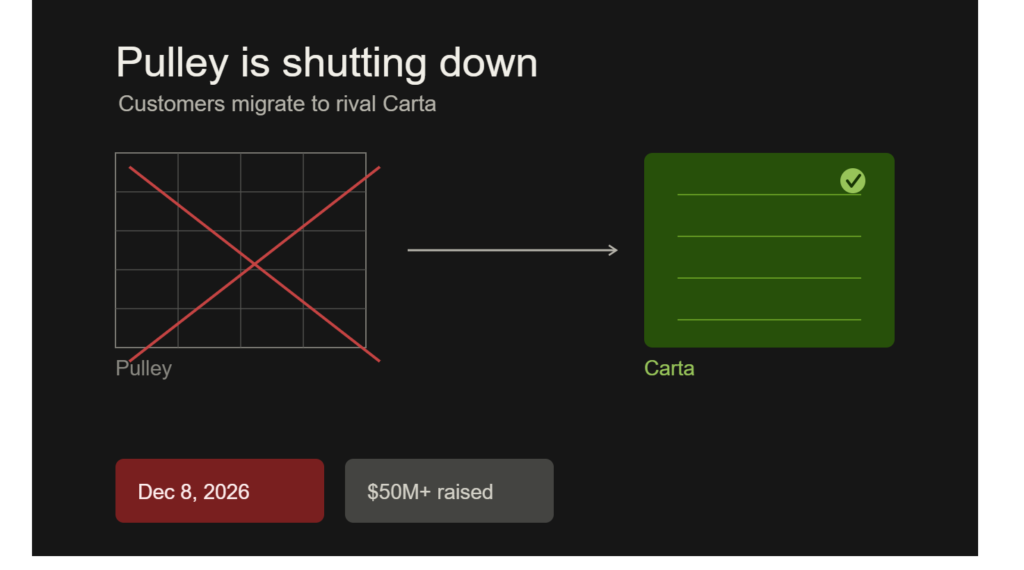
The immediate fact is straightforward: Pulley is shutting down its operations and services on December 8, 2026. The company has not publicly given a specific reason for the decision.
Pulley announced the closure on its website and said it had entered an exclusive partnership with Carta. Existing customers may qualify for a limited-time offer and assisted migration to Carta, while prospective customers are being directed to Carta’s equity management platform.
TechCrunch reported on September 16, 2026, that Pulley had not provided an explanation for the shutdown. The publication also reported that it had contacted Wu for comment but had not received an immediate response.
That distinction matters.
It is possible to identify what Pulley has announced without claiming to know why the company made the decision. Any explanation beyond the company’s public announcement should therefore be treated as speculation unless Pulley or its leadership provides additional information.
Question → When will the Pulley shutdown happen?
The Pulley shutdown is scheduled for December 8, 2026, when the company says it will cease all operations and services. Pulley is encouraging existing customers to log into their accounts to check their migration status and initiate any available offer.
The company also says prospective customers should consider Carta rather than starting a new Pulley relationship.
That gives current users a defined transition deadline rather than an indefinite shutdown process.
What Is Pulley and Why Did Startups Use It?
Definition + Expansion , Cap table management: A cap table, short for capitalization table, records who owns what portion of a company, including shares, options, and other equity interests.
For a startup, that information can become complicated quickly. A company might have founders, employees with stock options, angel investors, venture capital firms, and other stakeholders.
As fundraising progresses, ownership can change through new investment rounds, employee equity grants, option exercises, dilution, and other transactions.
Pulley was built to help companies manage this information digitally.
Its website describes the product as an equity platform for founders and finance leaders, with tools for managing equity and making ownership-related decisions.
The importance of this category is easy to understand.
Imagine a startup tracking ownership in multiple spreadsheets. One file contains employee options, another contains investor information, and another includes historical transactions. If different versions start circulating, determining which spreadsheet is correct can become difficult.
Specialized cap table software attempts to centralize that information.
Pulley entered this market as a competitor to Carta, one of the best-known companies in startup equity management.
Question → Why do startups need cap table software?
Startups use cap table software to organize and manage complicated ownership information as their companies grow.
The software can reduce dependence on disconnected spreadsheets and provide a centralized system for tracking stakeholders, equity grants, ownership changes, and related records.
Pulley itself previously described its platform as a way for founders and finance leaders to manage equity and make decisions using centralized tools.
Pulley Was Built as a Carta Alternative
Yin Wu began building Pulley in 2020 after previously working at Microsoft and founding other companies, according to TechCrunch. The startup subsequently raised more than $50 million from prominent investors.
Among those investors were General Catalyst, Stripe, and Founders Fund, giving Pulley substantial backing as it attempted to compete in the equity-management market.
The company’s positioning was clear: startups needed alternatives for managing their equity.
Pulley’s own 2026 materials even published content comparing equity-management providers and describing the problems companies could face when managing ownership information through spreadsheets.
That makes the eventual shutdown particularly interesting.
A startup can raise significant venture funding, build specialized software, attract customers, and still reach a point where continuing independently is no longer the chosen path.
Question → Was Pulley directly competing with Carta?
Yes. Pulley was positioned as a competitor to Carta in cap table and equity management.
The two companies operated in the same broad market, and Pulley’s shutdown announcement now says the company has partnered with Carta to transition customers.
The irony is hard to miss: a company that began by challenging an established rival is now directing customers toward that rival.
What Happened to Pulley Customers?
For existing customers, the most immediate issue is not the startup’s funding history. It is continuity.
A cap table contains sensitive and important information about a company’s ownership. Founders need access to accurate records for fundraising, employee equity, financial planning, and other corporate activities.
Pulley’s website says existing customers may qualify for a limited-time offer and assisted migration to Carta. It tells customers to log into their Pulley account to check their status and initiate the offer redemption process.
This means the Pulley shutdown is not simply a matter of customers losing access overnight.
Instead, Pulley and Carta have established a transition arrangement intended to move eligible customers onto Carta.
For companies using Pulley, however, the practical work of preparing for a migration still matters.
What Pulley customers should consider
Existing users should pay attention to:
- The December 8, 2026 shutdown date
- Their current Pulley account and migration status
- Available Carta migration terms
- Exported copies of important company records
- Equity documents and historical information
- Internal stakeholders who need access to ownership records
- Any upcoming fundraising, financing, or equity-related deadlines
The goal is not to panic. It is to make sure an important company record remains accessible and accurate during the transition.
Question → What should Pulley customers do before December 8?
Pulley customers should log into their accounts, review the company’s migration information, and determine whether they qualify for the assisted transition to Carta.
Pulley specifically instructs existing customers to log in to check their account status and initiate the available offer.
Companies should also make sure their internal records and important equity documentation are organized before the shutdown deadline.
Why Is Carta Taking Over Pulley Customers?
The partnership creates an unusual outcome in the startup software market.
Instead of customers being forced to independently search for a replacement, Pulley is directing them toward an established competitor.
Pulley says its exclusive partnership with Carta is intended to ensure that pre-IPO companies can continue accessing equity-management capabilities.
Carta therefore becomes the destination for both existing Pulley customers who migrate and prospective customers who might otherwise have considered Pulley.
| Aspect | Pulley | Carta after Pulley shutdown |
| Current status | Shutting down | Continuing operations |
| Final Pulley service date | December 8, 2026 | Not applicable |
| Customer transition | Assisted migration offered | Receiving eligible Pulley customers |
| Cap table management | Pulley’s service ends | Carta provides equity-management services |
| New customers | Pulley directs prospects elsewhere | Pulley directs prospects to Carta |
| Relationship | Former competitor | Migration partner |
The comparison is important because the shutdown does not mean cap table management is becoming unnecessary.
Instead, customers are being redirected to another provider.
Question → Does Pulley becoming unavailable mean startups no longer need cap table software?
No.
The Pulley shutdown affects one provider, not the underlying need for equity management. Startups still need accurate records of ownership, equity grants, and related information as they grow.
The change is primarily about which software provider customers will use.
Did AI and Spreadsheets Contribute to Pulley’s Shutdown?
This is where the story becomes more complicated.
TechCrunch reported that a former Pulley employee speculated online that Pulley was competing not only with Carta but also with spreadsheets. The former employee suggested that AI is making it easier for startups to maintain and improve spreadsheets.
That is a speculation, not an explanation confirmed by Pulley.
Still, it points to a larger technology question.
Software companies often compete against other software companies. But they can also compete against something much simpler: a spreadsheet that a customer already understands.
For some small startups, maintaining information in Excel or Google Sheets may appear sufficient, particularly before their ownership structures become complicated.
AI can potentially make spreadsheets easier to generate, analyze, clean up, or modify.
That does not mean AI has made specialized cap table software obsolete. A spreadsheet and a dedicated equity-management platform can provide very different levels of functionality, controls, workflow, and support.
The key lesson is that startup software companies need to solve a problem that customers consider important enough to pay for.
Question → Is AI definitely responsible for Pulley’s shutdown?
No. Pulley has not publicly stated that AI or spreadsheets caused the shutdown.
The connection comes from a former employee’s online speculation reported by TechCrunch. It should therefore be treated as an interpretation rather than an established cause.
The Spreadsheet Problem Is Bigger Than Pulley
The spreadsheet angle is worth examining because it applies to many startups.
Early-stage companies often try to keep costs low. If a spreadsheet can solve a problem adequately, founders may hesitate to purchase specialized software.
But complexity increases over time.
A startup that begins with two founders and no outside investors has a relatively simple ownership structure.
A company that later adds employees, angel investors, venture capital funds, option pools, multiple funding rounds, and other equity instruments has a much more complicated record.
That is where specialized software can become more useful.
The challenge for a software company is proving that its platform offers enough additional value to justify replacing a familiar spreadsheet workflow.
This is not unique to equity management.
The same tension appears across software categories: specialized applications compete with general-purpose tools, while AI increasingly makes those general-purpose tools more capable.
What Does the Pulley Shutdown Mean for Startup Software?
The Pulley shutdown offers several lessons for founders and technology professionals.
1. Funding does not guarantee permanence
Pulley raised more than $50 million, including investment from General Catalyst, Stripe, and Founders Fund.
That demonstrates that venture backing can provide resources for building a company, but it does not guarantee that a business will operate indefinitely.
Startup funding is capital for building and growing a business, not a guarantee of long-term survival.
2. Critical software needs a continuity plan
When a startup provides software that companies depend on for important records, customers need to think about what happens if the vendor disappears.
This is especially relevant for:
- Equity records
- Financial information
- Customer databases
- Payroll systems
- Compliance tools
- Cloud infrastructure
- Developer platforms
The Pulley shutdown is a reminder that vendor risk exists even when the product itself is functioning.
3. Competitors can become transition partners
The relationship between Pulley and Carta shows that competition and cooperation can coexist.
Pulley competed with Carta for customers, but the companies are now working together on the customer transition.
For the affected startups, that relationship may make the shutdown easier to manage.
4. AI changes the competitive landscape
The former employee’s spreadsheet theory highlights a broader challenge for SaaS companies.
A startup does not necessarily have to be defeated by another startup offering the same product.
It could face competition from a combination of spreadsheets, automation, AI assistants, internal tools, and increasingly capable general-purpose software.
What Can Founders Learn From Pulley’s Closure?
For founders, the story is useful because it illustrates a less-discussed part of startup strategy: customer dependency cuts both ways.
When customers depend heavily on your software, that dependence can be commercially valuable.
But it also creates a responsibility to think about data portability, migration, customer communication, and operational continuity.
Pulley’s current shutdown announcement provides a concrete example.
Rather than simply announcing that service will stop, the company has partnered with Carta and created a migration path for existing customers.
That does not eliminate every practical challenge for customers, but it gives them a defined route forward.
Question → What should founders consider when choosing startup software?
Founders should consider not only features and pricing but also data portability, export options, vendor stability, customer support, integrations, and what happens if the provider changes direction.
These questions can seem unnecessary when a startup is small.
They become much more important when the software contains records that are difficult or costly to reconstruct.
What Happened to Yin Wu After the Shutdown Announcement?
Wu’s statement following the Pulley shutdown suggests that the story may not be the end of her entrepreneurial career.
In a LinkedIn statement cited by TechCrunch, Wu thanked Pulley’s team and investors and said that she and many of the company’s strongest team members had no intention of “riding off quietly into the night.”
She also wrote that there had never been a better time to solve big problems.
The statement does not announce a specific new company or product, so it would be premature to assume what Wu or former Pulley employees will build next.
But the response illustrates something common in the startup ecosystem: the closure of one company does not necessarily end the careers of its founders or employees.
People can take lessons, relationships, technical experience, and market knowledge from one startup into their next project.
What Does the Pulley Shutdown Mean for Students and Young Professionals?
For students and freshers interested in startups, the story offers a useful lesson about how technology businesses actually work.
A product can be technically useful and still face difficult commercial realities.
A company can raise millions and still shut down.
A competitor can become a partner.
And a specialized software company can discover that its real competition is not another startup but a tool customers already have.
These are important concepts for anyone studying entrepreneurship, product management, software engineering, marketing, or venture capital.
The story also demonstrates why understanding the business model behind technology matters.
Knowing what a product does is only the first step. Understanding who pays for it, what alternative customers have, how expensive the problem is, and what happens when the market changes can be equally important.
Why Pulley’s Story Matters Beyond Cap Tables
The Pulley shutdown is ultimately a story about the changing economics of startup software.
Pulley entered a market with a clear competitor, raised significant funding, and built software for a specialized business need.
Now the company is closing while sending its customers to the very company it once competed against.
At the same time, the rise of AI creates a new layer of competition.
If AI can make general-purpose tools substantially more capable, specialized SaaS companies may have to work harder to demonstrate why customers need dedicated software.
That does not mean specialized software disappears.
Instead, the standard for creating valuable software may become higher.
Products may need to offer automation, integrations, reliability, compliance, specialized workflows, and other capabilities that are difficult to reproduce with a spreadsheet and an AI assistant.
Question → What is the biggest technology lesson from Pulley’s closure?
One major lesson is that a software company’s competitive position depends on the problem it solves and the alternatives customers have,not simply on how much funding it has raised.
The Pulley shutdown shows why startups must continuously demonstrate value as technology, customer expectations, and competing tools evolve.
Frequently Asked Questions
What is the Pulley shutdown?
The Pulley shutdown is the company’s planned closure of its cap table and equity-management business. Pulley says it will cease all operations and services on December 8, 2026.
Why is Pulley shutting down?
Pulley has announced that it is shutting down but has not publicly provided a specific reason for the decision. TechCrunch reported that the company had not offered an explanation and had contacted founder Yin Wu for comment.
What will happen to Pulley customers?
Pulley has partnered with Carta to help transition existing customers. The company says eligible customers may receive a limited-time offer and assisted migration to Carta.
When does Pulley stop operating?
Pulley says its final day of operations and services will be December 8, 2026. Customers should review their accounts and migration information before that date.
How much funding did Pulley raise?
Pulley raised more than $50 million, according to TechCrunch. Its investors included General Catalyst, Stripe, and Founders Fund.
Is AI responsible for Pulley’s shutdown?
There is no public confirmation from Pulley that AI caused its closure. A former employee speculated that Pulley was competing with spreadsheets and that AI could make spreadsheet-based workflows more capable, but this remains an attributed speculation rather than a confirmed reason for the shutdown.
The Bottom Line
The Pulley shutdown marks the end of a startup that spent years building an alternative to Carta and raised more than $50 million from major investors. Pulley will stop operations on December 8, 2026, while its partnership with Carta provides a migration path for eligible customers.
The bigger lesson extends beyond cap tables. In today’s startup environment, companies must compete not only against direct rivals but also against spreadsheets, internal tools, automation, and increasingly capable AI systems.
For founders and young professionals, Pulley’s story is a useful reminder that funding, technology, and a strong product do not exist separately from market dynamics. The tools customers already use, the alternatives they can adopt, and the value they are willing to pay for can ultimately shape a software company’s future.
Explore Kalinga.ai for more explainers on startup technology, AI-driven business models, SaaS competition, and the companies reshaping the digital economy.