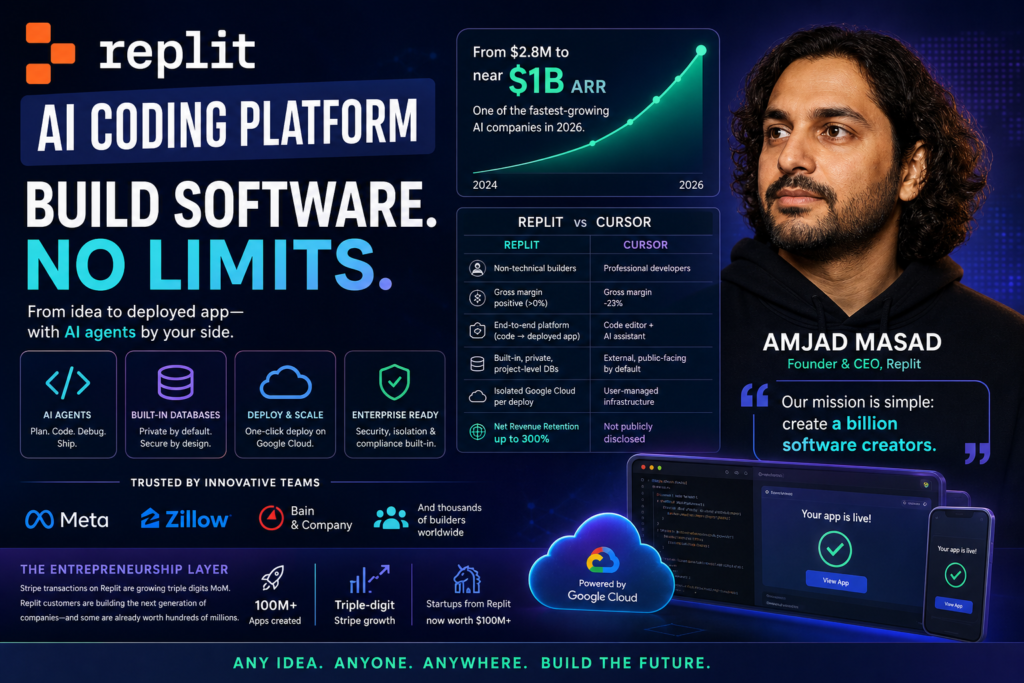
The Replit AI coding platform is quietly becoming one of the most consequential companies in the AI developer tools race — and unlike its rivals, it may not need to sell to survive. Here’s everything you need to know about where Replit stands, how it stacks up against Cursor, and why its bet on non-technical builders could define the next era of software creation.
What Is the Replit AI Coding Platform?
Definition: The Replit AI coding platform is a browser-based, end-to-end software development environment that uses AI agents to help users — including those with no coding experience — go from a natural language prompt to a fully deployed, scalable application.
Unlike traditional IDEs or even newer AI coding assistants like Cursor or GitHub Copilot, Replit is not just a code editor with AI bolted on. It is a full-stack platform that handles code generation, databases, database migrations, security, cloud deployment, and scaling — all within a single interface.
Replit was founded in 2016 by Amjad Masad, who has spent a decade building toward a singular vision: creating a billion software creators. For years, that goal sounded utopian. As of 2026, it sounds prescient.
In a candid interview at TechCrunch’s StrictlyVC San Francisco event in May 2026, Masad revealed that Replit went from $2.8 million in annual revenue in all of 2024 to tracking toward what he described as a billion-dollar annual run rate — one of the most dramatic growth arcs in recent startup history.
Replit vs Cursor: The AI Developer Tools Showdown
The AI developer tools market has never been more crowded or more consequential. The biggest story shaping the conversation in early 2026 is Cursor’s reported acquisition talks with SpaceX at a staggering $60 billion valuation.
So how does the Replit AI coding platform compare to Cursor — and why does Masad believe Replit can stay independent while Cursor may not?
| Feature | Replit | Cursor |
|---|---|---|
| Primary User | Non-technical / citizen developers | Professional developers |
| Gross Margin | Positive (>0%) | Reportedly -23% |
| Deployment | End-to-end (code → deployed app) | Code editor + AI assistant |
| Database Handling | Built-in, private, project-level | External (public-facing by default) |
| Security Model | Isolated Google Cloud per deploy | User-managed |
| Independence Path | Viable (profitable economics) | Challenging (cash-burning) |
| Primary AI Partners | Anthropic, Google, OpenAI | Anthropic-heavy |
| Net Revenue Retention | Up to 300% | Not publicly disclosed |
| App Store Presence | iOS (disputed) + Android | N/A |
The contrast is stark. While Cursor has built a beloved product among professional coders, its negative gross margins make staying independent nearly impossible at scale. Replit, by contrast, has structured its business around a different — and arguably stickier — customer: the non-technical builder who previously couldn’t create software at all.
The Business Case for Replit’s Independence
Gross Margins That Actually Work
In the AI coding tools space, most companies are in a race to acquire users at any cost, subsidizing compute and model inference to grow market share. The hope is that scale eventually brings profitability. Cursor’s reported -23% gross margins illustrate the danger of this approach: at negative margins, growth actually makes the financial problem worse, not better.
The Replit AI coding platform has taken a different road. Masad confirmed that Replit has been gross margin positive for over a year — a relatively rare distinction among AI-native startups. This is partly a function of pricing (Replit is “slightly more expensive,” per Masad) and partly a function of the value delivered: because Replit provides an all-in-one platform rather than a single-point solution, customers are willing to pay a premium.
This economic foundation is why Masad can credibly argue for independence. When your unit economics work, you don’t have to sell.
Net Revenue Retention of 300%: What It Means
What is net revenue retention (NRR)? NRR measures how much existing customers expand their spending over time, accounting for churn and contraction. A figure of 100% means customers spend the same amount. Above 100% means existing customers are spending more — even without adding new ones.
Replit’s NRR of up to 300% is exceptional by any standard. World-class SaaS companies celebrate NRR above 130%. At 300%, Replit’s existing customer base is tripling its spend — a sign of both deep product value and virtually nonexistent churn.
Masad attributes this to a counterintuitive dynamic: when companies try to migrate apps off Replit and rebuild them on their own infrastructure, they often end up with a worse product. The “rebuild it properly” impulse that might erode other platforms’ retention actually reinforces Replit’s.
How Replit Wins Enterprise Deals
A Product-Led Growth Machine
One of the most telling details from Masad’s interview: Replit has acquired enterprise customers like Zillow and Meta through entirely organic, bottom-up adoption. Employees discover the Replit AI coding platform on their own, build something useful, and eventually raise their hand to purchase a formal enterprise plan.
This product-led growth (PLG) model is powerful because it means Replit’s sales motion is largely inbound. The product sells itself — which also means lower customer acquisition costs and more loyal customers.
When deals do go top-down with formal procurement and IT evaluation, Replit wins on a different axis: security.
Security as a Competitive Moat
Security is where the Replit AI coding platform has a structural advantage over “vibe coding” competitors that generate apps connecting to external, publicly accessible databases.
Here’s the problem with many AI code generators: they create a front-end app and link it to a third-party or publicly exposed database. The developer (often non-technical) must then configure row-level security manually — a complex task that most citizen developers will skip or misconfigure.
Replit’s architecture sidesteps this entirely:
- Built-in databases are private and scoped to the project by default
- Every deployment creates a fully isolated environment on Google Cloud
- Google’s security model is inherited automatically
- 10 years of battling crypto scammers and hackers has given Replit a security function Masad compares to a dedicated cybersecurity startup
The result: Replit has displaced legacy BI tools like Tableau and Power BI at enterprise clients like Bain & Company, which now uses Replit alongside Databricks for analytics and reporting.
The Apple App Store Battle: Fighting for the Right to Build iOS Apps
One of the most contentious storylines in Replit’s 2026 narrative involves Apple. While a rival, Lovable, recently had its app-building tool approved in the App Store, Replit has been stuck in what Masad calls “App Store purgatory” — with Apple blocking updates to the Replit app for months.
Apple’s stated reason: Replit violates App Store guidelines by downloading new code to the device after the app approval process.
Replit’s response: “That’s a lie. And we can prove it in court if we have to.” — Amjad Masad, May 2026.
Masad’s theory for why Replit was targeted when others weren’t: the Replit AI coding platform can build iOS apps. When Replit launched this capability in December 2025, there were reportedly charts circulating showing how many new apps were entering the App Store through Replit. Apple, it seems, felt threatened by a tool that commoditizes iPhone app development for non-technical users.
While Masad expressed a preference for collaboration rather than litigation — he called himself a fan of Apple and said he’s happy to send customers to Xcode — he drew a firm line: a marketplace accessed by a billion people cannot make discriminatory decisions based on competitive self-interest.
This battle is worth watching. A court ruling in Replit’s favor could have significant implications for App Store governance and the broader vibe coding ecosystem.
Agentic Coding and the AI Developer Tools Revolution
What Is Agentic Coding?
Definition: Agentic coding refers to AI systems that don’t just autocomplete or suggest code, but autonomously plan, execute, debug, and iterate on multi-step software tasks — functioning more like a junior developer than a text prediction engine.
Replit launched its agentic coding experience in September 2024, and Masad credits this as the inflection point for the company’s extraordinary revenue growth. The product moved from helping developers write faster to enabling non-developers to create functional software from scratch.
Which AI Models Power Replit?
The Replit AI coding platform is model-agnostic by design, drawing from the best available foundation models:
- Anthropic (Claude): Masad called Anthropic “still undefeated on the core agentic loop,” citing superior tool calling and longer coherence in agent tasks
- OpenAI (GPT-5): “Catching up quickly”
- Google (Flash family): “Amazing on price-performance” — beating open source for fast, cheap inference
- Emerging labs: Reflection AI’s open-source models and Chinese lab Kimi are also on Replit’s radar — Masad noted Kimi is roughly three months behind Anthropic’s generation
This multi-model strategy insulates Replit from being locked into any single AI provider while allowing it to route tasks to the optimal model for each job.
The Entrepreneurship Layer: Replit as a Startup Factory
Perhaps the most underappreciated dimension of the Replit AI coding platform is the entrepreneurial ecosystem it’s creating. Masad shared that Stripe transactions flowing through Replit are growing triple digits month over month. He predicted that Replit’s customers will soon be generating more revenue than Replit itself.
One example he cited: a teacher who used Replit during COVID to build an AI productivity app for other teachers. The product, Magic School, generated $20 million in revenue in its first year. Other companies that started on Replit are now valued at hundreds of millions of dollars.
Masad has personally invested in several of these startups and indicated that a formal Replit investment vehicle — similar to models used by Nvidia and OpenAI — is under active consideration.
Frequently Asked Questions About the Replit AI Coding Platform
Q: Is Replit being acquired? A: As of May 2026, Replit is not for sale. Amjad Masad has stated clearly that Replit intends to remain independent. Unlike Cursor, which reportedly operates at negative gross margins, the Replit AI coding platform is gross margin positive and has the financial foundation to pursue independence.
Q: Who is Replit’s target customer? A: Replit primarily targets non-technical users — people who have never written code — as well as business professionals who want to build internal tools, dashboards, or customer-facing applications without a dedicated engineering team. It also serves enterprise customers like Meta, Zillow, and Bain & Company.
Q: How does Replit differ from GitHub Copilot or Cursor? A: GitHub Copilot and Cursor are AI coding assistants embedded in traditional development environments — they help developers write code faster. The Replit AI coding platform is a complete end-to-end environment: it generates code, manages databases, handles security, and deploys applications, all within a single browser-based interface.
Q: What happened between Replit and Apple? A: Apple blocked updates to Replit’s iOS app, citing guideline violations around post-approval code downloads. Replit denies this characterization and has stated it can prove Apple’s claims false in court. The conflict is believed to stem from Replit’s ability to build and deploy iOS apps — a capability that may be seen as competitive with Apple’s own Xcode developer tools.
Q: What is Replit’s net revenue retention? A: Replit reports net revenue retention of up to 300% in some customer segments, meaning existing customers more than triple their spending over time. This is significantly above the ~130% threshold considered excellent for enterprise SaaS companies.
Q: Which AI model does Replit use? A: Replit uses a combination of models from Anthropic, OpenAI, and Google depending on the task. Masad has described Anthropic as the current leader for agentic tasks, GPT-5 as rapidly improving, and Google’s Flash models as best for fast, cost-efficient inference.
The Bottom Line: Why the Replit AI Coding Platform Could Define the Next Decade of Software Creation
The Replit AI coding platform is no longer just another startup riding the AI hype cycle. In a market overflowing with AI coding assistants, copilots, and automated developer tools, Replit has managed to position itself as something much larger: an end-to-end operating system for software creation. That distinction is important because most competitors still focus on improving productivity for existing developers, while the Replit AI coding platform is focused on creating entirely new software builders.
This difference is what makes Replit strategically unique. Traditional coding tools such as IDEs, extensions, and AI copilots assume users already understand development workflows, version control, databases, deployment pipelines, and debugging. That is still a high barrier for millions of people with ideas but no engineering background. The Replit AI coding platform removes much of that complexity by combining AI-generated code, hosting, deployment, cloud environments, databases, and security into a single browser-based ecosystem.
That approach expands the total addressable market dramatically. Instead of only competing for professional developers, the Replit AI coding platform targets entrepreneurs, marketers, teachers, consultants, analysts, startup founders, and enterprise teams that need software solutions but lack dedicated engineering resources. This is a fundamentally larger opportunity than simply selling productivity gains to coders.
The timing also favors Replit. AI has changed user expectations across every software category. People increasingly expect natural language interfaces, automation, and instant execution. In that environment, the Replit AI coding platform fits naturally into broader market behavior. Users no longer want to spend weeks learning frameworks or configuring infrastructure just to validate an idea. They want to describe a product, generate it, test it, and launch it quickly.
That is exactly where Replit’s agentic model becomes powerful. Rather than functioning as an autocomplete engine, the Replit AI coding platform acts more like a collaborative AI engineer capable of planning workflows, generating logic, fixing bugs, and iterating on product requirements. This makes software development feel less like a technical discipline and more like a problem-solving workflow accessible to anyone.
Replit’s business fundamentals also make its story more compelling than many AI-native companies. Growth alone is common in AI right now, but profitable or near-profitable growth is much rarer. According to Amjad Masad, the Replit AI coding platform has already achieved positive gross margins while scaling aggressively. That matters because many competitors subsidize usage with unsustainable economics, effectively paying users to adopt their products.
When AI infrastructure costs remain high, negative-margin businesses face structural pressure to raise more capital, cut product quality, or pursue acquisition. The Replit AI coding platform appears to have avoided this trap by pricing around value rather than raw compute consumption. Customers are not paying only for tokens or code suggestions—they are paying for an integrated software delivery system.
This pricing power is reinforced by strong expansion metrics. Replit’s reported net revenue retention reaching as high as 300% suggests that users begin small, discover more use cases, and increase spending over time. That is one of the strongest possible indicators of product-market fit. A sticky workflow product with high expansion revenue is often far more durable than a tool users experiment with briefly and abandon.
Enterprise adoption further strengthens the long-term case. The Replit AI coding platform is no longer limited to hobbyists or solo builders. Large organizations are adopting it for internal tools, dashboards, analytics layers, lightweight applications, and experimentation environments. This bottom-up adoption model gives Replit a strong distribution advantage because usage often starts organically before procurement teams ever get involved.
Security is another underappreciated differentiator. Many AI code generation platforms leave deployment, database permissions, infrastructure setup, and security configuration to users. For technical teams, this is manageable. For non-technical builders, it creates major operational risk. The Replit AI coding platform simplifies this by controlling more of the environment, which reduces complexity while increasing reliability.
This full-stack ownership model creates a stronger moat than standalone AI editors. A user who depends on Replit for code generation, hosting, deployment, databases, and scaling is much less likely to churn than someone using a lightweight plugin inside an existing editor. In practical terms, the Replit AI coding platform becomes infrastructure, not just software.
Perhaps the biggest long-term opportunity is cultural rather than technical. Replit is helping redefine who gets to build software. Historically, software creation was gated by education, time, and technical literacy. AI changes that equation. The Replit AI coding platform is positioned at the center of that shift by reducing the friction between idea and execution.
If this vision succeeds, Replit will not simply be competing with AI coding tools. It could become a default software layer for a generation of non-traditional builders. That is a much larger narrative than competing with Cursor, GitHub Copilot, or other developer-first tools.
The broader AI market will likely see consolidation, acquisitions, and platform wars over the next several years. Some companies will be absorbed by larger infrastructure providers, while others may struggle to sustain economics. The Replit AI coding platform stands out because it appears to have a clearer monetization path, differentiated audience, and stronger ecosystem lock-in than many rivals.
Ultimately, the significance of the Replit AI coding platform is not just about AI-assisted coding. It is about shifting software from a specialized skill into a more universal capability. If Replit continues executing on this vision, it may help create a world where building software feels as accessible as creating a presentation, editing a video, or launching an online store.
That is why Replit matters beyond revenue milestones or valuation headlines. The Replit AI coding platform is building toward a future where software creation becomes mainstream infrastructure for ideas. And if that future arrives, Replit will not just be another AI success story—it could be one of the defining technology platforms of this decade.