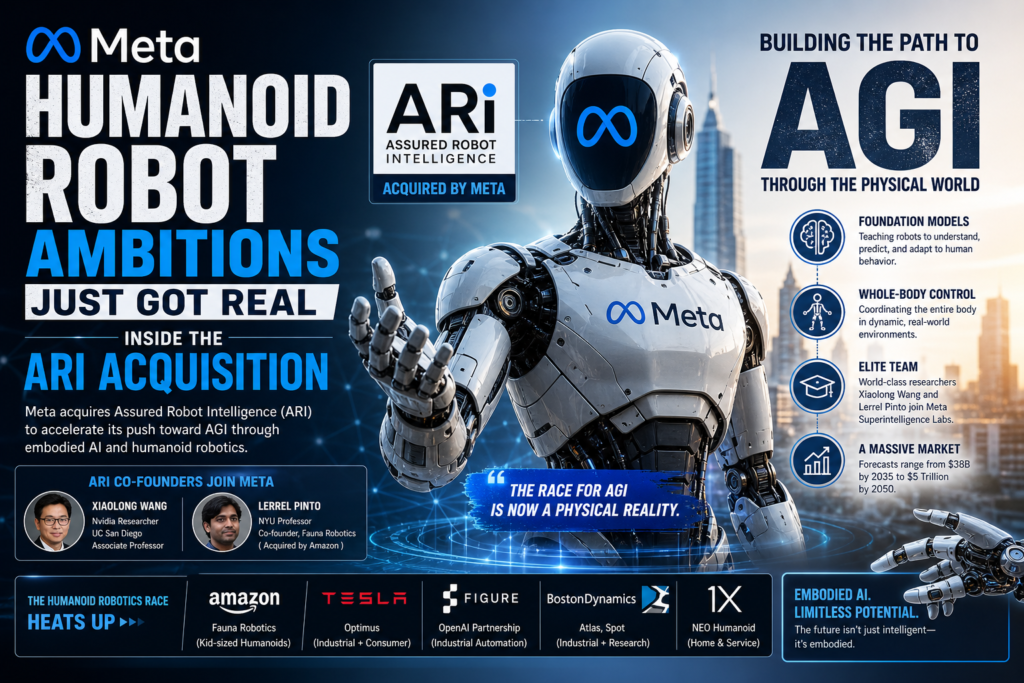
Meta has acquired Assured Robot Intelligence (ARI), a cutting-edge humanoid robotics startup, to accelerate its push into AI-powered physical robots — and this move signals that the race for artificial general intelligence (AGI) is no longer just a software war.
If you’re wondering why a social media company is buying a robotics firm, the answer is straightforward: the path to AGI runs through the physical world, and Meta humanoid robot development is now a strategic priority, not just a research curiosity.
What Is Assured Robot Intelligence (ARI)?
Definition: Assured Robot Intelligence (ARI) is a robotics startup that builds foundation models enabling humanoid robots to understand, predict, and adapt to human behaviors in complex, real-world environments.
Think of ARI’s technology as the “operating system” of the body — not just software that tells a robot to pick up a cup, but a model that learns how humans move, what they’re likely to do next, and how to adapt on the fly when the environment changes. The startup was focused specifically on enabling robots to perform whole-body humanoid control, covering everything from household chores to dynamic physical labor in unpredictable settings.
ARI had raised an undisclosed seed round from AIX Ventures, an AI-focused seed fund, before Meta came calling. The acquisition price was not disclosed, but the strategic value is unmistakable: Meta absorbed not just technology but an elite team of researchers at the frontier of robotic intelligence.
Why Meta Is Betting Big on Humanoid Robotics AI
The AGI Connection: Why Physical World Training Matters
Question: Why does a humanoid robot matter for building AGI?
Direct Answer: Many leading AI researchers now believe that training AI exclusively on internet data has hard limits — and that true intelligence will require robots learning through direct, physical interaction with the world.
This is the central bet behind Meta’s humanoid robot strategy. Today’s large language models learn from text, images, and video. But text cannot teach a model what it feels like to catch a falling object, navigate a crowded kitchen, or adjust grip based on surface texture. Embodied AI — AI that inhabits a physical body — learns from a richer, more grounded signal.
Meta’s own researchers have been working on humanoid robotics technology for years. A leaked internal memo from early 2025 revealed the company’s ambitions to build consumer-facing humanoid robots, complete with custom AI models and proprietary hardware. The ARI acquisition is the clearest confirmation yet that those ambitions are accelerating into a serious program.
What the Superintelligence Labs Division Signals
ARI’s founding team — along with all of its employees — will join Meta’s Superintelligence Labs, the company’s elite AI research division. This is not a typical acqui-hire placement in a product team. Superintelligence Labs is where Meta does its most ambitious, frontier-level AI research.
That placement tells us something important: Meta humanoid robot development is being treated as a core AGI research track, not a consumer gadget project. The company is investing in the foundational intelligence layer — the models, the learning algorithms, the self-improvement loops — that would power any future robot product.
Meta Humanoid Robot vs. the Competition
The humanoid robotics space has become one of the most competitive arenas in tech. Here’s how Meta’s position stacks up against key players following the ARI acquisition:
| Company | Key Asset | Robot Focus | AI Strategy |
|---|---|---|---|
| Meta | ARI acquisition, Superintelligence Labs | Consumer humanoid, whole-body control | Foundation models, physical world training |
| Amazon | Fauna Robotics acquisition (March 2026) | Kid-sized humanoid robots | Logistics + home assistance |
| Tesla | Optimus robot, in-house manufacturing | Industrial + consumer labor | End-to-end vertical integration |
| Figure AI | OpenAI partnership | Industrial labor automation | General-purpose manipulation |
| Boston Dynamics | Atlas, Spot | Industrial + research applications | Motion control, hardware excellence |
| 1X Technologies | NEO humanoid | Home and service environments | Data-first learning approach |
The pattern is clear: the biggest tech companies are racing to acquire robotics talent and foundational model expertise, rather than building from scratch. Meta’s ARI deal follows Amazon’s absorption of Fauna Robotics just weeks earlier — a signal that acquisition is now the fastest path to humanoid robotics capability.
The Founders Behind ARI: Who Meta Just Recruited
The ARI acquisition is as much about people as technology. The two co-founders joining Meta are genuinely world-class researchers:
- Xiaolong Wang — Previously a researcher at Nvidia and an associate professor at UC San Diego, Wang has earned a long list of prestigious academic and industry awards. His work sits at the intersection of reinforcement learning, computer vision, and robot locomotion.
- Lerrel Pinto — Previously a professor at NYU and co-founder of Fauna Robotics (the kid-sized humanoid startup that Amazon acquired in March 2026), Pinto is one of the most decorated researchers in robot learning. His work focuses on teaching robots to learn manipulation skills from minimal human supervision.
Together, Wang and Pinto bring a rare combination: deep expertise in foundation model design for robots and hands-on experience building startups that ship. Meta’s statement specifically noted the pair will lead efforts on “robot control and self-learning to whole-body humanoid control” — precisely the hardest unsolved problems in physical AI.
How Big Is the Humanoid Robotics Market?
Question: How large will the humanoid robotics market become?
Direct Answer: Market forecasts vary enormously — from $38 billion by 2035 (Goldman Sachs) to $5 trillion by 2050 (Morgan Stanley) — reflecting both the sector’s massive potential and the genuine uncertainty about timeline and adoption.
That spread is not a sign of analytical failure. It reflects the reality that humanoid robot adoption depends on several variables that are still unsettled:
- Cost per unit — High manufacturing costs currently price humanoids out of most consumer and small-business use cases.
- Task reliability — Robots that fail unpredictably in home or industrial settings will face major adoption barriers.
- Regulatory environment — Worker safety regulations and liability frameworks around autonomous robots are still being written.
- Foundation model quality — The intelligence layer determining whether a robot can generalize across new tasks is still an open research problem.
The ARI and Fauna Robotics acquisitions — happening weeks apart — suggest that major tech companies believe the market is close enough to maturity to justify large strategic investments now, even if mass consumer deployment remains years away.
What the Meta Humanoid Robot Push Means for the Future of AI
Embodied Intelligence as the New Frontier
The Meta humanoid robot strategy represents a broader shift in how the AI industry thinks about intelligence itself. For years, the dominant paradigm was scale: more data, more compute, more parameters. The scaling laws that drove GPT-4, Gemini, and Claude to remarkable capability also have diminishing returns when it comes to physical reasoning, spatial understanding, and real-world adaptability.
Embodied AI — robots that learn by doing — offers a qualitatively different training signal. When a Meta humanoid robot fails to stack plates without breaking them, that failure contains information that no amount of YouTube video training can replicate. The physical world is a teacher that text corpora simply cannot replace.(embodied AI development, humanoid robotics AI, ARI acquisition Meta, Meta robotics acquisition)
What “Whole-Body Humanoid Control” Actually Means
Definition: Whole-body humanoid control refers to an AI system’s ability to coordinate all parts of a humanoid robot’s body — arms, legs, torso, balance, grip strength — simultaneously, in response to a dynamic environment.
This is profoundly harder than it sounds. Most current robots excel at one narrow task: a robotic arm in a factory that welds precisely, or a wheeled robot that navigates warehouse floors. A humanoid designed for home environments must handle a kitchen, a staircase, a toddler’s toy on the floor, and a wet spill — all in the same afternoon.
ARI’s foundation model approach tackles this by training robots to predict and adapt to human behavior, not just execute pre-scripted motions. That adaptability is what separates a useful home robot from an expensive demo. (embodied AI development, humanoid robotics AI, ARI acquisition Meta, Meta robotics acquisition)
The Consumer Product Question
Even if Meta never releases a direct-to-consumer humanoid robot, the ARI acquisition still generates enormous value. The foundation models and training frameworks developed through this program will likely flow into:
- Meta’s AI research publications, reinforcing the company’s position as a leading AI lab
- Internal automation tools for Meta’s own data centers and physical operations
- Future hardware products that may not resemble a traditional humanoid but use the same underlying physical intelligence models
The consumer humanoid, if it ever arrives, would simply be the most visible application of a much deeper capability stack being built today.
Key Takeaways
- Meta acquired Assured Robot Intelligence (ARI) to accelerate its Meta humanoid robot program, bringing the ARI team into the Superintelligence Labs research division.
- ARI’s technology focuses on foundation models that allow humanoid robots to understand, predict, and adapt to human behavior in complex environments — a key unsolved problem in physical AI.
- Co-founders Xiaolong Wang and Lerrel Pinto are world-class robotics researchers who bring both academic prestige and startup execution experience to Meta’s AI organization.
- The humanoid robotics market is forecast to reach between $38 billion (Goldman Sachs, 2035) and $5 trillion (Morgan Stanley, 2050), with major uncertainty depending on cost, reliability, and regulation.
- Meta’s strategy is AGI-first, not product-first. The company believes that training AI models in the physical world through embodied robots is a necessary path to achieving machine intelligence that rivals or surpasses human capability.
- The acquisition race is intensifying: Amazon absorbed Fauna Robotics in March 2026, and Meta followed with ARI in May 2026 — signaling that humanoid robotics capability is becoming a prerequisite for any serious AGI contender.
Frequently Asked Questions
What is Meta’s humanoid robot called? Meta has not announced an official consumer product name. The program is being developed within the Superintelligence Labs division, and the ARI acquisition is focused on foundational research and model development rather than a named product launch.
Why did Meta acquire Assured Robot Intelligence? Meta acquired ARI to gain expertise in foundation models for humanoid robots — specifically, the ability to train robots to understand and adapt to human behavior in real-world environments. The acquisition also brings ARI’s co-founders, Xiaolong Wang and Lerrel Pinto, into Meta’s AI research team.
What is the difference between a humanoid robot and a traditional robot? A traditional robot typically performs a single, pre-programmed task in a controlled environment (such as a factory arm). A humanoid robot is designed to operate across a wide range of tasks in human environments, using a body and movement profile similar to a person — with the corresponding AI challenges that entails.
Is Meta building a consumer humanoid robot? Meta has not officially confirmed a consumer product. However, a leaked 2025 internal memo revealed that building a consumer-facing humanoid robot was under consideration. The ARI acquisition accelerates the underlying research regardless of whether a finished product is released.
Conclusion: Meta Humanoid Robot Signals the Next Phase of AI Evolution
The acquisition of Assured Robot Intelligence marks a defining moment in Meta’s long-term artificial intelligence roadmap. For years, the company was primarily associated with social media, digital advertising, virtual reality, and the metaverse. However, the latest Meta humanoid robot initiative proves that the company is now aggressively positioning itself at the center of the next technological revolution: embodied AI and physical machine intelligence.
The importance of this move goes far beyond a simple startup acquisition. By bringing ARI’s technology and research talent into its Superintelligence Labs division, Meta is making a clear statement to the market: future AI leadership will not be decided by software models alone. Instead, the next wave of innovation will depend on systems that can interact with the physical world, adapt in real time, and learn through experience. This is exactly where the Meta humanoid robot strategy becomes critically important.
Today’s leading AI models are undeniably powerful. They can generate text, create images, write code, and analyze vast datasets at extraordinary speed. Yet these systems remain fundamentally limited because they lack direct physical experience. A chatbot can describe how to hold a glass, but it cannot understand balance, grip force, or the friction of a slippery surface. This limitation is one of the strongest arguments for embodied intelligence, and it is precisely why the Meta humanoid robot project is attracting so much industry attention.
By investing in robotics foundation models, Meta is pursuing a much deeper layer of intelligence development. The company is not merely building a machine that can walk or lift objects. The real objective is to create systems capable of perception, motion, adaptation, and decision-making across unpredictable real-world environments. A successful Meta humanoid robot would combine language intelligence with physical reasoning, enabling AI systems to bridge the gap between digital knowledge and practical execution.
This is where ARI’s expertise becomes highly strategic. The startup specialized in whole-body humanoid control, an area considered one of the hardest challenges in robotics. Coordinating arms, legs, balance systems, spatial awareness, object interaction, and dynamic adaptation simultaneously is enormously complex. Unlike traditional robots built for narrow industrial tasks, a Meta humanoid robot must eventually function in human-designed environments filled with uncertainty, clutter, motion, and changing conditions.
Imagine a future where a Meta humanoid robot can organize a room, assist elderly users, carry groceries, manage repetitive household tasks, or collaborate with humans in semi-structured workplaces. None of these tasks are simple. Each requires generalization, memory, prediction, and physical adaptability. That is why the acquisition of ARI is not just about robotics hardware. It is about solving intelligence itself.
Another reason this development matters is timing. The robotics sector has entered a new competitive phase, with major technology companies rapidly consolidating expertise. Tesla continues to advance Optimus, Figure AI is scaling industrial robotics with strong AI partnerships, and Amazon has expanded its own robotics capabilities through acquisitions. In this context, the Meta humanoid robot initiative is both offensive and defensive. Meta cannot afford to remain absent from a field increasingly seen as essential to the future of AGI.
The placement of ARI’s team inside Superintelligence Labs further reinforces this point. This is not a side project or experimental hardware division. Superintelligence Labs represents Meta’s highest ambition in frontier AI research. By integrating humanoid robotics directly into that ecosystem, the company is effectively acknowledging that the Meta humanoid robot program is central to its broader intelligence goals.
From a market perspective, the long-term commercial opportunity is equally compelling. Analysts continue to debate how large the humanoid robotics market will become, but even conservative forecasts suggest enormous growth potential. Whether the market reaches tens of billions or several trillion dollars over the coming decades, the strategic importance is obvious. Companies that control the intelligence layer behind general-purpose robots could dominate entirely new categories of labor automation, service assistance, logistics, healthcare support, and consumer technology.
For Meta, this creates optionality. Even if a branded Meta humanoid robot never reaches mainstream consumer shelves, the company still benefits from the research outcomes. The robotics models, learning systems, simulation environments, and control architectures developed through this initiative could influence everything from AI assistants to future wearable devices, augmented reality systems, and enterprise automation tools.
There is also a broader industry implication worth emphasizing. The rise of the Meta humanoid robot reflects a philosophical shift in AI development. The previous decade was dominated by scale: more data, more parameters, and larger training runs. While scaling laws remain powerful, many researchers now believe intelligence cannot fully emerge from passive observation alone. Systems must interact, experiment, fail, recover, and adapt within the real world.
That is why embodied AI is becoming such a major frontier. A Meta humanoid robot does not simply process information—it acquires grounded knowledge through action. Every failed grasp, every navigation mistake, every balance correction produces valuable learning signals. This creates a richer feedback loop than text or video alone can provide. In practical terms, it means future AI systems may become dramatically more capable because they learn like agents, not archives.
Of course, substantial challenges remain. Hardware costs are still high, reliability is inconsistent, safety standards are evolving, and regulatory frameworks are far from mature. A widely deployed Meta humanoid robot will require breakthroughs in affordability, durability, battery efficiency, edge compute, and safety validation. Public trust will also be a determining factor, especially as humanoid systems move closer to homes and personal spaces.
Still, transformative technologies rarely begin in mature form. The smartphone, cloud computing, autonomous vehicles, and generative AI all experienced years of skepticism before reaching mass adoption curves. The same pattern may apply here. What matters is not whether the first Meta humanoid robot launches tomorrow, but whether Meta is building the capabilities needed for the decade ahead. Based on this acquisition, the answer appears to be yes.
Ultimately, the ARI acquisition confirms something much bigger than one corporate deal. It signals that the future of AI is becoming physical. Intelligence is no longer confined to screens, servers, or chat interfaces. It is moving into bodies, motion systems, sensors, and environments that demand real-world adaptation. The Meta humanoid robot initiative is one of the clearest signs that this transition is already underway.
As the competition for AGI intensifies, the companies most likely to lead may not be those with only the best language models, but those capable of combining digital intelligence with physical competence. In that race, the Meta humanoid robot project gives Meta a serious foothold.
Meta’s ambitions are no longer limited to connecting people online. With the Meta humanoid robot program gaining momentum through ARI, the company is now pursuing a far more ambitious goal: building AI systems that can understand, move through, and eventually operate within the human world itself. That is not just a new product direction—it is a new chapter in the evolution of artificial intelligence.