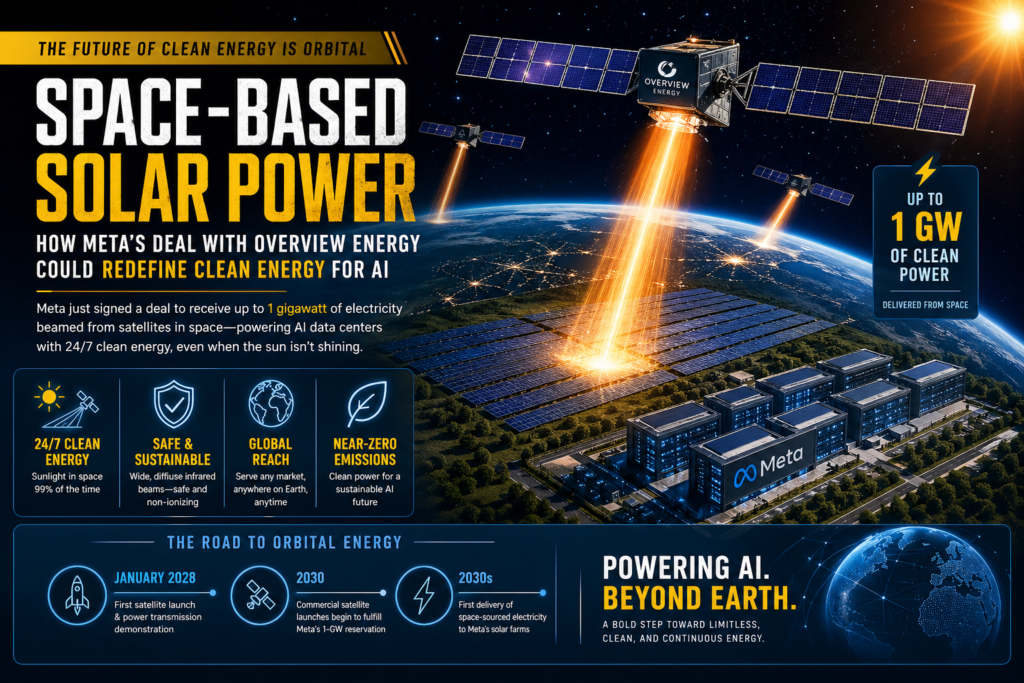
Meta just signed a deal to receive up to 1 gigawatt of electricity beamed from satellites in space — making space-based solar power one of the most ambitious bets in the history of clean energy. If it works, AI data centers could run on renewable energy around the clock, even when the sun isn’t shining.
The company inked a capacity reservation agreement with startup Overview Energy on April 27, 2026, marking the first commercial contract of its kind. The deal signals a turning point: the energy demands of AI are so enormous that tech giants are now looking beyond Earth for solutions.
What Is Space-Based Solar Power?
Space-based solar power (SBSP) is the concept of collecting solar energy in orbit and transmitting it back to Earth as light or electromagnetic waves, where it is converted into electricity.
Unlike terrestrial solar panels, which stop generating power when the sun sets or clouds block the sky, satellites in high orbit are exposed to sunlight roughly 99% of the time. This makes the energy source continuous and highly predictable — a major advantage over ground-level renewables that require expensive battery storage to bridge supply gaps.
The expansion of this idea beyond theory into commercial viability is what makes the Meta–Overview Energy agreement historically significant. Space-based solar power has been studied by NASA and the European Space Agency for decades, but it has never been deployed at commercial scale. Overview Energy is betting that a combination of cheaper satellite launches, improved photovoltaic materials, and clever beam design can finally make SBSP economically viable.
The Meta–Overview Energy Deal Explained
What Meta Agreed To
Meta signed what Overview Energy calls a “capacity reservation agreement” for up to 1 gigawatt of power delivered via the startup’s spacecraft. The announcement does not confirm whether money changed hands upfront, but the scale of the commitment is extraordinary: 1 gigawatt is roughly equivalent to the output of a large nuclear power plant.
To structure the contract, Overview developed a new unit of measurement — the megawatt photon — defined as the amount of light energy required to generate one megawatt of electricity on the ground. This metric will govern how power delivery is tracked and billed under the agreement.
Meta’s motivation is straightforward. In 2024, Meta’s data centers consumed over 18,000 gigawatt-hours of electricity TechCrunch — enough to power more than 1.7 million American homes for a year. The company has committed to building 30 gigawatts of renewable power capacity, with industrial-scale solar a central pillar of that plan. Space-based solar power is being explored as the piece that solves solar’s most persistent problem: darkness.
How the Technology Works
Overview’s approach is deliberately designed to sidestep the dangers and regulatory nightmares associated with earlier space solar proposals, which relied on high-powered lasers or microwave beams capable of causing serious harm if misdirected.
Instead, Overview uses wide, diffuse infrared beams that illuminate existing ground-based solar farms. According to CEO Marc Berte, the beam is safe enough to look at directly with no ill effects. The satellites convert solar energy collected in space into near-infrared light, then transmit it toward terrestrial photovoltaic arrays, which are already optimized to convert light into electricity. No new receiving infrastructure is needed — just a large enough solar farm on the ground.
Why AI Data Centers Are Driving This Deal
The Electricity Appetite of AI Is Unprecedented
AI model training and inference require enormous, sustained compute workloads. Every query processed by a large language model, every image generated, every recommendation served — all of it runs on data centers that consume electricity 24 hours a day, 7 days a week.
The challenge for renewable-powered data centers is not a shortage of solar or wind energy during the day. The challenge is continuous, dispatchable power at night and during low-generation periods. Battery storage at the required scale is expensive, land-intensive, and not yet proven at gigawatt-hour levels. Grid power often means drawing on fossil fuel generation when renewables fall short.
This is precisely the gap that space-based solar power is designed to fill. Because satellites in geosynchronous orbit remain fixed above the same point on Earth, they can beam energy at a solar farm the moment the sun sets at that location — compensating for the exact hours when terrestrial generation drops to zero.
Meta’s Scale Makes It an Ideal Partner for Emerging Technology
Few companies have both the capital to absorb long-term risk and the electricity demand to justify it. Meta fits both criteria. Its willingness to sign a capacity reservation agreement now — with commercial delivery not expected until the 2030s — provides Overview Energy with the commercial credibility needed to raise funding and iterate on its technology.
This is the same dynamic that helped accelerate commercial spaceflight: NASA’s early contracts with SpaceX gave the latter the runway to develop reusable rockets. Meta’s agreement with Overview Energy may play a similar catalytic role for space-based solar power.
Space-Based Solar Power vs. Traditional Alternatives
How does space-based solar power compare to the other options available to data center operators? The table below breaks down the key trade-offs.
| Energy Solution | 24/7 Availability | Carbon Emissions | Land Use | Cost Maturity | Scalability |
|---|---|---|---|---|---|
| Space-Based Solar Power | ✅ Yes (orbital) | 🟢 Near-zero | 🟢 Low (no new land) | 🔴 Emerging / High | 🟡 High (but unproven) |
| Terrestrial Solar + Battery | 🟡 Partial (storage gap) | 🟢 Near-zero | 🔴 High | 🟡 Moderate | 🟢 Proven |
| Nuclear (Advanced SMRs) | ✅ Yes | 🟢 Near-zero | 🟡 Moderate | 🟡 Emerging | 🟡 Limited pipeline |
| Natural Gas (Grid backup) | ✅ Yes | 🔴 High | 🟢 Low | 🟢 Mature | 🟢 Proven |
| Offshore Wind | 🟡 Variable | 🟢 Near-zero | 🟢 Low | 🟡 Moderate | 🟡 Moderate |
Key takeaway: Space-based solar power is the only solution that combines near-zero emissions, minimal additional land use, and continuous 24/7 availability — but it is also the least mature technology. Every other option trades off at least one of these three properties.
How Overview Energy’s Satellites Will Actually Work
The Infrared Beam Approach
Overview’s core innovation is targeting existing solar infrastructure rather than building dedicated receiving stations on the ground. This is a critical design decision.
Previous SBSP proposals required purpose-built rectenna arrays — enormous, expensive receiving installations that would need to be constructed from scratch. By instead directing a wide infrared beam at conventional photovoltaic panels, Overview can piggyback on billions of dollars of already-deployed solar infrastructure. The company estimates that target farms need to be “on the order of hundreds of megawatts” in size to receive the beam effectively.
The infrared wavelength is chosen because silicon-based solar panels are particularly responsive to near-infrared light, and because this frequency of electromagnetic radiation is non-ionizing and poses no biological hazard at the beam intensities involved. This dramatically simplifies the regulatory approval pathway compared to microwave or laser transmission proposals.
The Geosynchronous Fleet
Overview plans to deploy a constellation of 1,000 spacecraft in geosynchronous orbit — a ring approximately 35,786 kilometers above the equator where each satellite remains stationary relative to a fixed point on Earth. This orbital choice is deliberate.
Geosynchronous orbit means each satellite maintains a permanent line-of-sight relationship with the solar farms it serves. As Earth rotates and those farms enter night, the satellites above them continue receiving sunlight and can immediately begin transmitting. The planned initial deployment will cover a geographic arc from the US West Coast to Western Europe, targeting the world’s densest cluster of data center infrastructure.
Berte expects each spacecraft to operate for more than 10 years once deployed, providing a long asset life that improves the economics of the system over time. The company has already demonstrated power transmission to the ground from an aircraft, and plans to launch its first orbital demonstration satellite in January 2028.
What Are the Key Challenges for Space-Based Solar Power?
The primary challenges facing space-based solar power are cost, launch cadence, and regulatory approval for large-scale beam transmission operations.
Here is a summary of the most significant hurdles Overview Energy must navigate:
- Launch cost: Placing 1,000 satellites in geosynchronous orbit requires hundreds of rocket launches over several years. Even at dramatically reduced launch prices, the capital cost will run into billions of dollars.
- Satellite manufacturing at scale: Building 1,000 identical spacecraft is a manufacturing challenge of the first order. Overview will need to establish or contract industrial production lines for its hardware.
- Regulatory approval: While the diffuse infrared beam approach avoids the most dangerous hazards of earlier designs, transmitting energy from space to Earth at gigawatt scale will require novel international regulatory frameworks covering spectrum allocation, orbital slots, and safety certification.
- Grid integration: Delivering space-sourced electricity reliably into the grid requires integration with utility operators and potentially new interconnection agreements.
- Timeline risk: Overview’s first commercial satellite launches are planned for 2030. Any delay in the launch cadence, technology maturation, or regulatory approval extends the timeline before Meta sees a single megawatt of delivered power.
Despite these challenges, Overview’s strategy of targeting existing solar farms and using a safe, wide beam substantially de-risks the technology compared to earlier proposals. The deal with Meta provides both financial signal and a guaranteed early customer.
What This Means for the Future of Clean Energy
A New Asset Class for Energy Markets
Overview CEO Marc Berte articulated the broader strategic vision clearly: satellites in geosynchronous orbit can serve multiple energy markets simultaneously, rotating their beam delivery as Earth turns below. “There’s a big difference between being in any one energy market, and being in all of the energy markets,” Berte told TechCrunch.
This is a fundamentally different model from any terrestrial energy asset. A wind farm in Texas serves Texas. A fleet of geosynchronous space-based solar power satellites can serve California at 9pm, then shift to serve London at 2am, then Sydney at 7am — continuously optimizing delivery to wherever electricity is most valuable.
If the economics work, this transforms space-based solar power from a novelty into a dispatchable, globally fungible energy commodity.
The AI-Energy Nexus Is Reshaping Infrastructure Investment
The Meta–Overview deal is the latest in a series of extraordinary energy commitments by AI-driven technology companies. Microsoft has committed to restarting Three Mile Island’s nuclear reactor. Google has signed agreements for advanced geothermal power. Amazon has backed small modular nuclear reactors.
In each case, the driver is the same: AI workloads require reliable, continuous, carbon-free electricity at a scale that existing renewable infrastructure cannot yet deliver without significant storage or backup generation.
Space-based solar power represents one of the most ambitious answers to this problem. It is not a guaranteed solution — the technology must still prove itself at orbital scale, and the economics must withstand the scrutiny of commercial deployment. But for the first time, a major technology company has placed a real commercial bet on the concept, providing the funding signal and anchor contract that could define whether SBSP becomes a pillar of the 21st-century energy system or remains a fascinating experiment.
What Happens Next
Watch for these milestones as indicators of whether the Meta–Overview deal will mature into delivered power:
- January 2028: Overview’s first satellite launch to low Earth orbit for power transmission demonstration.
- 2030: Planned beginning of commercial satellite launches to fulfill Meta’s 1-gigawatt reservation.
- 2030s: Potential first delivery of space-sourced electricity to Meta solar farms.
The window between now and 2030 will determine whether space-based solar power graduates from concept to commercial infrastructure — and whether the most energy-hungry industry in history has found its most audacious solution.
Frequently Asked Questions (FAQ) on Space-Based Solar Power
1. What is Space-Based Solar Power and why is it important?
Space-Based Solar Power (SBSP) is a technology that collects sunlight in space using satellites and transmits it to Earth as energy. Unlike traditional solar panels on the ground, these satellites operate in orbit where sunlight is almost constant, making energy production continuous. This is important because it solves one of the biggest limitations of renewable energy—intermittency. For industries like AI, where data centers require uninterrupted electricity, SBSP could provide a stable, carbon-free power source. It represents a major shift toward sustainable infrastructure, especially as global energy demand continues to rise rapidly.
2. How does space-based solar power actually work?
The process begins with satellites equipped with advanced solar panels capturing sunlight in space. This energy is then converted into electromagnetic radiation—often in the form of infrared light or microwaves—and transmitted toward Earth. On the ground, solar farms or receiving stations capture this energy and convert it into usable electricity. In the case of newer approaches like Overview Energy’s, the transmitted beam is directed at existing solar panels, eliminating the need for specialized infrastructure. This makes the system more scalable and cost-efficient compared to earlier designs.
3. Why is space-based solar power better than traditional solar energy?
Traditional solar power depends on weather conditions and daylight, which means energy generation stops at night or drops during cloudy periods. SBSP, on the other hand, operates in orbit where sunlight is available about 99% of the time. This allows it to deliver power continuously, including during nighttime on Earth. Additionally, it reduces the need for large-scale battery storage, which can be expensive and resource-intensive. The ability to provide 24/7 clean energy gives SBSP a significant advantage, especially for high-demand sectors like artificial intelligence and cloud computing.
4. Is space-based solar power safe for humans and the environment?
Safety is a major concern, but modern SBSP designs are addressing it effectively. Instead of using high-intensity lasers, newer systems rely on low-energy, diffuse infrared beams or microwaves that are non-ionizing and safe at controlled levels. These beams are designed to spread over a wide area, reducing the risk of harm to people, animals, or aircraft. Additionally, because SBSP produces no greenhouse gas emissions during operation, it is environmentally friendly. However, regulatory frameworks and long-term safety studies will still be essential before large-scale deployment.
5. How will space-based solar power support AI data centers?
AI data centers consume enormous amounts of electricity because they run continuously and process massive workloads. Renewable sources like wind and ground-based solar cannot always meet this demand due to their variability. SBSP offers a solution by providing consistent, round-the-clock power without interruptions. This ensures that AI systems can operate efficiently without relying on fossil fuels as backup. As AI adoption grows globally, reliable clean energy sources like SBSP will become critical to maintaining sustainable operations.
6. What are the biggest challenges facing space-based solar power?
Despite its promise, SBSP faces several significant challenges. The cost of launching and maintaining satellites in orbit remains high, although it is decreasing with advancements in space technology. Manufacturing thousands of satellites at scale is another complex task. Regulatory approval is also a hurdle, as transmitting energy from space requires international coordination and safety standards. Additionally, integrating this power into existing electrical grids may require new infrastructure and agreements. These challenges mean that widespread adoption is still years away.
7. When will space-based solar power become commercially available?
Most experts believe that SBSP will begin early commercial deployment in the 2030s. Companies like Overview Energy are planning demonstration missions as early as 2028, with full-scale satellite launches expected around 2030. However, timelines may shift depending on technological progress, funding, and regulatory approvals. While it won’t replace traditional energy sources immediately, SBSP is likely to complement existing renewable systems and gradually scale up over time.
8. Can space-based solar power replace all other energy sources?
While SBSP has enormous potential, it is unlikely to completely replace all other energy sources in the near future. Instead, it will likely become part of a diversified energy mix that includes terrestrial solar, wind, nuclear, and other renewables. Its main advantage lies in providing continuous, reliable power, which can fill gaps left by intermittent sources. Over time, as the technology matures and costs decrease, SBSP could play a much larger role in global energy production.
9. Why are companies like Meta investing in this technology?
Tech companies such as Meta are investing in SBSP because their energy needs are growing rapidly due to AI and cloud computing. Traditional renewable solutions alone cannot guarantee uninterrupted power at the scale required. By investing early, these companies gain access to future energy sources that could provide a competitive advantage. Such investments also help accelerate innovation and bring the technology closer to commercial reality.
10. What does the future hold for space-based solar power?
The future of SBSP looks promising but uncertain. If technical and economic challenges are successfully addressed, it could revolutionize how energy is produced and distributed globally. It may enable a new kind of energy market where power is delivered from space to wherever it is needed most. This would not only support industries like AI but also contribute significantly to reducing global carbon emissions. Ultimately, SBSP represents one of the most ambitious and forward-thinking solutions to the world’s growing energy demands.
Meta’s bet on space-based solar power is either the most visionary infrastructure investment in clean energy history — or the most ambitious reminder that solving the AI energy crisis requires us to think beyond the planet. Either way, the race to power artificial intelligence has officially left the atmosphere.