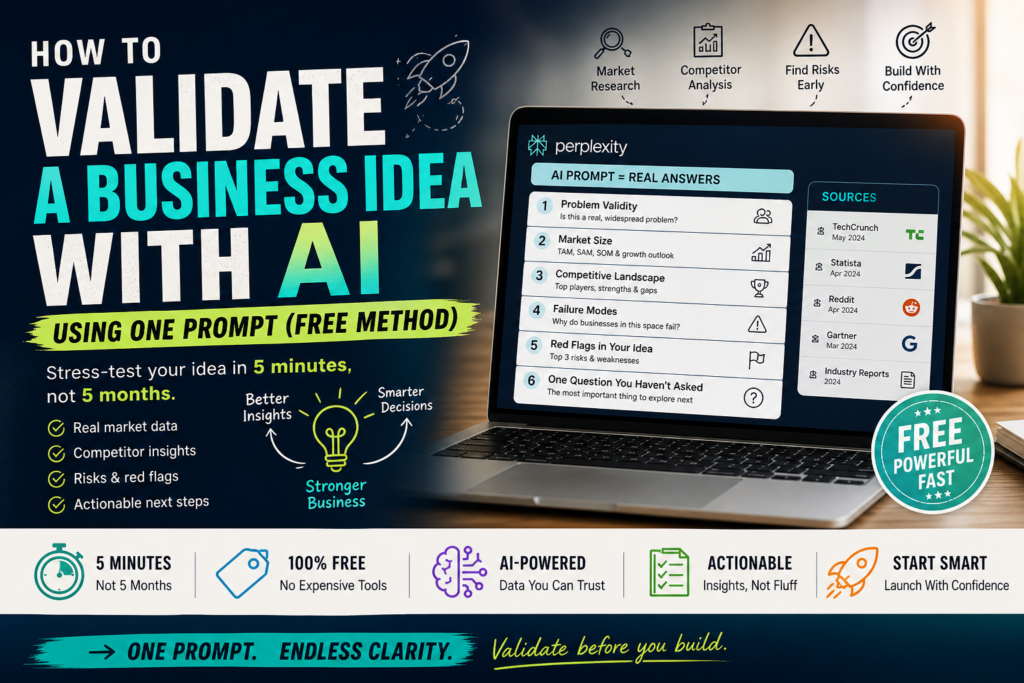
You can validate a business idea with AI in under five minutes — for free — using a single, well-crafted prompt in Perplexity AI. No expensive consultants, no months of surveys, no guesswork. This guide shows you exactly how to do it, what to look for in the results, and how to go deeper when the first answer raises more questions. validate business idea with ai.
Why Traditional Business Validation Is Broken
Most entrepreneurs fall into one of two traps: they either spend months building a product before talking to a single customer, or they run informal polls among supportive friends who tell them what they want to hear. Neither approach is real validation.
Traditional market research — focus groups, paid surveys, competitive analysis reports — costs thousands of dollars and weeks of calendar time. By the time the data arrives, the market has shifted or the founder has already lost momentum.
The promise of AI business idea validation isn’t that it replaces real customers. It’s that it replaces the expensive, slow, biased first pass. It lets you stress-test your assumptions before you’ve spent a dollar on anything else.
What It Means to Validate a Business Idea with AI
Definition: To validate a business idea with AI means using a large language model or AI-powered search tool to systematically pressure-test your core assumptions — about the problem, the market, the competition, and the go-to-market approach — before committing time or money.
This is different from simply asking an AI “is this a good idea?” That question invites flattery. A well-designed stress-test prompt instead asks the AI to argue against your idea, surface overlooked risks, benchmark it against existing competitors, and identify gaps in your thinking. (validate business idea with ai, AI business idea validation, Perplexity AI business prompt, startup idea validation, business idea market research)
AI as a Stress-Test Engine, Not Just a Search Tool
When you use a tool like Perplexity AI — which combines a large language model with live web search — you’re not just getting a static knowledge dump. You’re getting a synthesis of current market data, recent news, competitor landscapes, and common failure patterns, all assembled in response to your specific prompt.
That’s the difference between asking an AI “tell me about the meal kit market” and asking it to validate a business idea with AI in a structured, adversarial way. One returns a Wikipedia summary. The other returns a usable intelligence brief.
The One-Prompt Framework: How It Works
The core insight behind this approach is that AI systems — especially retrieval-augmented ones like Perplexity — are exceptional at synthesizing multi-source information quickly. When your prompt is structured as a set of discrete, answerable questions, you get modular, actionable outputs rather than vague encouragement.
The framework is built around five dimensions every strong business idea must survive:
- Problem validity — Does the problem actually exist at scale?
- Market size — Is the market large enough to build a real business?
- Competitive landscape — Who else is solving this, and how?
- Unfair advantage — Why would customers choose you over existing alternatives?
- Failure modes — What are the most common reasons ideas like this die?
The Anatomy of a High-Quality Stress-Test Prompt
A weak prompt produces a cheerleader. A strong prompt produces a sparring partner. The difference comes down to four things: (validate business idea with ai, AI business idea validation, Perplexity AI business prompt, startup idea validation, business idea market research)
- Specificity: The more specific your idea, the more specific the feedback. Don’t say “a fitness app.” Say “a subscription app that gamifies strength training for women over 40 in Tier 2 Indian cities.”
- Adversarial framing: Explicitly ask the AI to argue against you. Tell it to assume you’re wrong and find out why.
- Multi-part structure: Break the request into numbered sub-questions so the AI returns organized, passage-level answers rather than a wall of text.
- Source grounding: In Perplexity specifically, request that it cite recent sources. This separates current data from outdated training knowledge.
The Prompt Template (Copy & Use)
Here is the complete stress-test prompt. Replace the bracketed section with your own idea description:
Prompt:
I have a business idea and I want you to stress-test it like a skeptical investor. Do not try to encourage me — assume I’m wrong and help me figure out where.
My idea: [Describe your business idea in 2–3 sentences. Include who the customer is, what problem you’re solving, and how you plan to charge for it.]
Please answer each of the following questions with data and sources where possible:
- Problem validity: Is this a real, widespread problem? Are people actively complaining about it online or spending money trying to solve it today?
- Market size: What is the estimated size of this market (TAM/SAM/SOM)? Is it growing or shrinking?
- Competitive landscape: Who are the top 5 existing solutions? What do they do well? Where do they fall short?
- Failure modes: What are the most common reasons businesses in this category fail? Find specific examples if possible.
- Red flags in my idea: Based on all of the above, what are the 3 biggest weaknesses or risks in my specific concept?
- One question I haven’t asked: What is the most important thing I haven’t considered that I should investigate next?
This prompt is engineered to validate a business idea with AI in a way that produces structured, independently useful sections — each of which can be read on its own, saved, and acted upon.
How to Run This in Perplexity AI (Step by Step)
Perplexity AI is free to use at perplexity.ai (an account is optional but recommended for saving searches). Here’s how to get the best results:
Step 1: Go to perplexity.ai and start a new thread.
Step 2: Set the focus to “Web” (not “Academic” or “YouTube”) so it pulls current market data from news sources, forums, company websites, and industry reports.
Step 3: Paste your completed prompt with your specific idea filled in. Be as specific as possible in the idea description — vague inputs produce vague outputs.
Step 4: Review the cited sources. Perplexity shows numbered citations inline. Click through to verify the quality of the sources backing each claim. A competitor analysis grounded in a TechCrunch article from this year is worth more than one drawn from a five-year-old blog post.
Step 5: Use the follow-up thread. Don’t treat the first response as final. Perplexity maintains conversation context. Use the follow-ups listed at the end of this article to go deeper on whatever area showed the most risk.
How to Interpret Your Results
When you validate a business idea with AI, the output is only as useful as your ability to interpret it critically. Here’s a simple framework for reading what comes back. (validate business idea with ai, AI business idea validation, Perplexity AI business prompt, startup idea validation, business idea market research)
Green Flags vs. Red Flags
| Signal | Green Flag | Red Flag |
|---|---|---|
| Problem validity | Multiple forum threads, active subreddits, recent news coverage | No evidence of people complaining or paying to solve it |
| Market size | Growing market, multiple funded players, rising search trends | Flat or declining market, highly consolidated incumbents |
| Competition | Fragmented market with clear gaps | One dominant player with network effects or switching costs |
| Failure modes | Failures were due to execution, not the idea itself | Failures were structural (regulatory, unit economics, timing) |
| AI red flags | Risks are addressable with differentiation or capital | Risks are fundamental to the category |
A response with two or more red flags doesn’t mean kill the idea — it means you’ve found the most important questions to answer before you invest further.
AI Validation vs. Traditional Market Research: A Comparison
Understanding where to validate a business idea with AI fits into your research stack helps you use it well — and avoid over-relying on it.
| Dimension | AI Prompt (Perplexity) | Paid Surveys | Customer Interviews | Competitor Analysis Firm |
|---|---|---|---|---|
| Cost | Free | $500–$5,000 | Free–$1,000 | $5,000–$50,000 |
| Speed | 5 minutes | 1–3 weeks | 2–4 weeks | 4–12 weeks |
| Data recency | Live web data | Depends on panel | Current | Often 6+ months old |
| Depth | Medium | Medium | High | Very high |
| Bias risk | Low (adversarial framing) | High (leading questions) | Medium (social desirability) | Low |
| Best for | First-pass stress test | Quantitative validation | Emotional drivers | Strategic decisions |
The AI prompt wins on speed and cost. Traditional methods win on depth and primary data. Use AI to validate a business idea first; use traditional research to confirm what the AI flagged as important.
Limitations: What AI Business Validation Can’t Tell You
To validate a business idea with AI is to get a powerful first filter — not a complete answer. Here’s what it cannot reliably surface:
- Emotional purchase drivers. Why people actually buy (status, fear, identity) often doesn’t show up in market reports or web text. Customer interviews remain irreplaceable for this.
- Localized or niche signals. If your idea targets a hyperlocal or low-internet-penetration market, AI will have limited data to draw from.
- Proprietary data. Competitor internal metrics, unpublished research, and private community conversations are invisible to any AI system.
- Your personal execution advantage. Whether you specifically can build and sell this is a judgment no AI can make. Founder-market fit is a human call.
- Regulatory nuance. For health, fintech, or legal-adjacent ideas, AI can flag that regulation exists but cannot give you legal advice on how it applies to your specific model.
Use AI as the starting line, not the finish line. It tells you where to dig — not whether to start.
Going Deeper — 5 Follow-Up Prompts After Your First Run
After your initial stress-test, use these follow-up prompts in the same Perplexity thread to validate a business idea with AI at a deeper level:
- On competition: “Of the competitors you mentioned, which ones have raised money in the last 18 months and what problem did investors say they were solving?”
- On the customer: “What are the top 10 phrases people use when they complain about [core problem] on Reddit, Twitter, and product review sites?”
- On pricing: “What pricing models are competitors using and which ones have changed their pricing recently? What does that signal?”
- On timing: “Why hasn’t this idea succeeded before? Are there any failed startups in this space and what went wrong?”
- On the wedge: “If I had to start with one specific customer segment and one specific use case to get my first 100 customers, what would you recommend based on the competitive gaps you found?”
Each of these prompts is designed to extract a specific, modular insight — the kind of structured, answer-first response that’s most actionable.
Putting It All Together: Your 30-Minute Validation Sprint
Here’s how to run a complete AI business idea validation session in under 30 minutes:
- Minutes 1–5: Write your idea description. Be ruthlessly specific about the customer, the problem, the revenue model, and the geography.
- Minutes 5–10: Run the main stress-test prompt in Perplexity. Read the full response once without reacting.
- Minutes 10–20: Go back through each section. For every claim, check the cited source. Mark the top 2 risks the AI identified.
- Minutes 20–30: Run 2–3 of the follow-up prompts above, focused on your top risks. Save the full thread for reference.
At the end of 30 minutes, you should have a clear picture of the strongest and weakest assumptions in your idea — and a short list of the next questions to answer through real customer conversations.
Final Thoughts
The single biggest mistake first-time founders make is spending months building before they know if anyone wants what they’re building. The second biggest mistake is validating only with people who want to be supportive.
The ability to validate a business idea with AI changes the calculus. It gives you an adversarial, data-grounded first look at your concept in minutes and for free. It won’t replace talking to real customers — nothing does — but it will make those conversations sharper, faster, and more focused on what actually matters.
The prompt in this guide is a starting point. Customize it, push back on the AI’s answers, and use the follow-ups to go deeper. The founders who do this consistently arrive at customer conversations with better hypotheses and leave them with better data.
Start with the prompt. Let the AI poke holes in your idea before the market does.
Frequently Asked Questions
Can I use this method with ChatGPT instead of Perplexity? Yes, but with limitations. ChatGPT (without plugins or browsing) draws only from training data and cannot access current market data or cite live sources. Perplexity’s live web search makes it significantly better for business validation where recency matters.
Is this approach only for tech startups? No. The prompt works for any business concept — brick-and-mortar, e-commerce, service businesses, creator businesses, or SaaS. The key is to be specific about your customer and market geography in your idea description.
How often should I re-run the validation? Run a fresh validation whenever your core assumptions change significantly — when you pivot the target customer, change the pricing model, or enter a new geography. Markets move; your validation should move with them.
What if the AI is overly negative? Treat it as data, not a verdict. AI stress-testing is calibrated to find problems. If the AI identifies five risks but you can credibly address four of them, that’s actually a useful outcome — you now know where to focus.
Bottom Line: Why You Should Validate Business Idea With AI Before Building Anything
In today’s fast-moving startup ecosystem, the ability to validate business idea with AI has become one of the smartest advantages available to founders, freelancers, creators, and entrepreneurs. Instead of spending months building a product nobody wants, founders can now run a quick validation sprint using modern AI tools and get meaningful insights in minutes. This shift is changing how early-stage businesses approach risk, research, and decision-making.
The biggest benefit of learning how to validate business idea with AI is speed. Traditional validation methods often involve expensive consultants, slow surveys, or biased feedback from friends and family. In contrast, AI tools like Perplexity AI can instantly analyze web data, competitors, trends, and user pain points. This makes AI business idea validation accessible even for bootstrapped founders or solo entrepreneurs with zero research budget.
A structured AI workflow also helps founders think more critically. Instead of asking vague questions like “Is this a good startup idea?”, using a strong Perplexity AI business prompt forces you to break your concept into practical layers: problem validation, market size, competitor gaps, pricing opportunities, and business risks. This is what makes AI especially powerful for startup idea validation. It doesn’t magically decide your future, but it helps you identify weak assumptions before they become expensive mistakes.
Another major reason to validate business idea with AI is objectivity. Human feedback is often emotional, polite, or incomplete. AI, especially when prompted with adversarial instructions, can challenge your thinking and highlight flaws you may not notice. This makes it an excellent first step before conducting real customer interviews or investing in deeper business idea market research.
That said, AI should not replace direct customer conversations. No algorithm can fully capture emotional buying triggers, niche community behavior, or founder execution ability. The best strategy is hybrid: start with AI for fast filtering, then move to real-world validation. This approach combines the speed of automation with the depth of human insight.
For entrepreneurs wondering how to validate a business idea with AI, the process is now surprisingly simple. Define your audience, explain the problem clearly, outline your pricing model, and run a structured prompt through an AI-powered search engine. Within minutes, you can gather enough information to decide whether to move forward, pivot, or kill the idea entirely.
The rise of free AI tools for entrepreneurs is leveling the playing field. A founder no longer needs venture capital or research teams to make informed early decisions. With the right framework, anyone can run meaningful validation from a laptop. This is why more founders are searching for the best prompt for startup validation before writing code, building landing pages, or spending on ads.
Ultimately, founders who consistently validate business idea with AI reduce waste, improve focus, and increase their odds of building something people actually want. It helps transform guesswork into a more structured decision-making process.
So before you build your MVP, hire developers, or spend on marketing, pause and run an AI validation sprint first. Use one strong prompt, review the evidence, challenge your assumptions, and let data guide your next move. In 2026 and beyond, founders who learn to validate business idea with AI early will move faster, make better bets, and build with far greater confidence.