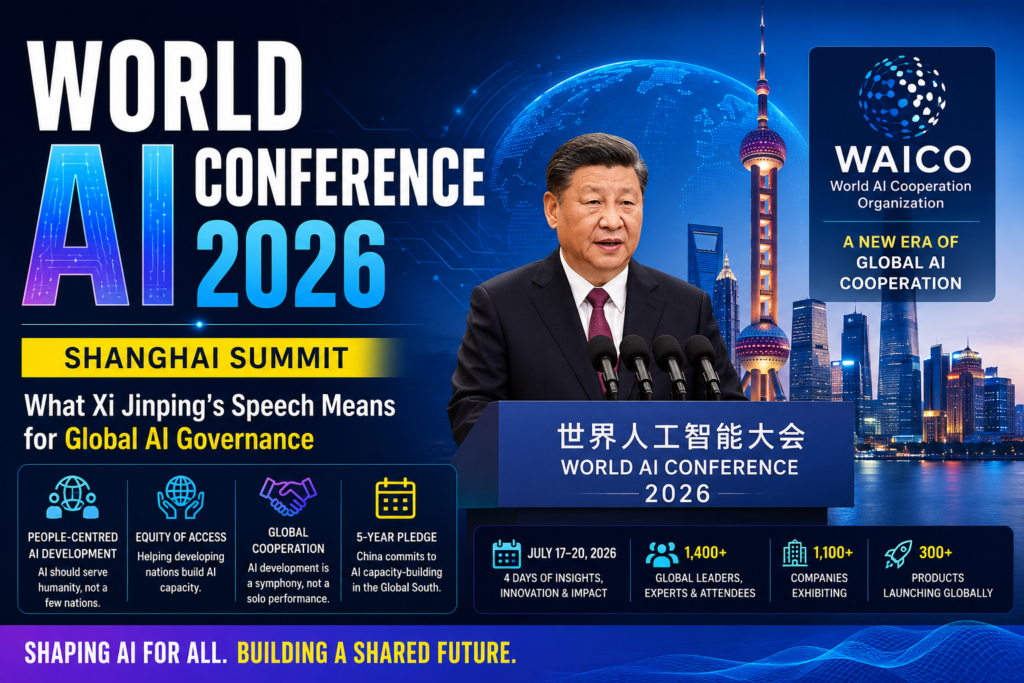
The World AI Conference 2026 opened in Shanghai on July 17 with Chinese President Xi Jinping delivering the keynote address in person for the first time since the event launched in 2018 — a move that signals Beijing is now treating artificial intelligence as a top-tier national and diplomatic priority. In his speech, Xi pledged that China would support AI capacity-building in developing nations over the next five years while pushing a “people-centred” model of AI development positioned as an alternative to the US approach.
If you’re trying to understand what happened at this year’s summit, why it matters, and how it fits into the broader US-China AI rivalry, this guide breaks down everything in plain language — from what Xi actually said, to the new institution he unveiled, to what it means for businesses and policymakers watching the global AI governance landscape shift in real time.
A Brief History of the World AI Conference
Shanghai has hosted this annual technology summit every year since 2018, building it up gradually from a regional tech showcase into one of the largest AI industry gatherings anywhere in the world. In earlier years, the event served mainly as a platform for Chinese tech companies, research institutes, and provincial governments to display new products and forge partnerships, with national leadership represented at arm’s length. Premier Li Qiang, China’s second-ranking official, opened both the 2024 and 2025 editions, while Xi Jinping limited his involvement to a congratulatory letter.
That pattern changed this year. Xi’s decision to personally deliver the keynote tells China’s ministries, state banks, and provincial governments that artificial intelligence has moved to the very top of the national agenda — no longer a portfolio item delegated to the premier’s office, but a subject the country’s top leader wants directly associated with his own name and legacy.
What Happened at the World AI Conference 2026?
This year’s summit, held alongside a High-Level Meeting on Global AI Governance, runs from July 17 to July 20 in Shanghai. The edition is different from previous ones for one simple reason: Xi Jinping showed up in person, for the first time in the event’s eight-year history.
Key Themes from Xi Jinping’s Keynote
Xi’s address centered on a handful of recurring ideas:
- A “people-centred” approach to AI — framing technology development as something that should serve humanity broadly, not just a handful of powerful nations or companies.
- Equity of access — a commitment to help developing countries build AI capacity so the technology doesn’t create what Xi called “new historical injustices.”
- International cooperation over unilateralism — Xi used the metaphor that AI development shouldn’t be “a solo performance by a single country, but a symphony of international cooperation.”
- A five-year capacity-building pledge — China announced a formal commitment to support AI development in the Global South over the coming five years, extending outreach to partners across Africa, Latin America, Asia, and the BRICS bloc.
Why Xi’s Personal Appearance Matters
Beijing has spent the past year simultaneously restricting overseas access to its most advanced AI models while accusing US firms of overstating their lead — a contradiction that made outside observers watch this year’s Shanghai summit especially closely. Xi’s presence changes the calculus: it’s no longer just an industry trade show, it’s a statement of state priority delivered directly by the country’s top leader.
What Is WAICO, and Why Was It Announced in Shanghai?
One of the biggest storylines tied to this year’s conference isn’t just Xi’s speech — it’s the formal launch of the World AI Cooperation Organization (WAICO), headquartered in Shanghai.
What is WAICO? WAICO is a China-proposed international body intended to set governance norms for artificial intelligence and position itself as a multilateral alternative to US-led AI governance efforts. Xi first floated the concept publicly at the APEC leaders’ summit in Gyeongju, South Korea, describing it as a way to make AI “a public good for the international community.”
Why does Shanghai host it? Shanghai has spent roughly a decade building itself into China’s AI hub — with municipal compute subsidies, dedicated funding, and a growing cluster of research labs. Hosting WAICO’s headquarters converts that reputation into something more concrete: a permanent institutional address for China’s AI diplomacy.
Is WAICO fully operational? As of this year’s summit, WAICO exists mostly on paper. Xi’s keynote was heavy on partnership language and comparatively light on operational mechanics — meaning it remains to be seen whether the organization develops real regulatory teeth or functions primarily as a diplomatic forum.
World AI Conference 2026: Key Facts at a Glance
Here’s a quick-reference summary of the event’s scale and scope:
- Dates: July 17–20, 2026
- Location: Shanghai, China
- Keynote speaker: President Xi Jinping (his first-ever WAIC appearance)
- Co-located event: High-Level Meeting on Global AI Governance
- Forums: More than 140 sessions across the four days
- Guests: Over 1,400 attendees expected
- Exhibitors: More than 1,100 companies
- Product debuts: Upward of 300 products making their global launch at the event
- Major announcement: A five-year China-backed AI capacity-building commitment for developing nations, alongside the formal unveiling of WAICO
China’s AI Capacity-Building Pledge: What Was Promised
A central piece of Xi’s Shanghai message was a concrete offer to developing economies: access to Chinese AI infrastructure, training resources, and cooperative programs designed to close the gap between AI leaders and AI latecomers. The pitch draws on China’s existing “Global AI Governance Initiative,” which Beijing has promoted for several years as a companion to its Belt and Road-style development diplomacy.
Definition: What Does “AI Capacity Building” Mean in This Context?
AI capacity building refers to the transfer of technical infrastructure, compute access, model training, and governance frameworks to countries that currently lack the resources to develop AI independently. In Xi’s framing, this isn’t just charity — it’s a strategic play to build long-term alliances and normalize Chinese AI standards, hardware, and platforms across the Global South before Western alternatives take root there.
In practical terms, this kind of pledge typically unfolds through a mix of channels: subsidized or donated compute access for research institutions, technical training programs for local engineers and civil servants, joint research partnerships with Chinese universities and labs, and preferential financing tied to the adoption of Chinese-made AI hardware and cloud platforms. None of these mechanisms are unique to China — the US, EU, and multilateral development banks have run comparable programs for decades in areas like telecommunications and energy infrastructure. What’s notable here is the speed and scale at which China is applying the same playbook specifically to artificial intelligence, at a moment when the technology is still young enough that early infrastructure choices could shape a country’s digital ecosystem for a generation.
How the World AI Conference 2026 Fits China’s Broader AI Strategy
This year’s conference didn’t happen in a vacuum. It’s the latest chapter in a strategy that’s been building since early 2025, when the startup DeepSeek released a low-cost, high-performance model that rattled Western assumptions about China’s AI capabilities despite ongoing US chip export restrictions.
Since then, Beijing has leaned into what officials call “algorithmic sovereignty” — reducing dependence on foreign chips and software stacks — while simultaneously expanding its domestic “AI+” campaign, a government initiative aimed at embedding AI across manufacturing, agriculture, healthcare, and other sectors of the economy. China’s 2026 government work report explicitly called for building a “new form of intelligent economy,” and the World AI Conference 2026 functions as the public-facing showcase for that push.
Domestic Signal vs. International Signal
It’s worth separating the two audiences Xi’s speech was aimed at:
| Audience | What the Speech Signals | Practical Effect |
|---|---|---|
| Domestic (China) | AI is now a top national priority, not a delegated portfolio | Ministries, banks, and provinces accelerate AI funding and policy support |
| International (Global South) | China offers accessible AI capacity-building as an alternative to Western gatekeeping | Potential adoption of Chinese AI infrastructure and standards abroad |
| International (US/West) | China positions itself as a rule-setter, not just a rule-follower, in AI governance | Increased competition over whose AI governance framework becomes the global default |
China’s WAICO vs. Existing Global AI Governance Efforts
Xi’s Shanghai speech invites an obvious comparison: how does WAICO differ from other AI governance efforts already underway internationally?
| Initiative | Lead Actor(s) | Primary Focus | Status as of Mid-2026 |
|---|---|---|---|
| WAICO | China | Multilateral AI governance body, capacity-building for developing nations | Newly launched, Shanghai-based, largely aspirational |
| US AI policy approach | United States | Market-led innovation, resistant to binding international AI regulation | No unified multilateral body backed by Washington |
| UN-linked AI dialogues | Multiple member states | Ethical guidelines, non-binding recommendations | Ongoing but limited enforcement power |
| EU AI Act framework | European Union | Binding regulation within EU member states | Implemented regionally, not global in scope |
This table highlights the gap WAICO is trying to fill: a body that is both multilateral in appearance and anchored to a single country’s infrastructure and diplomatic priorities — a combination that’s new to the AI governance landscape.
How Are Other Countries Reacting?
Reactions to the summit fall into three broad camps, and understanding them helps explain why this year’s event carries more geopolitical weight than previous editions.
The Global South: Cautious Interest
Nations across Africa, Latin America, and parts of Asia have limited compute infrastructure, minimal access to frontier models, and few seats at the table in existing AI governance discussions. For these countries, China’s capacity-building pledge offers something concrete rather than aspirational — hardware, training programs, and technical partnerships they can act on immediately. The BRICS bloc, which several of these nations already participate in, gives China an existing diplomatic channel to formalize these commitments quickly.
The United States: Skepticism Mixed With Competitive Pressure
Washington has consistently resisted binding international AI regulation, preferring a market-led, innovation-first approach domestically while restricting chip exports to China through the same period. US officials and analysts have questioned whether WAICO represents genuine multilateralism or simply a vehicle for extending Chinese technical standards and infrastructure dependency to new regions. At the same time, China’s growing diplomatic activity on AI governance adds pressure on the US to articulate its own international framework rather than ceding that ground by default.
Europe: Watching From the Sidelines
The European Union has already built a binding regulatory framework through the EU AI Act, but that framework applies only within EU borders. Brussels has generally supported multilateral AI governance in principle, which puts it in an awkward position: sympathetic to the stated goals of equitable AI access, but wary of a body headquartered in Shanghai and shaped primarily by Chinese diplomatic priorities.
What Should AI Companies and Policymakers Do Next?
For organizations operating internationally, this year’s developments carry a few practical implications worth tracking:
- Watch for WAICO membership announcements. Which countries formally join in the months ahead will indicate whether the organization gains real traction or stalls as a diplomatic gesture.
- Track compute and hardware partnerships. China’s capacity-building pledge will likely translate into specific infrastructure deals — data centers, training programs, and hardware exports — that are worth monitoring for competitive and supply-chain reasons.
- Expect competing standards to emerge. If WAICO gains adopters, businesses operating across multiple regions may eventually need to navigate divergent AI governance and compliance frameworks between China-aligned markets and US- or EU-aligned ones.
- Reassess Global South market strategy. Companies planning AI expansion into Africa, Latin America, or Southeast Asia should factor in the possibility that Chinese-backed infrastructure and standards become the default in some of these markets before Western alternatives arrive.
Frequently Asked Questions About the World AI Conference 2026
What did Xi Jinping announce at the World AI Conference 2026?
Xi announced a five-year commitment to help developing countries build AI capacity, formally launched the World AI Cooperation Organization (WAICO) headquartered in Shanghai, and called for a “people-centred” model of global AI development.
Why is this Xi’s first appearance at the World AI Conference?
The event launched in 2018, but Xi had always delegated hosting duties to Premier Li Qiang or sent a congratulatory letter. His decision to personally headline this year’s summit reflects AI’s elevated status in China’s national strategy amid intensifying competition with the United States.
Where will WAICO be based?
Chinese officials have indicated WAICO will be headquartered in Shanghai, reinforcing the city’s decade-long push to become China’s AI capital.
Does the World AI Conference 2026 include US participation?
The event is primarily a China-led gathering, with Beijing positioning itself as an alternative pole to US-driven AI governance rather than seeking direct US co-sponsorship. Washington has generally resisted binding multilateral AI regulation, creating a structural gap that China’s initiative is designed to fill.
How many companies are participating in the World AI Conference 2026?
Organizers expect more than 1,100 exhibitors and over 1,400 guests across 140-plus forums, with more than 300 products debuting globally during the four-day event.
What is China’s “algorithmic sovereignty” strategy?
It refers to Beijing’s push to reduce reliance on foreign chips, cloud infrastructure, and software stacks for AI development, driven in part by ongoing US export restrictions and accelerated by domestic breakthroughs like DeepSeek’s low-cost model release in early 2025.
How does WAICO relate to the EU AI Act or US AI policy?
Unlike the EU AI Act, which is a binding regional regulation, WAICO is designed as a voluntary, multilateral cooperation body with no equivalent US counterpart. The three frameworks currently operate independently, with no formal coordination between them.
Will WAICO have real regulatory authority?
That remains unclear. Xi’s keynote emphasized partnership and capacity-building rather than binding enforcement mechanisms, so WAICO’s actual authority will depend on how many countries join and what powers they agree to grant it in the coming months.
The Bottom Line
The World AI Conference 2026 represents far more than another annual technology summit—it marks a significant shift in the global conversation about who will shape the future of artificial intelligence. President Xi Jinping’s decision to personally deliver the keynote address, rather than delegating the role as in previous years, signals that AI has become one of China’s highest national priorities. Combined with the launch of the World AI Cooperation Organization (WAICO) and a five-year AI capacity-building commitment for developing nations, the conference demonstrated that Beijing intends to play a leading role not only in AI innovation but also in establishing the international rules and governance frameworks that will guide the technology’s future.
For governments, this development introduces a new geopolitical dimension to AI policy. Countries—particularly those across Africa, Latin America, Southeast Asia, and other emerging markets—may increasingly find themselves evaluating competing AI ecosystems from China, the United States, and the European Union. China’s promise to expand AI infrastructure, technical training, cloud resources, and research partnerships offers an attractive pathway for nations seeking to accelerate digital transformation without building every capability from scratch. If these commitments materialize over the next five years, they could significantly reshape global AI adoption and influence which technical standards become dominant across large parts of the world.
For businesses and technology leaders, the implications are equally important. Organizations operating internationally should closely monitor WAICO’s evolution, membership growth, and future policy initiatives. Companies developing AI products, cloud platforms, or enterprise solutions may eventually need to comply with multiple governance frameworks depending on where they operate. Understanding China’s expanding influence in AI governance will become essential for strategic planning, regulatory compliance, and long-term investment decisions.
The conference also reinforces a broader reality: the AI race is no longer defined solely by breakthroughs in large language models or semiconductor manufacturing. Increasingly, success will depend on which countries can build trusted international partnerships, establish governance standards, and provide accessible AI infrastructure at scale. In that sense, the World AI Conference 2026 serves as both a technology showcase and a diplomatic platform, illustrating how artificial intelligence has become intertwined with global economics, international relations, and national security.
Whether WAICO evolves into a powerful global institution or remains primarily a diplomatic initiative will depend on how many countries join, how its governance mechanisms develop, and how competing AI powers respond in the coming months and years. Regardless of its ultimate trajectory, the announcements made in Shanghai have already shifted the global AI conversation. Policymakers, enterprises, researchers, and investors should view the World AI Conference 2026 as a milestone that signals the beginning of a new era—one in which AI governance, international cooperation, and geopolitical competition will shape the future of artificial intelligence just as much as technological innovation itself.