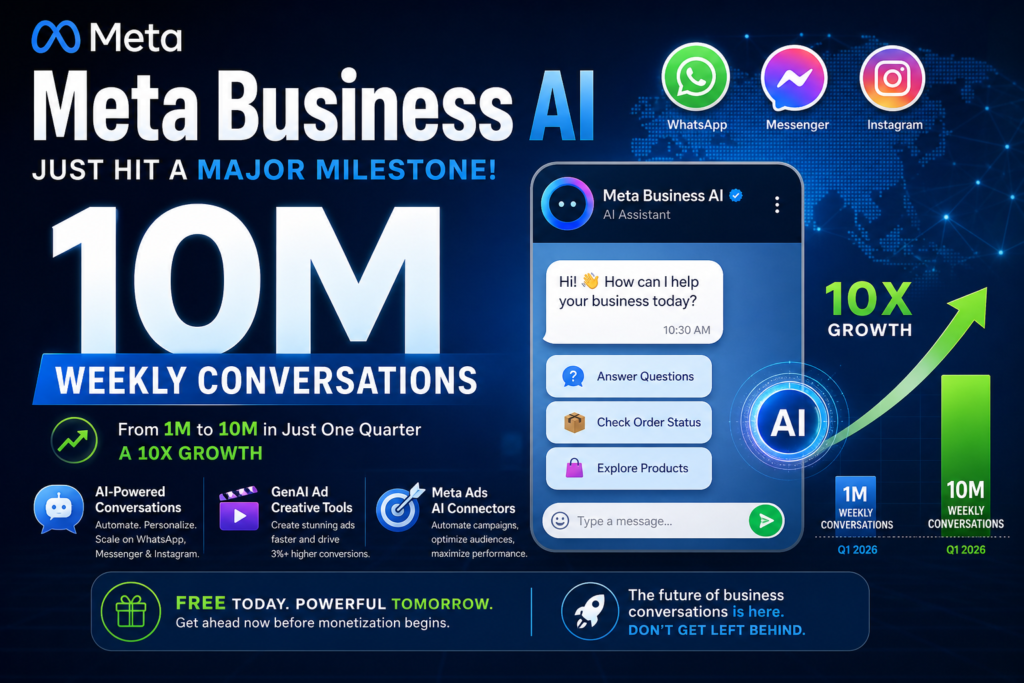
Meta Business AI is no longer an experiment — it’s a fast-scaling commercial reality. If your business operates on WhatsApp, Messenger, or Instagram, this technology is already reshaping how your customers expect to be served.
In a single quarter, Meta’s business-focused AI tools grew from facilitating 1 million conversations per week to 10 million, according to remarks made by CEO Mark Zuckerberg during the company’s Q1 2026 earnings call. That tenfold growth signals something important: conversational AI is moving from novelty to necessity for businesses of every size.
This guide breaks down exactly what Meta Business AI is, what it can do, and — most critically — how your business should position itself before Meta begins monetizing these tools.
What Is Meta Business AI?
Meta Business AI is a suite of AI-powered tools built into Meta’s family of apps — primarily WhatsApp, Messenger, and Instagram — that allows businesses to automate, personalize, and scale customer conversations.
Unlike standalone AI chatbot platforms, Meta Business AI is embedded directly into the messaging infrastructure where billions of users already spend their time. It draws on Meta’s large language model capabilities — currently powered by Muse Spark, the first model released under Meta’s Superintelligence Labs division — to handle customer inquiries, support sales workflows, and deliver personalized experiences at scale.
The core value proposition is simple: your customers are already on WhatsApp. Meta Business AI lets you meet them there, at any hour, without hiring additional support staff.
The 10 Million Milestone — Why It Matters
From 1 Million to 10 Million in One Quarter
The numbers here deserve a second look. At the start of 2026, Meta’s business AI tools were facilitating roughly 1 million conversations per week. By late March 2026 — just a few months later — that figure had reached 10 million, a 10x increase in a single quarter.
This isn’t an incremental improvement. It’s the kind of growth curve that redefines a market category.
The timing aligns with Meta’s global expansion of its business AI assistant beta program, which the company rolled out across the United States, EMEA, APAC, and Latin America. Scale breeds scale: the more businesses that activate Meta Business AI, the more end-users interact with it, and the more usage data feeds back into the model.
What’s Driving the Adoption?
Several factors are accelerating this growth:
- Zero cost barrier. Meta is currently offering its business AI tools for free to most businesses, removing the financial friction that often slows AI adoption among smaller operators.
- Platform integration. Because Meta Business AI is native to WhatsApp and Messenger, businesses don’t need to build or maintain separate integrations.
- Proven demand for messaging. Meta’s apps generated $885 million in revenue in Q1 2026, largely driven by paid messaging demand on WhatsApp and app subscriptions — proof that users are engaged and willing to pay for premium messaging experiences.
- SMB-first design. Meta has specifically targeted small and medium-sized businesses, the segment most underserved by complex enterprise AI platforms.
What Can Meta Business AI Actually Do for Your Business?
AI-Powered Customer Conversations at Scale
The centerpiece of Meta Business AI is its conversational capability: an AI assistant that can handle customer inquiries, answer frequently asked questions, guide users through purchase decisions, and escalate to human agents when necessary — all within WhatsApp or Messenger threads.
What this looks like in practice:
- A customer messages your WhatsApp business number at 2 a.m. asking about product availability
- Meta Business AI responds instantly with accurate inventory information
- The AI qualifies the customer’s interest and, if purchase-ready, routes them to a checkout link or a human sales agent
For businesses previously relying on static chatbot menus or delayed human responses, this represents a fundamental upgrade to customer experience.
GenAI Ad Creative Tools
Meta Business AI extends beyond customer service into advertising. According to CFO Susan Li on the Q1 2026 earnings call, more than 8 million advertisers are already using at least one of Meta’s generative AI ad creative tools — with particularly strong adoption among small and medium-sized businesses.
The performance data is compelling: advertisers using Meta’s video generation feature are seeing over 3% higher conversion rates in tests. For an e-commerce business operating on thin margins, a 3% conversion lift can materially impact profitability.
These tools allow businesses to:
- Automatically generate ad variations from a single creative brief
- Produce video ads without production budgets
- Test multiple creative directions simultaneously using AI
Meta Ads AI Connectors
The newest addition to Meta’s AI business toolkit is the Meta Ads AI Connectors open beta, launched in late April 2026. This feature allows advertisers to connect their Meta ad account directly to an AI agent, enabling more automated campaign management, audience targeting, and optimization workflows.
Think of it as giving your media buying strategy an AI co-pilot that operates within Meta’s ecosystem — adjusting bids, refining audiences, and surfacing creative recommendations without requiring manual oversight at every step.
Meta Business AI vs. Other Business AI Tools
How does Meta Business AI stack up against alternatives businesses are currently using? Here’s a clear comparison:
| Feature | Meta Business AI | WhatsApp Business API (3rd Party) | Standalone Chatbot Platforms | Enterprise CRM AI (e.g., Salesforce Einstein) |
|---|---|---|---|---|
| Platform Integration | Native (no setup) | Requires API partner | External embed needed | Requires CRM integration |
| Current Cost | Free (most businesses) | Varies by provider | Subscription-based | High (enterprise licensing) |
| Ad Creative Tools | Built-in GenAI tools | Not included | Not included | Limited |
| User Reach | 3B+ Meta users | WhatsApp users only | Website/app visitors | Existing CRM contacts |
| AI Model | Muse Spark (Meta LLM) | Third-party models | Third-party models | Salesforce proprietary |
| Best For | SMBs & mid-market | Businesses needing API control | Multi-channel chat | Large enterprise teams |
| Monetization Status | Currently free | Paid | Paid | Paid |
The clearest advantage of Meta Business AI right now is its zero-cost entry point combined with direct access to Meta’s massive user base. The clearest limitation is that it currently operates within Meta’s ecosystem — businesses dependent on other channels will still need complementary tools.
How Small Businesses Should Prepare for Meta’s Monetization Shift
Free Today, Paid Tomorrow — What Zuckerberg Hinted At
Meta isn’t monetizing its business AI tools today, but the direction is clear. On the Q1 2026 earnings call, Mark Zuckerberg stated directly: “Business AIs today are currently free for most businesses on our messaging apps, but as we make more progress, we expect that we will also work towards establishing a longer-term monetization model.”
This is not a vague hint. It’s a monetization roadmap being telegraphed publicly. The “free during scale” model is a classic platform play — maximize adoption, prove value, then introduce pricing when switching costs are high.
Businesses that begin using Meta Business AI now will benefit from:
- Free access to tools that will eventually carry subscription or usage costs
- Time to build AI-driven workflows before pricing pressure emerges
- A head start on training the AI on their specific customer interactions
How to Get Maximum Value Before Monetization Kicks In
The window of zero-cost access is finite, but the competitive advantage built during it doesn’t have to be. Here’s how to use this period strategically:
Build your conversational playbooks now. Every FAQ your Meta Business AI handles is a conversation your team doesn’t need to staff. Document which queries it resolves best, and refine prompts for higher-stakes interactions.
Integrate ad creative tools into your testing workflow. Don’t wait for a campaign crisis to experiment with AI-generated video ads. Run controlled tests now while production costs are effectively zero.
Connect the Ads AI Connectors during beta. Beta access often comes with more support, fewer restrictions, and direct feedback channels to Meta’s product teams. Early adopters tend to develop deeper platform expertise.
Audit your customer journey for AI-ready touchpoints. Not every customer interaction is equally suited for AI. Identify where conversational AI adds the most value — typically high-volume, lower-complexity queries — and where human agents remain essential.
Frequently Asked Questions About Meta Business AI
What is Meta Business AI? Meta Business AI is a collection of AI-powered tools — including a conversational AI assistant, generative ad creative tools, and AI Connectors — built into Meta’s apps (WhatsApp, Messenger, Instagram) to help businesses automate customer interactions and scale marketing.
Is Meta Business AI free? Yes, as of April 2026, Meta Business AI tools are available for free to most businesses. However, Meta’s CEO has indicated that the company plans to introduce a monetization model as the tools mature.
Which businesses can use Meta Business AI? Meta has expanded the business AI assistant beta globally, with availability across the U.S., EMEA, APAC, and Latin America. Small businesses and SMBs are the primary target segment.
How does Meta Business AI differ from the WhatsApp Business API? The WhatsApp Business API requires third-party integration partners and is primarily developer-focused. Meta Business AI is a native, managed service that doesn’t require API expertise to deploy.
What AI model powers Meta Business AI? Meta Business AI is powered by Muse Spark, the first large language model released under Meta’s Superintelligence Labs division, launched in April 2026.
What results can businesses expect from Meta’s AI ad creative tools? Meta’s internal tests show that advertisers using the video generation feature see more than 3% higher conversion rates — a meaningful lift for performance marketers.
The Bottom Line
Meta Business AI has moved from an interesting beta to a platform-scale technology in less than a year. Ten million weekly conversations isn’t a statistic — it’s a signal that AI-mediated business communication has entered the mainstream, and the businesses that adapt earliest will carry a durable advantage.
The strategic moment for small and medium-sized businesses is right now: the tools are free, the platform is global, and the monetization clock hasn’t started yet. Building AI-powered customer workflows on Meta today is the equivalent of claiming premium digital real estate before the neighborhood gets discovered.
Meta Business AI isn’t just a customer service upgrade. Used deliberately, it’s a competitive moat — one that’s currently available at no cost.