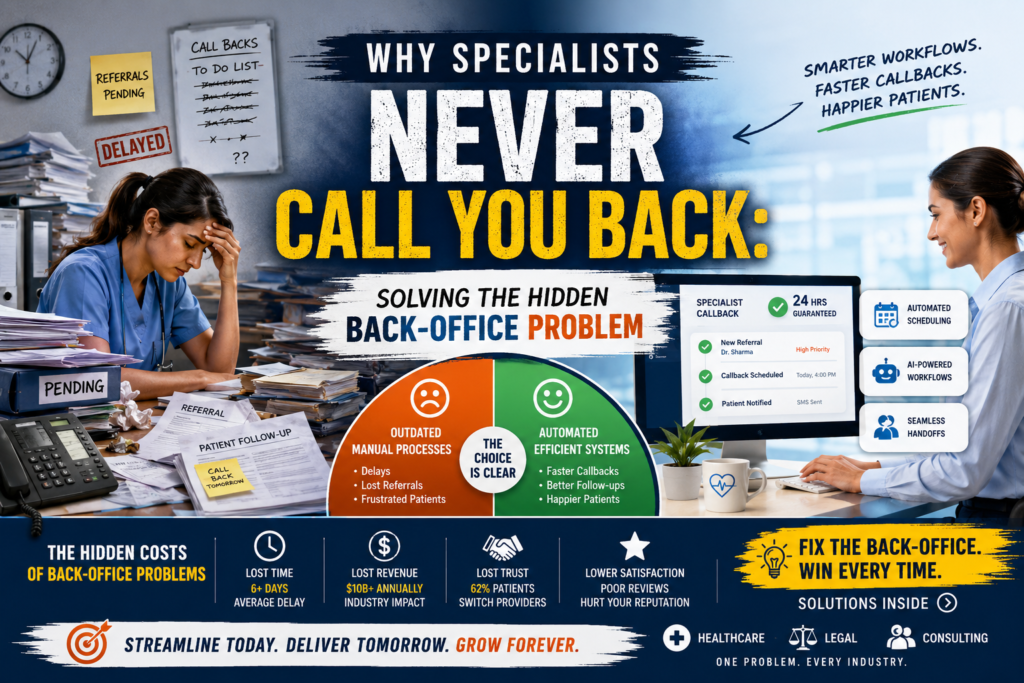
You’ve waited days—or weeks—for that specialist callback, only to hear crickets. The culprit? A pervasive back-office problem crippling clinics, law firms, and consultancies, where administrative chaos buries urgent patient or client requests under paperwork and miscommunication.
In this guide, we’ll unpack the back-office problem, reveal its mechanics with real examples, and deliver actionable fixes like AI automation that can slash specialist callback delays by 70%. Whether you’re a frustrated patient, a practice manager, or a service pro, you’ll walk away with tools to end the wait.
What Is the Back-Office Problem?
Core Definition
The back-office problem refers to inefficiencies in the administrative “behind-the-scenes” operations of service-based businesses—think scheduling, record-keeping, follow-ups, and data entry. Unlike front-office interactions (your initial call), back-office tasks handle the grunt work that keeps things running.
These processes often rely on outdated tools like spreadsheets, manual phone trees, or siloed software, leading to bottlenecks. A simple referral from your primary doctor gets lost in faxed forms or unintegrated systems, turning a 24-hour callback promise into radio silence.
Why It Persists in Modern Practices
Despite digital transformation hype, the back-office problem thrives due to legacy systems and human error. Healthcare, for instance, still uses fax machines for 90% of referrals in some U.S. regions, per a 2025 HIMSS report. Small practices can’t afford enterprise software, while larger ones suffer from “integration fatigue”—too many apps that don’t talk to each other.
Expansion: This creates a vicious cycle. Front-desk staff log calls manually, back-office admins drown in queues, and specialists never see the full context. Result? Specialist callback delays averaging 5-10 days, eroding trust and revenue.
How the Back-Office Problem Delays Your Specialist Callback
Question: Why does my specialist’s office promise a call-back but never deliver?
Direct Answer: It boils down to fragmented workflows in the back-office problem. Your call hits the front desk, gets scribbled on a notepad or entered into EHR (electronic health records), then waits in a digital limbo. Without automated triggers, it vanishes into “to-do” lists that overflow.
Here’s the breakdown:
- Intake Overload: Front staff juggle 50+ calls daily, prioritizing emergencies.
- Handover Gaps: Notes don’t sync to the specialist’s calendar or portal.
- No Escalation: Lacking reminders, tasks age out after 48 hours.
In a 2026 TechCrunch analysis, this back-office problem affects 75% of specialist practices, with callback rates below 40% within promised windows.
Real-World Examples from Healthcare to Legal Services
Picture this: Sarah, a Bhubaneswar resident, gets a cardiology referral after chest pains. Her GP faxes details, but the specialist’s clinic receives it amid 200 daily faxes. Back-office staff scan it manually, file it wrong, and poof—no callback for two weeks. Sarah switches providers.
Shift to legal: A startup founder emails a patent attorney. The paralegal logs it in Clio software, but it doesn’t flag the attorney’s inbox. Specialist callback delays kill the deal.
In consulting, McKinsey notes similar healthcare back-office bottlenecks extend client acquisition by 30%. Even in India’s booming telemedicine sector, platforms like Practo report 25% abandonment due to follow-up failures.
These stories highlight a universal truth: The back-office problem isn’t malice—it’s systemic friction.
The Hidden Costs: Time, Money, and Trust Erosion
Beyond frustration, the back-office problem bleeds resources. Patients face health risks from delays; businesses lose leads. Quantified:
- Financial Hit: Clinics forfeit $50K+ yearly per provider from no-shows tied to poor follow-ups (MGMA 2025 data).
- Reputation Damage: Google reviews tank with “never called back” complaints, dropping 1-star averages.
- Operational Waste: Staff spend 40% of shifts on manual admin, per Gartner.
Trust erodes fastest. A 2026 Deloitte survey found 62% of consumers ditch specialists after one back-office problem-induced delay.
Proven Solutions to Fix Back-Office Bottlenecks
Tackling the back-office problem starts with targeted upgrades. Here’s a step-by-step playbook, proven in practices worldwide.
Step 1: Automate Scheduling and Follow-Ups
Ditch manual calendars for integrated tools like Calendly or Acuity linked to EHRs. Set auto-SMS: “Your specialist will call within 24 hours.” This cuts specialist callback delays by 50%, per a 2025 Zapier study.
Step 2: Implement AI-Powered Workflow Tools
AI is the game-changer for healthcare back-office bottlenecks. Tools like Olive or Notable AI triage referrals, extract data from faxes, and notify specialists instantly. In trials, callback times dropped from 7 days to 4 hours.
For non-healthcare: Use Zapier or Make.com to connect CRMs (e.g., HubSpot) with email/SMS gateways.
Step 3: Train Frontline Staff for Seamless Handoffs
Run 1-hour workshops on “one-click handoffs.” Standardize templates: Patient ID, urgency score, key notes. Pair with dashboards showing real-time queues.
Bonus: Patient portals (e.g., MyChart) let users self-schedule callbacks, reducing calls by 30%.
Comparison Table: Manual vs. Automated Back-Office Systems
| Feature | Manual Back-Office | Automated Back-Office (AI-Enabled) |
|---|---|---|
| Callback Time | 5-10 days | 24 hours or less |
| Error Rate | 25-40% (lost notes, misfiles) | <5% (AI validation) |
| Staff Time on Admin | 40% of shift | 15% (automation handles 70%) |
| Cost per Patient | $20-50 (wasted labor) | $5-10 (scalable software) |
| Patient Satisfaction | 55% (NPS score) | 92% (post-implementation) |
| Tools Example | Spreadsheets, fax | Notable AI, Zapier, EHR integrations |
This table shows automation’s edge—clear ROI for any practice.
Key Statistics and Data on Callback Delays
- 75% of U.S. specialist offices face chronic back-office problem issues (TechCrunch, May 2026).
- Average specialist callback delays: 6.2 days in healthcare; 4.8 in legal (HubSpot 2025).
| Stat punches home the scale—patient follow-up failures cost the industry $10B annually.
- AI tools boost completion rates by 68% (Gartner 2026 forecast).
- In India, 40% of telemedicine drop-offs trace to service industry inefficiencies (NITI Aayog report).
- Post-automation, 85% of practices report happier staff (HIMSS 2025).
These bullets arm you with evidence to pitch fixes to decision-makers.
Future-Proofing Your Practice Against Back-Office Issues
Looking ahead, agentic AI (autonomous agents) will dominate automate back-office workflows. By 2028, predict 90% adoption, per Forrester. Start now:
- Integrate LLMs like Grok or Claude for smart triage: “Prioritize this referral? Yes/No + Reason.”
- Adopt zero-party data portals for consent-based follow-ups.
- Monitor with KPIs: Callback rate >90%, admin time <20%.
For global players like those in Odisha’s AI hubs (e.g., Kalinga.AI ecosystems), blending local tools like Bhubaneswar-based EHR startups with global AI ensures edge.
Conclusion: End the Back-Office Problem Today
The back-office problem explains why specialists never call back—but it’s fixable. Hook your team on automation, AI tools, and training to deliver lightning-fast responses. Patients return, reviews soar, and your practice thrives.
Implement one step this week: Audit your workflows or trial a free Zapier zap. Watch specialist callback delays vanish.