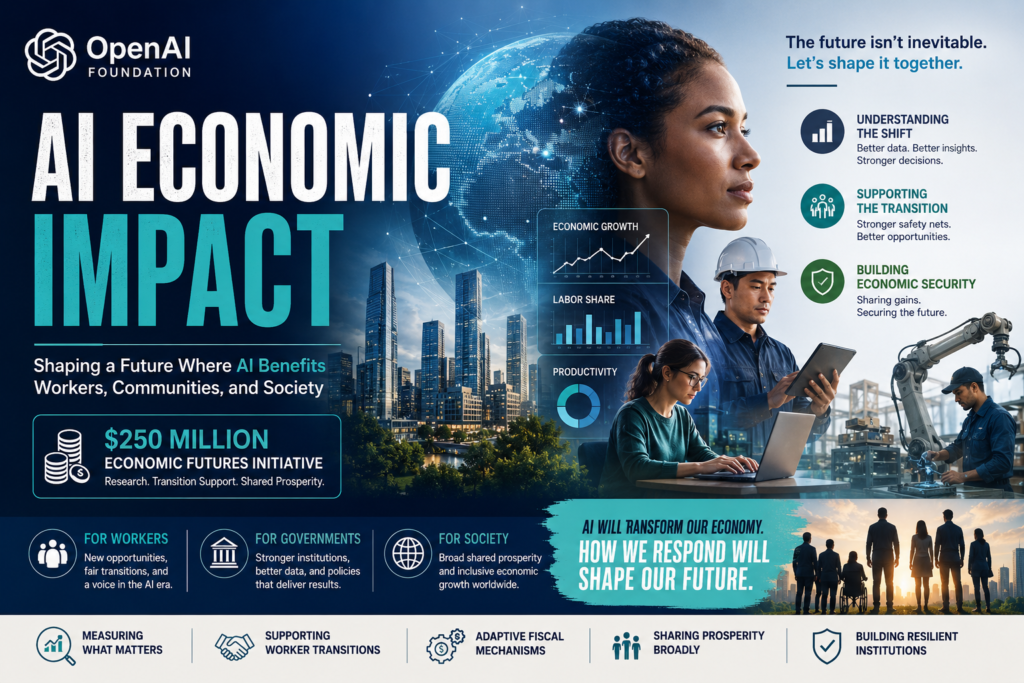
The AI economic impact is no longer a future scenario — it’s happening now, and one of the most significant institutions in the technology world just committed $250 million to shape how that transition unfolds. The OpenAI Foundation’s new Economic Futures program is a direct acknowledgment that AI will restructure how value is created, distributed, and measured across the global economy.
This post breaks down what the initiative actually involves, what it reveals about the real risks ahead, and what it means for workers, governments, and societies navigating one of the most consequential economic shifts in generations.
What Is the OpenAI Foundation’s Economic Futures Initiative?
Definition: The OpenAI Foundation’s Economic Futures initiative is a $250 million program designed to fund research, partnerships, and direct work aimed at ensuring AI’s economic benefits are broadly shared — and that its disruptions are actively managed rather than simply absorbed.
The program was announced in May 2026 and is authored by Divya Siddarth and Wojciech Zaremba. It frames the AI economic impact not as a fixed outcome but as a variable one — dependent entirely on the institutional choices societies make in the next several years.
As the Foundation’s announcement puts it, AI will make “previously scarce capabilities far more widely available,” creating deep uncertainty about how far and how fast economic changes will go. The program’s goal is to fund concrete, testable, and scalable options before they become urgent — not after.
The Three Pillars of the Program
The initiative is organized around three areas of action:
- Understanding the Shift: Investing in independent measurement and forecasting infrastructure to build a clearer picture of AI’s economic effects — who benefits, who doesn’t, and by how much.
- Supporting the Transition: Funding near-term support systems for workers and communities experiencing disruption, including job transition assistance, expanded wage insurance, and public institution capacity-building.
- Building Economic Security: Supporting new approaches to organizing post-AI economies, including mechanisms for sharing economic gains broadly across populations worldwide.
Each pillar addresses a different time horizon: present disruption, medium-term transitions, and long-term structural change.
Why AI’s Economic Impact Is Harder to Measure Than You Think
Understanding the AI economic impact requires acknowledging a significant blind spot: the measurement tools we rely on were built for a different era.
GDP, wage statistics, and employment figures are all designed to capture value that flows through traditional labor markets. AI disrupts that flow in ways that existing instruments were never designed to detect.
The Problem With GDP and Wage Statistics in an AI Economy
Consider this scenario: AI generates enormous value as digital goods and services — better healthcare recommendations, faster legal guidance, more efficient logistics. If that value doesn’t show up as higher wages, it won’t appear in standard income statistics. Citizens may be materially better off, but our economic dashboards will say otherwise.
The OpenAI Foundation’s initiative explicitly targets this gap, calling for measurement infrastructure that tracks what people can “actually do and access, not just what they earn.” That is a meaningful shift in how we define economic wellbeing.
The AI economic impact also depends on a set of questions current models don’t ask well:
- Where does the value AI creates actually go — to workers, firms, consumers, or capital owners?
- Does automation displace labor or create new labor-complementary roles?
- How do task distributions shift as model capabilities improve?
- How do firms and states reorganize around those changes?
Answering these requires better public labor market infrastructure globally — tools analogous to the U.S. Bureau of Labor Statistics and the Occupational Information Network (O*NET), but modernized for an AI-driven economy and designed to be globally relevant and linked.
Supporting Workers Through the AI Transition
The AI economic impact will not be evenly distributed across time. Some workers will face disruption now, years before society has agreed on the right long-term responses. The initiative is designed to fund support systems that operate in real time.
What Traditional Retraining Gets Wrong
Retraining programs have historically shown mixed evidence. The assumption that laid-off workers can be retrained into growing sectors at scale is appealing but poorly supported by data. The OpenAI Foundation’s initiative acknowledges this explicitly, noting that “an AI transition agenda will likely need to be broader” than conventional workforce retraining.
What the initiative envisions instead:
- Easier access to unemployment insurance
- Expanded wage loss insurance
- Pathways into growing sectors that don’t require full credential retraining
- Rigorous evaluation of programs based on whether they lead to better work, more stability, and more real choices
The emphasis on evaluation matters. Too often, workforce programs are assessed by enrollment numbers rather than actual labor market outcomes. The AI economic impact demands higher standards.
New Models for Worker Agency and Voice
One of the initiative’s more notable commitments is its interest in giving workers agency over AI deployment itself — not just cushioning the blow after decisions have been made.
This reframes the AI economic impact debate. Instead of asking only “how do we help displaced workers,” it asks “how do workers participate in decisions about AI adoption in their workplaces?” That distinction carries significant political and institutional weight.
The initiative is also interested in the qualitative dimensions of work: when does work provide meaning, purpose, and satisfaction? How do we ensure more people retain access to those conditions as AI transforms job structures?
Building Long-Term Economic Security in an AI World
The hardest part of any AI economic impact analysis is confronting deep uncertainty about what happens if automation accelerates dramatically. The near-term support programs described above are not designed for a world in which labor’s share of income shrinks significantly or economic gains concentrate rapidly among a small number of capital owners.
The initiative is clear-eyed about this. It wants to move promising policy mechanisms from theoretical proposals to tested institutional designs.
Revenue and Distribution Mechanisms: A Comparison
| Mechanism | What It Does | Models That Exist | Key Questions |
|---|---|---|---|
| Labor-to-Capital Tax Shift | Taxes capital and economic rents more heavily than labor income | Several Nordic countries’ partial models | How quickly can it be implemented? What are the competitive effects? |
| Windfall / Excess-Return Levies | Taxes extraordinary returns generated by AI-driven productivity gains | No major existing model | How do you define “excess” returns? Who administers it? |
| Sovereign / Public Wealth Funds | Collects revenue from economic activity and distributes returns broadly | Norway’s Government Pension Fund; Alaska’s Permanent Fund | What assets do they hold? How are dividends calculated and distributed? |
| Adaptive Fiscal Mechanisms | Tax rates or dividend formulas that automatically respond to observable economic indicators (labor share, displacement rates) | Pilot-stage concepts only | What triggers adjustments? Who governs the indicators? |
The AI economic impact at scale may ultimately require combinations of these mechanisms rather than a single policy lever. The initiative’s goal is to generate the institutional knowledge needed to make informed choices — before the window to act closes.
Who Benefits and Who Is at Risk from AI’s Economic Changes?
Mapping the AI economic impact requires understanding how different groups are positioned relative to the transition. Based on the Foundation’s analysis and existing economic research, here is a realistic breakdown:
Groups likely to benefit:
- Highly skilled workers whose roles complement AI capabilities (analysts, designers, engineers, strategists)
- Capital owners and shareholders of AI-adopting firms
- Consumers in high-income countries who gain access to faster and cheaper AI-powered services
- Workers in low- and middle-income countries where AI could rapidly expand access to legal, financial, and healthcare guidance that currently requires scarce expertise
Groups facing the most significant disruption risk:
- Workers in roles with high task automation potential — particularly routine cognitive and administrative work
- Workers in low- and middle-income countries whose labor cost advantage may diminish without strong institutional support
- Communities whose economic base depends on industries undergoing rapid AI-driven restructuring
- Workers without access to quality retraining pathways or portable benefits
Groups whose outcomes are most uncertain:
- Knowledge workers in mid-skill occupations where AI acts as a partial substitute and partial complement
- Public sector workers whose institutions may adopt AI-powered tools slowly but whose jobs may be restructured significantly
- Workers in creative industries where AI augments some capabilities and displaces others simultaneously
Understanding who bears the AI economic impact — and who captures the gains — is fundamental to designing policy responses that actually work. future of work with AI
What Governments and Institutions Must Do Now
The OpenAI Foundation’s initiative is explicit that good policy design is not enough if public institutions lack the capacity to deliver it. One of the program’s core funding priorities is strengthening governments’ ability to actually implement support systems at scale.
This is not a minor detail. History suggests that the quality of economic transition support depends less on the policy design than on whether the institutions running it can execute effectively.
The initiative is also interested in AI as a tool for strengthening state capacity itself — using AI-powered systems to improve public services, reduce administrative burden, and expand access to government support for people who currently fall through the cracks.
Several priorities for institutional action stand out:
Near-term:
- Build or strengthen unemployment and wage insurance systems capable of handling rapid scaling
- Invest in modern labor market data infrastructure that can track AI’s effects in real time
- Fund economic evaluations specific to low- and middle-income country contexts
Medium-term:
- Design and pilot adaptive fiscal mechanisms that can respond to observable AI economic impact indicators
- Test worker voice and agency models in AI deployment decisions at the firm and sector level
- Build internationally linked labor market data systems
Long-term:
- Develop frameworks for public or sovereign wealth mechanisms that can distribute AI-generated gains broadly
- Support multi-agent economic simulations and scenario planning to prepare for a range of possible AI futures
- Establish governance structures for adaptive policies that are transparent, accountable, and revisable
The Bottom Line: Is $250 Million Enough?
The honest answer is no — $250 million is a meaningful commitment but it is not proportional to the scale of the AI economic impact the initiative itself describes as potentially the “most significant economic shift in generations.”
What the initiative does do well is identify the right problems and the right approach to solving them. It is explicit that the goal is not to fund a fixed agenda but to build institutional options that can be tested, governed, revised, and scaled. That epistemic humility is appropriate given genuine uncertainty about AI’s trajectory.
The most valuable contribution may be the framing: the AI economic impact is not a fate to be accepted but a variable to be shaped. The window to get this right is shorter than most policymakers and institutions appreciate. And the cost of getting it wrong — in lost livelihoods, eroded trust, and concentrated power — is immense.
What happens next depends on whether the institutional knowledge this program generates reaches decision-makers fast enough, and whether governments, firms, and civil society have the will to act on it.
Key Takeaways
- The OpenAI Foundation has committed an initial $250 million to manage the AI economic impact through measurement, transition support, and long-term security building.
- Current economic measurement tools are poorly equipped to capture the AI economic impact, particularly when value accrues as digital goods rather than wages.
- Traditional retraining programs have mixed evidence — the AI economic impact demands broader, more rigorously evaluated responses.
- Long-term economic security may require new fiscal mechanisms including capital taxation shifts, windfall levies, and sovereign wealth funds.
- The quality of institutional delivery matters as much as policy design — governments need capacity to implement at scale.
- The window to shape the AI economic impact is shorter than most institutions currently recognize.